Act I
The crystal hit the ballroom floor like a gunshot.
Three wine glasses shattered beneath the chandelier light, sending bright fragments skittering across the dark wood. Every conversation died at once. Forks hovered above plates. A woman near the front table gasped and pressed a hand to her pearls.
Phaedra stood frozen with the empty silver tray tilted in her hands.
One second earlier, she had been moving carefully between the tables, eyes lowered, her black vest neat over her white shirt, her gold name tag catching the light.
Now everyone was staring.
Someone had hooked a heel around her ankle.
She knew it.
But before she could speak, a hand clamped around her arm and yanked her upright.
“Stay away from my husband!”
The voice cracked across the ballroom.
Celeste Montgomery stood in front of her in a shimmering silver gown, blonde hair swept back, diamonds glittering at her throat. She looked elegant enough to belong on a magazine cover and furious enough to burn the room down.
Phaedra winced as Celeste’s nails dug into her sleeve.
“I didn’t—”
“Don’t lie to me,” Celeste snapped. “Tell them why you keep following him.”
The guests began whispering.
A man at a nearby table lifted his phone. Then another. Within seconds, Phaedra was not just humiliated. She was being recorded.
Her cheeks burned. Her breath shook. She could see herself reflected in the polished floor: a young waitress surrounded by broken glass, held in place by a rich woman who wanted the world to believe she was trash.
Across the room, Elias Montgomery stood from his chair.
He was tall, composed, and dressed in a black tuxedo. Phaedra had seen his face in newspapers for weeks while preparing herself for this night, but seeing him in person still made her chest tighten.
Not because he was powerful.
Because he had her eyes.
Celeste turned toward him dramatically. “Elias, she’s been watching you all evening. I saw her.”
The room shifted toward him.
Elias looked at Celeste’s hand gripping Phaedra’s arm.
“Let go of her.”
His voice was calm, but the command moved through the ballroom like a blade.
Celeste released Phaedra as if burned.
Phaedra rubbed her arm, fighting tears. She had imagined this moment a hundred different ways. She had pictured walking up to Elias quietly, asking for five minutes, showing him the photograph in a private corner.
She had not imagined broken glass.
She had not imagined the whole room laughing.
She had not imagined his wife turning her search for a father into something ugly before she could even say his name.
“Why are you here?” Elias asked.
The question was not cruel.
That almost broke her.
Phaedra reached into the front pocket of her apron with trembling fingers. Her diamond ring flashed under the chandeliers, the old stone duller than the jewels around the room, but dearer to her than anything Celeste wore.
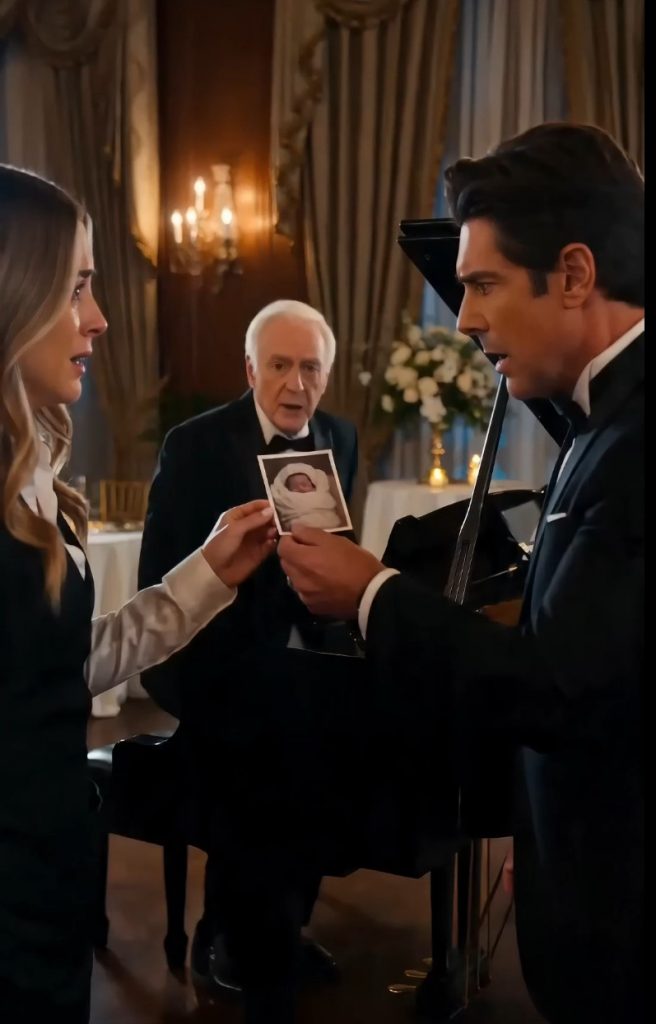
She pulled out a small square photograph.
Then she held it toward Elias.
The ballroom leaned closer.
Elias took the photo and looked down.
A newborn baby slept in the picture, wrapped in a thick white knitted blanket. Her eyes were closed. One tiny fist rested near her cheek. In the corner, almost faded with age, someone had written one word.
Phaedra.
Elias’s face changed.
The color drained slowly, as if the photograph had reached into him and pulled twenty-five years of grief into the light.
At the black grand piano, the elderly pianist stopped playing.
The final note hung in the air.
He rose from the bench, stepped forward, and stared at the picture over Elias’s shoulder.
Then he whispered the sentence that turned the humiliation into a family tragedy.
“That blanket,” he said. “I wrapped his missing daughter in that blanket the night she vanished.”
Phaedra looked directly at Elias through her tears.
“My mother died telling me to find my real father.”
And for the first time all evening, Celeste Montgomery looked afraid.
Act II
Phaedra had not come to the Montgomery gala for revenge.
She had come for an answer.
For twenty-four years, she had lived in a narrow brick house outside Providence with a woman named Lila Graves, who cleaned hotel rooms by day and altered dresses by night. Lila was not glamorous. She wore cheap reading glasses, drank tea from chipped mugs, and fell asleep in front of the television with sewing needles still stuck in her sleeve.
But she loved Phaedra fiercely.
Too fiercely, sometimes.
She never let Phaedra attend sleepovers. Never allowed photographs on school forms without asking why. Never spoke about the day Phaedra was born except to say, “You came to me when heaven knew I needed you.”
When Phaedra was little, that sounded magical.
When she got older, it sounded like a locked door.
There were no baby pictures except one.
The newborn in the white blanket.
Lila kept it in a Bible with dried lavender pressed between the pages. Whenever Phaedra asked about her father, Lila’s eyes filled with fear, not anger.
“He was a good man,” she would say.
“Then why doesn’t he know me?”
Lila never answered.
Everything changed after Lila got sick.
Illness stripped away her strength first, then her pride, then the stories she had built to protect them both. On her last night, she gripped Phaedra’s hand with surprising force and asked for the Bible.
Inside was the photograph.
Behind it was a folded piece of paper with a name written in faded ink.
Elias Montgomery.
Phaedra had stared at it, confused.
The Montgomery name belonged to buildings, hospitals, art foundations, scholarships. It appeared on plaques in places where ordinary people lowered their voices.
“That’s not possible,” Phaedra whispered.
Lila began to cry.
“I promised I would keep you safe.”
“Safe from what?”
But Lila was fading fast, and guilt does not always speak clearly before the end.
“She said they would take you,” Lila breathed. “She said he didn’t want you. I believed her. God forgive me, I believed her.”
“Who?”
Lila’s eyes moved toward the photograph.
“The woman in silver.”
Those were the last words she ever gave Phaedra.
For weeks after the funeral, Phaedra searched through everything Lila left behind. Old bills. Sewing patterns. Hospital bracelets. A pawn ticket for a baby bracelet that had already been sold years earlier to pay rent.
Then, in the lining of Lila’s old winter coat, Phaedra found a second clue.
A newspaper clipping from twenty-five years ago.
MONTGOMERY INFANT DISAPPEARS AFTER CHARITY NIGHT CHAOS.
The article showed a younger Elias Montgomery with his first wife, Isabel. They looked exhausted, terrified, and surrounded by police. Their newborn daughter, Aria, had vanished from a private nursery during a fundraising event at the family estate.
A nurse claimed the baby’s mother took her.
But Isabel Montgomery had collapsed that night from shock and grief.
She died less than a year later.
The baby was never found.
Phaedra read the article until the ink blurred.
Then she looked at the photograph again.
The white blanket.
The date.
The name.
The face that had followed her in mirrors all her life.
She wrote to Elias Montgomery three times.
No answer came.
She called his office and was redirected by assistants who treated her like a scammer. She went once to the Montgomery Foundation headquarters and was escorted out before Elias ever knew she was there.
Then she saw the gala posting.
A formal dinner. Staff hired through an outside agency. Elias Montgomery attending with his second wife, Celeste.
The woman in silver.
So Phaedra applied as a waitress.
She wore Lila’s old diamond ring on her left hand for courage. Lila had bought it at an estate sale when Phaedra turned eighteen and called it “something beautiful nobody could take from us.”
Phaedra never imagined the ring would become part of the accusation.
She had only wanted to get close enough to hand Elias the photograph.
But Celeste had seen her watching him.
And Celeste, who had spent years guarding the past like a locked room, recognized fear before anyone else did.
Act III
The pianist’s name was Adrian Bell.
He had played for the Montgomery family for nearly forty years, first at weddings, then funerals, then charity dinners where people donated fortunes between courses. Age had bent his back slightly, but his mind remained sharp, especially when it came to music, memory, and the night the Montgomery child vanished.
He took the photograph from Elias with both hands.
The guests watched in breathless silence.
Adrian did not look at Phaedra first.
He looked at the blanket.
“It was made by Elias’s mother,” he said. “Margaret Montgomery knitted it herself. Thick white wool. Uneven stitches near the edge because her hands had started to tremble.”
Elias’s fingers tightened around the back of a chair.
Adrian continued, voice breaking. “There was a blue thread sewn inside one corner. For protection, she said. Old family superstition.”
Phaedra reached for the photograph.
With trembling hands, she turned it over.
On the back was a small tear in the paper where the lower corner had been folded for years. She opened the crease carefully.
A blue thread showed beneath the baby’s blanket in the image, almost invisible unless someone knew to look.
A murmur moved through the room.
Celeste laughed suddenly.
It was a thin, sharp sound.
“This is absurd,” she said. “A blanket? A blurry photograph? Elias, darling, don’t let some waitress manipulate you.”
Phaedra flinched at the word waitress, not because she was ashamed of the work, but because Celeste said it like a stain.
Elias did not look at his wife.
“Adrian,” he said, his voice low, “who else saw that blanket that night?”
Adrian’s eyes moved slowly to Celeste.
The room felt the movement before anyone spoke.
Celeste’s smile froze.
“I was there,” Adrian said. “So was Isabel. So was Nurse Marlow. So was Celeste.”
Celeste lifted her chin. “I was Isabel’s friend.”
“No,” Adrian said. “You were her assistant.”
The correction landed cleanly.
Phaedra looked between them, pulse roaring in her ears.
Adrian faced the guests now, as if the ballroom itself had become a witness stand.
“Isabel trusted Celeste with everything. Her schedule. Her medication. The nursery arrangements. The guest list. When the baby vanished, Celeste was the first person who said Isabel must have been unstable.”
Elias closed his eyes.
That old wound had never healed. It had only learned to wear expensive clothes.
For years, people whispered that Isabel had hidden her own child during a breakdown. That perhaps she sent the baby away, then forgot. That grief had swallowed the truth.
Elias had never believed it.
But after Isabel died, belief without proof became a private prison.
Celeste had entered his life gently after that. She brought order to the estate. Managed condolence letters. Organized searches. Stayed when everyone else returned to their own lives.
Years later, he married her.
Not because she replaced Isabel.
Because she had made herself necessary to his grief.
Now she stood in the ballroom with every chandelier shining on her face, and all that careful necessity began to look like design.
Phaedra’s voice trembled.
“My mother wasn’t my real mother,” she said. “But she raised me. Before she died, she told me a woman gave me to her and said my father didn’t want me.”
Elias opened his eyes.
“What was your mother’s name?”
“Lila Graves.”
Adrian covered his mouth.
Phaedra turned to him. “You knew her?”
“She worked at the Montgomery estate laundry,” he whispered. “Only for one season. Then she disappeared after the gala.”
Celeste snapped, “This proves nothing.”
But she had spoken too quickly.
Too loudly.
And in a room full of rich people trained to hide discomfort, desperation sounded vulgar.
Elias looked at Celeste at last.
“Why are you scared?”
The question emptied the room.
Celeste’s lips parted.
For once, she had no beautiful answer ready.
Act IV
A guest near the back lowered his phone.
Another kept recording.
The ballroom had shifted from spectacle to reckoning. Minutes earlier, they had watched a waitress being publicly shamed. Now they were watching a wealthy woman become smaller with every truth spoken aloud.
Celeste tried to regain control the only way she knew how.
“You’re all being manipulated,” she said, turning to the guests. “Look at her. She came here wearing a ring, staring at my husband all night, carrying some dramatic little photograph. This is a performance.”
Phaedra looked down at the ring on her hand.
“My mother gave it to me.”
“Your mother,” Celeste said coldly, “was a liar.”
Phaedra’s face went pale.
Elias stepped forward.
“Do not speak about the woman who raised her.”
Celeste turned on him. “You don’t even know who this girl is.”
“No,” Elias said. “But I know who she might be.”
His voice cracked slightly on the last word.
The sound broke something in the room.
For the first time, Phaedra saw not a billionaire, not a patron, not a man from headlines, but a father who had spent half his life afraid to hope.
Adrian reached into his tuxedo pocket and pulled out an old key ring.
“I kept something,” he said.
Elias stared at him.
“What?”
Adrian looked ashamed.
“After Isabel died, the nursery was cleared. Your mother asked me to box up the piano sheet music from that room. I found something under the bench. I should have given it to you then, but the house was full of police, lawyers, Celeste’s people.”
Celeste went rigid.
Adrian removed a tiny silver hospital bracelet from his pocket.
Time had yellowed the plastic band, but the lettering remained visible.
ARIA MONTGOMERY.
Elias took it like his hands might shatter it.
Adrian’s eyes shone. “It was tucked inside one of Celeste’s old silk scarves. I told myself it must have fallen there by accident. Then years passed, and shame got heavier than truth.”
Celeste backed away.
“That is not mine.”
Adrian looked at her. “Your initials were embroidered on the scarf.”
A chair scraped as someone stood.
Celeste glanced toward the exits.
Phaedra saw it and understood.
She was going to run.
But Elias moved first.
“Close the doors,” he said.
Security stepped quietly into place.
Celeste laughed again, but it trembled now. “You’re imprisoning me at a dinner party?”
“No,” Elias said. “I’m asking why my missing daughter’s hospital bracelet was found in your scarf.”
The silence that followed was merciless.
Celeste’s eyes filled with tears, but they were not soft tears. They were angry, humiliated tears, the kind that come when a person realizes pity is no longer available.
“You were going to leave Isabel,” she said suddenly.
Elias stared at her.
Celeste’s voice rose. “Don’t pretend. Everyone knew. She was fragile. She was ruining you. I was the one holding that house together.”
Elias looked sick. “I never planned to leave my wife.”
“You looked through me,” Celeste said. “Do you know what that does to a woman who gave you everything?”
Phaedra stepped back, horrified.
Celeste continued as if the years had finally broken open inside her.
“I didn’t hurt the baby. I sent her away. Lila needed money. She couldn’t have children. I thought it was cleaner.”
Cleaner.
The word moved through the ballroom like poison.
Elias went completely still.
Phaedra could barely breathe.
Celeste looked at her then, and the hatred in her face was not jealous anymore. It was older.
“You were supposed to vanish.”
Phaedra’s tears fell silently.
“I was a baby.”
Celeste blinked, as if that had never mattered enough to consider.
Then Elias spoke, and his voice was no longer cracked.
It was cold.
“Get her out of my sight.”
Act V
No one clapped.
No one whispered.
Even the guests who had recorded the humiliation seemed ashamed to be holding phones.
Security escorted Celeste from the ballroom while she protested, cried, threatened lawsuits, then finally said nothing at all. Her silver gown flashed once beneath the chandeliers before the doors closed behind her.
The silence she left behind felt enormous.
Phaedra stood among broken glass, old secrets, and strangers who had judged her before they knew her name. Her apron was wrinkled. Her arm still hurt where Celeste had grabbed her. The photograph shook in her hand.
Elias took one step toward her.
Then stopped.
He seemed afraid that moving too quickly might frighten her away.
“Phaedra,” he said.
She almost corrected him.
Almost said that maybe her name was Aria, maybe it was Phaedra, maybe she did not know who she was anymore.
But she only looked at him.
Elias swallowed.
“I don’t know what to say.”
Phaedra gave a small, broken laugh.
“Neither do I.”
Adrian wiped his eyes and returned to the piano, but he did not sit. He simply rested one hand on the glossy black lid, as if the instrument itself had witnessed enough.
Elias looked at the photograph again.
“May I?”
Phaedra handed it to him.
He touched the edge of the image, careful not to cover the baby’s face.
“I searched for you,” he whispered.
Phaedra’s lips trembled.
“My mother said she was told you didn’t want me.”
Elias shook his head hard, the control finally leaving him. “Never.”
One word.
But it reached the little girl in Phaedra who had spent a lifetime trying not to wonder why nobody came.
Elias covered his mouth with his hand.
“I buried an empty cradle,” he said.
Phaedra closed her eyes.
The ballroom around them blurred into light.
Later, there would be tests. Lawyers. Police statements. Reporters gathering outside. Old estate employees brought back to tell what they had seen and what they had been paid not to remember. Celeste’s confession, recorded by half the room, would become the thread investigators pulled until the whole tapestry came apart.
But in that moment, there was only a father and a daughter standing on opposite sides of a life stolen from them.
Elias held out his hand.
Not to claim her.
To ask.
Phaedra looked at it for a long second.
Then she took it.
The guests watched as Elias Montgomery, a man famous for never losing composure, bowed his head over the hand of the waitress his wife had tried to destroy and wept.
Adrian sat at the piano at last.
He began to play softly.
Not the polished dinner music from earlier, but a lullaby.
Elias looked up sharply.
“I know that song,” he said.
Adrian nodded. “Isabel sang it in the nursery.”
Phaedra’s breath caught.
Lila had sung it too.
Off-key, usually while folding sheets or stirring soup, without ever explaining where she learned it.
Phaedra began to hum the next line without thinking.
The room heard it.
So did Elias.
His face changed again, this time with wonder so painful it looked almost like grief.
“My God,” he whispered.
The DNA test confirmed it three days later.
But everyone who had stood in that ballroom already knew.
Phaedra was Aria Montgomery.
The missing daughter.
The baby in the white blanket.
The child stolen by jealousy, raised by guilt, and returned by a photograph her dying mother refused to burn.
The headlines were merciless. Celeste’s friends disappeared. Her charities removed her name. Her lawyers tried to soften the confession, then abandoned that strategy when more evidence surfaced: payments to Lila, forged letters, a private investigator dismissed after getting too close, and old nursery records altered in Celeste’s handwriting.
Lila Graves was not innocent.
Phaedra knew that.
But love rarely arrives in clean containers. Lila had accepted money and a lie, then spent the rest of her life trying to love a stolen child well enough to make up for the theft.
It did not erase the wrong.
It did not erase the bedtime stories, either.
Months later, Phaedra returned to the Montgomery estate.
Not as staff.
Not as a spectacle.
As family.
The house overwhelmed her at first. Portraits stared from walls. Rooms carried names. Every hallway seemed to whisper that she was late to a life already built without her.
Elias did not rush her.
He gave her Isabel’s letters first.
Then the nursery key.
Then, when she was ready, the small white blanket sealed in tissue paper in a cedar chest.
Phaedra touched the blue thread in the corner and cried so hard Elias had to sit beside her on the floor.
“I don’t know how to be your daughter,” she said.
Elias looked at her.
“I don’t know how to be your father yet.”
That honesty saved them.
They did not pretend time could be restored. They did not turn pain into a neat miracle for other people to admire. Some days Phaedra was angry at everyone. Some days Elias could not look at baby photographs without leaving the room.
But slowly, awkwardly, they began.
Coffee on Sundays.
Walks through the garden.
Stories about Isabel.
Stories about Lila.
And eventually, the truth that one mother had given birth to her, another had raised her, and both had left pieces of love behind.
One year after the gala, Elias hosted another dinner in the same ballroom.
The chandeliers still glittered. The tables still held china and flowers. But the mood was different now. Warmer. Gentler. Less impressed with itself.
There were no speeches about scandal.
Only a small performance near the piano.
Adrian played the lullaby while Phaedra stood beside Elias, wearing a simple black dress and the old diamond ring Lila had given her. Around her shoulders was the white knitted blanket, restored by a textile expert but still soft at the edges from age.
When the music ended, Elias turned to the guests.
“Last year,” he said, voice steady, “my daughter came into this room as a waitress and was treated as though she did not belong.”
He looked at Phaedra.
“She belonged before any of us did.”
Phaedra lowered her head, tears shining but not falling.
This time, when the room went silent, it was not with judgment.
It was with respect.
Later that night, after the guests left, Phaedra walked alone to the center of the ballroom. The floor had been polished so perfectly there was no trace of broken glass.
But she remembered where it fell.
She stood there for a moment, then looked toward the piano.
Adrian smiled softly and played the first notes of the lullaby again.
Elias joined her at the edge of the dance floor.
“May I?” he asked.
Phaedra laughed through tears. “I don’t really dance.”
“Neither do I.”
“That’s not true. Rich people always know how to dance.”
He smiled. “Not with daughters they just found.”
She took his hand.
They moved slowly under the chandeliers, not gracefully, not perfectly, but carefully. A father learning the weight of a grown daughter’s hand. A daughter learning that being found did not mean losing the woman who had raised her.
At the edge of the room, the photograph rested in a silver frame.
A newborn baby in a white blanket.
For years, it had been proof of a mystery.
Then proof of a crime.
Now it was something else.
Proof that the truth can survive locked drawers, rich lies, public humiliation, and all the people who try to shame it into silence.
Phaedra looked up at Elias.
“Do you ever think about what would’ve happened if I hadn’t dropped those glasses?”
Elias glanced at the polished floor.
“I think,” he said softly, “they had to break.”
She leaned her head briefly against his shoulder.
And beneath the warm chandelier light, in the same ballroom where she had once been accused of chasing a man who did not know he was her father, Phaedra finally stopped feeling like a stranger standing outside her own life.