Act I
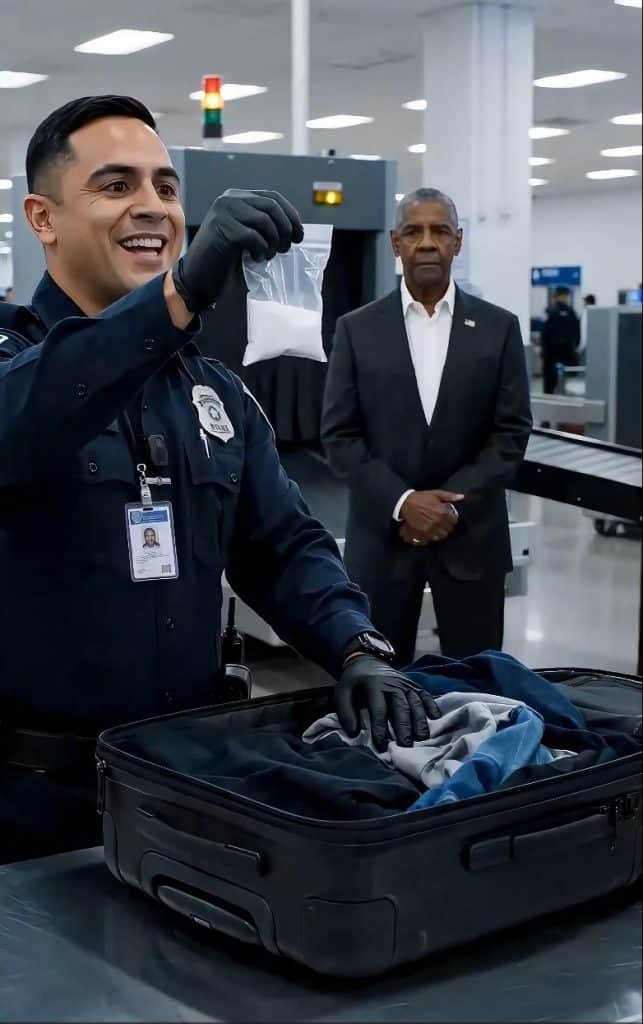
Officer Caloe smiled before the suitcase was even fully open.
That was the first thing Raymond Cole noticed.
Not the uniform. Not the gloves. Not the badge clipped neatly to the officer’s chest. The smile.
It was too small for anyone else to catch, just a slight curve at the corner of the mouth as Caloe leaned over the black suitcase on the inspection table.
“All right,” Caloe said. “Open it up.”
Raymond did.
Around them, the airport security checkpoint moved with its usual rhythm. Conveyor belts hummed. Shoes thudded into plastic trays. A woman behind Raymond argued quietly about a water bottle. Somewhere above them, an announcement crackled through the terminal speakers, swallowed by the steady roar of travelers trying to get somewhere.
Caloe snapped on his black nitrile gloves.
Then he began searching.
He lifted Raymond’s folded jeans. Shifted a gray sweater. Pressed his gloved hand into the lining. His movements were practiced, almost bored, but Raymond’s eyes followed everything.
Especially the right hand.
It went near Caloe’s pocket once.
Only once.
The movement lasted less than a second.
A little dip. A curl of the fingers. A faint crinkle that disappeared under the airport noise.
Raymond said nothing.
Caloe kept digging through the suitcase, making a show of it now. He pulled clothes higher, pushed them aside, and finally slid his hand beneath the bottom layer.
Then he stopped.
His smile widened.
“Well, well,” he said. “Look what we got.”
He lifted a small clear plastic bag between his thumb and forefinger.
Inside was a white powder-like substance.
The travelers behind Raymond went quiet.
A nearby officer looked over.
Caloe held the bag higher, as if the whole checkpoint were his stage.
Raymond did not blink.
He looked at the bag. Then at the officer’s name tag.
CALOE.
“Sir,” Caloe said, louder now, enjoying himself. “You want to explain why this was hidden in your luggage?”
Raymond stood perfectly still in his dark suit and white shirt, his gray hair cropped close, his face unreadable.
Caloe mistook that stillness for fear.
They always did.
Raymond looked at the bag again.
Then he looked directly into Caloe’s eyes.
“You just made a big mistake,” he said.
Caloe’s smile flickered.
Raymond reached inside his jacket, removed a black leather wallet, and flipped it open with one clean snap.
The gold badge caught the terminal lights.
FBI.
The checkpoint went silent.
Raymond’s voice stayed calm.
“You just set up a federal agent.”
And for the first time since the suitcase opened, Officer Caloe stopped smiling.
Act II
Raymond Cole had learned long ago that corrupt men rarely looked frightened at the beginning.
At the beginning, they looked comfortable.
That was what made them dangerous.
They knew which cameras had blind spots. Which coworkers looked away. Which travelers were too tired, too scared, too foreign, too poor, or too overwhelmed to challenge a uniform.
They knew how to turn procedure into a weapon.
Raymond had spent twenty-eight years watching men like that.
He had worked organized crime, internal corruption, airport trafficking networks, and public officials who accepted bribes in hotel bars while giving speeches about law and order the next morning.
He knew the performance.
Officer Caloe had been performing from the moment Raymond stepped into the secondary screening area.
The extra politeness. The unnecessary delay. The way he scanned the line before selecting Raymond’s suitcase. The way his right shoulder dipped when his hand moved near his pocket.
Raymond had been watching Caloe for six weeks.
Not officially at first.
The first complaint had come from a college student flying home to Detroit. She claimed an officer planted something in her backpack after she refused to pay a “cash processing fee” for a seized item. No one believed her.
The second complaint came from an older couple returning from a funeral. Medication disappeared from their luggage, then reappeared after they agreed not to file a report.
The third complaint came from a businessman from Lagos who said an officer found a bag of white powder in his suitcase, threatened arrest, and then offered to make the problem vanish for five thousand dollars.
All three complaints described the same man.
Dark hair. Smug smile. Name tag reading CALOE.
The local authority dismissed the reports as traveler confusion. Airport security called them isolated misunderstandings. Caloe’s supervisor said he was “aggressive but effective.”
Raymond knew what that meant.
It meant people were afraid to look too closely.
So he did.
He reviewed footage. Interviewed victims quietly. Studied Caloe’s shifts. Built a pattern from tiny details most people ignored.
The white powder was never tested.
The incident reports were never completed properly.
The targets were always alone, always under pressure, always chosen at moments when the checkpoint was crowded enough to create confusion but not so crowded that supervisors paid attention.
Caloe was not just planting evidence.
He was running a private extortion booth under airport lights.
Raymond could have sent younger agents.
He could have arranged a controlled operation with a team visible from every angle.
But there were reasons he went himself.
One of Caloe’s victims was a seventeen-year-old boy named Malik Reed, traveling alone for the first time. Caloe had threatened him with federal charges over a planted bag, then frightened him into handing over six hundred dollars his grandmother had given him for school.
Malik had not told anyone for two days.
When he finally did, he cried through the interview.
Raymond had listened without interrupting.
By the end, he knew exactly who would carry the suitcase.
He would.
Because men like Caloe needed to feel superior before they revealed themselves.
And Raymond had spent a lifetime making arrogant men underestimate him.
But Caloe still had one mistake left to make.
Act III
The badge changed the air.
A woman in line whispered, “Oh my God.”
The nearby officer stepped closer, then stopped, unsure whether to help Caloe or distance himself from him.
Caloe’s hand lowered a few inches. The plastic bag crinkled between his fingers.
“FBI?” he said, as if the letters might become less real if he repeated them.
Raymond kept the credential wallet open.
“Yes.”
Caloe tried to recover. “Sir, I was conducting a lawful inspection.”
“Were you?”
The calmness in Raymond’s voice made Caloe sweat.
“I found this in your bag.”
“No,” Raymond said. “You placed it there.”
The nearby officer looked sharply at Caloe.
Caloe’s face tightened. “That is a serious accusation.”
“It is.”
Raymond turned slightly toward the security camera above the inspection area. “Which is why this checkpoint has been under federal observation since 6:12 this morning.”
Caloe froze.
Not fully.
Just enough.
His eyes moved before his face did. Up to the camera. Then toward the ceiling. Then toward the two travelers near the end of the lane who no longer looked like travelers.
A man in a hoodie removed an earpiece.
A woman pretending to reorganize her carry-on took out her credentials.
Federal agents.
Caloe’s gloved fingers loosened around the bag.
Raymond’s voice hardened slightly. “Do not drop it.”
Caloe swallowed.
Raymond glanced at the female agent. “Special Agent Morris, secure the item.”
She stepped forward with an evidence sleeve.
Caloe’s breathing changed.
That small white bag, which had been a prop in his little theater five seconds earlier, was now the most dangerous object in his hand.
Morris took it carefully.
Another agent approached the suitcase.
Raymond looked at the nearby officer. “Step back from the table.”
The officer obeyed instantly.
Caloe tried one more time. “This is a misunderstanding.”
Raymond closed his badge wallet slowly.
“No,” he said. “A misunderstanding is when a passenger forgets a laptop in a bag. A misunderstanding is when a bottle exceeds the liquid limit.”
He looked down at Caloe’s black gloves.
“This was a choice.”
The words struck harder than a shout.
Behind them, passengers were being redirected to other lanes. The checkpoint continued moving, but the space around Caloe had emptied, leaving him alone beneath the bright lights with his name tag, his gloves, and the open suitcase he had chosen too confidently.
Raymond reached into the suitcase and lifted the gray sweater Caloe had moved.
Under it was a small black device, no bigger than a button, stitched into the lining.
Caloe stared at it.
Raymond allowed him to see it fully.
“Audio and video,” he said. “Your hand. Your pocket. The placement. The staged discovery.”
Caloe’s mouth opened.
Nothing came out.
Raymond leaned closer, his voice low enough that only Caloe and the nearest agents could hear.
“You didn’t just frame the wrong man.”
He paused.
“You framed yourself.”
Act IV
Officer Caloe’s knees did not buckle.
Men like him rarely gave the world that satisfaction.
Instead, he stood rigid, jaw tight, eyes darting from agent to agent, calculating the distance to every exit and finding none of them available.
Raymond watched him think.
The security door to the staff corridor opened.
A supervisor hurried in, pale and sweating. “What’s going on here?”
Agent Morris turned. “Federal operation. Stand where you are.”
The supervisor stopped so fast his shoes squeaked against the polished floor.
Raymond studied him.
“Supervisor Grant?”
The man nodded stiffly.
“We’ll need your office, your shift logs, and access to complaint files for the last eighteen months.”
Grant’s eyes flicked toward Caloe.
That glance told Raymond enough.
Maybe Grant knew everything. Maybe he only knew enough to protect himself. Either way, the rot had traveled higher than one officer.
Caloe saw the glance too and panicked.
“I’m not the only one,” he blurted.
The terminal seemed to inhale.
Grant’s face went gray.
Raymond did not move.
He had been waiting for that sentence.
Caloe realized too late that fear had spoken for him.
Agent Morris stepped closer. “Officer Caloe, keep your hands visible.”
Caloe lifted them slowly.
The black gloves looked obscene now.
He had worn them to protect himself from leaving evidence. Instead, they made him look exactly like what he was: a man caught in the middle of a staged crime, dressed as authority.
Raymond turned to the nearby passengers.
“Ladies and gentlemen, please follow airport personnel to the next screening lane. You are not in trouble.”
A few moved quickly. Others lingered just long enough to see Caloe’s badge removed from his uniform.
That was the moment his face truly changed.
Not when he saw the FBI badge.
Not when the evidence bag was taken.
When his own badge came off.
A uniform can make a weak man feel powerful. Without it, Caloe looked smaller than anyone expected.
The officer who had stood nearby earlier stared at him with disgust.
“How many?” he asked quietly.
Caloe looked away.
Raymond heard the anger beneath the question. Not all officers were dirty. Some were simply blind until the truth stood in front of them wearing their own patch.
Raymond nodded to Agent Morris.
She opened a folder and placed three photographs on the inspection table.
Malik Reed.
The older couple.
The businessman from Lagos.
Then she added four more.
A nurse. A musician. A single mother traveling with a toddler. A retired schoolteacher.
Caloe’s eyes moved across the faces.
He recognized them.
Raymond saw it.
“You chose people you thought no one would believe,” Raymond said. “Young travelers. Immigrants. People in grief. People in a hurry. People who looked like they couldn’t afford a lawyer.”
Caloe whispered, “I want representation.”
“You’ll have it.”
Raymond’s answer was immediate.
That mattered.
Justice was not revenge. Raymond had seen too many people confuse the two. Revenge wanted humiliation. Justice required process, evidence, restraint.
But restraint did not mean softness.
He looked at Caloe one last time before agents moved in.
“And they’ll have theirs too.”
Act V
The arrest happened quietly.
No dramatic tackle. No shouted confession. No chaos.
Just cuffs closing around wrists once wrapped in black gloves, while airport announcements continued overhead as if the building had not just exposed a crime hidden in plain sight.
Passengers watched from a distance.
Some looked satisfied.
Others looked shaken.
A few looked afraid in a way Raymond understood. For many people, security checkpoints were already places where dignity could be taken piece by piece. Shoes off. Belt off. Bags opened. Questions asked. Authority leaning over your belongings.
They obeyed because they had to.
Caloe had turned that obedience into prey.
As he was led away, his eyes met Raymond’s once more.
There was hatred there.
But beneath it was something stronger.
Fear.
Not of Raymond.
Of the paperwork. The footage. The victims. The pattern. The fact that every small abuse he thought had vanished into terminal noise had been gathered, dated, preserved, and brought back to face him.
Supervisor Grant was escorted next.
Not in cuffs yet, but pale enough to understand the day was not going to end kindly for him.
Agent Morris sealed the planted bag, then the gloves, then the hidden recording device from Raymond’s suitcase. Every piece went into the chain of custody.
Raymond repacked his suitcase slowly.
Blue jeans. Gray sweater. White shirt.
The same ordinary clothes Caloe had tried to turn into a crime scene.
When he zipped the suitcase closed, he saw Malik Reed standing near the far end of the checkpoint.
The teenager had been brought in with his grandmother to identify Caloe if needed. He wore a denim jacket and held his grandmother’s hand, though he looked old enough to pretend he didn’t need to.
Raymond walked over.
Malik looked at him with cautious hope.
“Was it him?” Raymond asked.
Malik nodded.
His grandmother squeezed his hand.
Raymond’s voice softened. “You did the right thing by reporting it.”
Malik stared at the floor. “Nobody believed me.”
“I did.”
The boy looked up.
That was the part Raymond had learned never to underestimate.
For people who had been dismissed, belief could be the first piece of justice.
Malik’s grandmother wiped her eyes with a tissue.
“Thank you,” she said.
Raymond shook his head. “Thank him. He told the truth.”
By evening, the airport released a careful statement about cooperation with federal investigators. By morning, Caloe’s name was in every local headline. The public learned about planted evidence, extortion, suppressed complaints, and an internal review that should have happened months earlier.
People argued online, as people always did.
Some said Caloe was just one bad officer.
Others asked how many victims it took before “one bad officer” became a system willing to look away.
Raymond did not argue.
He worked.
He interviewed passengers. Reviewed files. Followed money. Traced deleted reports. Found the names behind the names. By the end of the month, three more employees were suspended, two supervisors were charged, and every case connected to Caloe was reopened.
Some damage could not be undone.
A missed flight that cost a job. A record that caused immigration trouble. A teenager’s first lesson that authority could lie with a smile.
But some things could be restored.
Money returned. Records cleared. Apologies issued in writing, even if they arrived too late to feel generous.
Malik received his six hundred dollars back.
Raymond delivered it personally.
The boy tried to hide his relief and failed.
“Does he go to prison?” Malik asked.
“That’s for the court,” Raymond said.
Malik frowned. “What do you want?”
Raymond thought about Caloe’s smile. The glove. The crinkle of plastic. The confidence of a man who believed the vulnerable existed to be used.
“I want the truth to be too heavy for him to carry away,” Raymond said.
Months later, Raymond passed through the same airport again.
Different suit. Same black suitcase.
The checkpoint had changed. More cameras. More supervisors. New complaint notices posted where travelers could actually see them. Officers worked under a different kind of attention now, the kind that made good people more careful and bad people less comfortable.
As Raymond placed his suitcase on the belt, a young officer glanced at his ID and stiffened.
“Agent Cole,” he said respectfully.
Raymond nodded.
The officer handled the suitcase carefully, professionally, without performance.
That was all Raymond wanted.
Not fear.
Not theater.
Just the quiet dignity of people doing their jobs without turning power into a trap.
As he walked toward his gate, Raymond heard the terminal around him: wheels rolling, children laughing, announcements echoing through the bright halls.
Ordinary noise.
The kind Caloe had once used to hide his crimes.
Now, to Raymond, it sounded different.
It sounded like witnesses.