Act I
The insult was loud enough for the nurse behind the desk to stop typing.
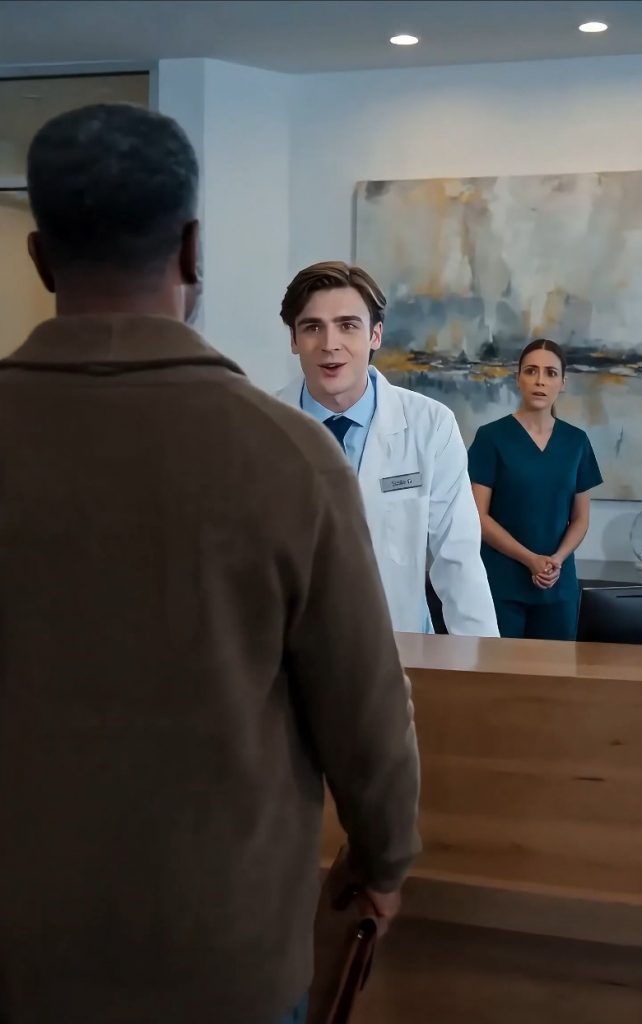
The man in the brown cardigan had barely passed the reception counter when the young doctor leaned forward with a smile that was too sharp to be professional.
“Sir, another loss?” the doctor called. “The public clinic is around the corner. Can’t you see this is a private elite hospital?”
The hospital hallway went quiet in a way only expensive places can manage.
No one gasped. No one stepped forward. A woman in pearls glanced over and quickly looked away. Two interns slowed near the glass doors, pretending to check a chart they were no longer reading.
The man stopped.
He was African American, somewhere in his late fifties, dressed simply in a white polo beneath a brown shawl-collar cardigan. His trousers were neat but plain. In his left hand, he carried a large brown leather portfolio worn smooth at the corners.
He did not look embarrassed.
That was what unsettled the doctor first.
Most people apologized when men like Dr. Gavin Scolar humiliated them in polished hallways. They explained themselves, fumbled for documents, lowered their voices, tried to prove they belonged in spaces designed to make them feel small.
This man did none of that.
He turned slowly.
The nurse in dark green scrubs, Leanne Ortiz, looked from the doctor to the stranger and felt something cold move through her chest. She had seen this before. The smile. The tone. The casual cruelty dressed as authority.
But never in front of so many people.
Dr. Scolar still had one hand lifted in a dismissive gesture toward the exit, as if the man were a delivery mistake someone needed to correct.
The man walked back to the counter.
His shoes made almost no sound on the polished floor.
“Good afternoon, doctor,” he said.
His voice was deep, calm, and steady enough to make the silence heavier.
Scolar’s smile faded by half. “Do you have an appointment?”
The man set the leather portfolio on the reception desk.
“I own this hospital,” he said. “And I do not tolerate this kind of prejudice.”
For one second, the words did not seem to reach Dr. Scolar.
Then they did.
His face went still. The color drained from his cheeks. His eyes dropped to the portfolio, then to the man’s face, then to Leanne, who was no longer pretending not to watch.
The name tag on his coat read:
Scolar G.
The man read it once.
Then he opened the leather portfolio.
Act II
Marcus Ellison had built Ellison Grace Medical Center because of a locked door.
Twenty-two years earlier, before the marble floors, the glass wings, the private suites, and the polished wooden reception desk, Marcus had been a widower sitting in an emergency waiting room with his wife’s scarf in his hands.
Her name was Grace.
She had been a school counselor with a laugh that filled kitchens and a temper that appeared only when children were mistreated. She used to say dignity was not a luxury. It was the floor every human being deserved to stand on.
The night she got sick, Marcus drove her to the closest private hospital because he believed clean walls and expensive machines meant faster help.
At the reception desk, a man looked at Marcus’s work jacket, then at Grace’s worn shoes, and told them billing had to be confirmed before she could be admitted.
Grace was in pain.
Marcus had insurance.
It did not matter.
By the time someone finally understood that she was not exaggerating, too much time had passed.
Marcus never forgot the sound of that locked door opening too late.
After Grace died, he did something people did not expect from a man who had grown up behind a laundromat and built his first business repairing office printers out of a rented garage.
He bought failing medical properties. He invested in clinics. He studied hospital boards the way other men studied markets. Slowly, stubbornly, ruthlessly when necessary, he built a healthcare network.
Then he named its flagship hospital after Grace.
Ellison Grace was meant to be different.
Private, yes. Excellent, yes. But never cruel. Never a place where a person’s clothes, accent, skin, age, or insurance card determined whether they were treated like a human being.
For years, Marcus believed the mission had survived him.
He was wrong.
The first complaint came six months before he walked into the reception area wearing a cardigan no one recognized as expensive. It was an anonymous note folded into a hospital feedback envelope.
A cardiology patient was told to wait outside because his work boots were “making the lounge uncomfortable.”
Then came another.
A grandmother was asked twice if she was sure she was in the right building.
Then another.
A young man visiting his father in oncology was followed by security until a surgeon recognized him as a donor’s son.
The complaints had one detail in common.
The front desk.
And one name appeared again and again, sometimes directly, sometimes through careful description.
Dr. Gavin Scolar.
Young. Brilliant. Well-connected. Polished. Arrogant.
The hospital board liked him because his father sat on two major philanthropic committees. Senior staff tolerated him because his surgical fellowship scores were excellent. Patients praised him when they looked like the kind of people he respected.
Everyone else learned to lower their eyes.
Leanne Ortiz had filed the most detailed complaint.
Not because she was fearless.
Because she was tired.
She had watched Scolar humiliate a janitor who asked for directions. She had watched him make a mother cry over a payment question he was not even responsible for answering. She had watched staff laugh nervously because silence felt safer than challenging a doctor whose family name opened boardroom doors.
So Leanne wrote it down.
Dates. Times. Names. Witnesses.
She expected nothing.
Then, three weeks later, Marcus Ellison called her personally.
“Ms. Ortiz,” he said, “I read every word.”
Leanne had sat alone in her parked car after that call, gripping the steering wheel and crying without making a sound.
Marcus did not tell the board he was coming that afternoon.
He did not wear a suit.
He did not arrive with photographers, lawyers, or assistants.
He came as the kind of man Dr. Scolar would feel safe insulting.
And Dr. Scolar did exactly what Marcus feared he would do.
Act III
Inside the portfolio were thirty-seven pages.
Scolar stared at them like they were a weapon.
Marcus removed the first sheet and placed it flat on the counter between them. His movements were slow, almost gentle, which somehow made them worse.
“March 4,” Marcus said. “A patient’s son was told this floor was for private families only, though his mother was recovering upstairs from heart surgery.”
Scolar’s mouth opened. “Mr. Ellison, I can explain—”
Marcus placed down another page.
“March 19. A home health aide was accused of loitering while waiting for discharge instructions.”
“That was a misunderstanding.”
Another page.
“April 2. A woman in cleaning staff uniform was asked whether she could read the visitor policy after asking where radiology was.”
Leanne’s eyes lowered.
She remembered that woman.
She remembered how Scolar laughed after the woman walked away.
Marcus looked up. “Was that also a misunderstanding?”
The doctor swallowed.
The hallway had become a courtroom without a judge’s bench. Staff gathered at a careful distance. A receptionist stood frozen behind her monitor. The two abstract landscape paintings behind the desk suddenly seemed absurdly calm, soft blue hills watching a man’s career unravel under recessed ceiling lights.
Scolar tried to recover.
Men like him always did.
“Sir, with respect, this hospital receives a lot of people who become confused. Security standards matter. I was protecting the environment.”
“The environment,” Marcus repeated.
“Yes. Families pay for privacy here. For comfort.”
Marcus’s expression changed for the first time.
Not anger.
Disappointment.
That was worse.
“Dr. Scolar, people do not pay us to protect them from the sight of others.”
Scolar looked toward Leanne, as if expecting help from the nurse he had ignored for months.
She gave him none.
Marcus turned one page in the portfolio and revealed a printed still from a security camera.
The image showed the reception desk from above. Scolar leaned forward, hand lifted, mouth open mid-sentence. In front of him stood an elderly man in a faded denim jacket.
Scolar’s face tightened.
“That video has no audio.”
“No,” Marcus said. “But the patient’s granddaughter did.”
He slid a transcript across the counter.
Scolar did not touch it.
The nurse beside him did not speak.
Marcus’s voice remained quiet. “Your words today were not an accident. They were a pattern.”
A pattern.
That word landed harder than any shout.
Because one cruel sentence could be dismissed. One incident could be softened. One complaint could be buried under polite doubt.
But a pattern was a mirror.
And Dr. Gavin Scolar was finally being forced to look.
Act IV
Scolar’s fear turned quickly into desperation.
“Mr. Ellison,” he said, lowering his voice, “I made a mistake. I was under pressure. We’re short-staffed, and there have been issues with unauthorized visitors.”
Marcus watched him carefully. “So you chose humiliation as a screening tool?”
“No. That’s not what I meant.”
“What did you mean?”
Scolar’s jaw worked.
For once, he had no polished answer.
The glass doors opened behind them, and an older woman entered the reception area pushing a walker. Her daughter was beside her, holding a folder of documents against her chest.
The older woman slowed when she saw Marcus.
Her eyes widened.
“Mr. Ellison?”
Marcus turned.
His face softened immediately. “Mrs. Bell.”
The woman’s daughter looked stunned. “You remember us?”
“Your husband was treated here last winter,” Marcus said. “Room 412. He liked the apple tea.”
Mrs. Bell’s eyes filled. “You sent flowers when he passed.”
“I remember.”
The hallway witnessed that, too.
Not a performance. Not branding. Just a man remembering a patient no one powerful had expected him to remember.
Mrs. Bell glanced at Scolar, and something hardened in her expression.
“He was the one,” she said quietly.
Marcus did not move. “The one?”
Her daughter stepped forward, voice trembling. “When Dad was in his final week, Dr. Scolar told my mother she should use the service elevator because she was upsetting the private guests.”
Leanne closed her eyes.
Scolar whispered, “That is not fair.”
Mrs. Bell lifted her chin. “No, doctor. It was not.”
The silence became unbearable.
Marcus turned back to Scolar.
“I created this hospital because my wife died after being judged at a desk very much like this one,” he said. “I have spent twenty-two years trying to make sure no family feels what I felt that night.”
His hand rested on the portfolio.
“You treated this place like a club.”
Scolar’s eyes shone with panic. “Please. My father knows half the board.”
“I know,” Marcus said. “He called me last month to recommend you for a permanent leadership track.”
Hope flickered across Scolar’s face.
Marcus let him feel it for one second.
“After reviewing your file,” Marcus continued, “I declined.”
The hope died.
Marcus turned to Leanne. “Ms. Ortiz.”
She straightened. “Yes, sir?”
“Please call Human Resources and the chief medical officer. Dr. Scolar is suspended from patient-facing duties effective immediately pending formal review.”
Scolar gripped the edge of the desk.
“Suspended?”
“And transferred out of this hospital network’s private reception and specialty access program,” Marcus said. “Your clinical work will be reviewed separately. Your conduct will not be.”
Scolar’s mouth opened, but no sound came.
Marcus leaned slightly closer, not to intimidate him, but to make sure every word was heard.
“Learn not to judge people by appearance.”
Then he closed the leather portfolio.
The sound was soft.
Final.
Act V
By evening, everyone at Ellison Grace knew what had happened.
Not because Marcus announced it.
Because hospitals carry stories through hallways faster than elevators carry patients. A nurse in oncology heard from a receptionist. A surgeon heard from an intern. A janitor heard from Mrs. Bell herself, who told anyone who would listen that the man who owned the building had remembered her husband’s tea.
Dr. Gavin Scolar left through a side corridor with his white coat folded over one arm.
No one clapped.
No one cheered.
That mattered to Marcus.
He did not want spectacle. He had seen enough public humiliation for one day. Accountability did not need cruelty to be firm.
Leanne found him later in the small chapel near the east wing.
It was the quietest place in the hospital, with one stained-glass window and a simple wooden bench donated by the family of a former nurse. Marcus sat alone near the back, the leather portfolio resting beside him.
Leanne stopped at the doorway. “Sir?”
He looked up. “Come in, Ms. Ortiz.”
She walked in carefully.
For a moment, she was not sure what to say. Thank you felt too small. Finally felt too bitter. I’m sorry felt too late.
So she told the truth.
“I didn’t think anyone read those reports.”
Marcus nodded slowly. “That is why people stop writing them.”
Leanne sat one row ahead of him, turned sideways. “Will anything really change?”
He looked toward the stained glass, where late afternoon light spread blue and gold across the floor.
“It has to.”
The next morning, the change began.
Not with a press release.
With policy.
Marcus ordered a full audit of patient access complaints, visitor screening practices, security referrals, and staff misconduct reports. Every department head had to attend listening sessions led not by executives, but by nurses, technicians, receptionists, and patient advocates.
Leanne was asked to lead the first one.
She almost refused.
Then she remembered the woman in the cleaning uniform who had been asked if she could read. She remembered Mrs. Bell being guided toward a service elevator with tears in her eyes. She remembered every time she had swallowed her anger because rent was due and power had a name tag.
So she said yes.
Two weeks later, the reception desk looked the same from a distance.
Same polished wood.
Same abstract paintings.
Same glass doors.
But behind it, something had shifted.
A sign appeared near the counter, simple and impossible to miss.
Every person who enters here deserves dignity.
Staff badges were updated with a new reporting line. Security protocols were rewritten. Volunteers were trained to greet people before questioning them. Complaints no longer disappeared into management folders no one opened.
Marcus visited often after that.
Sometimes in a suit.
Sometimes in the same brown cardigan.
He watched who smiled only when they recognized him. He watched who spoke kindly before they knew a name. He watched the hospital the way a man watches a promise he once made beside a grave.
One month after the incident, Mrs. Bell returned for a follow-up appointment.
At the reception desk, a new young doctor stepped aside to let her pass and asked if she needed assistance.
She smiled faintly.
“No, thank you. I know where I’m going.”
Leanne looked up from behind the desk and caught Marcus standing near the glass doors.
He had seen it.
The small moment.
The ordinary respect.
That was the point.
Not one dramatic reversal. Not one arrogant doctor stunned into silence. Not one powerful man revealing his title at the perfect time.
The point was what happened after the hallway went quiet.
Marcus walked past the reception desk, and this time no one stopped him for the wrong reason.
Leanne called after him gently.
“Good afternoon, Mr. Ellison.”
He turned back.
For a second, she thought he might correct her, ask for formality, remind everyone of his position.
Instead, he smiled.
“Good afternoon, Ms. Ortiz.”
Then he continued down the bright hospital corridor, leather portfolio in hand, passing under the clean white lights of the institution he had built from grief.
Behind him, the desk remained open.
The doors remained open.
And for the first time in a long while, the hospital named after Grace Ellison felt worthy of her name.