Act I
The mop was taller than she was.
It dragged across the marble in slow, wet streaks, leaving cloudy trails beneath the chandelier’s golden light. Each slap of the mop head echoed through the foyer like the house itself was accusing someone.
Sophie Whitmore knelt on the floor in denim overalls and a tan T-shirt, her small hands wrapped around the handle, her hair damp and messy against her tear-streaked face.
“Dad,” she sobbed, barely loud enough to fill the enormous room. “Where are you?”
The mansion gave no answer.
Only the crystal chandelier above her. The sweeping staircase. The polished marble. The large wooden doors that stood closed against the outside world.
Sophie wiped her nose with the back of her wrist and tried to push the mop again.
Her arms trembled.
The bucket beside her was half full of gray water. Her knees hurt. Her stomach hurt more. She had not eaten since breakfast, because Vivian said children who broke rules did not get served like guests.
They earned dinner.
That was the word Vivian used.
Earn.
Sophie did not fully understand what she had done wrong. She had spilled juice at lunch. Only a little. She had apologized right away. But Vivian had stared at the stain on the pale rug as if Sophie had done it on purpose.
Then she pointed to the foyer.
“If you want to eat in this house,” Vivian said, “you can start by learning what servants do.”
So Sophie cleaned.
And cried.
And waited for her father.
What she did not know was that he had already come home.
The front door opened quietly behind her.
Cold air moved into the foyer.
Nathan Whitmore stood in the doorway wearing a long black overcoat over a gray turtleneck, one hand holding a small white teddy bear with a blue ribbon around its neck.
He had bought it at the airport gift shop because Sophie liked bears more than dolls and because he had missed her birthday breakfast after his flight was delayed.
He came home expecting to hear her run down the stairs.
Instead, he saw his daughter kneeling on the floor with a mop in her hands.
His fingers tightened around the teddy bear.
Sophie still had not noticed him.
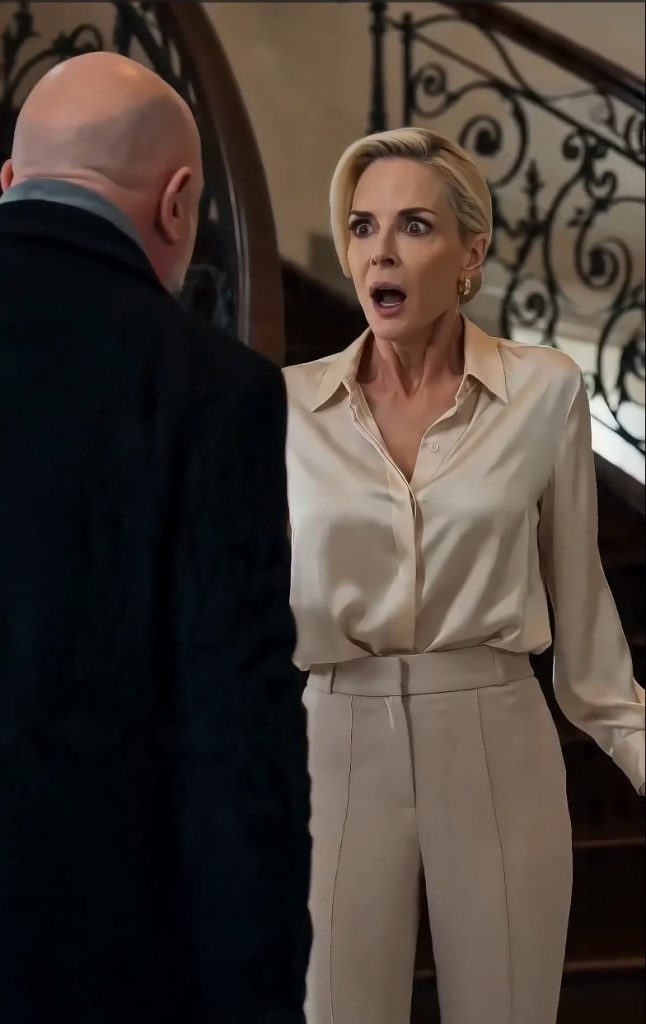
Then Vivian appeared at the top of the staircase with a glass of white wine.
She looked down at the child first, then at Nathan.
Her expression did not change enough.
“Why are you home early?” she asked.
Nathan took one step into the foyer.
Sophie looked up.
The mop slipped from her hands.
“Daddy,” she whispered.
And that single word broke the last piece of restraint left in him.
Act II
Nathan Whitmore had built the house before he understood what a home was.
The mansion was supposed to be a promise.
After Sophie’s mother died, Nathan threw himself into work because grief was easier when disguised as ambition. He bought the estate on the hill, hired architects, approved marble, iron, crystal, wood, and stone. He filled every room with things that looked permanent because everything in his life had suddenly felt fragile.
Sophie was three then.
She had slept with her mother’s scarf for almost a year.
Nathan did not know how to braid hair. He burned pancakes. He answered emails while she watched cartoons because hospitals, funerals, and single parenthood had made him afraid of stillness.
But he loved her.
Clumsily. Fiercely. Completely.
Then Vivian entered their lives.
She was elegant, composed, and dazzling in the way people become when they know exactly how to behave in expensive rooms. She hosted charity lunches. Remembered names. Sent handwritten thank-you notes. She knew which forks belonged with which course and how to make Nathan feel like his grief could be managed, arranged, softened into something presentable.
At first, Sophie liked her.
Vivian brought silk ribbons. Taught her how to sit at dinner. Called her “little darling” when Nathan was in the room.
But after the wedding, small things changed.
Sophie’s drawings disappeared from the refrigerator because they made the kitchen look untidy. Her toys were moved to the back playroom because guests should not “trip over childhood.” Her nanny was dismissed because Vivian said Sophie was old enough to become more independent.
Then Nathan’s business travel increased.
Vivian encouraged it.
“You can’t run an empire from a breakfast table,” she told him one morning, kissing his cheek as Sophie watched from her chair.
Nathan believed he was providing.
Vivian made sure Sophie believed he was leaving.
When he called from London, Sophie said she was fine. When he called from Singapore, she said school was good. When he asked if Vivian was taking care of her, Sophie looked toward the doorway, saw Vivian standing there with folded arms, and said yes.
Children learn quickly when love becomes something they must protect.
Sophie learned not to complain.
She learned to finish meals even when she was not hungry, because refusing food was “dramatic.” She learned to keep her room perfect because mess made Vivian cold. She learned that mistakes had consequences and tears made them worse.
And Nathan learned none of it.
Not because he did not care.
Because the house was built to hide things.
Polished floors reflected light, not pain. Staircases made people look graceful from a distance. A woman in ivory silk holding wine did not look like someone who would make a little girl scrub marble for dinner.
That was what Vivian counted on.
But that evening, Nathan’s flight landed four hours early.
And for the first time, he came home before the performance began.
Act III
Sophie tried to stand, but her knees slipped on the wet floor.
Nathan crossed the foyer in three long steps and caught her before she fell.
The teddy bear dropped onto the marble beside the bucket.
Sophie clung to his coat with both hands and began to cry harder, the kind of crying that does not ask permission anymore.
Nathan held her against him.
She felt too light.
Too cold.
He looked at the mop. The bucket. Her wet knees. Her red face. Then he looked up at Vivian, still frozen on the staircase.
“What is this?” he asked.
Vivian lifted her chin.
Her voice was smooth, but her fingers tightened around the wine glass. “She made a mess. I gave her a chore.”
Nathan’s eyes did not leave her face.
“She is seven.”
“Seven is old enough to understand discipline.”
Sophie trembled against him.
Nathan felt it.
That tremble told him more than Vivian’s answer ever could.
He lowered his voice. “Sophie, what happened?”
Vivian stepped down one stair. “Nathan, don’t encourage dramatics.”
He turned his head slightly.
“Do not speak over my daughter.”
The foyer went silent.
Vivian stopped.
Sophie pressed her face into Nathan’s coat.
“She said…” Her voice broke.
Nathan knelt, bringing himself to her height. He took her small hands from his coat and held them carefully.
“You can tell me.”
Sophie’s eyes flicked toward Vivian.
Nathan saw it.
Fear.
Not guilt. Not childish worry.
Fear of punishment.
His jaw tightened.
“I’m here,” he said. “No one is going to hurt you for telling the truth.”
Vivian’s face changed then.
Only for a second.
But Nathan caught it.
Sophie swallowed. “She said I had to earn dinner.”
The words landed softly.
That made them worse.
Nathan looked down at his daughter’s hands, wrinkled from dirty water. He looked at the red marks across her knees from kneeling on marble. He looked at the small white teddy bear lying abandoned beside the mop, its blue ribbon damp at the edge.
He stood.
Vivian’s voice sharpened. “You’re letting her manipulate you.”
Nathan turned toward her fully.
“Why is my daughter cleaning your floor?”
Vivian took another step down, trying to reclaim height, elegance, control.
“Our floor,” she said.
Nathan’s expression turned cold.
“No.”
The correction made her blink.
“This house was built for Sophie,” he said. “Not for you.”
Vivian laughed once, brittle and disbelieving. “You cannot be serious.”
Nathan pointed toward the bucket.
“That is my child on her knees beside a mop.”
“She spilled juice.”
“And you denied her food?”
Vivian’s lips tightened. “I taught her consequences.”
Nathan’s voice dropped.
“You taught her fear.”
For the first time, Vivian looked away.
That was when Mrs. Alvarez, the housekeeper, appeared at the hall entrance.
She stood there in her gray uniform, hands folded, face pale with a decision she had delayed too long.
“Mr. Whitmore,” she said quietly. “There is more you need to know.”
Vivian turned on her.
“Do not.”
Mrs. Alvarez looked at Sophie.
Then at Nathan.
And she stepped into the foyer.
Act IV
Mrs. Alvarez had worked for Nathan for nine years.
She had known Sophie when the child still carried a stuffed rabbit everywhere and mispronounced chandelier. She had packed lunches, mended costumes, sat beside fevers, and watched the mansion grow colder after Vivian took charge.
But she had also been afraid.
Afraid of losing her job. Afraid of Vivian’s threats. Afraid that Nathan, always traveling, would believe his wife before the staff.
Vivian had made that clear.
“No one likes a servant who invents stories,” she once said, smiling while Sophie sat silently at the breakfast table.
So Mrs. Alvarez kept records.
Not because she was brave at first.
Because she was ashamed that she was not.
Now, in the foyer, Nathan turned toward her.
“What more?”
Vivian descended the last steps quickly. “Nathan, this is absurd. You are allowing employees to interfere in our marriage.”
Mrs. Alvarez held up a small notebook.
Vivian stopped.
Nathan looked at it.
“What is that?”
“Dates,” Mrs. Alvarez said. “Meals Miss Sophie was denied. Times she was locked in the east playroom. Punishments. Instructions I was given not to contact you.”
Nathan felt Sophie’s fingers tighten around his coat.
He looked down.
His daughter was staring at the notebook like it might decide whether she was safe.
The realization nearly took his breath.
This had not been one cruel afternoon.
This had been a system.
Vivian’s face flushed. “She is lying.”
Mrs. Alvarez opened the notebook.
“January 12. Miss Sophie was sent to bed without dinner for crying during piano practice.”
“That is not—”
“February 3. Miss Sophie was made to stand in the service hallway for one hour after dropping a spoon at luncheon.”
Nathan’s eyes closed briefly.
Mrs. Alvarez continued, voice shaking now but steady enough.
“March 18. Mrs. Whitmore instructed staff to refer to Miss Sophie as ‘the little burden’ when Mr. Whitmore was not home.”
Sophie made a small sound.
Nathan turned.
She looked humiliated.
Not surprised.
Humiliated that he had heard it.
That broke something in him.
He knelt again and placed both hands gently on her shoulders.
“Sophie,” he said, voice rough, “look at me.”
She did.
“I am sorry.”
Her face crumpled.
“I tried to be good,” she whispered.
Nathan pulled her into his arms.
“You were never the problem.”
Vivian’s voice cut in, sharp with panic now. “This is emotional manipulation. Children exaggerate. Staff gossip. You know how these people are.”
Nathan stood slowly, lifting Sophie with him.
“These people,” he said, “protected my daughter better than her stepmother did.”
Vivian stared at him.
“Put your glass down,” he said.
The order was quiet.
She did not move.
Nathan turned to the security guard standing near the open door, summoned by the commotion.
“Escort Mrs. Whitmore to the guest suite. She is not to be near Sophie. Not tonight. Not alone. Not ever.”
Vivian’s mouth fell open. “You can’t remove me from my own home.”
Nathan’s eyes were colder than the marble beneath them.
“I just did.”
The wine glass trembled in her hand.
For the first time, Sophie saw Vivian afraid.
Act V
The divorce lawyers arrived before breakfast.
So did Nathan’s family attorney, Sophie’s pediatrician, a child therapist, and two investigators from family services. Nathan did not hide behind money. He did not ask for discretion before truth. He did not ask how to make it quiet.
He asked how to make Sophie safe.
That was the first decision that mattered.
Vivian left the mansion three days later in a cream coat and sunglasses, refusing to look at the staff gathered silently near the hall. She called it betrayal. She called it overreaction. She told Nathan he would regret humiliating her.
Nathan did not answer.
He stood on the staircase holding Sophie’s hand.
The same staircase Vivian had once used to look down on her.
When the front doors closed behind her, Sophie did not smile.
Children do not heal on command.
Instead, she leaned against her father’s side and whispered, “Can I eat breakfast now?”
Nathan bent and kissed the top of her head.
“Anything you want.”
She chose pancakes.
Mrs. Alvarez cried in the kitchen while making them.
For weeks, the house felt strange.
Not happy exactly.
Lighter.
The mop and bucket disappeared from the foyer. Nathan ordered the marble professionally cleaned, then fired the designer who suggested the room looked better “untouched by clutter.”
Sophie’s drawings returned to the refrigerator.
Her toys returned to the living room.
Her mother’s photograph returned to the grand piano, where Vivian had once removed it because “grief should not decorate shared spaces.”
At first, Sophie still asked before eating snacks. Asked before sitting on certain chairs. Asked if crying would make dinner go away.
Each question hurt Nathan in a new place.
Each time, he answered carefully.
“You don’t earn food.”
“You don’t earn love.”
“You don’t have to be perfect to stay here.”
Slowly, Sophie began to believe him.
Not all at once.
Trust is not a chandelier that can be switched back on.
It is a night-light. Small. Repeated. Left glowing every time darkness returns.
Nathan changed too.
He traveled less. Sold one division of his company. Moved his office into the east library so he could be home when Sophie returned from school.
People called it a dramatic shift in priorities.
Nathan called it being late and refusing to stay late.
One afternoon, months later, Sophie found the white teddy bear in her father’s study. Its blue ribbon had been cleaned. It sat on the shelf beside a framed photo of Sophie and her mother.
She picked it up carefully.
“You dropped him,” she said.
Nathan looked up from his desk.
“I did.”
“You were mad.”
“I was scared.”
Sophie hugged the bear to her chest. “Because of me?”
Nathan stood and crossed the room.
“Because I realized I hadn’t protected you the way I should have.”
Sophie looked down at the bear’s round face.
“You came home.”
He knelt in front of her.
“I should have come home sooner.”
She thought about that.
Then she placed the teddy bear in his hands and climbed into his arms.
Nathan held her tightly, but not too tightly. He had learned that love after fear had to ask, not grab.
In the fall, the mansion hosted a birthday party.
Not a gala. Not a polished event for donors and business partners. A real child’s party, loud and imperfect, with balloons tied to the staircase and frosting on the marble despite Nathan’s staff gently panicking in the background.
Sophie wore overalls by choice this time.
Pink ones.
She ran through the foyer with friends, laughing so loudly the chandelier seemed to tremble.
At one point, a cup of juice tipped over.
Red juice spread across the marble.
Every adult nearby froze for half a second.
Sophie froze too.
Her smile vanished.
Nathan saw it from across the room.
He walked over, picked up a napkin, and knelt beside the spill.
“Well,” he said lightly, “this floor has survived worse.”
Sophie stared at him.
Then, slowly, she laughed.
Nathan handed her a napkin, not as punishment, but as partnership.
Together, they wiped up the juice while her friends argued over cake flavors behind them.
No fear.
No hunger.
No humiliation.
Just a spill.
Just a floor.
Just a father kneeling beside his daughter, showing her that mistakes did not make love disappear.
That night, after the party ended, Sophie stood in the foyer under the chandelier, holding the white teddy bear.
“Daddy?”
“Yes?”
“Do you still think this house was built for me?”
Nathan looked around at the marble, the staircase, the grand doors, the room that had once echoed with her sobs and now held scraps of ribbon, balloon string, and laughter.
“Yes,” he said. “But I was wrong about one thing.”
Sophie frowned. “What?”
He smiled softly.
“Houses aren’t built by marble and chandeliers. They’re built by who feels safe inside them.”
Sophie considered this.
Then she slipped her hand into his.
“Then it’s a home now.”
Nathan closed his eyes for a moment.
When he opened them, the chandelier light blurred slightly.
“Yes,” he whispered. “Now it is.”