Act I
The sound that brought Thomas Whitaker running was not a scream.
It was sobbing.
Small, broken, rhythmic sobbing echoing across white marble.
He came through the hallway in his gray three-piece suit, one hand still gripping the phone he had dropped twice in the car after reading the message from the housekeeper.
Come home now. It’s Lily.
He had not waited for the driver. He had not called Vanessa. He had left the boardroom in the middle of a sentence and driven himself through three red lights with his heart lodged somewhere in his throat.
Now he reached the kitchen and stopped so abruptly his shoes slid against the polished floor.
His daughter was kneeling in front of the marble island.
Lily.
Six years old.
Pale pink dress. Brown hair falling loose over her shoulders. Little hands buried inside a white bowl on the floor.
A dog food bowl.
For one second, Thomas could not move.
The kitchen was pristine around her, almost violently beautiful. White cabinetry, stainless steel appliances, a gold chandelier glowing above the island, every surface polished until it looked untouched by real life.
And there, in the center of all that expensive perfection, his child was on her knees, crying with brown residue smeared around her trembling mouth.
“Lily.”
She flinched so hard the kibble rattled in the bowl.
Thomas dropped to his knees beside her.
“Stop,” he said, his voice breaking as he took her little hands in his. “Please stop.”
Lily shook her head wildly, panic rushing into her wet eyes.
“Don’t tell her,” she whispered.
The words hit him harder than the sight of the bowl.
“Don’t tell who?”
Lily’s lower lip trembled. She looked toward the doorway, then back at him, as if the walls themselves might report her.
Thomas held her shoulders gently.
“Baby, look at me. Who made you do this?”
Lily sobbed once, deep and jagged.
“Miss Vanessa…”
Thomas went still.
The chandelier hummed softly above them. Somewhere in the house, a clock ticked. The dog food bowl sat between them like evidence.
His hands tightened, not on Lily, but around the air of what he was beginning to understand.
“What did she say?” he asked.
Lily’s voice became almost too small to hear.
“She said I’m not your real daughter.”
Thomas stared at her.
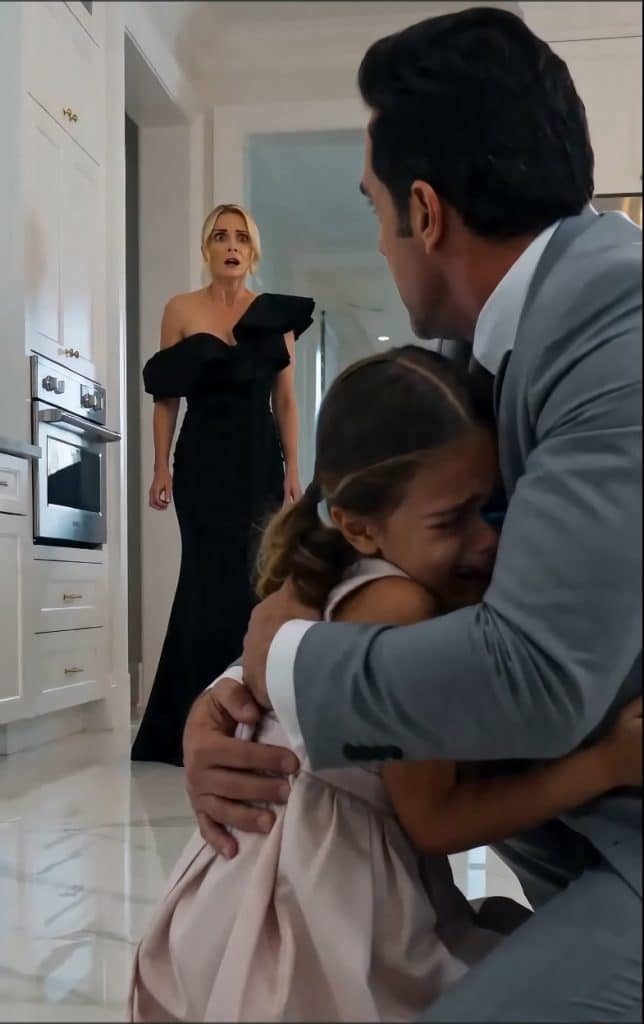
Then he pulled her into his arms so fast the bowl tipped sideways and scattered dry kibble across the marble.
Lily collapsed against his suit, crying into his chest.
Thomas held her with one arm and turned his body toward the doorway.
That was when Vanessa appeared.
Blonde hair styled perfectly. Black off-the-shoulder dress. One hand resting on the frame as if she had arrived to inspect a minor inconvenience.
But when she saw Thomas on the floor with Lily in his arms, the confidence drained from her face.
Thomas looked at his wife with a calm so cold it frightened even him.
“Vanessa.”
And for the first time since she entered the Whitaker mansion, Vanessa looked afraid.
Act II
Thomas had once believed Vanessa was elegant because she was controlled.
That was the word people used for women like her.
Controlled.
She never raised her voice in public. Never spilled wine. Never wore the wrong color to a charity gala. She remembered names, smiled at donors, and touched Thomas’s arm with perfect timing whenever a photographer turned their way.
When he married her, his friends congratulated him on “moving forward.”
As if grief were a hallway and remarriage were simply the next door.
His first wife, Emma, had died three years earlier.
Emma had been the opposite of Vanessa in almost every way. Warm, messy, impulsive, always leaving half-finished cups of tea on windowsills and handwritten notes inside books. She had chosen Lily’s pink nursery wallpaper before Lily could even sit up. She had sung off-key while cooking. She had loved with no strategy at all.
Lily was Emma’s miracle.
Not by blood, not at first. Emma and Thomas had spent years trying to have a child before they met Lily through a private adoption arrangement no one in their circle had understood. A newborn girl left without protection. A quiet court hearing. A trembling young mother who wanted one promise: that her baby would never feel unwanted.
Emma gave that promise with both hands.
Thomas did too.
Six months later, Lily was legally theirs.
To Thomas, the word adoption had never made Lily less his daughter. It had made fatherhood feel like a choice he was honored to keep every day.
But after Emma died, the house changed.
The laughter faded first.
Then the music.
Then the little rituals Emma had built into every room.
Thomas tried to raise Lily alone, but grief made him clumsy. He worked too much because work obeyed rules. A child’s sorrow did not. Lily would ask why Mommy’s perfume still smelled inside the closet, and Thomas would have no answer strong enough to carry both of them.
That was when Vanessa entered.
She had been a donor relations consultant for the Whitaker Foundation, poised and sympathetic, always arriving when Thomas was most exhausted. She brought meals in glass containers. She knew which guests to call and which relatives to avoid. She organized memorial events with such grace that people started whispering she was exactly what the household needed.
At first, she was kind to Lily.
Not affectionate, exactly.
But attentive.
She bought dresses. Arranged piano lessons. Hired tutors. Smiled when Lily presented crayon drawings at the breakfast table.
Thomas mistook management for care.
The first warning signs were small.
Lily stopped singing in the bath.
Then she stopped asking to sit beside Thomas at dinner unless Vanessa nodded first.
Then she began apologizing for things children should not even notice: breathing too loudly, leaving fingerprints on glass, spilling crumbs, asking questions.
When Thomas asked what was wrong, Vanessa always had an answer ready.
“She needs discipline.”
“She’s testing boundaries.”
“You’re too soft because of Emma.”
That last one always worked.
It turned his guilt against him.
So Thomas trusted Vanessa with the house.
With the schedules.
With the child who still slept with Emma’s scarf under her pillow.
He never imagined cruelty could wear silk, perfume, and a wedding ring.
Until the housekeeper sent the message.
Act III
Vanessa did not speak at first.
She stood in the doorway, frozen beneath the soft hallway light, her black dress making her look like a shadow that had learned to breathe.
Thomas rose slowly with Lily in his arms.
The little girl clung to him, face hidden against his shoulder.
“What did you do?” he asked.
Vanessa’s mouth opened, then closed.
“I was teaching her a lesson.”
The sentence was so calm it seemed unreal.
Thomas stared at her.
“A lesson?”
Vanessa lifted her chin, though her eyes kept flicking to the dog food scattered across the floor.
“She lied to me. She refused lunch. She said she wanted the food Emma used to make.” Vanessa swallowed. “So I told her if she wanted to act like an ungrateful little stray, she could eat like one.”
Lily whimpered into Thomas’s shoulder.
Something inside him went silent.
Not empty.
Worse.
Focused.
“You made my daughter kneel on the floor.”
Vanessa’s face tightened. “Thomas, stop being dramatic.”
“Do not use that word in this room.”
His voice did not rise.
That was what made Vanessa step back.
The old Thomas might have shouted. The grieving Thomas might have argued, demanded explanations, begged for this to be some misunderstanding.
But the man standing in front of her now was not confused.
He was seeing every small moment he had excused.
Every apology Lily whispered.
Every dinner where Vanessa corrected the way the child held a fork.
Every time Lily reached for him and stopped halfway, waiting for permission from a woman who had no right to stand between father and daughter.
Thomas looked at the residue around Lily’s mouth, then at Vanessa.
“You told her she wasn’t my real daughter.”
Vanessa’s mask slipped.
Only for a second.
But he saw it.
The satisfaction beneath the fear.
“Well,” she said carefully, “isn’t it time she understood the truth?”
Thomas took one step toward her.
Vanessa backed into the hallway.
“The truth,” he repeated.
“She’s not Emma,” Vanessa snapped. “She’s not blood. You built a shrine to a dead woman and handed everything to a child who came from nowhere.”
Lily began crying harder.
Thomas pressed a kiss to the side of her head.
“Listen to me,” he whispered to Lily, loud enough for Vanessa to hear. “You are my daughter. Nothing she said changes that. Nothing anyone says will ever change that.”
Lily’s little fingers tightened in his suit jacket.
Then a quiet voice spoke from behind Vanessa.
“That isn’t all she said, Mr. Whitaker.”
Vanessa turned sharply.
Mrs. Alvarez, the housekeeper, stood at the end of the hall with her phone in her hand and tears in her eyes.
Thomas looked at her.
She lifted the phone.
“I recorded enough.”
Vanessa’s face went pale.
Act IV
Mrs. Alvarez had worked in the Whitaker house since Emma was alive.
She had seen Lily take her first steps in the breakfast room. She had held the child during the funeral when Thomas stood beside Emma’s casket looking like a man whose entire world had been buried before he was.
She had tolerated Vanessa for Thomas’s sake.
At first.
Then she began noticing things.
The way Vanessa dismissed staff from rooms before correcting Lily. The way Lily’s shoulders tightened at the sound of her heels. The way small toys disappeared from the nursery and reappeared in the trash because Vanessa called them “cheap little relics.”
Mrs. Alvarez had warned Thomas once.
Carefully.
He had been grateful but distracted.
Vanessa had smiled through the whole conversation and reduced Mrs. Alvarez’s hours the next week.
But that afternoon, Mrs. Alvarez came back for a forgotten set of keys and heard Lily crying in the kitchen.
She did not interrupt immediately.
That guilt would stay with her.
Instead, she recorded.
Not out of cowardice, but because women like Vanessa survived by turning witnesses into liars. Mrs. Alvarez knew that a trembling accusation from a housekeeper could be dismissed.
A recording could not.
Thomas handed Lily gently to Mrs. Alvarez.
“Take her upstairs. Help her wash her face. Stay with her.”
Lily panicked. “Daddy, don’t go.”
Thomas turned back instantly.
“I’m not leaving you,” he said. “I will be right behind you. I just need to speak to Vanessa where you can’t hear her.”
Lily looked at Vanessa and shrank.
Thomas saw it.
So did Vanessa.
And whatever excuse Vanessa had been preparing died in her throat.
Mrs. Alvarez carried Lily away carefully, whispering comfort in Spanish and English the way she had when Lily was a baby.
Only when his daughter was out of sight did Thomas face his wife.
“Give me your phone.”
Vanessa laughed once, brittle and false. “Excuse me?”
“Your phone.”
“You don’t get to order me around like staff.”
“No,” Thomas said. “But my attorney does. And by morning, so will a court.”
Vanessa’s eyes narrowed. “You think you can divorce me over discipline?”
“I can divorce you for any reason I want. But that isn’t what you should be worried about.”
For the first time, real fear crossed her face.
Thomas walked past her to the small office beside the kitchen and opened the wall safe. Vanessa watched from the doorway as he removed a slim file.
She recognized it instantly.
The Whitaker Family Trust.
Her breathing changed.
Thomas turned, holding the file at his side.
“Two months ago,” he said, “my attorney flagged an attempted inquiry into Lily’s inheritance status.”
Vanessa said nothing.
“Someone requested sealed adoption records.”
Her lips parted.
“Someone asked whether Lily could be challenged as a beneficiary if I died before she turned eighteen.”
“That was standard estate planning,” Vanessa said quickly.
Thomas’s eyes hardened. “It was predatory.”
The word landed between them.
Vanessa’s elegance was gone now. Her shoulders were rigid, her face strained, her carefully arranged hair suddenly too perfect for the panic beneath it.
“You were trying to make her feel unwanted,” Thomas said. “Not because you believed it. Because you needed her to believe it.”
Vanessa’s silence confirmed what her mouth refused to say.
She had not only humiliated a child.
She had been preparing to erase one.
Act V
By sunset, Vanessa was no longer inside the Whitaker house.
Thomas did not throw her out in a scene fit for gossip.
He called his attorney. He called Lily’s therapist. He called Mrs. Alvarez’s niece, who came to stay with Lily while the adults handled what needed handling.
Then he stood in the foyer as Vanessa descended the staircase with a single suitcase and the expression of someone still trying to decide whether she could turn defeat into victimhood.
“You’ll regret this,” she said.
Thomas looked at her as if she were a stranger.
“No,” he replied. “I regret not seeing it sooner.”
That was the last sentence he gave her.
The divorce filings began the next morning.
The trust inquiry was traced through Vanessa’s private attorney. The staff provided statements. Mrs. Alvarez’s recording became the center of the custody and protection filing, not because Thomas wanted revenge, but because he would never again ask Lily to live in a house where her pain needed proof.
Vanessa tried to explain herself to friends.
Then to society columns.
Then to anyone who would listen.
She called Thomas unstable with grief. She called Lily difficult. She called the incident exaggerated.
But cruelty has a particular sound when recorded clearly in a bright kitchen.
People heard enough.
Invitations stopped.
Calls went unanswered.
The same women who once praised Vanessa’s taste suddenly remembered how cold she had been to waiters, assistants, florists, and anyone whose usefulness had expired.
But none of that mattered to Lily.
Not at first.
Children do not heal because adults are punished.
They heal because safety becomes predictable.
So Thomas began there.
He took a leave from the foundation. He learned how to braid Lily’s hair badly, then better. He burned pancakes. He sat on the floor outside her bedroom on nights she did not want to be alone. He answered the same question as many times as she needed to ask it.
“Am I really yours?”
Every time, he said the same thing.
“Completely.”
Some nights she believed him.
Some nights she cried anyway.
On the third week after Vanessa left, Thomas carried the white dog bowl out of the kitchen.
He wanted to smash it.
For hours, he imagined doing exactly that.
But when he asked Lily what she wanted, she stood beside the marble island in her socks and thought very seriously.
Then she said, “Can we put flowers in it?”
Thomas blinked.
“Flowers?”
“So it’s not bad anymore.”
The next morning, they filled the bowl with soil and planted tiny blue forget-me-nots inside it.
They placed it on the windowsill where sunlight reached it first.
Mrs. Alvarez cried when she saw it.
Thomas did too, later, where Lily could not hear him.
Months passed.
The kitchen changed.
Not in expensive ways. In living ways.
A pink step stool appeared beside the island. Crayon drawings covered part of the refrigerator. A small framed photograph of Emma returned to the breakfast nook after Vanessa had quietly removed it. Lily chose the frame herself, pale blue with little painted clouds.
One Saturday morning, Thomas found Lily standing in front of the photograph.
She was holding Emma’s scarf.
“Would Mommy be mad I forgot her soup recipe?” she asked.
Thomas crouched beside her.
“No,” he said softly. “She’d say we can learn it together.”
So they tried.
They made a terrible version first. Too salty. Too thick. Mrs. Alvarez laughed so hard she had to sit down. Lily laughed too, suddenly and brightly, and the sound filled the kitchen like sunlight entering a room that had been locked too long.
Thomas looked at his daughter with flour on her cheek and a wooden spoon in her hand.
Not his real daughter.
The words no longer had power in that room.
They had been buried under better words.
Chosen.
Loved.
Protected.
Home.
A year later, when the adoption anniversary came around, Thomas took Lily to the courthouse where he and Emma had first become her parents. Mrs. Alvarez came with them. So did Lily’s therapist, who had become something like an aunt by then.
Afterward, they returned to the mansion for a small dinner.
No chandelier-only elegance. No stiff guests. No black dresses moving like threats through doorways.
Just family.
At the end of the meal, Lily carried the flower bowl to the center of the table. The forget-me-nots had grown full and soft, blue petals spilling over the rim.
Thomas watched her touch one bloom gently.
“Daddy?”
“Yes, sweetheart?”
“Can bad things turn good?”
He looked at the bowl.
Then at the child who had survived being made to feel small and had somehow chosen to grow something living from the memory.
“Sometimes,” he said, voice thick. “With a lot of love.”
Lily nodded, satisfied.
Then she climbed into his lap, still small enough to fit there, still young enough to believe safety could be rebuilt if the people who loved you kept showing up.
Thomas wrapped his arms around her.
The marble floor gleamed beneath them. The gold chandelier shone overhead. The kitchen was still grand, still expensive, still impossibly white.
But it no longer felt cold.
Because the most important thing in that room was not the chandelier, the island, the marble, or the name on the deed.
It was the little girl in the pink dress, laughing softly against her father’s chest.
And the bowl on the table, blooming.