Act I
The studio went quiet before the music stopped.
Classical piano still floated through the bright room, soft and disciplined, but Amelia Bell had already lost the rhythm. Her reflection in the mirror froze mid-turn, pink skirt settling against her thighs, one hand hovering near the barre.
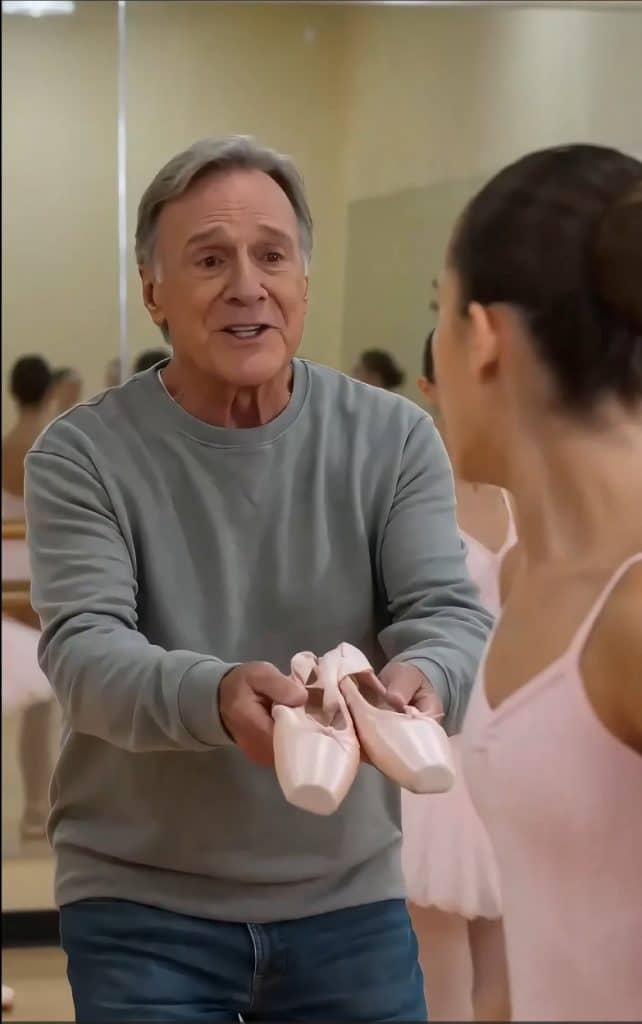
Her father stood by the door.
Not a driver. Not a sponsor. Not a polished ballet parent carrying flowers in a paper sleeve.
Just her father.
Thomas Bell wore a plain gray T-shirt, faded blue jeans, and the careful expression of a man trying not to interrupt something beautiful. In both hands, he held a pair of pink pointe shoes like they were fragile enough to break his heart.
Amelia felt the heat rise in her face.
Behind her, the other dancers noticed.
Celeste leaned toward Mara and whispered something. A muffled laugh followed. In the mirror, Amelia saw their eyes move from her father’s worn sneakers to his weathered hands, then back to her.
Thomas stepped forward.
“I brought these for you,” he said softly.
Amelia’s stomach twisted.
Not here.
Not in front of them.
Her father did not understand this world. He did not understand the quiet cruelty of girls who smiled while measuring the cost of your leotard. He did not understand how hard Amelia had worked to make them forget she came from a two-room apartment over a shoe repair shop.
She lifted one hand quickly. “Please, not here.”
Thomas stopped.
His smile faded only a little, but she saw the hurt anyway.
“I just wanted to help.”
The words made the snickering worse.
Amelia turned away sharply, humiliation winning before love could catch up.
“You’re embarrassing me.”
The piano stopped.
The entire studio heard it.
Thomas lowered the shoes.
For a second, he looked smaller than when he came in. Then his fingers loosened, not dramatically, not on purpose, but with the quiet defeat of a man who had carried something too carefully for too long.
The pointe shoes slipped from his hands and fell onto the polished floor.
A soft thud.
Then a faint paper flutter.
A small folded white note slid from inside one shoe and landed beside the ribbons.
Amelia stared at it.
“What is that?” she whispered.
Thomas did not answer.
And somehow, his silence frightened her more than anything he could have said.
Because the handwriting on the note looked like her mother’s.
Act II
Amelia had spent years trying to outrun the smell of leather glue.
It lived in her childhood the way other children remembered fresh laundry or Sunday breakfast. Leather glue, satin ribbon, dust from old soles, coffee gone cold beside her father’s workbench.
Bell Repair sat below their apartment on a narrow street that smelled of rain and bus exhaust. By the time Amelia was six, she could identify shoes by sound: stilettos clicking angrily on tile, work boots dragging after a long shift, ballet slippers whispering when dancers from the old theater came in for repairs.
Her mother had been one of them.
Elena Bell was never famous, not in the way posters made dancers famous. But she moved through the world like music had chosen her first. She danced in small productions, taught beginner classes, and laughed whenever Thomas tried to copy her posture behind the counter.
When Amelia was little, Elena would lift her onto the workbench and say, “Your father fixes shoes, but really, he fixes people’s courage.”
Amelia did not understand.
Then Elena got sick.
After that, the shop became quieter. Thomas worked longer hours. He repaired shoes until midnight and stitched ribbons before dawn. Amelia would wake to the yellow light under the kitchen door and find him bent over a pair of pointe shoes, hands moving with patient devotion.
He never complained.
Not when tuition bills came.
Not when Amelia outgrew slippers faster than they could afford replacements.
Not when she was accepted into the Laurent Conservatory, where the girls arrived in private cars and spoke casually about summer intensives in Paris.
At first, Amelia was proud of him.
She told everyone her father made shoes.
Then Celeste wrinkled her nose and said, “Like a cobbler?”
The word spread.
Not loudly. Never loudly enough for teachers to hear. But enough.
Cobbler girl.
Discount princess.
Basement ballerina.
Amelia learned to stop mentioning him.
She changed after that. Slowly at first. Then with the cruelty of someone trying to survive by cutting away the parts of herself other people could use against her.
She asked him not to wait inside the building.
Then not to wave from the sidewalk.
Then not to come to performances unless she left tickets at the back.
Thomas never argued.
That made it worse.
The day of the studio rehearsal was important. The company director was coming to observe. One dancer would be chosen as an apprentice for the spring tour. Amelia had dreamed of that chance for years.
But her pointe shoes were failing.
She had not told Thomas. She planned to make them last one more day, to dance through the pain and pretend nothing was wrong.
Thomas noticed anyway.
Of course he did.
He had noticed every limp she tried to hide since she was seven.
So he came to the studio with a new pair, made before dawn, the satin still smooth and clean, the ribbons folded with almost sacred care.
He came because he loved her.
And she humiliated him for it.
Now the note lay on the floor between them.
And Amelia suddenly understood that the shoes were not the only thing he had been carrying.
Act III
No one moved when Amelia bent down.
Not the dancers. Not Thomas. Not even Madame Laurent, who had appeared at the far end of the studio without a sound, her silver hair pulled back, her black rehearsal coat sharp against the pale wall.
Amelia picked up the note with trembling fingers.
The paper was old.
Not freshly folded. Not new.
Her breath caught when she saw the first line.
My little Amelia,
The room blurred.
She knew the handwriting.
She had seen it on recipe cards, birthday notes, labels inside old costume boxes. Her mother’s letters always leaned slightly to the right, as if every word were trying to move forward.
Amelia pressed the paper flat.
If your father is giving you this, then you are standing close to a dream I may not live long enough to see.
A small sound escaped her throat.
Thomas looked down.
He did not try to stop her reading.
He had waited years for this moment, and now that it had arrived, he looked as if he wished he could spare her from it.
Amelia continued.
You will be tempted, my love, to believe the world only respects beauty when it arrives polished. It does not. Every beautiful thing you will ever do will be held up by unseen hands.
Your father’s hands were the first hands that held you.
They were the hands that held me when I could no longer stand.
And if you are wearing shoes he made, then every step you take begins with love.
Amelia covered her mouth.
The studio had gone completely still.
Celeste was no longer smiling.
Madame Laurent stepped forward slowly, her eyes fixed not on Amelia, but on Thomas.
“Mr. Bell,” she said softly. “You should have told her.”
Thomas gave a tired smile. “Wasn’t mine to tell.”
Amelia looked up.
“What does she mean?”
Madame Laurent’s face softened with something that looked like memory.
“Your father does not simply repair shoes, Amelia.”
The words seemed to open a door the studio had been standing in front of for years.
“He made pointe shoes for half the dancers in this city before his hands became too stiff for full production. Your mother wore Bell shoes. I wore Bell shoes. Every principal dancer in my generation knew that stamp.”
She turned toward the pair on the floor.
“The balance. The box. The way the shoe held without punishing the foot. That was your father.”
Amelia stared at the shoes.
Her cheeks burned again, but now not from embarrassment.
From shame.
Madame Laurent continued, her voice quiet but clear enough for every dancer to hear.
“When the conservatory nearly lost its scholarship fund after the fire eight years ago, your father rebuilt our stock room shelves himself. Refused payment. When three dancers could not afford custom shoes before auditions, he made them and told me to say they came from the school.”
Celeste looked down at her own pink shoes.
Mara did too.
One by one, the dancers began checking the inner soles.
There, stamped faintly in worn ink, were two small words.
Bell Workshop.
The silence changed.
It was no longer awkward.
It was guilty.
Amelia looked at her father, but he was not looking at the dancers. He was looking only at her, and somehow that hurt most of all.
He had never needed the room to know his worth.
He had only wanted his daughter not to be ashamed of it.
Act IV
Amelia took a step toward him.
“Dad,” she whispered.
Thomas shook his head gently.
Not angry.
That was worse.
“I didn’t come to make a scene,” he said.
His voice was steady, but the hurt sat inside it like a bruise. “I saw the shank on your right shoe was dying last week. You were favoring the left foot. I thought you might need these today.”
Amelia looked down at her feet.
Of course he had noticed.
The teachers had not. The dancers had not. Even Amelia had tried not to notice.
But her father had seen one uneven landing from the back of the hallway and understood.
She clutched the note.
“Why didn’t you tell me about Mom’s letter?”
Thomas looked toward the mirrors, where they stood reflected together: the polished dancer and the tired man in jeans, both looking smaller than the room around them.
“She asked me to give it to you when you were ready.”
Amelia’s eyes filled.
“And you thought I was ready today?”
“No,” he said softly. “I thought you needed the shoes.”
The honesty broke something open in her.
She remembered being eight and waking up to find him sewing ribbons because she had a recital the next morning. She remembered him standing outside rehearsal in the rain because she had told him not to come in. She remembered the way he clapped from the last row, never too loudly, never wanting to embarrass her.
She remembered choosing other people’s approval over the man who had never once made her earn his love.
Behind her, Celeste whispered, “I didn’t know.”
Amelia turned.
The old Amelia, the frightened one, would have accepted that as enough. Would have laughed lightly, pretended nothing mattered, slipped back into the group because belonging had always felt safer than truth.
But the note in her hand was warm from her grip.
Her mother’s words would not let her hide.
“You didn’t know because you didn’t ask,” Amelia said.
Celeste’s face went pale.
Amelia’s voice trembled, but she did not stop.
“You laughed at him because of his clothes. Because of his hands. Because he looked like work instead of money.”
The room absorbed the accusation.
Some dancers looked ashamed.
Others looked defensive.
Madame Laurent did not interrupt.
Amelia bent and picked up the pointe shoes. She held them carefully, the way her father had.
“These shoes are why half of us can dance without injury,” she said. “These hands kept this studio standing when its own donors walked away.”
Thomas looked uncomfortable. “Amelia—”
“No,” she said, turning back to him. “Please. Let me say it.”
Her voice broke then.
“I was embarrassed because I was scared they’d see where I came from.”
Thomas’s eyes shone.
Amelia stepped closer.
“But where I came from is you.”
For one moment, father and daughter stood in the middle of the studio, surrounded by mirrors that reflected every angle of the truth.
Then Madame Laurent spoke.
“Put them on.”
Amelia turned.
Madame Laurent’s expression had become unreadable again, the face of a director measuring not scandal, but readiness.
“The audition panel is waiting. You may dance in the shoes your father brought, or you may continue hiding in the broken ones.”
Amelia looked down at the new pair.
Her mother’s note trembled in her hand.
Behind her, Thomas whispered, “You don’t have to.”
That was when she understood the real choice.
Not whether to dance.
Whether to stop being ashamed of the person who made it possible.
Act V
Amelia sat on the floor and changed shoes in front of everyone.
No curtain.
No hiding.
No turning away.
She untied the ribbons from the dying pair, removed them carefully, and set them aside. Her feet ached when they touched the cool wood, but when she slid into the new shoes, the fit stunned her.
Perfect.
Not comfortable in the false way people imagine pointe shoes should be. Pointe was never comfort. It was pressure, discipline, alignment, pain transformed into line.
But these shoes held her.
Her father had made them for the exact foot she had tried to hide from him.
The room watched as she tied the ribbons.
When she finished, she stood.
Thomas remained near the door, hands empty now.
Amelia crossed the studio and stopped in front of him.
“I’m sorry,” she said.
The words were too small.
They both knew it.
So she said more.
“I’m sorry I made you feel like you didn’t belong in the room I only reached because of you.”
Thomas’s face folded with pain he had no interest in showing anyone else.
“You’re my daughter,” he said. “I was never keeping score.”
“I know,” she whispered. “That’s why I should have.”
For the first time, he reached for her.
She stepped into his arms.
It was not graceful. Not elegant. Not the kind of moment ballet could choreograph into something pretty.
It was a girl in pink clinging to a father in a gray T-shirt while a room full of dancers learned that class could be measured very badly by people wearing expensive shoes.
When Amelia pulled away, Thomas brushed a strand of hair from her cheek the way he had when she was little.
“Dance,” he said.
So she did.
The piano began again.
At first, her body shook. Emotion sat too close to the surface. Every movement threatened to break into tears.
Then the shoes found the floor.
Or maybe they found her.
Amelia rose onto pointe, and for the first time all day, she did not dance to impress the dancers behind her. She did not dance for Celeste’s approval or the panel’s silence or the imagined life where no one knew her father’s hands were cracked from work.
She danced for the shop below the apartment.
For leather glue and late nights.
For Elena Bell’s handwriting.
For Thomas sitting in the back row.
For every unseen hand beneath every beautiful thing.
By the end, the studio was silent again.
But this silence was different.
Madame Laurent stood near the mirrors with her arms folded and tears bright in her eyes.
The audition panel said nothing for a long beat.
Then one of them began to clap.
Not loudly.
Not theatrically.
A single, respectful sound.
Madame Laurent joined.
Then the others.
Finally, the dancers too.
Celeste clapped last, her eyes fixed on the floor.
Amelia did not look at her.
She looked at her father.
Thomas stood by the door with one hand pressed lightly against his chest, as if keeping his heart in place.
Weeks later, Amelia was offered the apprenticeship.
She almost ran to the shop to tell him.
Thomas was behind the counter, repairing the heel of an old boot, glasses low on his nose. The bell above the door chimed when she entered, and he looked up the way he always had.
Hopeful.
Ready.
Hers.
“I got it,” she said.
His face changed slowly.
Then he smiled.
Not the polite smile he had worn in the studio. Not the careful smile of a man trying not to take up space.
A real one.
Elena’s note was framed in the studio lobby by the end of the month, beside a pair of old Bell pointe shoes and a small bronze plaque.
In honor of the hands that hold up the dance.
Amelia insisted Thomas attend the unveiling.
He tried to wear a suit. She told him to wear the gray T-shirt if he wanted.
He laughed.
He wore a clean blue shirt instead, which they both accepted as compromise.
At the ceremony, Celeste approached him with a pair of worn shoes in her hands.
“Mr. Bell,” she said awkwardly, “could you look at these? I think the box is soft.”
Thomas took them without bitterness.
“Of course.”
Amelia watched from across the room and felt something inside her loosen.
Forgiveness, she learned, was not always one grand gesture. Sometimes it was her father helping someone who had laughed at him because that was who he was, and because kindness had never made him weak.
That night, after everyone left, Amelia found him alone in the studio, standing near the mirrors.
“Do you miss making them?” she asked.
Thomas looked at the barre, the floor, the reflection of his daughter beside him.
“Sometimes.”
“You could again.”
He flexed his fingers with a small wince. “Not the way I used to.”
“Then teach me.”
He turned to her.
Amelia swallowed.
“I know how to wear them,” she said. “I want to know how to make them.”
Thomas’s eyes filled.
For a long moment, he could not speak.
Then he nodded.
The first lesson began the next Sunday in the shop below the apartment.
Amelia ruined three pieces of satin, tied one ribbon crooked, and got glue on her wrist. Thomas laughed until she threatened to throw a slipper at him.
It was the happiest sound she had heard in years.
Years later, when Amelia Bell danced her first principal role, the program listed her biography in clean, impressive lines. Conservatory. Apprenticeship. Company. Awards.
But at the bottom, by her request, was one extra sentence.
She dances in shoes made by her father.
Some critics called it sentimental.
Amelia called it the truth.
And when the curtain rose, she looked past the lights to the front row, where Thomas sat holding Elena’s folded note in both hands.
This time, when their eyes met, Amelia did not look away.
She lifted her chin.
Then she stepped onto the stage in the shoes he had made, carrying every unseen sacrifice with her.
And for the first time in her life, she was not embarrassed by where she came from.
She was balanced on it.