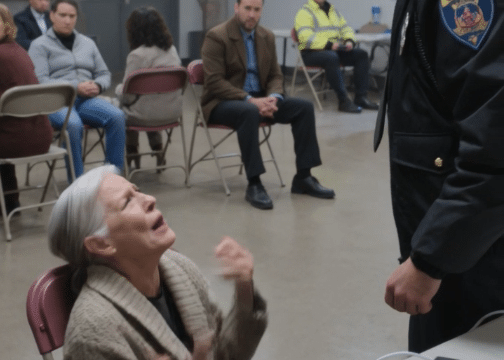
Act I
The therapy room fell silent the moment twelve-year-old Lily lost her balance.
Her crutches slipped against the rehabilitation floor, and she landed awkwardly on the padded mat between the parallel bars. She immediately reached for one of the crutches, determined to get back up before anyone could help.
Instead of encouragement, the trainer let out an impatient sigh loud enough for every therapist and patient nearby to hear.
“You’re wasting my session,” he snapped.
The words echoed through the room.
Lily lowered her eyes, embarrassed more than hurt. She had spent months fighting to regain strength in her injured leg, celebrating every painful step that most people would never notice.
The trainer only saw someone moving too slowly.
What he didn’t know was that someone else was already on the way to the center.
And his arrival would change everything.
Act II
The rehabilitation center proudly advertised compassion, patience, and hope.
Lily believed every word when she first walked through its doors.
She had always loved sports. Her dream was to run again after a serious injury left one leg significantly weaker than the other. Every session demanded determination most adults could never imagine.
But her assigned trainer measured success only by speed.
Every hesitation became criticism.
Every stumble became another excuse to question whether she belonged in the program.
The other therapists exchanged uneasy glances whenever he raised his voice, yet no one challenged him directly.
Lily never complained.
She simply picked up her crutch again.
That quiet resilience impressed everyone except the man responsible for helping her recover.
Outside, however, a black SUV rolled into the parking lot.
Inside sat someone whose connection to the center ran far deeper than anyone realized.
Act III
The main entrance opened, and conversations throughout the rehabilitation center came to an immediate stop.
Walking inside was former professional athlete Marcus Bennett.
Beside him were the center’s executive director, several board members, and a small media team invited to cover the unveiling of a new rehabilitation initiative funded by his charitable foundation.
Marcus smiled as he entered—until he saw Lily struggling to stand while the trainer continued criticizing her.
His expression changed instantly.
Without acknowledging anyone else, he crossed the room and knelt beside her.
“You okay, sweetheart?”
Lily nodded.
He gently helped her back onto her feet before turning toward the stunned trainer.
The room became completely silent.
Then Marcus asked one question.
“Who thought humiliating my daughter would help her heal?”
No one spoke.
The trainer’s face drained of color.
He had spent months boasting about the generosity of the center’s biggest sponsor.
He had never imagined that the quiet girl in therapy was that sponsor’s daughter.
Act IV
The executive director stepped forward holding a folder.
“Lily has been attending anonymously at her family’s request,” she explained.
“Her father wanted her treated exactly like every other child.”
Several therapists looked down in embarrassment.
Marcus nodded.
“We never wanted special treatment.”
His voice remained calm.
“We wanted professional treatment.”
He gestured toward the parallel bars.
“Children come here because they’re already fighting battles most adults never experience.”
“They should leave with confidence—not shame.”
The trainer searched for an explanation, but every witness had already seen what happened.
There were no excuses.
Only uncomfortable silence.
The board members quietly informed him that an immediate investigation would begin into his conduct and previous complaints from patients.
For the first time, he realized everyone else in the room had stopped looking to him for authority.
Act V
Marcus stayed beside Lily until she was ready to try again.
She adjusted her crutches, took a deep breath, and stepped forward.
One careful step.
Then another.
The therapists nearby began applauding—not because she was the sponsor’s daughter, but because they finally understood how much courage every step required.
Weeks later, the rehabilitation center introduced new patient-care standards emphasizing empathy, encouragement, and accountability.
Staff members received additional training focused on respectful treatment, especially for children recovering from serious injuries.
Lily continued therapy.
She became stronger every month.
Long after the headlines faded, people at the center remembered the lesson from that day.
The strongest people in a rehabilitation room are rarely the ones giving instructions.
They’re the ones who keep standing back up, no matter how many times life has knocked them down.