Act I
The tray slipped from her hands.
Soup splashed across the serving table, bread scattered onto the floor, and the entire lunch line froze.
Emily Harper didn’t even have time to apologize.
She had been trying to help an elderly veteran who looked too frail to stand through another hour without food. Seeing how hungry he was, she quietly handed him one extra meal tray.
It wasn’t greed.
It wasn’t theft.
It was compassion.
Unfortunately, compassion was something her supervisor had long forgotten.
Before anyone could react, Richard Cole stormed across the charity kitchen, his face twisted with rage.
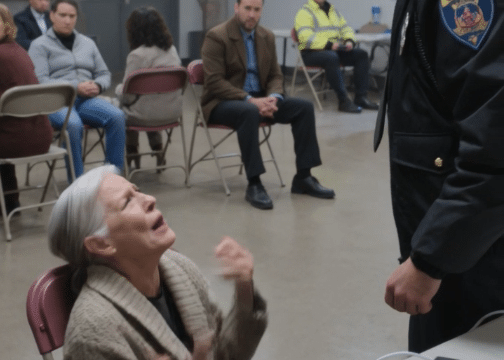
Without a word, he drove a brutal kick into Emily’s stomach.
The force hurled her backward into the edge of the serving table.
Metal trays crashed to the floor.
Hot soup splattered across the tiles.
Emily landed hard on the concrete, scraping her elbow as she instinctively curled inward, trying to catch the breath that had been ripped from her lungs.
A horrified gasp swept through the volunteers.
No one moved.
Richard stood over her as though humiliating someone in public were just another management lesson.
His eyes held no sympathy.
Only contempt.
Then, loud enough for everyone waiting in line to hear, he sneered,
“Trash. You just wasted donor money.”
The words cut deeper than the fall itself.
Emily lowered her eyes, fighting back tears.
She had volunteered at this soup kitchen every weekend for nearly three years.
She had never asked for recognition.
Never wanted attention.
She simply believed no one should go hungry.
Yet in one horrifying moment, she had become the target of public humiliation in the very place built on kindness.
She thought the worst was over.
She couldn’t have been more wrong.
Act II
Richard had always enjoyed reminding people who was in charge.
The soup kitchen depended on volunteers.
Most were students, retirees, or ordinary people donating their weekends.
Richard viewed them as disposable.
Especially the quiet ones.
Emily rarely argued.
She worked longer than anyone else, arrived before sunrise, stayed after closing, and often paid for extra groceries out of her own pocket whenever supplies ran low.
Almost nobody knew.
She preferred it that way.
Her father had taught her that charity only mattered when no one was watching.
Ironically, those words had brought her here.
Richard, however, believed generosity had limits.
Every slice of bread, every bowl of soup, every donated dollar became another excuse for control.
As Emily struggled to push herself up, Richard leaned closer.
“Serve from the floor.”
Then he kicked her again.
Once across her back.
A second time against her ribs.
Emily instinctively covered her head with both arms, refusing to cry out despite the pain.
Several volunteers looked away.
Others clenched their fists.
One elderly woman whispered through tears, “Please… stop.”
Richard ignored her completely.
Power had become an addiction.
And he believed no one in that room could take it away.
Then the front entrance opened.
Everything changed.
Act III
The heavy kitchen doors swung wide.
Conversations stopped instantly.
Three sharply dressed assistants entered first, followed by a photographer documenting the charity’s annual outreach program.
Walking behind them was a distinguished man in a tailored brown suit.
Daniel Harper.
To the volunteers, he was more than a wealthy philanthropist.
His foundation had rescued the soup kitchen years earlier when it stood on the brink of closing.
Without his donations, the building, the food program, and thousands of meals would never have existed.
Richard immediately forced a smile.
He straightened his shirt.
He opened his mouth to welcome the donor.
But Daniel wasn’t looking at him.
His eyes had locked onto the young woman lying on the floor.
The smile disappeared.
His face turned pale.
“Emily!”
He crossed the room almost at a run.
Ignoring every employee, every assistant, and every camera pointed toward him, he knelt beside the injured volunteer.
His hands trembled as he gently lifted her into his arms.
Emily tried to reassure him.
“I’m okay…”
But her scraped elbow, shaking hands, and labored breathing told a different story.
Daniel carefully brushed a strand of hair from her face.
Then he stood.
The warmth in his expression vanished.
When he looked at Richard, the room felt colder.
His voice was calm.
Too calm.
“Who kicked my daughter?”
Silence swallowed the kitchen.
The photographer slowly lowered his camera.
One assistant stared in disbelief.
Another quietly closed his notebook.
Richard blinked once.
Twice.
Surely he had misheard.
Emily…
The quiet volunteer…
Was his daughter?
The truth landed harder than any punch ever could.
But Daniel Harper hadn’t revealed everything yet.
Act IV
Most people assumed Emily volunteered because she wanted experience.
Others believed she needed community service hours.
Neither was true.
Years earlier, when Daniel Harper’s business empire began making headlines, Emily had asked her father for only one promise.
“Never tell anyone who I am.”
She wanted to understand charity from the ground up.
Not from boardrooms.
Not from fundraising galas.
Not from newspaper headlines.
She wanted to serve meals.
Wash dishes.
Listen to stories.
Carry heavy boxes.
Earn respect without borrowing her father’s name.
Daniel had agreed.
For three years, not even the soup kitchen director knew the truth.
Richard certainly didn’t.
He had mistaken humility for weakness.
Kindness for helplessness.
Silence for worthlessness.
Now every volunteer who had witnessed the assault began speaking.
One after another.
“He kicked her.”
“She only gave an extra meal to a veteran.”
“She never argued.”
“The cameras recorded everything.”
Each statement stripped away another layer of Richard’s authority.
The kitchen director arrived moments later, his face draining of color as he understood what had happened.
Daniel didn’t shout.
He didn’t threaten.
He simply looked around the room.
His eyes settled on the charity posters covering the walls.
Each one carried the same familiar logo.
The Harper Foundation.
The irony was almost unbearable.
The man who had screamed about “wasting donor money” had just assaulted the donor’s own daughter.
Justice had finally caught up.
And it had excellent timing.
Act V
Daniel helped Emily to her feet.
She winced slightly but refused to let the pain define the moment.
Her first concern wasn’t herself.
She glanced toward the elderly veteran still standing quietly with the extra meal tray in his hands.
Daniel noticed.
Without saying a word, he smiled softly.
“Make sure everyone gets seconds today.”
The volunteers stared.
Then, almost together, they returned to serving food.
This time with renewed purpose.
Because charity had never been about counting every bowl of soup.
It had always been about seeing the human being standing in front of you.
Investigators arrived before the afternoon ended.
Security footage was preserved.
Witness statements were collected.
Richard’s employment ended that very day, with additional inquiries launched into his conduct toward volunteers and guests.
The kitchen would continue.
But it would never again tolerate fear disguised as leadership.
Emily quietly picked up a fallen serving spoon from the floor.
Even after everything, she bent down to help clean the mess.
That simple gesture moved many of the volunteers to tears.
Her father watched with quiet pride.
Not because she was his daughter.
Because she had become the kind of person every charitable organization hoped to inspire.
Richard stood alone near the serving line.
Only minutes earlier he had believed a volunteer’s dignity was something he could take away with a single act of cruelty.
Now every eye in the room looked through him instead of at him.
His confidence dissolved.
His breathing became uneven.
His lips trembled uncontrollably.
He stared at Daniel holding Emily protectively by his side.
The realization finally crushed what remained of his arrogance.
His voice barely escaped as a broken whisper.
“Your daughter…?”
No one answered.
The silence was enough.
Because the man who had mocked compassion in the name of donor money had just discovered the cruelest irony of all.
The woman he called “trash” had been serving beside him all those years, not because she needed the charity—
but because she believed everyone else did.