Act I
The line of families waiting for emergency supplies stretched across the relief hall.
Everyone looked exhausted.
Parents clutched children wrapped in donated blankets. Volunteers carried crates of bottled water from one table to another. Boxes of infant formula and milk sat neatly stacked behind the distribution counter.
A young mother stepped forward with a baby sleeping against her shoulder.
Her coat was faded.
Her shoes were worn.
She looked as though life had tested every ounce of strength she possessed.
Quietly, almost apologetically, she asked,
“Please… just one more milk for my baby.”
The coordinator behind the table didn’t hesitate.
His face hardened with contempt.
“Rules are rules.”
The woman tried again.
“My baby hasn’t eaten since yesterday.”
Instead of compassion, she was met with cruelty.
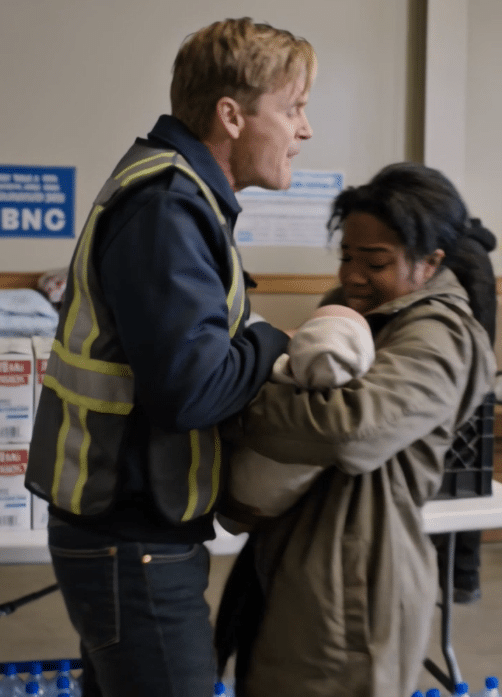
He lashed out, knocking her backward in front of everyone. She hit the floor while instinctively twisting her body to shield her baby, absorbing the impact herself. The infant burst into frightened tears as the hall fell silent.
The mother never loosened her grip.
Even through pain, her only concern was protecting her child.
The coordinator pointed toward the remaining milk boxes with open disgust.
“Trash.”
“One box is all you get.”
Not a single person in line expected the humiliation to continue.
But it did.
Act II
The woman slowly tried to sit up, rocking her crying baby gently despite the scrape on her elbow.
Her eyes weren’t angry.
They were tired.
The kind of exhaustion that comes from choosing every day between paying rent, buying medicine, or feeding your child.
Several volunteers exchanged uneasy glances.
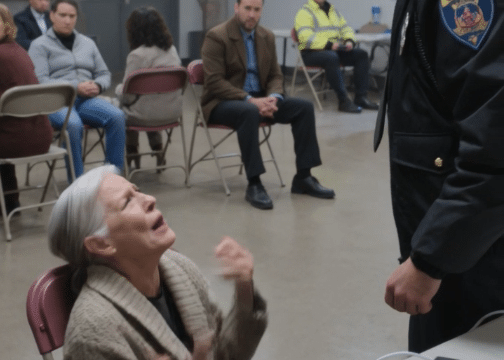
One elderly man quietly offered to give her his own ration.
The coordinator stopped him immediately.
He believed mercy encouraged dependency.
Generosity, in his mind, was weakness.
He leaned over the young mother and pointed toward the exit.
“Beg somewhere else.”
The words echoed through the relief center.
Some parents lowered their heads.
Others held their children a little closer.
The woman whispered soft reassurances to her baby, refusing to let fear become the child’s earliest memory.
For one heartbreaking moment, it seemed no one would stand up for her.
Then the impossible happened.
A deafening crash shattered the hall.
Every face turned toward the entrance.
Act III
The massive glass doors exploded inward.
A black donor vehicle rolled into the relief hall before coming to a controlled stop in the center of the lobby.
The room froze.
Relief workers stepped back.
Media cameras immediately swung toward the unexpected arrival.
A distinguished man in a black coat stepped out first, followed by members of his foundation, a media crew, and the relief director.
Everyone recognized him.
Nathan Caldwell.
The philanthropist whose foundation had financed emergency food programs across the state after a series of devastating natural disasters.
His donations had kept this relief center open.
But Nathan ignored the cameras.
He ignored the startled employees.
His attention locked onto one figure lying on the floor.
The young mother.
Without hesitation, he hurried across the hall and knelt beside her.
Only then did he notice the old silver bracelet around her wrist.
His expression changed instantly.
He reached toward it with trembling fingers.
Years ago, he had given that bracelet to someone he thought he would never see again—his younger sister, before family circumstances had torn them apart.
For a moment, the noise around them disappeared.
He looked into her eyes.
Recognition struck them both.
Nathan slowly rose.
His voice carried across the silent hall.
“Who hurt that woman?”
The coordinator suddenly felt the room shift beneath him.
And the worst was still to come.
Act IV
The relief director hurried forward, unable to hide his shock.
Nathan’s foundation had strict standards.
Every recipient was to be treated with dignity.
No exceptions.
Witnesses began speaking almost immediately.
A volunteer admitted the coordinator had publicly humiliated the mother.
An elderly recipient described how she had asked only for milk for her child.
Another quietly pointed toward the security cameras mounted above the distribution tables.
Everything had been recorded.
Nathan helped his sister to her feet while another volunteer gently comforted the baby.
She apologized through tears for asking for more.
Nathan shook his head.
“You never needed to apologize for feeding your child.”
Only then did he turn toward the coordinator.
His voice remained calm.
“People don’t come here because they want charity.”
“They come because life has given them no other choice.”
The media cameras captured every second.
The coordinator finally noticed the relief center’s banners lining the walls.
Each one displayed the same foundation logo.
The organization he claimed to protect had just witnessed him betray every value it stood for.
His confidence disappeared.
His authority vanished with it.
Act V
Nathan wrapped a blanket around his sister’s shoulders before gently taking his niece into his arms for just a moment, giving the exhausted mother a chance to catch her breath.
The baby slowly stopped crying.
Volunteers quietly gathered extra supplies.
Not because they had been ordered to.
Because compassion had finally overcome fear.
Nathan announced that every family still waiting in line would receive additional infant supplies before the center closed that evening.
No child would leave hungry.
The relief director immediately suspended the coordinator pending a full investigation, preserving witness statements and security footage.
Policies would be reviewed.
Training would be strengthened.
The center would continue its mission—but with renewed accountability.
As the hall slowly returned to order, the young mother thanked the volunteers who had shown kindness, even when they had been afraid to speak.
Nathan smiled softly at his sister.
Years had separated them.
Hardship had changed their lives.
But neither wealth nor poverty had erased the bond they once shared.
Across the room, the coordinator stood alone.
Only minutes earlier, he had believed he held absolute authority over desperate families.
Now every camera in the building pointed toward him instead.
His breathing became uneven.
His lips trembled.
He stared at Nathan standing protectively beside the woman he had humiliated.
The realization finally settled over him.
His voice emerged as nothing more than a broken whisper.
“You know her…?”
No one answered.
They didn’t have to.
Because in that moment, everyone understood the lesson he had failed to learn:
The true measure of a relief center is never how much aid it distributes—
but how much humanity it preserves when the most vulnerable ask for help.