Act I
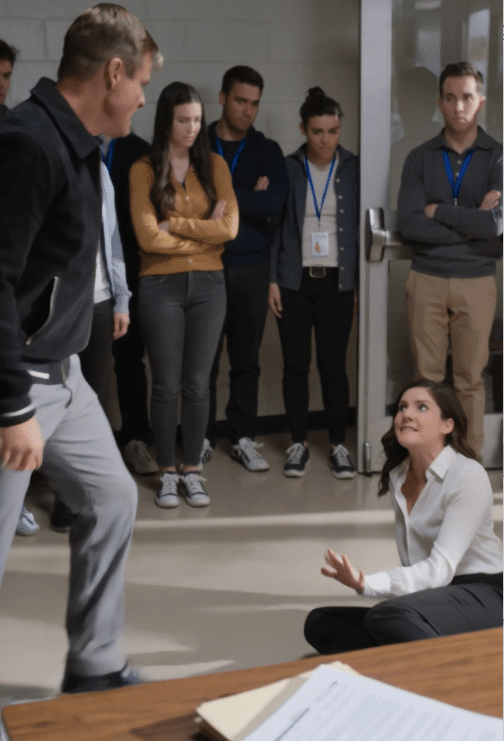
The faculty room erupted into chaos before anyone could understand what was happening.
Test papers scattered across the floor as a furious parent burst through the door, accusing a young teacher of deliberately failing their child. The grading laptop shook on the edge of the desk, and every conversation in the room came to an abrupt stop.
“The grade history is saved…” the teacher managed to say, gripping a stack of papers she had been reviewing only moments earlier.
The parent refused to listen.
“Trash. You ruined my child.”
Teachers gathered near the glass hallway door exchanged anxious glances but hesitated to step forward. Everyone knew emotions ran high when grades were involved, yet no one expected the confrontation to escalate so quickly.
The parent leaned toward the teacher, voice echoing through the room.
“Fix the grade now.”
The demand wasn’t a request.
It was an order delivered with the confidence of someone convinced that money and influence could rewrite reality.
But hidden inside the school’s academic system was something influence could never erase.
A complete digital history.
And someone else already knew it existed.
Act II
Emily Carter had taught history for eleven years.
Students described her as demanding but fair. She insisted that deadlines mattered, feedback mattered, and effort mattered even more.
She spent evenings grading essays long after most classrooms had gone dark.
She answered emails from struggling students.
She offered extra tutoring before exams.
Most parents appreciated her honesty.
A few did not.
The student at the center of the dispute had performed well on tests but repeatedly failed to submit several major assignments that counted heavily toward the final grade.
Emily had documented every reminder.
Every extension.
Every missing submission.
The school’s learning platform automatically recorded each upload, every deadline, and every grade adjustment.
Nothing could simply disappear.
Nothing could quietly be changed.
Emily knew that.
Unfortunately, the angry parent did not.
Convinced that a lower grade had to be the result of bias or misconduct, the parent marched into the faculty room expecting intimidation to accomplish what evidence never could.
What they didn’t realize was that schools keep more than report cards.
They keep history.
Act III
The faculty room door swung open once more.
The principal entered first.
Beside him walked the academic records director carrying a school-issued laptop with its screen carefully angled away from everyone nearby.
The room became silent.
The principal looked directly at the parent.
“Open the submission history.”
Only four words.
Yet they changed everything.
The academic director calmly set the laptop on the nearest desk without revealing a single detail on the display.
No one could see the records.
No assignments were shown.
No grades appeared.
But the parent’s confidence immediately began to crack.
The principal folded his arms.
“Our academic system records every submission automatically.”
The parent stared at the hidden screen.
For the first time, certainty gave way to uncertainty.
Because if the records truly existed…
Then the truth no longer depended on accusations.
Act IV
The academic director quietly reviewed the digital log while the principal addressed everyone in the room.
“Our grading system creates a permanent timeline.”
He paused.
“It records when assignments are submitted, when grades are entered, and when any changes are made.”
Emily lowered her eyes, saying nothing.
She didn’t need to defend herself.
The system already had.
Without revealing the confidential student record publicly, the principal confirmed that there was no evidence of unauthorized grade changes.
Instead, the timeline showed a consistent record that matched school policy from beginning to end.
The issue wasn’t altered grades.
It was incomplete coursework.
The parent slowly replayed the past several months in their mind.
Late-night reminders from teachers.
Emails requesting missing assignments.
Conversations their child had brushed aside.
Small warning signs that had been ignored until there was no one left to blame except the person who had recorded the results honestly.
The room remained still.
No one celebrated.
There was nothing satisfying about watching assumptions fall apart.
Only relief that the facts had been preserved.
Act V
After the meeting ended, the principal privately apologized to Emily for the ordeal she had endured and assured her that the incident would be handled according to school policy.
He also reminded the staff that no educator should ever face intimidation for doing their job with integrity.
The parent later met with school administrators again—this time not to demand a grade change, but to review the complete academic record and discuss how their child could recover academically in the future.
Emily returned to her classroom the next morning exactly as she always had.
She greeted students with a smile.
Collected homework.
Answered questions.
And continued believing that fairness sometimes requires the courage to stand firm even when no one is standing beside you.
Weeks later, the principal addressed the faculty during a staff meeting.
“The most important record we keep,” he said, “isn’t just grades.”
“It’s trust.”
Because grades can improve.
Assignments can be made up.
But once people abandon facts in favor of assumptions, everyone loses.
The digital records remained confidential, exactly as school policy required.
The public never saw the submission timeline.
They didn’t need to.
The truth had already spoken.
And it all began with four calm words that stopped an entire room from confusing anger with evidence.
“Open the submission history.”