Act I
The quiet suburban street erupted without warning.
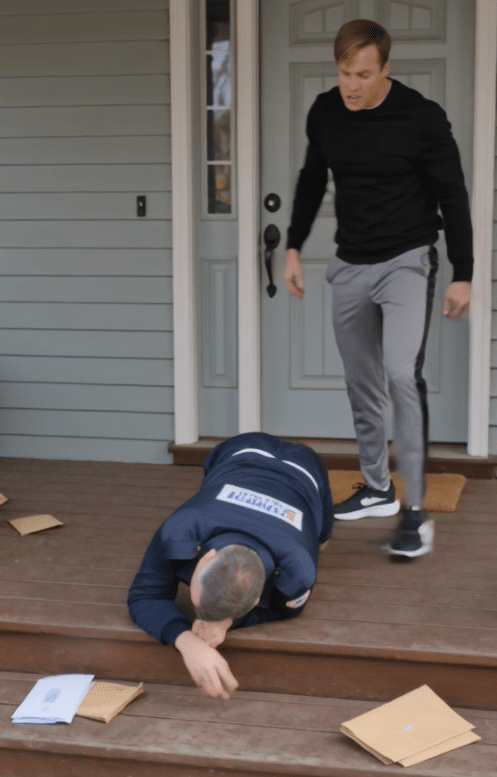
A front door flew open as a furious homeowner stormed onto the wooden porch, confronting the older mail carrier who had just finished his route. Letters slipped from the edge of a heavy mail bag, scattering across the porch as nearby neighbors turned toward the commotion.
“I delivered it to this porch…” the mail carrier said, struggling to keep his voice steady.
The homeowner wasn’t interested in explanations.
“Trash. Where is my package?”
The accusation echoed across the neighborhood.
Only minutes earlier, the delivery had been routine. Now every curious face seemed to focus on the sixty-four-year-old postal worker whose decades of service suddenly meant nothing in the face of one missing package.
The homeowner pointed toward the empty porch.
“You stole from my house.”
No one asked whether the package had actually disappeared after delivery.
No one mentioned the small camera mounted beside the front door.
But that camera had quietly witnessed everything.
And someone else already knew it.
Act II
Thomas Reynolds had spent thirty-eight years delivering mail.
Rain, snow, summer heat—it never mattered.
He knew every family on the route, remembered birthdays, looked out for elderly residents, and often stayed a few extra minutes to make sure oversized deliveries were safely placed where they belonged.
His record was spotless.
Not a single disciplinary complaint.
Not one confirmed missing package.
For Thomas, every parcel represented someone’s medication, birthday gift, paycheck, or long-awaited order.
He treated each one with care.
The homeowner, however, saw only frustration.
A valuable package had vanished.
Instead of checking delivery notifications or reviewing the doorbell camera, he chose the quickest explanation.
The delivery worker must have taken it.
Several neighbors exchanged uneasy glances.
They had seen Thomas walking the same streets for years.
None of them believed he would steal.
Yet uncertainty spread quickly when accusations were spoken loudly enough.
Then footsteps approached from the sidewalk.
Everything changed.
Act III
A postal inspector walked briskly toward the house, accompanied by a technician carrying a tablet.
The screen remained turned away from the crowd.
No footage could be seen.
The inspector glanced once at the doorbell camera above the entrance before calmly facing the homeowner.
“Replay the porch camera.”
Only four words.
The neighborhood became silent.
The technician stopped beside the porch, holding the tablet at an angle that revealed nothing.
The inspector moved directly beside Thomas, making it clear that the postal employee would not face the accusation alone.
The homeowner’s confidence faltered.
His eyes shifted from the inspector…
…to the camera…
…and back again.
For the first time, he remembered something he had ignored.
The doorbell camera recorded continuously.
Every delivery.
Every visitor.
Every departure.
If the recording existed, the truth no longer belonged to opinions.
It belonged to evidence.
Act IV
The inspector spoke with calm authority.
“Every reported delivery issue begins with the timeline.”
He explained that delivery scans, route records, and residential camera footage often worked together to establish exactly what happened after a package reached its destination.
No one viewed the recording publicly.
The technician kept the screen hidden.
Privacy mattered.
Procedure mattered.
Facts mattered.
The inspector simply confirmed that the camera footage had been preserved and would be reviewed according to postal protocol.
The homeowner’s expression changed.
He replayed the afternoon in his mind.
A meeting had delayed him.
The package notification had arrived earlier than expected.
The front porch had been unattended for quite some time.
He suddenly realized there was another possibility he had never considered.
The package may have been delivered exactly as reported.
His accusation had been built on assumption—not evidence.
Act V
Later that day, the official review confirmed the delivery had been completed correctly.
The package had been placed securely on the porch exactly as the delivery record indicated.
It disappeared only afterward.
Thomas had done his job exactly as required.
The inspector informed the homeowner that the matter would continue as a theft investigation rather than a delivery dispute.
The focus shifted away from the mail carrier and toward what happened after the successful delivery.
The homeowner privately apologized.
Thomas accepted with quiet dignity.
Years of delivering mail had taught him that trust, once questioned, is never restored by anger.
Only by truth.
Before leaving, the inspector addressed the small group of neighbors who had witnessed the confrontation.
“A delivery record tells us where a package was placed,” he said.
“A camera timeline tells us what happened next.”
Those words stayed with everyone long after the postal truck pulled away.
Because they realized how quickly frustration can become accusation when people forget to check the facts first.
The porch camera footage was never shown publicly.
It didn’t need to be.
The evidence had already done its job.
And in the end, one calm instruction proved stronger than every accusation shouted across that quiet suburban street.
“Replay the porch camera.”