Act I
The bag of pet food slipped only an inch.
A small cloud of dust drifted through the aisle, settling lightly on the cuff of an expensive pair of white pants.
That was all it took.
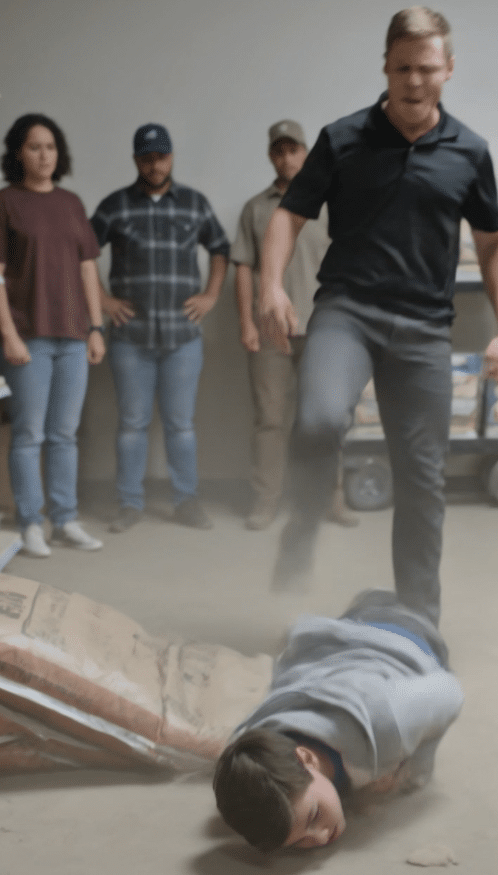
The wealthy customer spun around, glaring at the thirteen-year-old boy who had been struggling to steady the heavy stack.
The boy’s hands were still wrapped around the bag.
“It slipped. I didn’t mean it…”
His words barely escaped before the man drowned them out.
“Trash. You ruined my pants.”
The bustling pet supply store suddenly fell silent.
Customers stopped pushing their carts.
A cashier froze behind the checkout counter.
The boy stood motionless, too frightened to understand how a simple accident had turned into a public accusation.
The customer insisted the boy had done it deliberately.
No one noticed the small camera mounted above the aisle.
It had quietly recorded everything.
And before long, it would become the only voice that mattered.
Act II
Noah wasn’t even a full-time employee.
Every weekend after school, he helped the store owner stack heavy bags of dog food and cat litter to earn money for school supplies.
His blue store shirt was slightly too large.
His sneakers had seen better days.
Yet every customer who knew him described the same qualities.
Respectful.
Reliable.
Hardworking.
He never complained about lifting bags that weighed almost as much as he did.
He simply smiled and kept working.
The wealthy customer saw something entirely different.
He saw an easy target.
Someone too young and too poor to defend himself.
“You did that on purpose.”
The accusation echoed through the aisle.
Several shoppers exchanged uneasy glances.
Some wanted to speak.
None did.
Meanwhile, the truth remained fixed above their heads, patiently waiting for someone willing to look.
Act III
Inside the store office, the owner heard raised voices through the open doorway.
The shift lead hurried in moments later.
“You need to see this.”
Together they walked quickly toward the aisle.
Before saying a single word, the owner took in the scene.
The frightened teenager.
The scattered feed bags.
The angry customer.
The silent crowd.
Then he looked upward.
The overhead aisle camera overlooked the entire section.
He calmly pointed toward it.
“Check the aisle camera.”
The customer instinctively followed the direction of his finger.
His confidence faltered.
For the first time since shouting began, uncertainty appeared on his face.
The aisle grew so quiet that the gentle hum of the store lights seemed unusually loud.
Everyone understood what the owner’s words implied.
The camera had already seen what really happened.
Act IV
The owner stepped beside Noah, making it unmistakably clear that the frightened teenager would not face further intimidation.
He never displayed the footage to the crowd.
There was no need.
The recording would be reviewed through the proper process.
He explained that the camera covered the entire aisle and would show whether the feed bag slipped accidentally or had been handled intentionally.
The customer stared upward again.
Then he looked back at the boy.
His anger slowly gave way to doubt.
A nearby employee quietly examined the stack of feed bags.
One of the lower bags had shifted because a damaged pallet beneath it had tilted slightly.
It was a maintenance issue—not something Noah had caused.
The owner’s expression hardened.
“This young man tried to stop the bags from falling.”
Several customers nodded.
They had seen Noah reaching to stabilize the stack before the dust drifted into the aisle.
The story the customer had invented was beginning to collapse under the weight of simple facts.
Act V
The apology came quietly.
Far quieter than the accusation had.
The wealthy customer admitted he had jumped to conclusions after letting frustration and pride control his judgment.
Noah accepted the apology with surprising grace.
He wasn’t interested in humiliating anyone.
He simply wanted to finish his work.
The store owner later thanked him for staying calm under pressure and reminded everyone gathered near the checkout that respect should never depend on age, appearance, or income.
Word spread through the neighborhood over the following weeks.
Customers returned not because of the confrontation, but because they admired the young employee who remained honest even when someone tried to make him the villain.
Many regulars began greeting Noah by name.
Some even brought encouragement, telling him to keep working hard because integrity was something money could never buy.
Years later, people no longer remembered a dusty pant cuff.
They remembered the teenager who refused to answer anger with anger.
And they remembered one quiet camera that proved a simple truth:
The loudest accusation may capture a crowd’s attention, but evidence—and character—always have the final word.