Act I
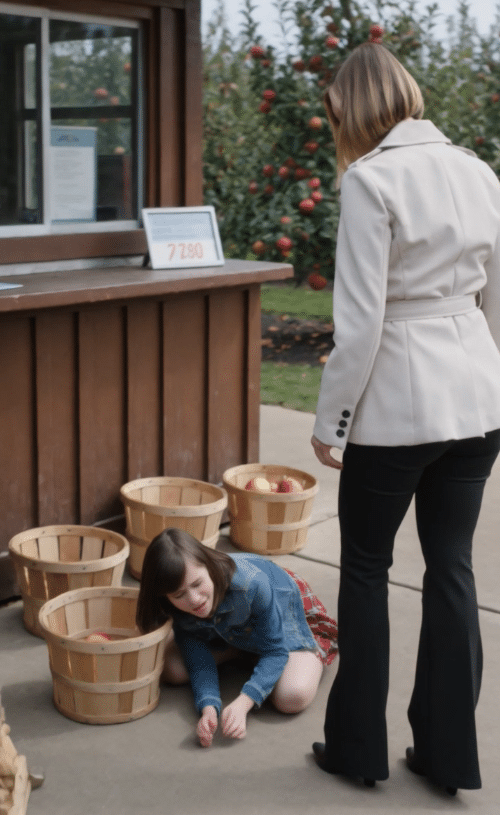
The peaceful orchard entrance erupted into chaos.
A silver bracelet had gone missing.
Before anyone could ask a single question, a sharply dressed businesswoman pointed directly at the fourteen-year-old girl handing out apple baskets to arriving guests.
“I know you took it.”
The teenager froze, still holding a wooden basket she had been about to pass to the next family in line.
“I never touched your bracelet…”
Her voice shook.
She had spent the entire morning greeting visitors with a smile, explaining the orchard rules, and wishing children luck as they raced toward the apple trees.
Now dozens of strangers stared at her as though she had become a criminal in a matter of seconds.
The wealthy visitor folded her arms with absolute confidence.
“Trash. Give it back.”
Nobody knew what to believe.
The guests exchanged uneasy glances, while the entrance booth, moments earlier filled with laughter, fell into an uncomfortable silence.
Above the counter, unnoticed by almost everyone, a small entrance camera quietly watched the entire scene.
It had already captured the truth.
The only question was who would discover it first.
Act II
Emma had worked weekends at the orchard since the previous autumn.
She wasn’t there because she had to.
She was there because every extra dollar helped her mother pay household bills after her father’s unexpected illness forced him to stop working.
She loved the orchard.
The crisp morning air.
The smell of fresh apples.
The excited children running between the rows of trees with oversized baskets.
Every visitor mattered to her.
So did every rule.
She knew never to touch a guest’s belongings.
She knew every reservation, every ticket, and every basket count by heart.
Yet none of those years of honesty mattered to the woman making the accusation.
To her, one simple fact seemed enough.
“You were standing right there.”
Proximity became guilt.
Appearance became evidence.
And confidence became louder than reason.
The crowd watched without knowing that the entire misunderstanding had begun only moments earlier—and for a far simpler reason than anyone imagined.
Act III
The orchard manager had been inspecting another section of the property when the entrance clerk hurried toward him.
“There’s a problem at the front gate.”
The clerk also carried the portable device connected to the entrance camera system.
Together they walked quickly back toward the booth.
The manager took in the scene immediately.
A frightened teenager.
A furious customer.
A silent crowd.
Without raising his voice, he stepped beside Emma.
Then he looked directly at the businesswoman.
“You blamed the wrong girl.”
The words echoed through the entrance.
No footage was displayed.
The screen of the camera device remained turned away from the crowd.
Still, the confidence on the visitor’s face began to fade.
She instinctively looked around, trying to remember every movement she had made after arriving.
For the first time, certainty gave way to doubt.
Act IV
The manager calmly explained that the entrance camera covered the entire check-in area and that the recording would establish exactly what had happened.
No one needed speculation anymore.
Only patience.
As everyone waited, the entrance clerk glanced toward the woman’s apple basket.
Something metallic caught the sunlight beneath a folded orchard map.
The clerk carefully lifted the paper.
There, resting inside the basket, lay the missing silver bracelet.
The woman stared in disbelief.
She remembered removing it moments earlier while adjusting the handle of the basket before reaching for her phone.
She had forgotten it completely.
Emma had never gone near it.
The accusation collapsed as quickly as it had begun.
The guests who had remained silent moments before now looked at the teenager with sympathy rather than suspicion.
The orchard became quiet once again—but for a very different reason.
Act V
The businesswoman apologized, her voice far softer than it had been only minutes before.
She admitted that embarrassment had clouded her judgment and that she had mistaken proximity for proof.
Emma accepted the apology politely.
She wasn’t interested in revenge.
She simply wanted to continue welcoming families to the orchard she loved.
The manager later addressed the guests before reopening the entrance.
“A missing item should always lead to a careful search,” he said, “never to an immediate accusation.”
His words stayed with many of the visitors long after they entered the rows of apple trees.
Over the following weeks, several families returned to the orchard and made a point of greeting Emma by name.
They remembered her calmness under pressure.
They remembered her honesty.
Most of all, they remembered how quickly assumptions can damage an innocent person’s reputation.
Years later, people no longer talked about the missing bracelet.
They talked about the young girl who refused to let someone else’s prejudice define who she was.
Because the easiest person to blame is not always the guilty one—and the truth has a remarkable way of waiting patiently until someone is willing to look in the right place.