Act I
The charity thrift store fell silent the instant the accusation rang out.
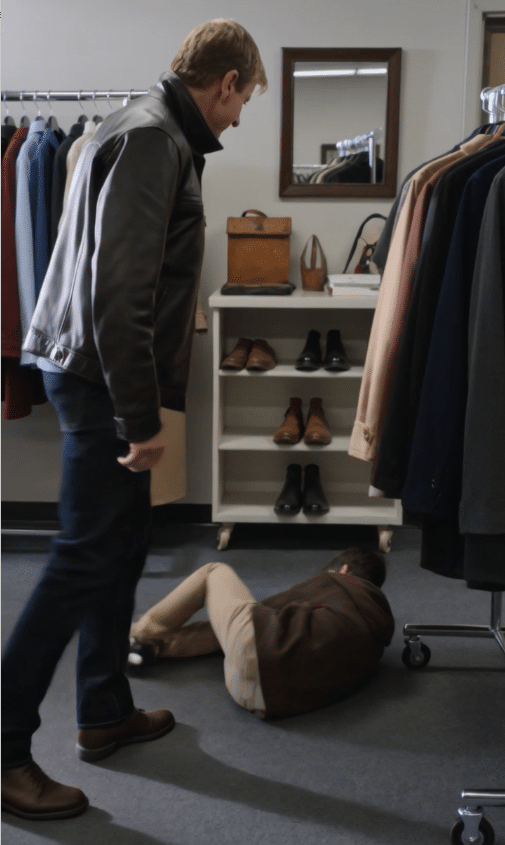
A wealthy customer had just stepped out of the fitting room, patting every pocket of his expensive leather jacket before his expression hardened.
“My wallet is gone.”
His eyes landed on the fifteen-year-old volunteer organizing donated coats only a few feet away.
The teenager froze.
He still wore the small volunteer name tag he proudly pinned to his old brown hoodie every Saturday morning.
“I didn’t take your wallet…”
His voice trembled, but no one seemed interested in hearing it.
The customer sneered.
“Trash. Volunteers steal too.”
The line of shoppers became uncomfortably quiet.
Some looked at the frightened boy.
Others looked away.
No one noticed that the fitting room curtain behind the customer still swayed gently, as though it had been left in a hurry.
The truth had never left that room.
It was simply waiting for someone willing to look.
Act II
Evan wasn’t paid for his work.
Every weekend he volunteered after finishing homework, helping sort donations, carrying heavy boxes, and greeting customers with the same polite smile.
His family struggled to make ends meet after his mother’s illness forced her to leave her job.
The thrift store had become more than a place to volunteer.
It had become a second home.
The manager often said Evan treated donated belongings with more care than many people treated expensive new ones.
But appearances can become dangerous when combined with assumptions.
The wealthy customer saw worn sneakers.
A faded hoodie.
A teenager from a poor family.
In his mind, those details became evidence before a single fact had been checked.
“Empty your pockets.”
The words echoed across the store.
Customers exchanged uneasy glances.
The boy’s face turned pale.
He had nothing to hide.
Yet he suddenly felt as though he had already been judged.
And the real answer remained only a few steps behind the man making the accusation.
Act III
The front door opened.
The store manager entered alongside Mr. Reynolds, one of the community’s most respected donors and a longtime supporter of the charity.
Both immediately sensed something was wrong.
The scattered coats.
The frightened volunteer.
The tense silence filling the shop.
Mr. Reynolds didn’t rush to conclusions.
Instead, he carefully observed the room.
Then his eyes settled on the fitting room behind the angry customer.
He spoke calmly.
“You checked the wrong pockets.”
The customer frowned.
“Wrong pockets?”
For the first time, certainty disappeared from his face.
The manager quietly walked toward the fitting room while the rest of the store watched in complete silence.
No one spoke.
No one moved.
Everyone suddenly realized the answer might not be where they’d been looking.
Act IV
Inside the fitting room hung the coat the customer had tried on moments earlier.
The manager reached into one of its inside pockets.
A wallet slid into his hand.
Untouched.
Exactly where it had been forgotten.
The customer stared in disbelief.
He remembered comparing the fit of two different jackets, placing his wallet into the coat he was trying on, then changing back into his own jacket after answering a phone call.
He had walked away without checking.
The volunteer had never even entered the fitting room.
Mr. Reynolds turned to the crowd.
“A person’s circumstances are never proof of guilt.”
His words carried more weight than any raised voice.
The shoppers who had remained silent lowered their eyes.
They hadn’t accused Evan.
But they hadn’t defended him either.
Sometimes silence gives unfair accusations room to grow.
Act V
The apology came slowly.
It was genuine, but it arrived too late to erase the humiliation of being publicly labeled a thief.
Evan accepted it with quiet dignity.
He wasn’t interested in revenge.
He simply wanted to continue doing what he had come there to do—help people.
Before leaving, Mr. Reynolds spoke privately with the store manager.
A week later, the charity announced a new scholarship fund for young volunteers who demonstrated exceptional honesty and service.
Evan became its very first recipient.
News of the incident spread throughout the community.
People didn’t remember the expensive wallet.
They remembered the teenager who protected his dignity even when others questioned his character.
More volunteers joined the thrift store in the months that followed.
Donations increased.
Customers returned, inspired by the kindness and integrity they had witnessed after the misunderstanding was resolved.
Years later, visitors still heard the story of the forgotten wallet.
Not as a tale about money.
But as a reminder that prejudice often searches the wrong person before it ever searches for the truth.
Because the easiest accusation is rarely the correct one—and sometimes the answer is waiting quietly in the very place no one thought to check.