Act I
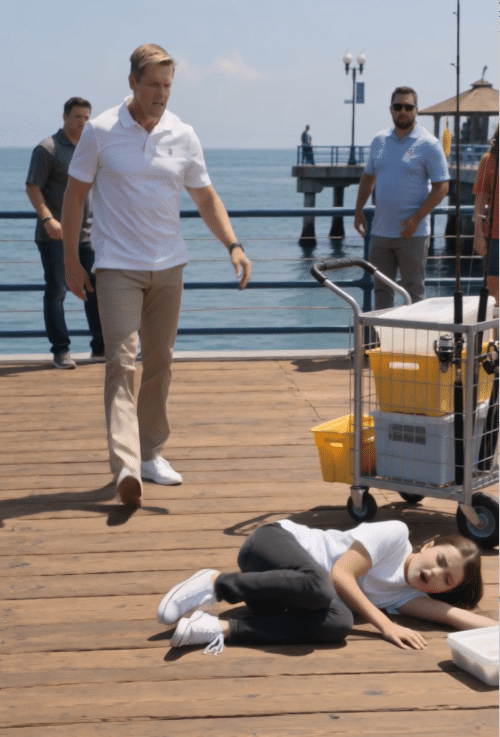
The bait box slipped from the rental cart in a split second.
A puff of sand and bait dust brushed the cuff of an expensive pair of shorts, and before anyone could react, the wealthy tourist exploded.
He pointed directly at the thirteen-year-old girl who had been cleaning rental fishing gear since sunrise.
“You did that on purpose.”
The tourists gathering near the wooden pier stopped talking.
The girl tightened her grip on the cart handle, her face turning pale.
“It slipped off the cart…”
Her explanation disappeared beneath the man’s louder voice.
“Trash. You ruined my clothes.”
People stared.
Some whispered.
Others simply watched, unwilling to challenge someone who looked powerful and wealthy.
The girl lowered her eyes.
She wasn’t embarrassed because of the accident.
She was embarrassed because a stranger had decided that someone dressed in a faded windbreaker couldn’t possibly be telling the truth.
What no one noticed was that two people were already walking quickly toward the commotion from the far end of the pier.
And they knew far more than anyone in the crowd.
Act II
Emily spent every weekend helping her grandfather maintain the rental fishing equipment.
She cleaned rods, organized tackle boxes, and wheeled heavy carts across the pier before the first tourists arrived.
The work wasn’t glamorous.
It helped keep her family business alive.
Regular visitors knew her as the cheerful girl who remembered returning customers by name and patiently helped children choose their first fishing rod.
The wealthy tourist knew none of that.
He saw worn shoes.
A teenager working on a dock.
An easy person to blame.
The dirt on his clothing became, in his mind, proof that someone had intentionally disrespected him.
But assumptions have a dangerous habit of replacing facts.
And facts were already on their way.
Act III
The owner of the fishing pier arrived with a distinguished businessman who had invested in preserving the historic waterfront.
Both immediately sensed the tension.
The silent crowd.
The frightened girl.
The angry customer.
The businessman studied the scene for only a moment before speaking.
“You will regret what you just did.”
The tourist frowned.
“Regret what?”
For the first time, confidence disappeared from his face.
The owner calmly examined the rental cart.
One of its locking wheels had failed to engage.
The slight slope of the pier, combined with a gust of sea wind, had allowed the cart to roll just enough for the bait box to slide off by itself.
Several nearby tourists quietly admitted they had seen the cart move before anyone touched it.
The accusation was already beginning to fall apart.
Act IV
The pier owner pointed out that the faulty wheel had already been scheduled for replacement.
Maintenance records confirmed the report had been filed the previous evening.
The businessman looked directly at the tourist.
“This young employee followed every safety procedure available to her.”
The crowd remained silent.
The tourist replayed the moment in his mind.
He realized he had never asked what happened.
He had never looked at the cart.
He had simply assumed.
The people around him were no longer watching the frightened girl.
They were watching him.
His expensive clothes no longer commanded respect.
His behavior defined him instead.
Act V
The apology came quietly.
Far more quietly than the accusation.
Emily accepted it with remarkable maturity.
She had learned that dignity doesn’t come from winning an argument.
It comes from refusing to let someone else’s prejudice define who you are.
The businessman later funded improvements for the pier, including new rental carts and better safety equipment, ensuring that accidents like this would be far less likely in the future.
Visitors continued arriving throughout the season.
Many remembered the incident.
Not because someone’s clothes had become dirty.
But because they had witnessed how quickly appearances can become unfair judgments.
Years later, locals still shared the story with new employees.
Not as a warning about equipment.
But as a reminder that respect should always come before assumptions—and that the strongest people are often those who stay calm while the truth catches up.