Act I
“It’s all I sleep in…”
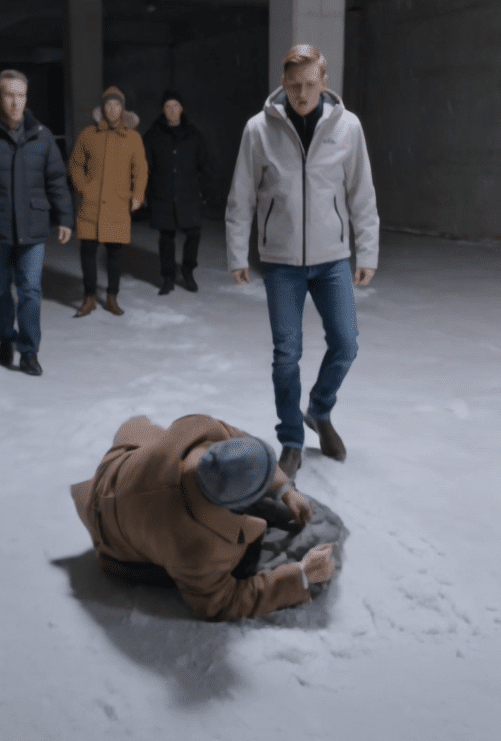
The old man’s voice trembled as he reached for the sleeping bag lying in the snow.
His gray knit hat was slipping over one ear, and his weathered hands struggled to grip the wet fabric. Beneath the concrete bridge, the wind howled through the columns, driving snow across the pavement and into the small patch of shelter where he had spent the night.
The young man in the expensive white jacket laughed.
He had dragged the sleeping bag out from the dry space beside the bridge column because it was ruining his shot. His phone was already recording, its lens pointed at the seventy-seven-year-old man as though the old man’s desperation were nothing more than entertainment.
“Come on,” the young man said, smirking at his screen. “Move your junk. You’re ruining my video.”
The old man bent lower, trying to pull the sleeping bag away from the freezing water. It was his only shelter, the one thing standing between his aging body and the brutal cold.
“Please,” he whispered. “I don’t have anywhere else.”
The young man rolled his eyes.
Then he kicked the old man hard in the back.
The elderly man stumbled forward and crashed face-down onto the frozen concrete beside the bridge column. His sleeping bag scraped through the snow, and his gray hat fell from his head. As he struck the base of the column with his elbow, a thin trace of blood appeared against his weathered skin.
For a moment, he couldn’t move.
Then he grimaced, curled in pain, and reached blindly for the sleeping bag.
The young man kept filming.
Nearby, several people sheltering beneath the bridge recoiled in horror. A woman covered her mouth. An older commuter took a step backward, his eyes fixed on the scene. Nobody moved toward the injured man.
The bully glanced at his phone, apparently disappointed that the scene hadn’t gone exactly as he wanted.
The old man managed to pull the sleeping bag closer.
“It’s all I sleep in,” he repeated, his voice breaking.
The young man looked down at him.
“Trash. You’re ruining my video.”
The words hurt almost as much as the kick.
The old man tried to push himself onto one elbow, but his body shook from the cold and the impact. His fingers tightened around the edge of the sleeping bag as though letting go would mean losing the last piece of safety he possessed.
The young man stepped around him and delivered two more forceful kicks into his back and side.
The old man cried out and curled around the fabric.
The witnesses gasped again.
“Cry for the camera,” the bully sneered.
He held his phone closer, searching for the perfect angle. In his mind, the humiliation was the point. He imagined strangers watching the clip, laughing at the helpless old man, and praising him for having the nerve to do what others supposedly wouldn’t.
He didn’t see a human being.
He saw a viral moment.
Then the sound of screeching tires cut through the wind.
An unmarked news vehicle braked hard beneath the bridge.
The driver’s door flew open, and a fifty-four-year-old man in a black coat stepped into the snow. A camera operator climbed out behind him, lifting a professional camera toward the scene.
The reporter saw the old man on the ground.
He saw the sleeping bag.
Then he saw the young man holding his phone.
Without hesitation, he crossed the pavement and positioned himself between the bully and the injured stranger. The camera operator moved beside him, keeping the lens trained on the young man’s face.
The reporter crouched near the old man, shielding him from the wind while signaling to his team to get medical assistance.
Only after the victim was protected did he look toward the camera operator.
“Keep recording.”
The words were quiet.
They didn’t need to be loud.
For the first time that night, the bully stopped smiling.
He stared at the reporter, then at the professional camera pointed directly at him.
“Recording what?” he demanded.
The reporter didn’t answer.
And that silence was far more frightening than any threat.
Because the young man had come beneath the bridge believing he could turn another person’s suffering into entertainment.
He had no idea that the man standing in front of him had spent twenty-five years exposing people who believed their money, influence, or popularity placed them beyond accountability.
And the worst part?
The reporter had not arrived by accident.
He had been looking for someone exactly like him.
Act II
The old man’s name was Walter Hayes.
He had once owned a modest house in a quiet Midwestern town, where the winters were harsh but the people still knocked on one another’s doors when snow covered the roads. For thirty-eight years, Walter had worked as a maintenance technician at a manufacturing plant, repairing machinery, changing worn belts, and keeping production running long after everyone else had gone home.
He was not a wealthy man.
But he had been proud of what he earned.
He paid his bills, kept his promises, and made sure his wife, Margaret, never went without the small comforts that made an ordinary life feel safe. Every Sunday, he bought her flowers from the grocery store. Every winter, he shoveled the sidewalk before the neighbors woke up.
When Margaret became ill, Walter spent his savings on her treatment.
He never complained.
When she died, he sold the house to cover the debts that remained. He moved into a small apartment, convinced that he could continue working and eventually rebuild his savings.
Then the factory closed.
The pension payments he had expected became entangled in a dispute involving the former employer’s financial collapse. His retirement income shrank, and the money he had saved disappeared into rent, utilities, and medical expenses.
At first, Walter managed.
He took small repair jobs and worked whenever someone needed a door fixed, a leaking pipe checked, or a broken appliance examined. But at seventy-six, his body could no longer endure the hours he once worked without thinking.
After missing several rent payments, he lost his apartment.
His daughter, Emily, had moved across the country years earlier. Their relationship had never been easy, and Walter refused to tell her how bad things had become. He remembered how frightened she had been when her mother died, and he couldn’t bear the thought of becoming another burden in her life.
He told her he was doing fine.
He told everyone he was doing fine.
Eventually, his phone stopped working because he could no longer afford the monthly bill. The messages became less frequent, then stopped altogether.
By the time the first serious snow arrived, Walter was sleeping beneath the bridge.
He chose the spot because one side was protected from the wind and the concrete overhead offered some shelter from the weather. He had learned to fold his sleeping bag tightly each morning and keep his few belongings close.
The bag had belonged to Margaret.
They had bought it years earlier for a camping trip they never took because she became too ill to travel. After her death, Walter kept it in a closet, unable to part with something they had chosen together.
When he lost his apartment, he took it with him.
It had become his bed, his blanket, and his last connection to the home he remembered.
He treated it carefully.
He shook out the snow, patched small tears with strips of fabric, and kept it folded whenever he wasn’t sleeping. On particularly cold nights, he tucked his hands beneath his coat and whispered Margaret’s name when the loneliness became too heavy.
He never imagined that someone would deliberately drag it into the snow for a joke.
The young man who had attacked him was named Blake Mercer.
At twenty-three, Blake had grown accustomed to a world in which attention was a form of currency. His parents had paid for his education, bought him his first car, and helped him move into an expensive apartment after graduation. When he struggled to hold a regular job, he began making prank videos online.
Some were harmless.
Others relied on humiliating strangers who couldn’t easily defend themselves.
Blake discovered that the more uncomfortable his targets looked, the more reactions his videos received. A startled shopkeeper, an irritated commuter, a confused elderly man—each became another opportunity to create a clip designed to provoke outrage or laughter.
He told himself it was entertainment.
He told anyone who criticized him that people were too sensitive.
But beneath the confident smile was a growing obsession with numbers. His audience had begun to shrink, and his recent videos had failed to generate the attention he wanted. He needed something more shocking, something that would make people stop scrolling.
That night, he had seen Walter sheltering beneath the bridge.
Blake decided the old man would make a perfect target.
He imagined filming himself ordering Walter to move, then capturing the confusion and embarrassment that followed. If the old man became angry, even better. If he begged, Blake believed the clip would be irresistible.
He had not planned to stop at words.
Once Walter tried to reclaim his sleeping bag, Blake became irritated that his target wasn’t following the script in his head.
So he escalated.
He kicked him, filmed him falling, and continued the humiliation while the witnesses stood frozen.
Blake believed he controlled the story because he controlled the phone.
He had never considered that someone else might be recording the truth from a different angle.
The reporter who had arrived beneath the bridge was Daniel Cross, an investigative journalist known for exposing fraudulent charities, corporate misconduct, and public figures who used their reputations to conceal wrongdoing.
Daniel had built his career on a simple principle: people often reveal the most about themselves when they believe nobody important is watching.
For several weeks, his team had been investigating a growing pattern of online prank videos in which vulnerable people were targeted for humiliation. The clips appeared spontaneous, but their timing and distribution raised questions about whether some creators were deliberately staging confrontations for engagement.
Daniel had been tracing the pattern through public posts, witness accounts, and interviews with people who recognized themselves or their neighbors in the videos.
He wasn’t looking for a confrontation that night.
He was following a lead about a creator who had repeatedly filmed people living outdoors in the same part of the city.
Then his team saw Blake dragging Walter’s sleeping bag into the snow.
They stopped.
The camera began recording.
And within seconds, Daniel understood that the scene was no longer merely suspicious.
A man was being assaulted in front of a camera.
Daniel’s team had captured it.
But the footage wasn’t the only thing he had come to collect.
His investigation had uncovered a connection between Blake’s online persona and a much larger operation—one involving sponsored content, manufactured outrage, and a network of accounts that rewarded increasingly cruel stunts.
Blake thought the camera was his shield.
Daniel knew it could become the evidence that brought everything into the open.
And as Walter shivered beneath the reporter’s coat, Daniel realized that the old man might be the person who finally made the entire story impossible to dismiss.
Act III
“Sir, can you hear me?”
Daniel knelt beside Walter while the camera operator continued filming from several feet away.
Walter nodded weakly.
“Can you move your arm?”
“It hurts,” Walter whispered.
“Don’t force it. Help is coming.”
Daniel signaled to his producer, who was already contacting emergency services. Another member of the team retrieved a thermal blanket from the vehicle.
Walter kept reaching toward the sleeping bag.
Daniel gently moved it closer without asking him to let go.
“I’ve got it,” he said. “Nobody is taking it from you.”
Walter looked at him with the wary expression of someone who had learned that help often came with conditions.
“Are you going to put me on the news?”
Daniel paused.
“Not without considering your safety and your privacy. Right now, we’re getting you warm and making sure you receive medical care.”
Walter studied his face.
Then, slowly, he stopped trying to pull himself across the pavement.
Behind them, Blake had begun to recover his confidence.
He pointed at Daniel.
“You can’t just film me without permission.”
Daniel looked up.
“You were filming an elderly man while attacking him.”
“I was making a video.”
“That’s not an answer.”
Blake glanced toward the camera operator, then at the growing number of witnesses. His face tightened.
“You don’t know what happened before you got here.”
“Then tell me,” Daniel said.
Blake hesitated.
He could have apologized.
He could have admitted that he had gone too far, stepped back, and allowed the authorities to handle the situation.
Instead, he lifted his chin.
“He was in my shot. I told him to move.”
Daniel held his gaze.
“And you decided to kick him?”
Blake’s jaw shifted.
“He wouldn’t listen.”
A woman standing near the bridge column let out a disbelieving breath.
The explanation was so casual, so utterly detached from the violence it described, that several witnesses began speaking at once. One man explained that Blake had dragged the sleeping bag away first. Another described the kick that sent Walter to the ground. A third confirmed that the young man had continued attacking him while filming.
Blake looked around sharply.
“You all just stood there!”
Nobody denied it.
The accusation struck a nerve because it contained a painful truth. They had been afraid, shocked, uncertain what to do. Some had feared that intervening would make them the next target.
But now they were speaking.
And their accounts matched what Daniel’s team had recorded.
When emergency responders arrived, they assessed Walter’s injuries and helped him onto a stretcher. He winced as they moved him, his hands still clutching the edge of the sleeping bag.
Daniel walked beside him.
“What’s your name?” he asked.
“Walter.”
“Walter Hayes?”
The old man looked startled.
“Yes.”
Daniel exchanged a glance with his producer.
The name had appeared in a document his team had reviewed earlier that week.
Not in a police report or a criminal file.
In a housing complaint.
Several months earlier, a local outreach organization had submitted concerns about elderly residents being displaced from temporary accommodation during a redevelopment project. Walter’s name appeared among a group of people who had lost access to a winter shelter after funding for its overnight program had been withdrawn.
Daniel had requested interviews with several former residents, but Walter had disappeared before the team could locate him.
Now the missing man was lying on a stretcher beneath the bridge.
“Walter,” Daniel said carefully, “have you been staying here long?”
“Long enough.”
“Did you have somewhere else to go before this?”
Walter looked away.
“I had an apartment. Before that, a house.”
“What happened?”
Walter hesitated, then answered with the weary honesty of someone who no longer had the energy to disguise his circumstances.
“My wife got sick. Then the factory closed. Everything just… went.”
Daniel listened without interrupting.
Walter didn’t describe himself as a victim. He spoke about bills, missed payments, and choices that had seemed manageable until they weren’t. He spoke about the shame of asking for help and the stubborn belief that he should be able to solve his own problems.
Then he said something that made Daniel look toward his producer.
“I tried the winter shelter. They told me they didn’t have a bed for me anymore.”
“Who told you that?”
Walter gave him the name of the organization.
Daniel recognized it immediately.
It was one of the organizations connected to the redevelopment project his team had been investigating.
The same project whose promotional materials promised to improve public spaces and expand support services for people in need.
The same project that had displaced vulnerable residents while officials publicly celebrated its success.
Daniel felt the pieces begin to connect.
Blake’s attack had not been planned by the organization. There was no reason to assume the two events were related, and Daniel had no intention of inventing a connection simply because the timing was striking.
But the assault had exposed something the redevelopment campaign’s glossy advertisements had carefully avoided showing.
The people supposedly being helped were still sleeping beneath bridges.
And some of them were being treated as obstacles to someone else’s carefully constructed image.
Daniel rose and looked toward the camera operator.
“Keep the original footage secure,” he said. “Back it up. Preserve the full recording, including what happened before and after the assault.”
Then he turned to his producer.
“Call the editor. I want the shelter records, the funding documents, and the outreach reports reviewed tonight. No assumptions. We verify everything.”
Blake heard him.
His confidence began to crack.
“What are you talking about?” he demanded.
Daniel faced him.
“I’m talking about what we recorded.”
“You can’t ruin my life over a prank.”
Daniel’s expression hardened.
“I’m not responsible for what you chose to do.”
The words landed with a finality Blake had never encountered in his carefully managed online world.
He had always been able to delete a post, block a critic, or claim that an offensive clip had been misunderstood. His audience usually saw only the version he chose to upload.
But Daniel’s team had captured the full incident.
The witnesses were willing to speak.
And Walter’s injuries were being documented by medical professionals.
For the first time, Blake could not edit the consequences out of the frame.
Yet Daniel knew that exposing the assault would only be the beginning.
Because the documents surrounding Walter’s lost shelter suggested that the story of how he ended up beneath the bridge was just as important as what had happened there.
And one of those documents contained a signature that would soon force an influential local official to answer some very uncomfortable questions.
Act IV
By morning, the snowfall had eased, leaving the city covered in a thin layer of white.
Walter was receiving medical care in a hospital room where the windows were warm and the blankets were clean. His injuries were being evaluated, and social workers had begun discussing emergency accommodation with him.
The sleeping bag sat in a large plastic bag beside his belongings.
It had been cleaned as carefully as possible, but the fabric was damaged and the insulation had absorbed water. A hospital staff member had offered to replace it.
Walter had declined at first.
Then he changed his mind.
“Maybe I can keep the old one too,” he said quietly.
The staff member assured him that they would do their best to preserve it.
For Walter, accepting a new sleeping bag was not a betrayal of Margaret’s memory. It was an acknowledgment that he deserved to be warm.
Across town, Daniel Cross and his investigative team were working through the night.
They verified the footage, interviewed witnesses, and confirmed the basic timeline of the assault. The original recordings were preserved, and the relevant material was provided to the authorities investigating the incident.
Daniel’s editors reviewed the evidence before approving any public report.
They would not publish Walter’s medical details or turn his vulnerability into another spectacle. They would not use a dramatic headline to imply that the attack had been orchestrated by people who had no proven connection to it.
But they would not conceal what had happened either.
The report began with Blake’s own words.
You’re ruining my video.
Then it showed the moment he kicked Walter to the ground.
The footage was handled carefully, with the most distressing details limited to what was necessary to establish the seriousness of the assault. Walter’s face was not used to invite ridicule, and his identity was withheld until he had given informed permission to share his story.
The report did not ask viewers to laugh at an old man.
It asked why anyone had thought his suffering was entertainment.
Within hours, the story spread.
People recognized the bridge. Others recognized Blake from his online accounts. Several viewers came forward with reports of earlier encounters in which he had filmed vulnerable strangers for supposedly comedic content.
Those accounts were treated as leads, not proof.
Daniel’s team contacted the individuals involved and sought independent confirmation wherever possible. Some provided original videos. Others supplied messages in which Blake had discussed filming strangers for reactions.
A pattern emerged.
Blake’s most successful clips relied on a familiar formula: find someone with little power, provoke a confrontation, then present the resulting distress as proof that the target was unreasonable.
The videos were edited to make the creator look clever and the victim look ridiculous.
In one clip, an elderly shopkeeper appeared to lose his temper after Blake repeatedly disturbed his display. In another, a man sitting outside a public building was mocked for asking to be left alone.
Not every accusation could be verified.
But the material that could be authenticated painted a disturbing picture of a creator who had learned to confuse humiliation with comedy.
Then the investigation widened.
Daniel’s team returned to the housing records associated with Walter’s former shelter. They found that the overnight program had lost funding several months before the redevelopment project was publicly announced as a success.
The official statements described the closure as a temporary restructuring.
The people who had relied on the shelter told a different story.
Some had been referred elsewhere but found no available beds. Others had received lists of telephone numbers and instructions to call during business hours. Several older residents had stopped appearing in outreach records altogether.
Walter had been one of them.
Daniel’s team traced the funding decisions to a series of meetings involving city contractors and a nonprofit organization responsible for coordinating local housing services. Documents showed that officials had been warned about the likely consequences of reducing overnight capacity during the winter.
The warnings had not been reflected in the public announcements.
That did not automatically establish criminal wrongdoing. Budget decisions could be challenged, and administrative failures could have several causes.
But the records raised legitimate questions about whether the public had been given an accurate account of the project’s impact.
One internal memorandum was especially troubling.
It described the visible presence of unhoused residents near a proposed redevelopment corridor as a reputational concern. The document recommended improving the area’s appearance before a scheduled promotional event.
It did not instruct anyone to assault residents.
It did, however, reveal how easily vulnerable people could become problems to be moved rather than neighbors whose needs required attention.
Daniel read the memorandum twice.
He thought of Walter’s sleeping bag being dragged across the snow because it had spoiled a young man’s video.
Different people, different motives.
Yet both situations contained the same ugly assumption: that the comfort and image of the powerful mattered more than the dignity of those who had nowhere else to go.
The report was published after the newsroom completed its fact-checking.
It included the verified footage of the assault, witness accounts, the relevant housing records, and responses from the organizations named in the investigation. The officials involved were given an opportunity to address the findings.
The story prompted immediate questions from local reporters, housing advocates, and members of the public.
The nonprofit announced an independent review of the shelter closures. City officials requested a briefing on the documented gaps in winter accommodation. Community organizations called for emergency funding and clearer reporting on how displaced residents were being supported.
None of those developments solved Walter’s problems overnight.
But the people responsible for overseeing the services he had relied upon could no longer pretend that the consequences were invisible.
Blake’s situation changed too.
The assault investigation proceeded through the appropriate authorities, with the footage and witness statements forming part of the evidence. His online accounts attracted intense scrutiny, and several commercial partners paused their relationships while reviewing the material associated with him.
He posted a statement claiming the incident had been taken out of context.
The full footage made that defense difficult to sustain.
He later removed the statement.
But Daniel did not treat the loss of Blake’s online reputation as the conclusion of the story. Public anger could be temporary, and online attention could move on as quickly as it arrived.
The more important question was what would happen to Walter when the cameras were gone.
So Daniel returned to the hospital.
Walter was sitting upright, looking out at the snow-covered street.
“They tell me people are talking about me,” he said.
“They are,” Daniel replied.
Walter frowned.
“I don’t want anyone feeling sorry for me.”
Daniel pulled a chair closer.
“Then we won’t ask them to feel sorry for you. We’ll tell them what happened, what the records show, and what still needs to change.”
Walter considered that.
“Can I tell my own story?”
Daniel smiled.
“Of course. It’s yours.”
For a long moment, Walter looked at the sleeping bag beside the wall.
Then he nodded.
He was ready to speak.
But he had one condition.
He wanted the story to include something nobody had bothered to ask him about before.
Not how he had lost his home.
Not how cold the bridge had been.
He wanted people to know what he had done for a living, what he had loved, and why he had kept going after Margaret died.
He wanted them to understand that he had been a person long before he became a man sleeping beneath a bridge.
Daniel agreed.
And when Walter began speaking, the investigation took on a meaning no document could have supplied.
Act V
Walter Hayes had spent nearly four decades keeping machines alive.
He had worked through freezing mornings and sweltering afternoons, stayed late when production lines broke down, and taught younger technicians how to identify problems before they became dangerous.
He had been the man people called when something stopped working.
He had been a husband, a father, a neighbor, and a friend.
He had loved Margaret with the quiet devotion of someone who understood that a lifetime was built from ordinary moments: coffee in the morning, a hand held beneath a restaurant table, the familiar sound of another person moving around the house.
And when she died, he had continued living because he believed that was what she would have wanted.
Losing his home had not erased those years.
Neither had the bridge.
Nor the sleeping bag.
Nor the young man who had looked at him and seen nothing but a prop for a cruel joke.
When Daniel’s report aired, Walter chose to let the public hear his story in his own words. He spoke from a quiet room at the hospital, wearing a clean shirt and the gray knit hat that had been recovered beneath the bridge.
He did not ask viewers for money.
He did not demand that Blake’s life be destroyed.
He simply explained what it felt like to lose a home one bill at a time, how difficult it was to ask for help, and how quickly people began looking through you when your clothes became worn and your address disappeared.
Then he spoke about the sleeping bag.
“My wife and I bought it for a trip we never got to take,” he said. “I kept it because it reminded me of her. After I lost everything else, it was the one thing I could still carry.”
He paused.
“I know it was old. I know it wasn’t pretty. But it was mine. And on a night like that, it was the difference between having somewhere to sleep and having nothing.”
He looked directly into the camera.
“I don’t need people to think I’m special. I just want them to remember that a person doesn’t stop being a person because he loses his home.”
The room remained silent after he finished.
Daniel thanked him and stopped the recording.
For once, the silence did not feel like fear.
It felt like respect.
In the days that followed, a local housing outreach team helped Walter secure a temporary room while they worked with him to identify a longer-term option he could afford. He received assistance replacing essential belongings, and a caseworker helped him reconnect with services he had been unable to reach while living outdoors.
The shelter closure investigation continued separately, with officials reviewing the funding decisions and the gaps in winter accommodation.
No single report could undo what Walter had experienced.
But his circumstances were no longer hidden beneath the bridge.
People who had previously been treated as statistics began receiving renewed attention from the organizations responsible for helping them. Local advocates used the documented failures to push for clearer emergency placement procedures and better communication when temporary services changed.
The work was slow.
It involved meetings, budgets, practical decisions, and arguments over what could realistically be funded.
But the conversation had changed.
People were no longer debating whether homelessness existed in their city.
They were being asked what happened when a man like Walter tried to find a bed and was turned away.
Blake, meanwhile, faced the consequences of the assault investigation and the scrutiny surrounding his videos. The legal process determined the outcome of the case; the public report did not substitute for that process.
His commercial relationships remained uncertain, and the audience he had once chased began to disappear.
He eventually issued an apology.
It was shorter than his earlier defenses and less confident than the videos he had posted before.
He admitted that he had wanted a reaction, that he had treated Walter as an object, and that the assault had been indefensible.
Walter read the statement once.
Then he folded the newspaper clipping that carried the story and placed it in a drawer.
He did not forgive Blake immediately.
He did not feel obligated to offer forgiveness at all.
He had more important things to do.
He needed to learn the bus routes near his new room. He needed to make appointments, replace his identification documents, and work out how to live within a limited budget. He wanted to call his daughter, though he still worried about how she would react to discovering what had happened.
For the first time in months, however, those problems seemed possible to face.
Several weeks later, Walter called Emily.
The conversation began awkwardly.
He admitted that he had not been honest about his circumstances. She cried when he told her how long he had been sleeping outside, and he apologized for making her believe he was safe when he wasn’t.
Emily apologized too.
She had assumed his silence meant he wanted distance. She had not understood how much pride had kept him from asking for help.
They spoke for nearly two hours.
Nothing was repaired in a single phone call, but the distance between them began to shrink.
Before they hung up, Emily asked whether she could visit.
Walter looked around the small room he was beginning to call his own.
“I’d like that,” he said.
When Daniel returned to check on him, Walter was folding a clean blanket at the foot of his bed.
“You look different,” the reporter observed.
Walter smiled.
“I slept through the night.”
Daniel nodded.
“That’s a good start.”
Walter looked toward the window, where snow was gathering along the sill.
“I used to think the worst thing that could happen to a man was losing everything he worked for,” he said. “Now I think the worst thing is believing that once you’ve lost it, nobody can see you anymore.”
Daniel let the words settle.
“People see you now.”
Walter shook his head gently.
“Some do. That’s not enough by itself.”
He gestured toward the street.
“There are other people out there. People who didn’t get filmed. People who didn’t have somebody pull up in a news van. They’ll still be cold tonight.”
Daniel understood.
Walter did not want to become a symbol that allowed everyone else to feel they had done enough.
He wanted the attention to lead somewhere useful.
So the newsroom continued following the housing investigation, reporting verified developments rather than treating Walter’s recovery as a tidy ending. The outreach organizations continued their work. The review of shelter capacity moved forward, and the public questions raised by the documents remained on the record.
Daniel also returned to the bridge once more.
The concrete column was still there. Snow gathered along its base, and the wind still found its way through the gaps between the buildings.
But the small patch where Walter had slept was empty.
There was no sleeping bag lying in the snow.
No gray hat abandoned beside the column.
No old man trying to make himself small enough to be ignored.
Daniel stood for a moment, remembering the night the vehicle had stopped and the young man had turned toward the camera with a confident smile.
Recording what?
Blake had asked the question because he thought the camera was a threat to his reputation.
He had failed to understand what it was recording.
Not merely a cruel prank.
Not merely an assault.
It was recording the moment a man who believed he could humiliate someone without consequence discovered that the world was larger than the frame on his phone.
It was recording witnesses who had frozen in fear, then found the courage to speak.
It was recording the failure of a system that had allowed an elderly man to disappear into the cold.
And it was recording Walter Hayes, who had lost his house, his savings, and the woman he loved, yet still insisted that he was more than the worst thing that had happened to him.
A few days later, Daniel received a photograph from Walter.
It showed the old man sitting beside a window, wearing a clean sweater and holding a cup of coffee. On the table beside him was a folded newspaper containing the story of the assault.
Walter had written a short message beneath the photograph.
I have a door that locks now. I slept well. Thank you for seeing me.
Daniel read it twice.
Then he placed the photograph beside his desk.
The image was not dramatic. There was no snowstorm, no confrontation, no powerful entrance, and no villain staring into a camera as his confidence collapsed.
There was only an old man in a warm room.
For Walter, that was enough.
And perhaps that was the truth the entire story had been trying to reveal.
The young man in the white jacket had believed that Walter’s life was worthless because he had nowhere to go.
The city had treated Walter as a problem that could be moved out of sight.
But neither a phone camera nor a public report had given Walter his humanity.
He had never lost it.
He had simply needed a chance to live somewhere that allowed him to remember it.
And on the coldest night of the winter, when a stranger kicked his only shelter into the snow, the camera finally captured what the bully could not understand.
A person can lose almost everything.
But the moment someone decides that loss makes another human being disposable, the shame belongs to the person doing the looking—not the person left out in the cold.