Act I
The horn blared again, sharp and furious against the pounding rain.
“Move that thing!”
The elderly man pushing the scrap cart barely had time to turn his head before the driver of the black luxury sedan threw open his door and stormed into the road.
At seventy-three, Walter Hayes had learned to move carefully. His knees ached when the weather turned cold, his fingers stiffened around the cart’s metal handle, and every uneven patch of pavement demanded more effort than it had the day before.
But he kept moving.
His cart rattled beneath a collection of discarded cans, bent metal, and cardboard he had spent the afternoon gathering along the industrial road. It wasn’t much, but the scrap dealer would pay him enough to buy a few groceries and perhaps save a little toward the next night he couldn’t find shelter.
At the bottom of the cart sat a small bag of rice.
It was his dinner.
Walter had bought it with the last few dollars in his pocket after spending the day collecting scrap in the rain. He had imagined cooking it in the tiny room he rented by the week, adding whatever inexpensive vegetables he could find, and eating slowly while listening to the rain against the window.
It wasn’t a feast.
But it was something warm to look forward to.
Then the luxury sedan appeared behind him.
The driver leaned on the horn as though the entire road belonged to him. When Walter tried to guide his cart closer to the curb, one wheel caught in a shallow rut filled with rainwater.
The cart lurched.
Walter struggled to steady it.
“Are you deaf?” the driver shouted.
“I’m sorry, sir,” Walter called back. “The wheel’s stuck. I’ll move as soon as I can.”
The driver stepped out.
He wore a perfectly tailored black suit, polished shoes, and a watch that flashed beneath the industrial lights. He looked at Walter’s thin raincoat, his old knit cap, and the rattling cart with unmistakable disgust.
“You’ve been blocking me for thirty seconds.”
Walter lowered his eyes.
“I’m trying, sir.”
“Then try harder.”
The driver marched toward him.
Walter tightened his grip on the cart, hoping the man would simply pass and return to his car. He had dealt with impatient people before. Most cursed, honked, or complained before eventually moving on.
This man seemed determined to make the encounter personal.
He looked at the cans scattered across the cart and laughed.
“Look at this. You’re dragging garbage around in the middle of the road.”
Walter swallowed his humiliation.
“I collect scrap. That’s how I pay for my food.”
The driver stepped closer.
“And now you’re wasting my time.”
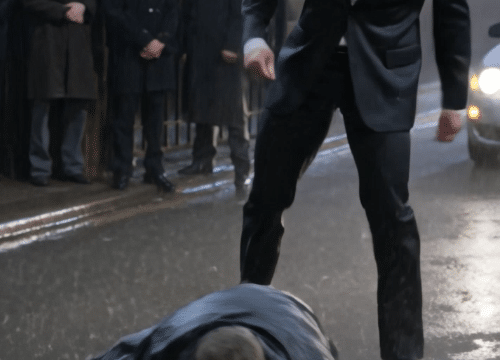
Before Walter could answer, the man ran up behind him and drove a hard kick into his back.
Walter’s chest slammed against the edge of the cart.
The metal frame tipped violently, overturning onto the wet road. Cans bounced and rolled in every direction, clattering against the curb. Cardboard scattered beneath the rain, and the small bag of rice tore open as it struck the pavement.
White grains spilled into the gutter.
Within seconds, the rainwater was carrying them toward a drain.
Walter fell onto his elbow, grimacing as pain shot through his arm. A thin trace of blood appeared where his skin struck the wet road.
For a moment, he couldn’t move.
Then he saw the rice.
“No…”
He dragged himself forward, reaching toward the gutter with trembling fingers.
“No, please. Not that.”
The driver stood over him.
Walter tried to gather the rice, but the water was already washing it away. He scooped up a handful of wet grains, desperately trying to separate what remained from the dirt and debris.
“That rice is for tonight…” he whispered.
The driver looked down at him.
“Trash. Your cart blocked my car.”
Walter looked up, his face twisted with pain and disbelief.
“I didn’t mean to. I said I was sorry.”
The apology only seemed to irritate the man further.
He stepped over the spilled rice and delivered two more forceful kicks into Walter’s back and side as the old man struggled beside the overturned cart.
Walter curled inward, gasping and trying to protect himself.
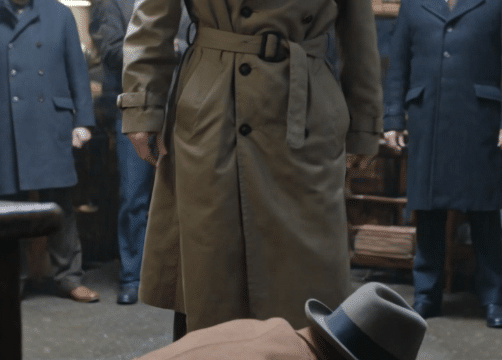
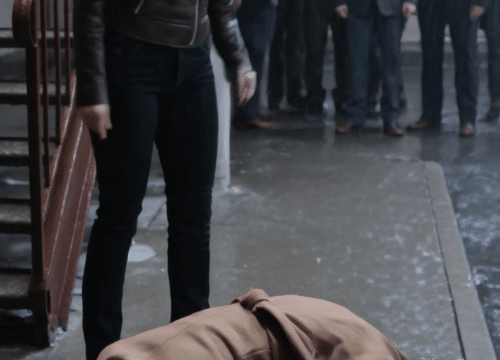
Nearby workers and pedestrians stopped beneath the industrial awnings. One man covered his mouth. A woman turned away, unable to watch. Several others stepped backward, frozen by the sudden violence.
Nobody intervened.
The driver straightened his jacket.
“Pick your garbage faster.”
He glanced at the scattered cans as if Walter had inconvenienced him by making a mess.
Walter remained on the ground, one hand pressed against his side and the other stretched toward the last grains of rice disappearing into the gutter.
Then a different engine sounded at the far end of the road.
A black SUV approached through the rain and braked sharply near the industrial gate.
The rear door opened.
A silver-haired man in a long navy coat stepped out, followed by a security team. He looked toward the overturned cart, then at the elderly man lying beside it.
His eyes settled on the rice washing through the gutter.
The man’s expression changed.
He crossed the road immediately, placing himself between Walter and the driver. One security officer moved to shield Walter while another called for medical assistance.
Only after the old man was protected did the newcomer turn toward the luxury sedan.
His voice was calm, almost unnervingly so.
“Close this road behind him.”
The security team moved at once.
The driver spun toward the SUV, his anger still burning.
Then he noticed the guards taking positions around his car.
His expression faltered.
“Behind me?”
For the first time that evening, the rich man looked as though he had no idea what was going to happen next.
And he had just made the worst mistake of his life.
Act II
Walter Hayes had never owned much.
His wife, Margaret, used to joke that he could fit his entire life into the back of an old pickup truck. She said it affectionately, usually while he was trying to decide which battered piece of furniture they could afford to keep when they moved to a smaller home.
They had spent thirty-eight years together.
They raised a son, worked ordinary jobs, and saved what they could. Margaret worked in a school cafeteria, while Walter spent decades repairing machinery at a manufacturing plant outside town.
They weren’t wealthy, but they had never considered themselves poor.
They had a home, a modest retirement fund, and a little garden where Margaret grew tomatoes every summer.
Then the factory closed.
Walter was sixty-six when his job disappeared. The company promised severance payments and explained that retirement would give him time to enjoy his remaining years.
For a while, he believed it.
Then Margaret became ill.
Their savings dwindled as medical expenses accumulated. Walter took temporary jobs, sold tools he had owned for decades, and postponed repairs around the house. When Margaret died two years later, he discovered that grief could make even simple tasks feel impossible.
He stayed in their home as long as he could.
But after falling behind on several bills, he sold it to settle the debts. He told himself that downsizing was sensible, that he could find a small apartment and rebuild his savings.
The apartment never became permanent.
A series of unexpected expenses forced him to move again. One landlord increased the rent, another required a deposit he couldn’t afford, and a third decided not to renew his agreement.
Eventually, Walter began renting a tiny room by the week.
He told his son, Daniel, that everything was fine.
Daniel lived several states away and had a family of his own. Walter refused to tell him how difficult things had become. He remembered the years when he had helped Daniel buy his first car, paid for school supplies, and worked overtime so his son wouldn’t have to worry about money.
He didn’t want their relationship to become a conversation about bills and rescue.
So he kept working.
Collecting scrap was exhausting, but it gave him a little independence. He knew which businesses threw away aluminum cans, which construction sites discarded usable metal, and which streets were worth searching after a busy weekend.
Most days, he could earn enough for basic food and his room.
Some days, he couldn’t.
The small bag of rice on his cart had represented a rare moment of relief. It meant he wouldn’t have to choose between dinner and the room where he slept.
Now even that had been taken from him.
When the security team approached, Walter flinched.
He had spent enough time being ignored by people with money to assume that every expensive vehicle brought another problem. He tried to sit up, but pain made him gasp.
“Easy,” the silver-haired man said, kneeling beside him. “Don’t try to stand yet.”
Walter looked at him warily.
“I’m all right.”
“You don’t have to convince me of that.”
The man removed his navy coat and placed it around Walter’s shoulders, protecting him from the cold rain while a security officer crouched nearby and called for an ambulance.
“What’s your name?”
“Walter.”
“I’m Richard Bennett.”
Walter recognized the name immediately.
Richard Bennett owned Bennett Industrial Holdings, the company responsible for the sprawling industrial park surrounding them. Its warehouses supplied regional distributors, its manufacturing facilities employed hundreds of workers, and its commercial properties stretched across several counties.
His company name appeared on the signs outside the industrial gates.
Walter had passed those signs hundreds of times.
He had never imagined meeting the man whose name was printed on them.
“Mr. Bennett,” Walter murmured, trying to push himself upright. “I’m sorry about the road.”
Richard stared at him.
“Why are you apologizing to me?”
Walter looked down at the overturned cart.
“I know I’m slow. I try to stay out of people’s way.”
Richard’s face tightened.
“You were collecting scrap. You weren’t doing anything wrong.”
Walter seemed uncertain how to respond.
He had become so accustomed to apologizing for occupying space that the idea of someone defending his right to be there felt almost foreign.
Richard turned toward the luxury car driver.
“Who are you?”
The man lifted his chin.
“Why does that matter?”
“Because I just watched you assault an elderly man.”
“He blocked the road.”
“That doesn’t answer my question.”
The driver glanced at the security officers.
“I have somewhere to be.”
“So did he,” Richard replied, nodding toward Walter. “He was trying to get home with his dinner.”
The driver scoffed.
“This is ridiculous.”
Richard didn’t raise his voice.
“Call the police. Preserve the security footage from the gate and the nearby facilities. Nobody touches that car until the officers have had a chance to document what happened.”
One of the guards immediately made the calls.
The driver’s confidence began to erode.
He had expected anger, perhaps an argument, maybe even a brief confrontation before he drove away. He had not expected the owner of the entire industrial park to arrive, protect his victim, and order the road secured.
But Richard Bennett wasn’t interested in humiliating him in return.
He wanted to know exactly what had happened.
And the answer would soon reveal that the driver’s problem extended far beyond one blocked road.
Act III
The ambulance arrived while the rain continued beating against the industrial roofs.
The paramedics examined Walter, checked his injuries, and helped him onto a stretcher. He winced as they moved him, but his first question concerned the cart.
“My cans,” he said weakly. “I need to get those back.”
One of the paramedics exchanged a glance with Richard.
“We’ll make sure your belongings are kept safe,” Richard promised.
Walter looked toward the gutter.
“The rice is gone.”
The words came out quietly, almost apologetically.
Richard followed his gaze.
The rain had carried most of the grains into the drain. What remained was mixed with mud and fragments of cardboard.
Richard had seen people lose expensive watches, damaged vehicles, and valuable shipments. He had watched executives argue for hours over financial losses that barely registered in their quarterly reports.
But there was something unbearable about watching an elderly man mourn a few dollars’ worth of food because someone with far more than he needed had decided that thirty seconds of inconvenience justified violence.
Richard turned to his operations director, who had arrived in another company vehicle.
“Arrange a replacement cart. Get him food and dry clothing. Cover whatever medical expenses aren’t handled by his insurance.”
Walter immediately shook his head.
“No, sir. I can’t ask you to do all that.”
“You didn’t ask.”
“I can manage.”
Richard looked at the old man’s trembling hands.
“I believe you can manage. That’s not the point.”
Walter fell silent.
Richard continued, “You shouldn’t have to prove how little help you need before someone treats you decently.”
For a moment, Walter’s eyes shone with tears.
Then the police arrived.
Officers began interviewing the witnesses and photographing the overturned cart. Several workers had seen the entire assault from beneath the loading-bay awnings. One had recorded the confrontation on his phone, capturing the driver leaving his vehicle and attacking Walter.
The industrial park’s gate cameras had also recorded the luxury sedan entering the road.
The footage would be preserved for investigators.
The driver, whose name was Gregory Shaw, insisted that Walter had deliberately blocked him.
Gregory was a successful commercial contractor who had built a reputation among local business owners for aggressive negotiations and extravagant displays of wealth. He was accustomed to getting what he wanted, and he had come to believe that impatience was a sign of importance.
When the officers asked him to describe the incident, he claimed that he had merely been trying to get Walter out of the road.
The witness recording contradicted him.
So did the security footage.
Richard remained nearby, answering questions about the industrial park and making sure the company cooperated with the investigation.
Then his operations director approached him with an unexpected concern.
“Mr. Bennett, there’s something else you should know about Shaw.”
Richard turned.
“What is it?”
“His company has been bidding on several contracts inside the industrial park.”
Richard’s expression remained neutral.
“Which contracts?”
“The new logistics facility. The drainage renovation. And the warehouse expansion on the east side.”
Richard looked toward Gregory.
The man was standing beside his luxury sedan, arguing with an officer about whether he was required to remain at the scene.
“Has he been awarded anything?”
“Not yet. His company submitted proposals for all three projects. The bids are under review.”
“Who has been handling them?”
The operations director hesitated.
“Martin Cole. He’s our regional procurement manager.”
Richard’s gaze sharpened.
Martin had worked for Bennett Industrial Holdings for nearly a decade. He was considered efficient, commercially minded, and particularly good at negotiating favorable prices.
But Richard had recently noticed irregularities in several procurement summaries. Some contracts had been recommended without the usual comparisons, and certain subcontractors appeared repeatedly despite offering prices higher than competing firms.
The explanations had sounded reasonable at the time.
Now Richard wanted the original files.
“Get me the complete procurement records for Shaw’s company,” he said. “Every bid, every evaluation, every communication connected to those projects.”
His operations director nodded.
“And Martin?”
“Preserve his records too. Don’t accuse anyone of anything until we know what we’re looking at.”
Richard returned his attention to Walter, who was listening to the paramedics explain the next steps.
He had come to the road expecting to find an elderly man who needed immediate help.
He had not expected the assault to intersect with a business review already troubling his company.
Gregory had thought the industrial park was simply another place where he could force people out of his way.
He hadn’t realized that the man now standing beside the ambulance had the authority to examine the contracts Gregory was counting on.
And those contracts might reveal why a man with an expensive car had been so desperate to get through the industrial road.
Act IV
By the following morning, the assault had become a formal police investigation, and Richard Bennett had ordered an independent review of the pending procurement contracts.
The two matters were kept separate.
The police would investigate Gregory’s conduct based on the available evidence. Richard’s company would examine whether its contracting procedures had been followed and whether any employee had improperly influenced the bids.
Neither investigation would be decided by anger or assumption.
But the records quickly raised serious questions.
Gregory’s company had submitted bids for three major projects at Bennett Industrial Holdings. On paper, its proposals looked competitive enough to attract attention.
The problem lay in the evaluation documents.
Several competing bids had been marked incomplete, even though the submissions contained the required information. In other cases, Gregory’s company had received additional time to revise its proposal while competitors were held to the original deadline.
The exceptions had been approved by Martin Cole.
Emails showed that Martin had repeatedly urged the evaluation team to prioritize Gregory’s company, describing its owner as a valuable long-term partner. He had also discouraged staff from escalating questions about unusual revisions to the bids.
The documents did not, by themselves, prove corruption.
But they did establish that the process had not been applied consistently.
Richard requested an independent audit of the evaluations and suspended the pending awards until the review was complete.
Martin was removed from the procurement process while the investigation proceeded.
When confronted with the documents, he claimed that he had been trying to secure reliable contractors and avoid delays.
Richard listened without interrupting.
Then he asked one question.
“Why were the rules different for one company?”
Martin had no clear answer.
The investigation widened to examine communications, approval records, and any potential conflicts of interest. If the evidence established misconduct, the company would refer the matter to the appropriate authorities.
Meanwhile, Gregory began to panic.
His lawyer informed him that the assault footage was difficult to reconcile with his account of the incident. The witnesses had been consistent, and the security cameras established where his car had stopped and what happened next.
Gregory had initially assumed that a wealthy victim would be too embarrassed to pursue the matter.
He had assumed that Walter would be too frightened, too exhausted, or too preoccupied with survival to stand up for himself.
Instead, Walter agreed to provide a statement.
He described the horn, the confrontation, the kick that sent him into the cart, and the moment he watched his dinner disappear into the gutter.
He did not exaggerate.
He did not demand revenge.
He simply told the truth.
Gregory’s lawyer also warned him that the contract review could jeopardize his company’s pending business with Bennett Industrial Holdings.
That was when Gregory finally understood the danger of the situation.
He had not merely assaulted an old man in front of witnesses.
He had done it on a road owned by a company whose owner was now examining the business dealings on which Gregory’s next major contracts depended.
Gregory demanded a meeting with Richard.
Richard agreed to a discussion with Gregory’s attorney present, but made it clear that the criminal investigation was not a subject for private negotiation.
At the meeting, Gregory attempted to present himself as the victim of an overreaction.
“I made a mistake,” he said. “I lost my temper. But now you’re threatening my entire business over one incident.”
Richard looked at him steadily.
“Your business is being reviewed because its bids raised questions. The assault is being investigated because you attacked a man.”
“They’re connected.”
“They happened to involve the same people. That doesn’t mean either investigation should be manipulated.”
Gregory leaned forward.
“You know how many people depend on my company?”
“Do you know how many people depend on being treated fairly when they submit a bid?”
Gregory fell silent.
Richard continued.
“I won’t award you a contract to prove a point, and I won’t deny you one to settle a personal score. The independent review will determine whether your proposals were evaluated fairly and whether they meet our requirements.”
He paused.
“But I will not let anyone use this company to bypass its rules.”
The review eventually found that the procurement process had been compromised by inconsistent exceptions and inadequate oversight. The evidence justified further investigation into whether those irregularities were deliberate and whether anyone had received an improper benefit.
The pending contracts were reopened for a fair evaluation.
Gregory’s company was no longer guaranteed the advantage it had previously enjoyed.
Martin faced a separate internal investigation, and the company referred the relevant findings for external review where appropriate.
Gregory’s assault case continued through the legal system.
Richard did not use the incident to dictate its outcome.
He did not need to.
The evidence was already there.
But the most important consequence was waiting for Walter.
For several days, the old man remained in a modest medical facility while his injuries were treated. Richard’s staff arranged for his cart to be replaced and helped him locate a more stable room with a manageable rent.
Walter was reluctant to accept the assistance.
He had spent years protecting his independence, and he feared that accepting help would somehow make him less of a person.
Richard understood the hesitation.
So he offered choices rather than orders.
Walter could decide where to stay. He could keep collecting scrap if he wished, or explore lighter work through the industrial park’s employment office. The company would help him replace what he had lost, but it would not dictate how he lived.
For the first time in a long while, Walter felt that someone was asking what he wanted rather than telling him what he should do.
Then Richard brought him the news that would finally let him breathe.
The police had preserved the evidence, the witnesses had provided statements, and the case was moving forward. Walter’s replacement cart had arrived, and a local community organization had offered him assistance with food and housing resources.
Richard placed a small grocery bag on the table beside him.
Inside were rice, vegetables, cooking oil, and a few other essentials.
Walter looked at the bag for a long moment.
Then he laughed softly.
“You know, I was only trying to get home and eat dinner.”
Richard sat across from him.
“I know.”
Walter shook his head.
“Funny how a little bag of rice can cause so much trouble.”
Richard’s expression softened.
“The rice didn’t cause the trouble, Walter.”
He paused.
“Someone decided your life mattered less than his convenience.”
Walter looked down at the groceries.
For the first time since the assault, he did not feel the need to apologize.
Act V
A month later, the industrial road looked much as it always had.
Delivery trucks moved through the gate. Workers arrived before sunrise. Rainwater collected along the curb, and the sound of metal containers clattering across the loading bays carried through the warehouses.
But Walter Hayes was no longer pushing his broken cart through the traffic.
His replacement cart had sturdy wheels and a covered compartment to protect the materials he collected. The local community organization had helped him find a small, affordable apartment near a bus route, and he had begun working a few mornings a week sorting recyclable materials for a nearby depot.
It wasn’t a glamorous life.
He still counted his money carefully. He still compared grocery prices and saved what he could. He still missed Margaret whenever he returned to an empty room at night.
But he could close his door against the weather.
He could cook his dinner without worrying that he would be forced to spend the money on something more urgent.
And he could sleep without listening for every unfamiliar sound outside.
One afternoon, Richard visited the depot.
Walter was sorting cans into a large collection bin when he spotted the industrial park owner approaching.
He wiped his hands on his coat.
“Mr. Bennett. I didn’t expect to see you here.”
“I wanted to check how things were going.”
Walter smiled.
“Better than before.”
Richard glanced at the cart.
“Working well?”
“Like a dream.”
Walter laughed at his own exaggeration.
Then he grew serious.
“I don’t know how to thank you.”
Richard shook his head.
“You’ve thanked me enough.”
“No,” Walter said. “I mean it. That night, I thought I had lost everything. It wasn’t just the rice. It was the feeling that I could work all day and still have nothing to show for it.”
Richard listened quietly.
Walter continued.
“I’ve been poor before. I know what it’s like to be tired. But being treated like you don’t deserve to be on the road because you’re old and slow…” He looked away for a moment. “That was worse than I expected.”
Richard nodded.
“I’m sorry you experienced it.”
Walter looked at him.
“Do you know what I remember most?”
“What?”
“You didn’t ask why I was there before you helped me.”
Richard considered that.
“I saw a man who had been hurt.”
“That’s all?”
“That’s all I needed to know.”
Walter lowered his head, blinking back tears.
For years, he had become accustomed to explaining himself before asking for anything. He had learned to justify his presence, his work, and even his need to eat.
Richard had asked none of those questions.
He had simply stepped between Walter and the man hurting him.
That act had changed more than the course of one terrible evening.
It had reminded Walter that his dignity was not something he had to earn by being useful, fast, wealthy, or convenient.
Meanwhile, the investigations continued.
Gregory’s assault case proceeded according to the evidence and the legal process. His company was permitted to participate in the reopened procurement process under the same rules as every other bidder, but it received no special treatment.
The review of the contracting irregularities resulted in changes to the company’s evaluation procedures. Approval exceptions were documented more carefully, conflicts of interest were subject to additional scrutiny, and staff members gained a clearer route for reporting concerns.
Martin’s conduct remained subject to the appropriate internal and external review.
Richard made no public spectacle of the matter.
He understood that the purpose of accountability was not to create a dramatic moment in which one powerful person defeated another.
It was to make sure that rules applied consistently, evidence was preserved, and people were protected from abuse.
Gregory eventually learned that losing control of a situation could be far more frightening than winning an argument.
He could no longer dismiss the assault as a private misunderstanding. The witnesses remained available, the footage had been preserved, and his own words had revealed how little he thought of the man he had attacked.
The consequences were not determined by Richard’s anger.
They came from the facts.
And the facts were impossible to erase.
Several weeks after the assault, Walter received a letter from his son, Daniel.
Daniel had learned that his father had been hospitalized and had called repeatedly, upset that Walter had concealed how difficult things had become.
Their first conversation was uncomfortable.
Daniel wanted to know why his father had never asked for help.
Walter wanted to explain that he had been trying to protect him from worry.
Neither man had the right words at first.
But they kept talking.
Daniel arranged to visit, bringing his wife and children. When they arrived at Walter’s new apartment, his youngest granddaughter ran straight into his arms.
“Grandpa! Mom said you have a new cart!”
Walter laughed.
“I do. And this one doesn’t fall apart when it rains.”
They spent the afternoon together.
Daniel helped repair a loose kitchen cabinet. His wife prepared dinner, and the children covered the refrigerator with drawings. Before leaving, Daniel asked his father to call whenever he needed something, promising that asking for help would never make him a burden.
Walter did not promise that he would suddenly become comfortable asking.
But he promised to try.
That evening, after his family had gone, Walter cooked a pot of rice.
He measured the water carefully, added a few vegetables, and waited while the steam rose into the small kitchen.
The smell brought back memories of Margaret standing beside him in their old house, teasing him for adding too much salt. He smiled at the memory rather than turning away from it.
When the rice was ready, he carried his bowl to the table.
Outside, rain began tapping against the window.
Walter listened for a moment.
The sound no longer filled him with dread.
He had a roof above his head, food in front of him, and a family that knew where to find him.
He thought about the industrial road, the overturned cart, and the grains of rice disappearing into the gutter.
Then he looked at his dinner and whispered a quiet thank-you.
Not because the world had suddenly become fair.
Not because every problem had vanished.
But because one terrible night had not been allowed to define the rest of his life.
The wealthy driver had seen an old man moving too slowly and decided that his time was worth more than another person’s dignity.
Richard Bennett had seen the same man and understood that the measure of a person was not the speed of his cart, the value of his belongings, or the money in his pocket.
One man had used his power to hurt someone who could not defend himself.
The other had used his power to make sure the truth could not be ignored.
And Walter, who had spent years believing he needed to apologize for taking up space, finally understood something he wished he had known much earlier.
He had every right to be on that road.
He had every right to work for his dinner.
And he had every right to go home safely.
Because a person’s worth is never measured by how much inconvenience they cause someone richer.
Sometimes, the smallest thing someone loses reveals the largest truth about the people standing around them.
For Walter, it had been a bag of rice.
For Gregory, it had been the illusion that money could excuse anything.
And for Richard Bennett, it had been a reminder that the real responsibility of power begins when someone vulnerable has no one else willing to stand beside them.