Act I
The money hit the snow before the old woman understood what he had done.
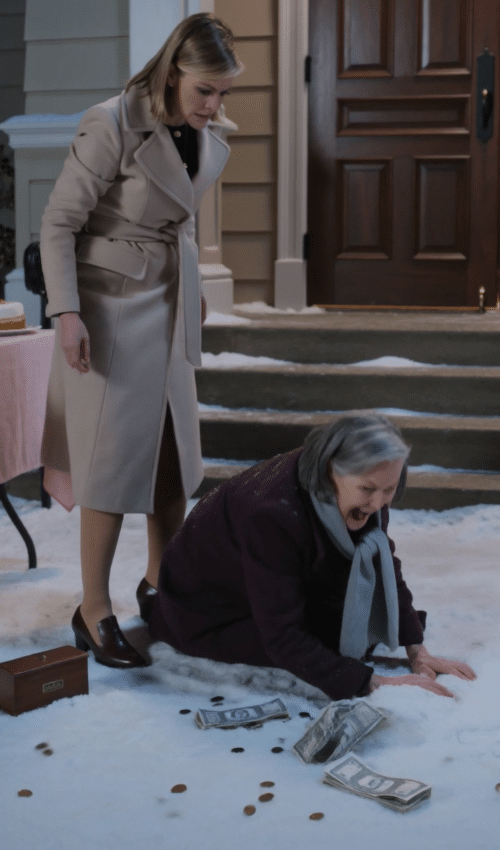
One moment, Margaret Wilson was standing beside a folding table outside a small American church, carefully arranging the last of her homemade cakes. The next, a man in an expensive black coat had snatched the little metal box from her hands and flung its contents across the church steps.
Dollar bills scattered into the snow. Coins rolled beneath the table. A few landed in the dirty slush beside a fallen chocolate cake.
Margaret dropped to her knees.
“No, please,” she whispered, reaching for the money with trembling fingers. “Please, I need that.”
The man, a thirty-nine-year-old real estate investor named Daniel Cross, watched her scramble after the bills as though he had purchased a ticket to a private show.
Margaret was seventy-six. Her purple coat was worn thin at the elbows, her gray scarf had begun to unravel, and her eyesight had deteriorated so badly that she could barely distinguish a face across the street. Yet every Saturday, she baked cakes in her tiny kitchen and sold them outside the church after evening service.
She was not saving for a vacation.
She was not saving for Christmas presents or a new coat.
She was trying to pay for eye surgery.
Without it, the doctors had warned, the damage to her vision could become permanent. She had already stopped driving, struggled to read the labels on her medicine, and learned to recognize neighbors by the sound of their footsteps rather than the shape of their faces.
The surgery was expensive, and her insurance would not cover everything. So Margaret had done what she had always done when life became difficult.
She worked.
She baked lemon cakes before dawn, carried flour home in heavy paper bags, and spent long hours standing over a hot oven even when her knees ached. She saved every spare dollar in a small metal box decorated with a faded Christmas sticker.
Every coin represented another day of sight she hoped she would not lose.
Daniel knew none of that.
Or perhaps he knew enough and simply did not care.
He had come out of the church moments earlier, where he had attended a holiday charity reception with several local business owners. He had taken two slices of Margaret’s cake without asking, dismissed her request for payment, and laughed when she reminded him that the cakes were for sale.
When she reached for the money box to protect it, he grabbed it first.
Now he stood above her as the snow thickened.
Margaret found a crumpled five-dollar bill and tried to wipe it clean with her sleeve. Her fingers were so cold that she could barely feel the paper.
“Please,” she said again. “That money is for my eye surgery.”
Daniel’s expression hardened into theatrical disgust.
“Trash. Then learn to see better.”
A gasp traveled through the small crowd gathered near the church doors.
Margaret looked up at him, struggling to make out his features through her failing vision. She could see only the dark shape of his coat and the movement of his mouth.
“I worked for every dollar,” she said.
Daniel stepped behind her.
Before she could turn, he kicked her hard in the back.
Margaret pitched forward and struck the ground beside the cake table. The tablecloth jerked crooked, sending cakes tumbling into the snow. Her forearm hit a table leg, leaving a thin red mark against her skin.
For several seconds, she could do nothing but curl around herself and struggle for breath.
The crowd recoiled.
Someone covered their mouth. Another person stepped backward toward the church entrance.
Nobody reached for Margaret.
She tried to lift her head. Her breath came in short, frightened bursts as she stretched one hand toward the scattered bills.
Daniel moved closer and kicked her twice more as she tried to retrieve the money.
“Bake your way out of blindness,” he sneered.
Margaret closed her eyes.
Not because she wanted to surrender, but because she could no longer bear to see the money she had worked so desperately to save disappearing beneath people’s shoes.
Then the church doors burst open behind Daniel.
A man in a long black coat stepped into the snow, followed by a medical assistant carrying a leather bag. He took one look at the fallen woman, the ruined cakes, and the money scattered across the steps.
His face changed.
He crossed the distance without hesitation, placed himself between Daniel and Margaret, and knelt beside the old woman.
Then he turned to his assistant.
“Cancel my flight.”
Daniel’s smirk faltered.
“Your flight?”
For the first time that night, the wealthy man seemed unable to understand what was happening.
He had no idea that the surgeon standing in front of him was about to make one of the most important decisions of his life.
And he had even less idea why that surgeon had recognized Margaret Wilson before anyone had spoken her name.
Act II
Margaret had spent most of her life learning how to endure things without asking anyone for help.
She grew up in a small Ohio town where her father repaired farm equipment and her mother baked bread for neighbors who could not afford a full grocery bill. Money was never plentiful, but the house was always warm, and nobody was turned away from the kitchen table because they had arrived hungry.
Margaret inherited her mother’s recipes and her father’s stubbornness.
She married young, raised two children, and worked for nearly thirty years in a school cafeteria. She knew how to stretch a meal, mend a coat, and make a birthday cake out of whatever ingredients remained in the cupboard.
When her husband, Thomas, died after a sudden heart attack, she learned to live alone.
When her children moved to other states for work, she learned to make their phone calls last a little longer.
And when her eyesight began to fail, she learned how to bake by memory.
She knew exactly how much flour belonged in her lemon cake. She could recognize the sound of butter softening in a warm bowl and tell when the oven had reached the right temperature by the faint smell that drifted through the kitchen.
The first time she burned a cake because she could not read the timer, she sat at the kitchen table and cried.
Then she cleaned the oven and started another one.
Her doctor eventually explained that surgery offered her the best chance of preserving useful vision. The procedure itself was routine for an experienced specialist, but the remaining cost was beyond what Margaret could comfortably afford.
She sold a few pieces of jewelry. She stopped buying anything that was not essential. She moved to a smaller apartment and canceled the cable television she had barely watched.
Still, the money came together painfully slowly.
That was when Reverend Paul, the pastor of the little church on Maple Street, offered to let her sell cakes after Saturday services. The congregation was small, but people knew Margaret’s baking. Some came for the lemon cake, others for her apple spice loaf, and a few simply bought something because they knew what she was saving for.
Every Saturday, Margaret brought her metal box.
She never demanded sympathy. If someone could not afford a cake, she sometimes gave them one anyway.
“Goodness shouldn’t depend on what’s in your wallet,” she liked to say.
By the week Daniel Cross appeared, she was only a few hundred dollars short of the amount she needed for the next stage of her treatment.
She had counted the money three times that afternoon.
There were folded bills from customers, a handful of coins, and a ten-dollar note her neighbor had quietly tucked into the box with a message that read, For your eyes, Margaret. Don’t argue.
She had laughed when she found it.
Then she had put the note back and promised herself that she would call the clinic on Monday.
She had no way of knowing that Daniel would take the entire box before the evening was over.
Daniel Cross had built his public reputation around generosity.
His company sponsored local events, donated to a children’s sports program, and hosted annual dinners for business leaders. Photographs of him shaking hands with charity organizers appeared regularly in the local paper.
He liked being seen as the man who had succeeded through hard work and good judgment.
What he disliked was anyone who reminded him that other people had needs he could not turn into a business opportunity.
Margaret’s little cake table offended him in a way he could not explain. She occupied space without offering him status. She asked for payment rather than gratitude. And when he took what he wanted, she dared to ask him to stop.
To Daniel, that was not a misunderstanding.
It was disrespect.
So he had humiliated her in front of a crowd, convinced that his expensive coat and confident voice would make everyone else accept his version of events.
But the surgeon who had just stepped through the church doors was not one of the people Daniel expected to impress.
Dr. Samuel Reed was sixty-one, internationally respected for his work in ophthalmology, and known for taking difficult cases that other specialists sometimes declined. He had spent decades treating patients whose lives had been narrowed by deteriorating vision, and he had a particular dislike for anyone who treated a person’s medical vulnerability as a punchline.
He had been at the church for a different reason.
A scheduled flight was supposed to take him to Boston that night, where he would attend a conference before an important surgical appointment the following week. He had stopped at the church to meet Reverend Paul about a charitable eye-care program for people who could not afford treatment.
He expected a brief conversation.
Instead, he found Margaret lying in the snow.
And the moment he recognized her, his plans changed.
Because Margaret Wilson was not a stranger to him.
Two months earlier, she had sat in his clinic with her hands folded tightly in her lap, apologizing for taking up his time.
She had told him she could not afford the procedure yet.
He had offered to help her find assistance.
She had thanked him and insisted she would save the money herself.
Now he was looking at the woman who had refused to ask for charity, beaten down beside the very money she had worked so hard to collect.
And he was not going to walk away.
Act III
“Margaret, can you hear me?”
Dr. Reed knelt beside her, keeping his voice calm as the medical assistant held a coat over her shoulders to shield her from the snow.
Margaret opened her eyes.
For a moment, she could not place the voice. Then she recognized the steady rhythm of the words and the gentle hand resting near her shoulder.
“Dr. Reed?”
“I’m here.”
Her face crumpled.
“I tried to pick up the money.”
“I know.”
“It was almost enough.”
“I know, Margaret.”
She turned her head toward the scattered cakes and bills.
“I don’t know what I did wrong.”
Dr. Reed’s jaw tightened, but he kept his voice soft.
“You did nothing wrong.”
Behind him, Daniel let out an impatient breath.
“This is ridiculous. She was making a scene over a few dollars.”
Dr. Reed slowly stood.
He did not shout. He did not threaten Daniel or demand that anyone recognize his name. He simply positioned himself between the injured woman and the man who had attacked her.
“Step away from her.”
Daniel looked him up and down.
“Do you know who I am?”
“No,” Dr. Reed replied. “And right now, I don’t care.”
A murmur passed through the crowd.
Daniel’s cheeks reddened.
“I took a couple of cakes. She started shouting at me, and then she fell.”
Several people stared at him in disbelief.
“You kicked her,” a woman near the doorway said.
Daniel turned on her.
“You didn’t see anything.”
“I saw you.”
“So did I,” another witness added.
Daniel looked around, expecting the crowd to retreat. But the presence of the surgeon had changed the atmosphere. People were still frightened, yet the fear no longer belonged entirely to Margaret.
Dr. Reed’s assistant had already called emergency services and was carefully gathering the money that had not been trampled into the snow. The surgeon took off his black coat and placed it around Margaret’s shoulders.
Then he turned back to Daniel.
“You attacked a seventy-six-year-old woman over a box of money she was saving for medical treatment.”
Daniel scoffed.
“And you think you can lecture me because you wear a doctor’s coat?”
“No,” Dr. Reed said. “I can tell you that she came to my clinic because her eyesight is failing, and she was doing everything she could to afford the treatment she needs.”
Daniel’s expression flickered.
For the first time, he seemed to understand that Margaret’s story was not an excuse invented to win an argument. Her condition was real. Her money was real. Her fear was real.
But he was too proud to admit that any of it mattered.
“Then give her the money,” he said. “You’re a famous surgeon. Surely you can afford it.”
Dr. Reed looked at him for a long moment.
“I can help her with her treatment,” he said. “That doesn’t make what you did acceptable.”
Daniel folded his arms.
“People like her always expect someone else to pay for their problems.”
Margaret flinched at the words.
Dr. Reed noticed.
He turned toward her again, lowering himself to one knee so she would not have to look up at him.
“Margaret, I want you to listen to me. You’re going to be examined tonight. We’ll make sure you’re safe, and we’ll discuss your surgery when your doctors have checked you over. You don’t need to make any decisions right now.”
She swallowed.
“What about the money?”
“We’ll account for what we can recover. The rest will not prevent you from receiving the care you need.”
Margaret’s eyes filled with tears.
She had spent months counting bills and coins, afraid that one unexpected expense would destroy the little progress she had made. She had never imagined that the answer would come from the very doctor whose treatment she had been trying to afford.
But Dr. Reed was not finished.
He turned to his assistant.
“Call the hospital. Tell them I need the on-call ophthalmology team to review her case as soon as she’s medically cleared.”
His assistant nodded.
Then he added, “And call the foundation office. We have a patient whose treatment cannot wait for a fundraising calendar.”
Daniel stared at him.
“Foundation?”
Dr. Reed finally faced him fully.
“I chair the Reed Vision Foundation. We fund treatment for patients who might otherwise lose their sight because they cannot afford it.”
The words landed quietly, but their effect was immediate.
A man near the church entrance lowered his phone. Reverend Paul, who had come to the doorway when he heard the commotion, stepped forward and confirmed that the church had been discussing a partnership with the foundation.
Dr. Reed continued.
“Margaret’s case was already under review. I was scheduled to leave tonight, but that can wait.”
Daniel forced a laugh.
“So what? You’re going to buy her some new eyes and expect everyone to applaud?”
“No,” Dr. Reed replied. “I’m going to make sure she gets medical care. The police can deal with the assault, and the witnesses can tell them what happened.”
Daniel’s confidence began to fracture.
He had assumed that the old woman had no connections, no protection, and no one who would care enough to challenge him. He had believed that her failing eyesight made her an easy target.
Instead, the person who had witnessed his cruelty was a surgeon with the authority to change her medical future—and the determination to make sure his actions did not disappear into the snow.
Still, Daniel had one last weapon.
He had money, influence, and a reputation he believed could survive almost anything.
He looked at Dr. Reed and gave him a thin smile.
“You really want to turn this into a public fight?”
Dr. Reed glanced at the witnesses, then at the money scattered around the ruined cakes.
“You turned it into a public fight when you decided she was beneath you.”
Daniel’s smile disappeared.
Then the church bell rang above them, sending a deep note through the snowy night.
And for the first time, Daniel Cross looked as though he was wondering who else had seen him.
Act IV
The police arrived while the last churchgoers were still standing on the steps.
Daniel immediately began explaining himself.
He spoke about the cakes, the money box, and the supposed misunderstanding. He insisted that Margaret had become emotional and that the surgeon was exaggerating what had happened.
But the witnesses told a different story.
A retired teacher described seeing Daniel snatch the box from Margaret’s hands. A young father explained how the bills scattered across the snow. The woman who had first spoken up gave a detailed account of the kicks and the way Margaret had curled around herself afterward.
Dr. Reed provided his own statement and made sure the responding officers understood that Margaret needed medical evaluation.
No one had to guess what had happened. Too many people had seen it.
When an officer asked Daniel whether he had touched Margaret, he hesitated.
“I might have moved her out of the way,” he said.
The retired teacher shook her head.
“You kicked her.”
Daniel’s eyes narrowed.
“You’d better be careful what you say.”
The officer stepped between them.
“Sir, you need to stop addressing witnesses.”
That was when Daniel finally understood that his usual methods were not working. He could intimidate one person in a hallway or pressure a worker who depended on his business. But he could not easily silence an entire group of people standing beneath a church bell, each of them prepared to describe the same incident.
Dr. Reed remained beside Margaret until the paramedics were ready to take her to the hospital.
Before she was lifted onto the stretcher, she reached for his sleeve.
“Doctor?”
“I’m here.”
“I don’t want you to miss your flight because of me.”
He looked at her in disbelief.
“Margaret, someone hurt you, and you’re worried about my flight?”
She gave a faint, embarrassed smile.
“You have important work.”
“So do you.”
She lowered her eyes.
“I only sell cakes.”
Dr. Reed shook his head.
“You raised a family. You worked for decades. You’ve spent your life making things for people you may never see again. And when your eyesight began to fail, you found a way to keep going without asking anyone to carry you.”
He paused.
“Don’t tell me that isn’t important work.”
Margaret began to cry.
She tried to hide it by turning toward the ambulance, but Dr. Reed stayed beside her until she was safely inside.
Meanwhile, Daniel stood near the church entrance, listening as the police continued their questions. He had expected the evening to end with him driving away in his luxury car, leaving Margaret to gather her money and cakes while the witnesses returned to their homes.
Instead, his actions were being recorded.
His public image was no longer the only thing at risk. An assault investigation could have serious consequences, and the witnesses had made clear that they were willing to cooperate. His attempts to portray the incident as a harmless disagreement were contradicted by the people who had seen him attack a vulnerable woman.
Then Reverend Paul approached him.
“Mr. Cross, I need you to understand something,” the pastor said. “Margaret has been selling those cakes here for months. She has never demanded anything from anyone. Sometimes she gives food away to people who cannot afford it.”
Daniel said nothing.
“She was saving for an operation that might preserve her sight. And you chose to mock her for that.”
“I’m not interested in a sermon.”
“This isn’t a sermon. It’s a question of what kind of man you choose to be when you think nobody can stop you.”
Daniel turned away.
But the pastor’s words followed him, because they touched the one part of his life he had spent years protecting: his belief that success made him a better person than those who struggled.
His company had recently announced a new community initiative. He had posed for photographs beside a banner about opportunity and dignity. He had spoken about helping families build brighter futures.
Now a group of witnesses had watched him kick an elderly woman in the snow because she wanted him to pay for the cakes he had taken.
The contradiction was impossible to hide.
Over the next few days, the incident became the subject of an official investigation. The witnesses supplied statements, and the church preserved the information it had about the event. Daniel’s representatives tried to frame the encounter as an unfortunate misunderstanding, but the people who had been there refused to change their accounts.
Dr. Reed, meanwhile, did not use Margaret’s suffering as publicity.
He arranged for her to receive a full medical evaluation and coordinated with the foundation’s staff to review the remaining costs of her treatment. He also made sure that her immediate needs were addressed before anyone discussed fundraising or public attention.
When a hospital social worker asked Margaret whether she had family who could support her, she explained that her children lived far away and had their own financial responsibilities.
“I don’t want to be a burden,” she said.
The social worker smiled gently.
“Receiving care when you need it doesn’t make you a burden.”
Margaret thought about that sentence long after the woman left the room.
She had spent so much of her life trying to avoid inconveniencing others that she had begun to believe her own needs were an inconvenience. Even now, after being attacked, she worried about the doctor’s schedule, the hospital’s resources, and whether the church would have to clean the snow from the steps.
She did not yet understand that accepting help could be an act of courage, too.
The following morning, Dr. Reed returned to her hospital room with an update.
The foundation would cover the eligible cost of her eye treatment. The medical team would determine the appropriate procedure after completing its examination, and the hospital would help her navigate the remaining paperwork.
Margaret listened without speaking.
Then she asked the question she had been afraid to ask all night.
“Does this mean I might be able to see my grandchildren clearly again?”
Dr. Reed pulled a chair beside her bed.
“It means we’re going to give you the best chance we can.”
For the first time in months, Margaret allowed herself to imagine a future that was not measured in blurred outlines and uncertain shadows.
But the most important part of the story was still waiting.
Because Dr. Reed had one more reason to make sure Margaret received help—and when he finally told her, she understood why he had refused to leave her side.
Act V
Three weeks later, Margaret sat in a quiet examination room with her hands folded in her lap.
The hospital had completed the necessary tests, and her surgical team had explained the procedure, the expected recovery, and the risks. Nothing had been promised as a miracle. Dr. Reed had been honest with her from the beginning: treatment could improve her vision, but no responsible doctor could guarantee exactly how much sight she would regain.
Margaret appreciated that honesty.
She had spent too much of her life surviving on promises other people made too easily.
On the morning of her procedure, she wore the same purple coat she had worn outside the church. It had been brushed clean and mended at the sleeve by one of the church volunteers. The gray scarf was folded neatly in her bag.
Before the nurse took her to the operating area, Margaret reached for Dr. Reed’s hand.
“I’ve never had anyone do this much for me.”
He looked at her kindly.
“You don’t have to earn the right to be treated with dignity.”
She held on to those words as the nurses prepared her for surgery.
The procedure went ahead under the care of the hospital’s ophthalmology team. Dr. Reed supervised her treatment and remained involved in her follow-up care. Recovery took patience. At first, the world remained hazy, and the brightness of the room made her uncomfortable.
There were moments when she feared the treatment had not worked.
Then, gradually, details began to return.
The dark outline of the window sharpened. The letters on a card became easier to distinguish. The nurse’s face, once a blur of light and color, began to emerge with clearer features.
At a follow-up appointment, Dr. Reed placed a familiar object on the table in front of her.
A photograph of Lily, Margaret’s granddaughter.
Margaret leaned forward.
For a moment, she said nothing.
Then her hand rose to her mouth.
“I can see her smile.”
Dr. Reed smiled back.
“That’s a good start.”
Margaret began to cry, not from fear this time, but from the overwhelming relief of recognizing a face she had worried she might never see clearly again.
The treatment would still require follow-up appointments, and she would need to be careful as she recovered. But her vision had improved enough for her to recognize the people she loved with a clarity she had not felt in a long time.
That evening, Lily visited with Margaret’s daughter.
The little girl hurried into the room carrying a drawing she had made at school. It showed a church, a snowy sidewalk, and a woman standing behind a table covered in cakes.
Above the woman, Lily had drawn a large yellow sun.
“I made it for you,” she said. “Mom told me you might be able to see the colors better now.”
Margaret took the paper with both hands.
She could see the yellow sun.
She could see the blue sky, the purple coat, and the tiny red hearts Lily had drawn around the church.
Most of all, she could see the face of the child who had been waiting for her to come home.
“Oh, sweetheart,” Margaret whispered, pulling her close. “It’s beautiful.”
Lily hugged her tightly.
“Now you can see my drawings again.”
Margaret closed her eyes and held the child against her chest.
“Yes,” she said. “Now I can.”
Outside the hospital room, Dr. Reed watched the reunion for a moment before quietly stepping away. He had canceled his flight that night without hesitation, but he had never thought of the decision as a sacrifice.
He had thought of it as the obvious thing to do.
Margaret had asked him why he cared so much, and he had finally explained the reason he had recognized her so quickly.
Years earlier, his mother had begun losing her eyesight. She had spent months hiding the problem because she did not want her children to worry about medical expenses. By the time she finally told him how much she was struggling, she had already stopped doing the ordinary things she loved: reading recipes, recognizing neighbors across the street, and working in the garden she had tended for decades.
He had been a young doctor then, still learning how much illness could take from a person beyond the medical diagnosis.
His mother eventually received treatment, but the experience changed the way he approached his work. He helped establish the Reed Vision Foundation so that financial hardship would not automatically close the door to care.
When he met Margaret, he saw a woman who reminded him of his mother: proud, determined, and so accustomed to managing alone that she found it difficult to admit when she needed help.
He had not been able to prevent what happened outside the church.
But he could make sure it did not end there.
As for Daniel Cross, the investigation continued after the snowfall melted.
Witnesses stood by their statements. The evidence gathered that night remained part of the record, and the incident brought unwanted attention to the gap between Daniel’s public image and his private conduct. His lawyers could dispute details, but they could not make the people who had watched him attack Margaret forget what they had seen.
The consequences came through the ordinary machinery of accountability: official inquiries, legal proceedings, and questions from business associates who no longer accepted his polished explanations without scrutiny.
There was no single magical moment when every problem disappeared.
There was something more lasting.
People who had once admired Daniel because of his wealth began to judge him by his actions. The church made it clear that its community work would not be used as a backdrop for anyone’s self-promotion. And the story of Margaret’s treatment became a reminder that a person’s worth could not be measured by the money in their pocket or the strength of their voice.
Months later, when Margaret returned to the church, the snow was gone.
Her cake table stood in its usual place beside the steps. A clean cloth covered the surface, and a small basket held lemon cakes, apple loaves, and chocolate cupcakes. The metal money box had been repaired, though Margaret still kept it inside her bag when she was not using it.
People gathered around her.
Some bought cakes. Others stopped simply to ask how she was feeling. The woman who had witnessed the assault brought a bouquet of flowers, while the retired teacher purchased two lemon cakes and insisted on paying full price.
Margaret laughed.
“You know you don’t have to buy two.”
“I know,” the woman replied. “But I want to.”
Reverend Paul rang the church bell as the evening service ended. The sound drifted through the neighborhood, clear and familiar.
Margaret looked up at the church doors.
She remembered the night she had fallen beside the table, unable to distinguish the faces around her. She remembered the money scattered across the snow, the pain in her back, and the awful certainty that nobody would help her.
Then she remembered the doors opening.
Dr. Reed had not asked what she could pay him. He had not demanded proof that she deserved his attention. He had not waited for someone wealthier or more important to approve his decision.
He had simply knelt beside her and stayed.
That was what Margaret wanted to remember.
Not Daniel’s expensive coat. Not his cruel words. Not even the money that had been scattered across the snow.
She wanted to remember the moment someone treated her life as valuable before knowing whether she could offer anything in return.
As the last customers left, Margaret packed the remaining cakes into a box and tucked the money safely into her bag.
Her eyesight was not perfect, and her recovery was still a work in progress. She continued attending her follow-up appointments, following her doctors’ instructions, and taking each improvement one day at a time.
But she could read the labels in her kitchen again.
She could recognize Lily’s smile from across a room.
And when she looked at the small metal box that had once held her hopes for surgery, she no longer saw only the money she had lost.
She saw the people who had helped her rebuild what cruelty had tried to take away.
Daniel Cross had believed that a woman selling cakes outside a church was beneath him. He had believed that her age, her failing eyesight, and her empty pockets made her an easy person to humiliate.
He had been wrong.
The night he scattered her surgery money across the snow, he thought he was demonstrating how little her life mattered.
Instead, he revealed how little his own wealth had taught him about human dignity.
And the man who canceled his flight to help her had offered a lesson no expensive coat, polished reputation, or carefully staged charity photograph could ever replace.
The worth of a person is not measured by what they can afford. It is measured by what we are willing to do when they have nothing left to offer us.