Act I
“Trash. Even your memories are junk.”
The words cut through the cold rain just as Walter Hayes reached for the photograph lying in the mud. At eighty-one, he had learned to endure a great many things—empty cupboards, aching joints, lonely winters, and the quiet humiliation of counting coins before buying bread. But nothing had prepared him for watching a stranger deliberately destroy the one thing he had spent forty-seven years trying to protect.
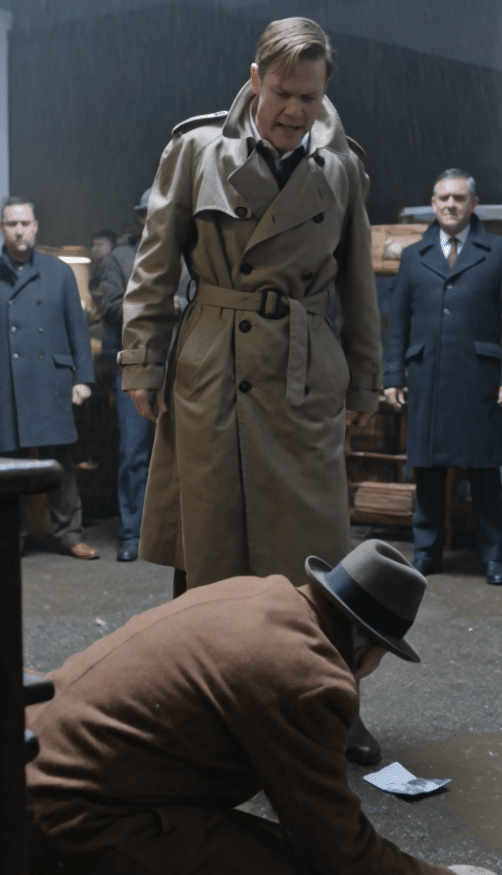
The man standing over him wore an expensive trench coat and polished leather shoes that had never known the misery of a muddy roadside. His name was Grant Mercer, a wealthy collector who traveled through flea markets looking for rare antiques, undervalued heirlooms, and desperate sellers willing to accept a fraction of what their possessions were worth.
Grant had offered Walter fifty dollars for an old wooden box and several objects arranged across a battered folding table. Walter had refused. The box had belonged to his father, and although its hinges were rusted and its surface scarred by decades of use, Walter had no intention of selling it for the price of a cheap dinner.
Grant had laughed at him.
“You’re selling broken junk in the rain,” he had said. “You should be grateful someone is willing to take it off your hands.”
Walter had quietly replied that he would rather pack everything up than accept an insult disguised as an offer.
That was when Grant snatched Walter’s wallet from his trembling hand.
The old man reached for it, but Grant pulled away with a smirk. In the struggle, a small photograph slipped from the wallet and fluttered onto the muddy ground. Walter’s expression changed instantly. He dropped to his knees, heedless of the cold water soaking through his trousers, and reached for the picture with both hands.
It showed a younger Walter standing between his wife, Eleanor, and their little daughter, Lily. Eleanor was smiling beneath a summer hat, one hand resting on Walter’s shoulder. Lily, barely six years old, had her arms wrapped around her father’s waist.
They had been gone for decades.
“That is my only family photo…” Walter whispered.
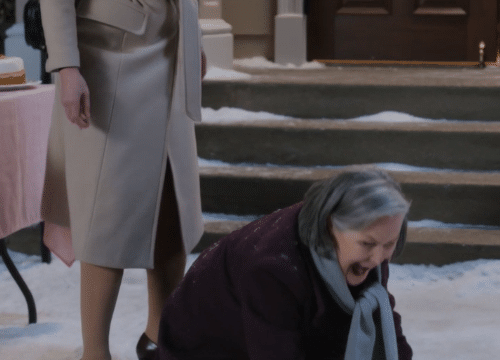
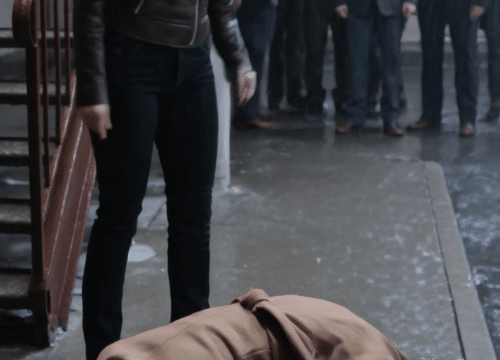
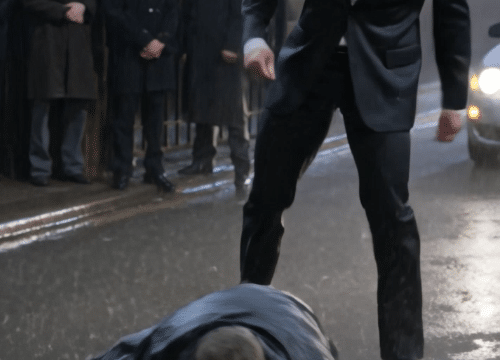
He was still bending over the picture when Grant kicked him hard in the back.
Walter crashed forward into the wooden leg of his stall. The table shuddered, and the old wooden box rattled violently as chipped plates, tarnished brass ornaments, and dusty collectibles tumbled onto the ground. His elbow struck the table’s edge, leaving a thin trace of blood against his weathered skin.
For several seconds, he could barely breathe.
His face tightened with pain. He curled inward, one arm wrapped around his ribs, the other stretched toward the photograph. Rain ran down his cheeks, making it impossible for anyone watching to tell whether he was crying.
Grant stepped closer.
Walter tried to shield the picture with his body.
Grant kicked him again, then delivered another forceful blow to his side. Walter grimaced and drew in a ragged breath, his hat slipping across the mud. Around them, vendors and shoppers recoiled. One woman covered her mouth. A man took half a step forward before stopping, frightened by Grant’s size, his fury, and the unmistakable confidence of someone accustomed to getting whatever he wanted.
Nobody moved to help.
Grant looked down at the old man as if Walter had inconvenienced him by falling.
“Your whole table is garbage.”
Walter stared at the photograph beneath his trembling fingers. One corner had disappeared into the mud, and the image of his daughter was smeared beneath a brown streak.
He could not even bring himself to answer.
Then, from the far end of the flea market lane, a black luxury vehicle braked sharply beside the stalls.
A door slammed.
A tall man in a long black coat hurried through the rain, followed by a younger assistant carrying a leather document case. The older man’s eyes went first to the wooden box on Walter’s table, then to the objects scattered across the ground, and finally to the elderly seller curled protectively around a photograph.
His expression hardened.
He stepped between Grant and Walter.
“Stop. Do not move anything on this table.”
Grant turned toward him, irritation still burning in his face.
“This junk?”
For the first time that afternoon, nobody in the market seemed to be looking at Walter.
They were all looking at Grant.
And the stranger in the black coat had just recognized something that could cost the wealthy collector far more than money.
Act II
The stranger was Arthur Whitmore, a sixty-four-year-old auction expert whose name appeared regularly in the catalogs of the world’s most prestigious auction houses. He had spent more than three decades evaluating historic estates, forgotten collections, rare American artifacts, and objects whose true value had escaped even experienced collectors.
His reputation rested on a peculiar ability: Arthur could look at something everyone else considered worthless and recognize the history hidden inside it.
He had built his career by refusing to judge an object solely by its appearance. A cracked frame might contain an extraordinary painting. A dusty desk might conceal a lost manuscript. A battered wooden box might hold the only surviving record of a family, a town, or an event that had been erased from history.
That afternoon, Arthur had not come to the flea market to browse.
He had come because of a photograph sent to his office three days earlier.
It showed a wooden box with a distinctive brass hinge and a tiny carved symbol beneath its lid. The person who sent it had written only a few lines, explaining that the box had belonged to his father and that he did not know whether it was worth anything.
Arthur had recognized the symbol immediately.
For years, he had been researching the private collection of Samuel Hayes, a respected American cabinetmaker and amateur historian whose surviving papers had been scattered after his death in the late 1940s. Samuel had documented local families, military service records, and the lives of ordinary people whose stories had never made it into official histories.
Most of his collection had vanished.
Arthur suspected that several missing objects had passed through estate sales over the decades, but he had never located the wooden box that appeared in the original inventory.
Now, standing in front of Walter’s stall, he saw it with his own eyes.
But the box was not what demanded his attention first.
Walter was still on the ground, struggling to sit upright. His fingers pressed against his ribs, and his face had gone pale beneath the rain. The photograph remained trapped beneath one hand.
Arthur immediately turned to his assistant.
“Call emergency services. Tell them we have an injured elderly man.”
Then he lowered himself beside Walter, keeping his own body between the old man and Grant.
“Sir, can you hear me? Don’t try to stand yet.”
Walter looked up at him with frightened, exhausted eyes.
“They’ll make me leave,” he murmured. “I can’t lose my things.”
“No one’s taking anything from you.”
Walter seemed unable to believe him.
For months, he had lived with the fear that one more loss would be the one he could not survive. His pension barely covered his rent and utilities. His daughter’s death had left him without close family, and after his wife died, he had gradually withdrawn from the world.
The flea market had become his last small source of income.
Every Saturday, he carried the same battered table into the market, arranged his father’s tools and old household possessions, and hoped someone might find something worth buying. He sold what he could spare, but he never sold the wooden box. And he never parted with the photograph.
The objects on his table were not simply merchandise.
They were the remains of a life that had once been full.
Arthur glanced at the picture. With Walter’s permission, he carefully lifted it from the mud using a clean cloth his assistant handed him. The image was damaged, but the faces remained visible.
Walter watched every movement.
“Please,” he said. “Don’t let that get ruined.”
Arthur’s expression softened.
“I won’t.”
Behind him, Grant gave an impatient laugh.
“This is ridiculous. The man fell down. I didn’t come here to watch some public performance.”
Arthur slowly stood.
“You kicked him while he was trying to recover a photograph.”
Grant’s jaw tightened.
“You have no idea what happened.”
“I saw enough.”
“You don’t know who I am.”
Arthur looked at him for a long moment.
“No,” he replied. “But I know exactly what you were trying to buy.”
Grant glanced at the wooden box.
For the first time, uncertainty flickered across his face.
Arthur turned toward his assistant, who had opened the leather case and removed a folder containing photographs, archival records, and a preliminary valuation report. He compared one of the images with the box on Walter’s table.
Then he examined the brass hinge.
His expression changed.
The box was not merely similar to the object in the historical inventory.
It was the object.
And inside it, Arthur believed, might be something that had been missing for nearly eighty years.
Grant had walked into the flea market hoping to exploit an old man who knew little about antiques.
He had accidentally placed himself in the middle of an investigation that could expose the truth about a collection worth far more than he had imagined.
But Arthur had not yet told anyone what the box might contain.
First, he intended to make sure Walter was safe.
Then he intended to find out why Grant had been so determined to take it.
Act III
The ambulance arrived within minutes.
Paramedics helped Walter onto a stretcher while Arthur remained beside him, refusing to let the growing crowd close in. Walter’s ribs hurt when he breathed, and his elbow had begun to swell, but his greatest concern remained the photograph.
Arthur placed it inside a protective sleeve and handed it to Walter.
“It’s damaged,” he said honestly, “but it can be preserved.”
Walter held it against his chest.
For the first time since Grant had attacked him, the old man’s face loosened slightly. He looked at Arthur with a mixture of gratitude and disbelief, as though kindness had become so unfamiliar that he no longer recognized it when it appeared.
“Why are you helping me?” Walter asked.
Arthur glanced toward the wooden box.
“Because someone should have helped you before I arrived.”
It was a simple answer, but it left Walter silent.
Meanwhile, two market security officers had arrived after witnesses reported the assault. Grant was already protesting, insisting that the entire incident had been exaggerated and that Walter had attacked him first.
Several vendors had witnessed the confrontation. Their fear had kept them silent during the assault, but now that Arthur stood beside the injured man, they began speaking.
A woman described seeing Grant snatch the wallet.
A nearby seller confirmed that Walter had refused the offer and that Grant had become furious.
Another witness had captured part of the confrontation on a phone.
Grant’s confident expression began to fade.
“This is a private transaction,” he snapped. “The old man was selling goods. I made an offer. He became difficult.”
Arthur turned toward him.
“Making an offer does not give you ownership of someone else’s property. And it certainly doesn’t give you the right to assault them.”
Grant straightened his coat.
“You’re an auctioneer. Stay out of it.”
Arthur’s assistant finally looked up from the papers in his case.
“Mr. Mercer,” she said, “perhaps you should be careful about what you say next.”
Grant stared at her.
She continued, her voice calm.
“We have your name from the market registration. The preliminary report from our client also includes correspondence about the Hayes collection.”
The mention of that collection silenced him.
Arthur opened the folder.
Several months earlier, a private foundation had commissioned him to trace the missing personal archive of Samuel Hayes. The collection was historically significant not because it contained royal jewels or priceless paintings, but because Samuel had spent decades documenting the lives of ordinary American families.
His papers included handwritten accounts, photographs, letters, and records of a small community whose early history had been poorly preserved. Historians believed the archive could settle longstanding questions about land ownership, family relationships, and the origins of several objects that had passed between generations.
The wooden box was listed in Samuel’s private inventory.
More importantly, a note beside the entry described a hidden compartment containing original documents.
For years, collectors had searched for it.
And Grant Mercer had recently begun making inquiries.
He had contacted several dealers, asking whether any items from the Hayes family might be available. He had also attempted to acquire a collection of old documents from a retired dealer who had once handled Samuel’s belongings.
Arthur had learned of those inquiries while researching the archive.
He had not expected to find Grant standing over the very person who possessed the missing box.
“You knew what this was,” Arthur said.
Grant scoffed.
“I knew it was an old box. That’s why I offered money.”
“How much did you offer?”
“Fifty dollars.”
Arthur looked down at the brass hinge.
“And you became violent when he refused?”
Grant’s silence lasted a fraction of a second too long.
Arthur’s assistant removed another document from the folder. It was a copy of an email exchange in which Grant had described the missing Hayes materials as an opportunity to acquire historically important property before other collectors learned of its existence.
The message did not prove every suspicion Arthur had formed, but it established something important: Grant had been searching for the collection.
He had not simply stumbled upon Walter’s stall.
He had been hunting for an object whose significance he understood well enough to conceal from its owner.
Arthur looked back at the box.
“Mr. Hayes,” he called gently toward the ambulance, “did your father ever tell you what was inside this?”
Walter turned his head.
“My father said there were things in there that belonged to people who couldn’t afford to keep their own stories safe.”
Arthur felt a chill that had nothing to do with the weather.
“Did he ever open it?”
“Not in front of me. He said it wasn’t his place to decide what should happen to everything inside.”
Walter paused, searching his memory.
“He told me that one day, someone might come looking for it. He said I should make sure it went to someone who understood that the truth was worth more than the price of the wood.”
Arthur slowly closed the folder.
Samuel Hayes had left behind more than a collection.
He had left behind a warning.
And now, after decades of silence, the box had found its way to the one man who had protected it without ever knowing what it contained.
Grant watched Arthur’s face and realized that the situation was slipping beyond his control.
“What exactly are you saying that box is worth?” he demanded.
Arthur did not answer immediately.
Because the most important question was no longer what the box was worth.
It was what Grant had been willing to do to obtain it.
Act IV
By late afternoon, the rain had intensified, and the flea market was nearly empty.
Walter had been taken to the hospital for examination. Before the ambulance left, Arthur promised that the photograph and the remaining possessions would be kept safe until Walter could return.
He also asked the market manager to preserve the security footage and provide the responding officers with the names of the witnesses.
Grant tried to leave.
The security officers stopped him long enough for police to arrive and begin taking statements. When Grant protested that his lawyers would make everyone regret interfering with him, one officer calmly reminded him that threats would not make the witnesses disappear.
For once, Grant had no room to negotiate.
Arthur remained at the stall with his assistant, examining the wooden box without opening any hidden compartments. He photographed its markings, recorded its condition, and compared its construction with the surviving archival descriptions.
The evidence matched.
The box had been made by Samuel Hayes himself, most likely in the early 1940s. The carved symbol beneath the lid appeared in several of Samuel’s handwritten notebooks, where he used it to mark documents that had been entrusted to him by other families.
Arthur had seen that symbol before.
It appeared beside the name Eleanor Hayes.
Walter’s wife.
He sat back slowly.
The photograph Walter had nearly lost was not merely a family keepsake. Eleanor had been Samuel’s granddaughter, and some of the missing documents appeared to have passed through her hands before disappearing from the family records.
Arthur called a colleague at the historical foundation and asked her to verify several names in the archive. Within minutes, she confirmed that Samuel’s collection had been the subject of a long-running search by researchers trying to reconstruct the history of a group of families whose records had been separated over generations.
Some of the documents might establish the provenance of valuable historical objects. Others could return names, letters, and photographs to descendants who had believed those memories lost forever.
The wooden box might be worth a considerable sum at auction.
But its contents could matter far more to the people whose lives they represented.
Arthur understood immediately why Walter’s father had been so careful.
And why Grant had wanted the box cheaply, before anyone could examine it.
The next morning, Arthur visited Walter at the hospital.
The old man sat propped against white pillows, wearing a borrowed cardigan. His face was bruised, and he moved cautiously, but he was alert. The photograph rested on the bedside table in its protective sleeve.
Arthur placed a small folder beside it.
“I’ve found something you should know,” he said.
Walter looked apprehensive.
“Am I in trouble?”
“No. Not at all.”
Arthur explained the connection to Samuel’s archive, the historical records, and the missing collection. He was careful not to promise that every document would be valuable or that the box contained a fortune. The full contents still needed to be examined by qualified specialists, with Walter’s consent.
Then he explained that the foundation wanted to work with Walter to preserve the collection.
Walter listened without speaking.
When Arthur finished, the old man looked down at his hands.
“My father spent his whole life collecting things other people threw away,” he said. “People used to laugh at him, too.”
Arthur waited.
“He’d bring home letters, old pictures, broken tools. He’d say you couldn’t tell whether something mattered just by looking at it.” Walter gave a faint, sorrowful smile. “I thought it was just something old men said because they couldn’t let go.”
“Sometimes,” Arthur replied, “they’re telling us what they learned the hard way.”
Walter looked at the photograph.
“My daughter used to ask me why I kept that box in the house. She wanted to paint it blue when she was little. Eleanor told her she’d ruin it, and Lily cried for half an hour.”
For a moment, the room seemed to soften around the memory.
“After they were gone, I couldn’t bring myself to change anything,” Walter continued. “I kept the box where it had always been. I kept the photograph in my wallet. I suppose I was afraid that if I let those things go, I’d have nothing left to prove they had existed.”
Arthur felt the weight of that confession.
The box was a piece of history. The photograph was a piece of Walter’s heart.
Neither could be measured by the same scale.
“There is one more thing,” Arthur said.
The historical foundation had agreed to fund the professional preservation of the box and its contents. It would also compensate Walter fairly if he chose to sell or license any items for public exhibition. Nothing would be removed from his ownership without his informed consent, and the foundation would help him obtain independent legal and valuation advice.
Walter stared at him.
“You mean I could finally stop selling my things in the rain?”
“If that’s what you want.”
Walter’s eyes filled, but he looked away before the tears could fall.
For years, he had believed his only choices were to surrender his memories for almost nothing or cling to them while poverty slowly stripped away everything else. Now someone was offering him a third choice: to preserve what mattered without being forced to sacrifice his dignity.
Meanwhile, the police investigation continued.
The witnesses’ statements and market footage contradicted Grant’s initial account. The footage showed him taking Walter’s wallet, knocking the photograph into the mud, and attacking the old man as he bent down to retrieve it.
The assault was no longer a story that could be dismissed as a misunderstanding between a buyer and a seller.
Grant’s wealth could pay for legal representation, but it could not erase the evidence. He faced the consequences of his actions through the legal process, and Arthur made certain that the foundation’s records concerning Grant’s attempts to acquire the missing collection were preserved for investigators.
There would be no secret deal to make the incident disappear.
No quiet payment to silence Walter.
No convenient arrangement that allowed Grant to purchase his way out of accountability.
When Grant’s attorney later contacted Arthur’s office, hoping to discuss the box and its possible value, Arthur declined to negotiate with him. The collection would be handled through proper documentation, independent review, and a process that protected Walter’s rights.
The man who had tried to exploit an elderly seller had finally encountered something money could not immediately control.
The truth.
But Walter still had one question he had not asked.
And when he finally asked it, Arthur understood that the most important discovery had nothing to do with auctions.
Act V
Three weeks later, Walter returned to the flea market.
The rain had stopped, leaving the pavement slick and silver beneath the morning light. The market manager had arranged for his stall to be moved beneath a covered section, where Walter could work without standing in the cold weather. His table had been repaired, and the scattered objects were back in their places.
The wooden box was not there.
It was being carefully examined by specialists, photographed, and documented as part of the foundation’s preservation project. Walter had signed the necessary paperwork only after an independent adviser explained every condition. For the first time in years, he knew he would not be pressured into making a decision he did not understand.
He had also received financial assistance to cover immediate expenses while the evaluation continued.
It was not a sudden fortune, and Arthur had never promised one. Some objects would prove historically significant; others might be ordinary possessions whose greatest value lay in the stories attached to them.
Walter found that he no longer needed every object to be worth money.
He only needed the chance to live without being forced to sell his memories to afford groceries.
Arthur arrived shortly after Walter opened his stall. His assistant carried a small archival case, and Walter noticed the care with which she held it.
Inside was the family photograph.
A professional conservator had removed the surface dirt, stabilized the damaged paper, and created a high-resolution copy. The original was protected behind archival material that would help prevent further deterioration.
The muddy streak had faded, although a small crease remained along one edge.
Walter held the case with both hands.
He looked at Eleanor’s face first.
Then Lily’s.
He had spent years fearing that the world would forget them because there were so few people left who remembered their voices. He had imagined that the photograph was the last fragile thread connecting him to a life that had disappeared.
Now he knew that his father’s box might preserve the stories of dozens of other families, too.
Somewhere inside that collection, there might be names that had been lost, letters that had never reached their recipients, and photographs waiting to be recognized by people who had never known they existed.
His family’s memories had not survived because they were expensive.
They had survived because someone had cared enough to keep them.
Walter looked up at Arthur.
“What will happen to the box?”
“We’ll document everything inside it,” Arthur said. “We’ll establish what belongs to your family, what may have been entrusted to your father, and what should be returned to other descendants if we can identify them. You’ll have independent advice at every stage.”
“And if it’s worth a lot?”
“Then you’ll be treated fairly. But we’ll find out what it actually is before anyone puts a price on it.”
Walter nodded slowly.
“That sounds like something my father would have wanted.”
Arthur smiled.
“I think he’d be pleased.”
Across town, Grant Mercer was learning that the story of the flea market assault had followed him into places where his reputation mattered. His actions had become part of a formal investigation, and the documentary evidence made it impossible to dismiss the incident as an old man’s misunderstanding.
The historical foundation had also declined to do business with him.
It was not revenge. Arthur had not launched a campaign to destroy Grant, nor had he exaggerated the significance of the box to punish him. He had simply refused to let money, influence, or intimidation replace the truth.
Grant had wanted the object without paying its true value.
Now he could not buy his way into the project at all.
His most revealing mistake had not been the low offer. Collectors negotiated every day, and a low offer was not a crime. His mistake was believing that the person across the table had so little power that he could take whatever he wanted.
He had looked at Walter’s faded coat, trembling hands, and battered possessions and assumed he was looking at a man who had nothing.
He had been wrong.
Walter had a family history that had survived wars, funerals, poverty, and nearly eight decades of uncertainty. He had a photograph that no auction house could replace and a wooden box that connected his father to people whose stories deserved to be remembered.
And he had one thing Grant had failed to recognize until it was too late.
Dignity.
A few months later, the foundation held a small exhibition devoted to Samuel Hayes and the families represented in his recovered archive. It was not a glittering event filled with celebrities or champagne. It took place in a modest historical gallery, where visitors moved quietly between handwritten letters, restored photographs, and objects that had once sat unnoticed in ordinary homes.
At the entrance was a photograph of Walter’s wooden box.
Beside it was a short account of how the collection had been preserved, including the role Walter had played in protecting it for decades without understanding its historical importance.
Walter attended the opening with Arthur.
He wore his old brown coat, freshly cleaned, and carried the restored family photograph in a protective case. When he saw the image of the box displayed beneath the exhibition lights, he stood still for a long time.
A young woman approached him.
She had come because one of the recovered letters mentioned her great-grandmother’s name. Until the exhibition, her family had possessed almost no information about the woman beyond a few dates recorded in an old Bible.
The letter helped them understand where she had lived, whom she had known, and why a particular family photograph had been passed down through generations.
The young woman thanked Walter.
He shook his head, embarrassed.
“I didn’t do anything special,” he said. “I just kept the box.”
“That’s exactly what you did,” she replied. “You kept it.”
After she walked away, Walter turned toward Arthur.
For a moment, he could not speak.
Then he took out the photograph of Eleanor and Lily.
“I used to think this was all I had left,” he said. “But perhaps keeping it was never just about me.”
Arthur looked at the two smiling faces.
“No,” he said softly. “Perhaps it was also about making sure they weren’t forgotten.”
Walter smiled, and this time the expression reached his eyes.
Outside, the afternoon light fell across the gallery windows. The world had not become perfect. Walter still missed his wife and daughter. His body still ached on cold mornings, and there were evenings when the silence of his apartment reminded him of everything he had lost.
But he no longer had to face that silence believing his life had been reduced to a table of unwanted objects.
His memories had survived.
And some of them had helped other families recover their own.
The wooden box was eventually valued by independent specialists, but Walter refused to let its estimated price become the story that defined it. The foundation’s records made clear that its importance came from the documents it preserved, the people it connected, and the history that might otherwise have vanished.
When a reporter asked Walter what he thought about the man who had attacked him, he paused before answering.
“I hope he learns that being able to afford something doesn’t mean you’re entitled to it.”
He glanced down at the photograph.
“And I hope he learns that something doesn’t have to be expensive to be precious.”
The reporter asked whether Walter wanted Grant punished.
Walter considered the question.
“I wanted someone to stop him when he was hurting me,” he said. “After that, the truth could take care of the rest.”
It was not a declaration of revenge.
It was the answer of a man who had lost too much to spend what remained of his life hating someone else.
On the day Arthur first rushed into the flea market, Grant had looked at a muddy photograph, a battered wooden box, and an elderly seller and seen nothing worth respecting.
“This junk?” he had sneered.
But the box had carried the memory of an entire family. The photograph had carried the love of a lifetime. And the old man he had kicked into the mud had guarded both without asking the world to reward him.
Grant had mistaken poverty for worthlessness.
Arthur had recognized the truth before the rain had even stopped.
And Walter Hayes, who had spent decades quietly preserving what others might have thrown away, finally discovered that the things he had protected were not merely remnants of his past.
They were proof that a life could be forgotten by the world and still matter.
Because the most valuable things are not always the ones that command the highest price.
Sometimes, they are the things someone refuses to let the world destroy.