Act I
“Open the gate from the ground.”
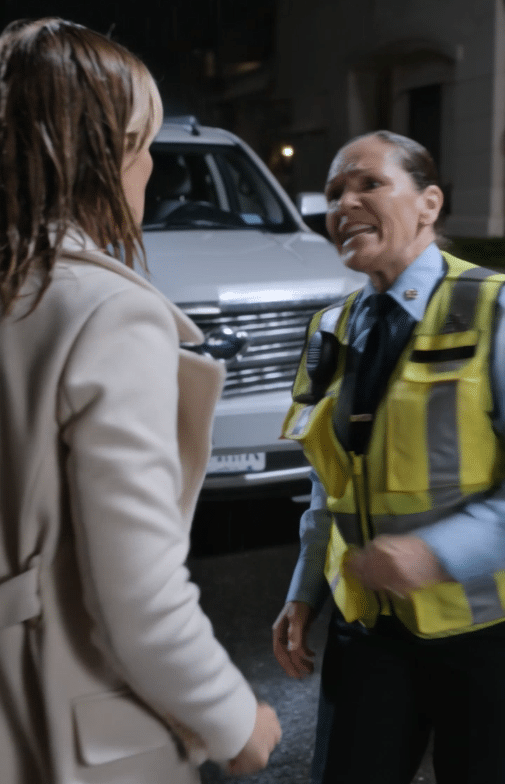
The words cut through the rain as Margaret Lawson lay beside the security barrier, struggling to catch her breath.
Her navy uniform was soaked, her yellow reflective vest twisted against her shoulder, and her gray hair had come loose from its tie. A few feet away, her resident-card scanner lay on the wet asphalt. Her radio had skidded beneath the guard booth, still crackling with the sound of someone asking whether everything was all right.
Standing over her was a woman in a white coat and black dress, her designer heels planted firmly on the pavement.
Her name was Victoria Ashford, forty-three years old, a resident of one of the most expensive homes in the community. She drove a white luxury SUV, wore jewelry that cost more than Margaret’s annual salary, and had spent years treating the neighborhood’s rules as inconveniences meant for other people.
Minutes earlier, Margaret had done nothing more than ask to see her resident card.
Now she was on the ground because she had refused to open a gate without verifying who was entering.
Victoria had pulled up to the entrance just after nine on a rainy Thursday night. Her headlights shone through the mist, illuminating the security booth and the red light on the resident-card scanner.
Margaret stepped beneath the awning and raised one hand.
“Good evening, ma’am. I need your resident card.”
Victoria stared at her through the windshield.
“Open the gate.”
“I’m sorry, ma’am. The scanner didn’t register a card.”
“You know exactly who I am.”
“I do recognize your vehicle, but I still need to verify your entry.”
Victoria threw her SUV into park and climbed out, slamming the door behind her.
“Are you serious?”
Margaret remained beside the barrier.
“It’s the same procedure for every resident.”
Victoria laughed bitterly.
“Every resident? I own more property here than you will ever own in your entire life.”
Margaret had heard variations of that sentence before. She had been working security for nearly twenty years, and she knew that some people regarded a uniform as permission to speak down to the person wearing it.
Still, she kept her voice calm.
“I’m just doing my job, ma’am. Please show me your card.”
Victoria’s expression hardened.
“Trash. Do you honestly think you have the right to hold me up in my own neighborhood?”
Before Margaret could answer, Victoria struck her hard across the face.
The impact knocked Margaret sideways into the metal barrier. Her scanner fell, and the radio bounced across the pavement. She tried to steady herself against the gate, but her wet shoes slipped, and she dropped to one knee.
Several residents waiting behind the SUV gasped.
A man in a rain jacket stepped out of his car, then stopped when Victoria turned toward him with a furious glare. Another resident lifted a hand to her mouth but remained behind her vehicle.
Margaret pressed one trembling hand against the barrier.
“Ma’am,” she whispered, “please stop.”
Victoria stepped closer.
Then she kicked Margaret in the back.
Margaret collapsed against the base of the barrier, grimacing as pain shot through her side. She tried to curl inward, but Victoria delivered another forceful kick before stepping back.
The guard’s forearm scraped against the rough edge of the barrier, leaving a thin red mark.
Rain tapped against the SUV roof.
For a few seconds, no one spoke.
Margaret’s breathing came in short, uneven bursts. Her face showed shock as much as pain. She had spent years dealing with angry drivers, intoxicated visitors, and residents who believed that a late-night rule should not apply to them.
She had never expected someone to attack her for asking to see an identification card.
Still, even from the ground, she looked toward the gate controls.
The barrier was down.
She had not opened it.
Victoria noticed.
“Open the gate from the ground,” she repeated.
Margaret swallowed, trying to push herself upright.
“I need your resident card, ma’am.”
Victoria stared at her as though the words were an unforgivable insult.
Then headlights swept across the entrance.
A black sedan pulled up sharply behind the white SUV. Two police cruisers followed, their lights reflecting across the wet road. The sedan’s rear door opened, and a tall, silver-haired woman stepped into the rain.
She was Eleanor Whitmore, sixty-two, president of the homeowners association and a retired attorney who had spent much of her career handling civil disputes and property law.
She had received an urgent call from the security manager after the gate camera captured the confrontation.
Eleanor took one look at Margaret on the ground and hurried toward her.
“Don’t try to stand yet,” she said, kneeling beside the guard. “The officers are here. You’re not alone.”
She signaled for medical assistance and asked the security manager to keep the area clear.
Only after making sure Margaret was being attended to did Eleanor rise and face Victoria.
Her expression was calm, but her voice carried across the entrance.
“Keep the gate closed.”
The security manager immediately confirmed that the barrier would remain down. Police officers moved between Victoria and Margaret while residents stepped away from the confrontation.
Victoria looked from the officers to the black sedan, then back at Eleanor.
“Closed?”
For the first time that evening, she seemed unsure of herself.
She had expected the gate to open because she demanded it. She had expected the security guard to apologize. She had expected everyone watching to understand that someone with her money and social standing did not have to wait.
Instead, the entire entrance had become a scene under police control.
And the woman who had ordered the gate to remain closed was about to reveal why Victoria’s reputation would not protect her from what came next.
Act II
Margaret Lawson had spent most of her adult life making other people’s lives easier.
At fifty-eight, she was a widow, a mother of two grown children, and a grandmother who rarely went more than a week without sending one of them a handwritten card. She had worked in hospital security before joining the residential community twelve years earlier.
The job was not glamorous.
She spent long shifts monitoring cameras, checking deliveries, recording visitors, and standing in the rain when residents forgot their access cards. She had learned how to stay calm when people were tired, embarrassed, or angry.
Most residents barely noticed her unless they needed something.
Margaret had accepted that as part of the work.
Her husband, Frank, had been a city bus driver. He used to tell her that a job did not become unimportant simply because the person doing it stood behind a counter or sat in a booth.
“When you get on a bus,” he would say, “you trust the driver to know where he’s going. When you walk into a hospital, you trust the person at the desk to tell you where to go. Everybody depends on somebody.”
Frank had died six years earlier after a long illness. Margaret had kept working because she liked the routine, needed the income, and did not want grief to become the only thing that defined her days.
She had a small house outside the city, a garden she tended when the weather allowed, and a granddaughter named Sophie who sometimes visited the gatehouse with her mother.
Sophie was nine and believed her grandmother knew everything.
Margaret had once explained that the red light on the resident scanner meant the system needed another check.
“Even if you know the person?” Sophie had asked.
“Especially then,” Margaret replied. “Rules matter most when somebody thinks they’re too important for them.”
The girl had nodded solemnly, as though her grandmother had explained the secret of the universe.
Margaret remembered that conversation as she lay beside the barrier, trying to breathe through the pain.
She had not wanted to humiliate Victoria. She had not wanted to delay her or prove a point. She had simply followed the procedure she had been trained to follow.
The community had experienced a security breach the previous month when an unauthorized vehicle followed a resident through the entrance. Nothing had been stolen, but the association had instructed security staff to verify access more carefully, especially when the scanner failed.
Margaret was doing exactly what she had been told to do.
Victoria, however, had never liked being asked to prove anything.
She lived in a large house on a private cul-de-sac, with a landscaped garden, a heated driveway, and a garage that could accommodate three vehicles. Her husband, Richard, was a commercial property investor whose company owned several office buildings and retail developments.
Victoria often attended association meetings, but she rarely stayed long enough to hear the details of a policy discussion. She preferred to speak directly with board members and expected small problems to be solved through personal favors.
When the association introduced stricter access verification, she complained that it was an insult to established residents.
When the security manager explained that the policy applied to everyone, Victoria threatened to speak with the association president.
The manager had politely directed her to the formal appeals process.
Victoria had never submitted an appeal.
She had simply decided that the rule should not apply to her.
Over time, she developed a reputation among security staff. She demanded that deliveries be admitted without checking, criticized guards who asked visitors to sign in, and once insisted that a contractor be allowed through the gate even though his authorization had expired.
Most employees learned to avoid contradicting her.
A few had filed reports.
Nothing had changed.
The problem was not that the association had no rules. The problem was that some residents believed influence could turn rules into suggestions.
Eleanor Whitmore had become association president two years earlier after retiring from a long legal career. She had not wanted the position at first. The previous board had struggled with disputes over security, landscaping contracts, and unequal enforcement of community regulations.
Eleanor had accepted the role because she believed the association needed someone willing to read the fine print, ask uncomfortable questions, and treat every resident fairly.
She was not impressed by expensive cars or grand houses.
Her father had been a public school principal, and her mother had worked as a nurse. Eleanor had grown up in a modest home where arguments were settled at the kitchen table, not by threatening to call someone more important.
As a young lawyer, she had represented tenants and small business owners who had been intimidated by people with more money and better connections. She had also represented wealthy clients, but she had never believed that wealth made anyone less accountable.
When the call came from the security manager that night, Eleanor had been reviewing the association’s quarterly report.
The manager sounded shaken.
“There’s been an assault at the entrance. The gate camera recorded it. Margaret’s injured, and the resident involved is refusing to step away.”
Eleanor asked whether police had been called.
“Yes. They’re on their way.”
“Keep the gate closed, preserve the footage, and don’t let anyone interfere with the scene. I’m coming.”
She arrived before the first responding officers had finished assessing the situation.
Now, as paramedics checked Margaret’s injuries, Eleanor listened to the security manager describe the events. The guard had requested a resident card. Victoria had refused. The confrontation had escalated almost immediately.
The camera footage would establish the sequence more clearly, but there was little doubt that the encounter had turned violent.
Eleanor looked toward Victoria.
The woman was speaking rapidly to one of the officers, gesturing toward her SUV and repeatedly insisting that she was a homeowner.
Eleanor knew that ownership gave Victoria certain rights under the community’s governing documents.
It did not give her the right to assault someone.
That distinction would soon become the center of a confrontation Victoria could not control.
Because Margaret was not the only person in the community who had been frightened into silence.
And when the security manager opened the incident log, Eleanor discovered that Victoria’s name had appeared in complaints far more often than she had expected.
Act III
The first police officer asked Victoria to explain what had happened.
Victoria folded her arms.
“This woman refused to let me into my own home.”
“Did you present your resident card?” the officer asked.
“I shouldn’t have to. I live here.”
“Did you present your card?”
Victoria looked toward Eleanor, apparently expecting the association president to intervene.
“No,” she snapped. “Because I shouldn’t need to.”
The officer made a note.
“And did you strike the security guard?”
“She was disrespectful.”
“That wasn’t my question.”
Victoria’s mouth tightened.
“I was trying to get past her.”
The officer asked her to remain where she was while the scene was documented. Another officer spoke with Margaret and the paramedics, who recommended that she receive further medical evaluation.
Eleanor stayed beside the guard until the medical team was ready to transport her.
“I’m sorry this happened,” Eleanor said quietly.
Margaret shook her head, then winced.
“You didn’t do it.”
“No. But I need to make sure the system doesn’t fail you after it happened.”
Margaret looked toward the security booth.
“My radio is under the barrier.”
“We’ll retrieve it once the officers say the area is clear.”
“I should have kept the gate closed.”
Eleanor’s expression softened.
“You did keep it closed. You followed the procedure.”
Margaret’s eyes filled with tears.
For a woman who had spent decades staying calm in front of angry people, being told that she had done her job correctly felt more comforting than she could explain.
Before the paramedics left, Eleanor asked the security manager to contact Margaret’s family and arrange for someone to meet her at the hospital.
Then she turned to the camera system.
The footage was clear.
It showed Victoria stepping out of her SUV, approaching Margaret, and striking her. It captured the guard stumbling into the barrier, the scanner falling, and Victoria kicking her while she was down.
The recording also showed the residents who had witnessed the attack.
Some had recoiled. One had stepped out of a vehicle, then retreated when Victoria turned toward him. Another had begun raising her phone before lowering it again.
Eleanor did not blame the witnesses for being frightened. She knew that people often froze when a situation became dangerous.
But she did want to understand why several earlier reports about Victoria had never been addressed.
The security manager opened the incident log.
Three months earlier, a guard had reported that Victoria shouted at him after he asked for identification from a contractor entering her property. The report described verbal abuse but no physical contact.
Two months earlier, a delivery driver had complained that Victoria threatened to have him fired from his company because he refused to leave a package inside the gatehouse without a signature.
Six weeks earlier, another security officer had written that Victoria tried to force the barrier open with her SUV when the scanner failed. The officer had stopped her, and the matter was referred to the community manager.
The report had been marked “resolved” after Victoria sent an email claiming the guard had been rude.
There was no record of a formal review.
Eleanor read the entries in silence.
“Who closed this report?” she asked.
The security manager named the former community administrator, who had left the position the previous week.
“Why?”
“She said Mrs. Ashford was a longtime resident and that we should avoid escalating a disagreement.”
Eleanor slowly closed the file.
“A disagreement is not the same thing as a pattern of intimidation.”
The manager nodded.
“I know.”
“Then why was it handled that way?”
He looked down.
“People were afraid of complaints. She knows several board members. Every time someone challenged her, she threatened to make trouble.”
Eleanor had heard that explanation too many times in her legal career.
People did not always ignore wrongdoing because they approved of it. Sometimes they ignored it because the person causing harm seemed expensive to confront.
The cost of speaking up appeared immediate.
The cost of remaining silent was spread among people who had less power to object.
Eleanor called the association’s legal counsel and requested an independent review of the earlier complaints. She also instructed the security manager to preserve the original video files, access logs, and communications relating to the incident.
Nothing was to be deleted or altered.
Meanwhile, Victoria had begun making calls.
She contacted her husband, then a friend who served on a neighborhood committee, then a board member she had known for years.
Her story changed slightly with each conversation.
At first, she said the guard had deliberately delayed her. Then she said Margaret had shouted at her. Finally, she described the incident as a minor physical confrontation that had been blown out of proportion.
But the camera footage showed no evidence that Margaret had threatened her.
The recording showed a guard doing her job.
Victoria’s husband, Richard, arrived at the gate shortly before eleven.
He was a broad-shouldered man in his late forties, dressed in a dark business suit beneath a raincoat. He approached Eleanor with the confident manner of someone accustomed to resolving problems through private negotiations.
“Eleanor, this is getting out of hand,” he said. “Victoria is upset. Let’s handle this quietly.”
Eleanor glanced at the police officers.
“The police are handling the alleged assault. The association will address the security and conduct issues through its own process.”
Richard lowered his voice.
“You know how these things work. She’s a resident. Margaret is an employee. Surely we can find a way to avoid turning this into a spectacle.”
Eleanor studied him.
“Are you asking me to suppress the footage?”
“I’m asking you to be reasonable.”
“Reasonable would have been showing a resident card.”
Richard’s expression hardened.
“You’re risking a long relationship with my family over a security guard.”
Eleanor’s reply was immediate.
“Margaret has worked here for twelve years. She is part of this community. Her job does not make her less deserving of protection.”
Richard looked past Eleanor toward the gate camera.
For the first time, he seemed to understand that the footage would not disappear simply because he wanted it to.
But he still believed the matter could be contained.
What he did not know was that the association’s legal review was about to expose an arrangement that had protected Victoria from consequences for years—and that the person who signed off on it was someone he had trusted.
Act IV
The emergency association meeting was scheduled for the following Tuesday.
By then, Margaret had returned home from the hospital with medical instructions and a follow-up appointment. Her injuries required rest, and she was advised not to return to work until she had recovered sufficiently.
Eleanor visited her on Sunday afternoon.
She brought a small basket of groceries and a folder containing the incident number, the contact details for the association’s legal adviser, and confirmation that Margaret would continue receiving the employment benefits available under her contract while the matter was reviewed.
Margaret looked uncomfortable.
“You didn’t have to bring all this.”
“I wanted to.”
“I’ve never had the president of anything visit my house before.”
Eleanor smiled faintly.
“Then the association has been missing opportunities to get to know its employees.”
Margaret laughed softly, then became serious.
“Will I lose my job?”
The question hurt Eleanor more than she expected.
“No. You followed the procedure. No one is going to punish you for doing that.”
Margaret looked down at the folder.
“People like her can make things difficult.”
“They can try. That’s why we have to make sure the rules protect the people who enforce them.”
Eleanor did not promise that the coming weeks would be easy. She knew that investigations could be stressful, and she did not want to give Margaret false reassurance.
Instead, she told her exactly what the association was doing and what support was available.
For Margaret, the honesty mattered.
On Tuesday evening, the association’s board gathered in a conference room at the community center. Victoria attended with her attorney. Richard sat beside her, his expression carefully controlled.
Eleanor opened the meeting by explaining that the purpose was not to determine criminal guilt. That decision belonged to the appropriate legal authorities.
The board’s responsibility was narrower: review the security policies, examine whether the association had handled earlier complaints properly, and decide what measures were necessary to protect employees and residents.
The security manager presented the footage.
No one spoke while it played.
The recording showed Margaret standing beside the barrier, holding the scanner. It showed Victoria getting out of her SUV, striking the guard, and kicking her while she was down.
When the screen went dark, Victoria’s attorney requested a recess.
After the break, he argued that the association should avoid making a decision until the police investigation was complete.
Eleanor agreed that the board should not prejudge the legal case.
“But we can review whether our own procedures were followed,” she said. “We can also take reasonable steps to protect our employees while that review continues.”
The board then examined the earlier reports.
The records revealed that the former administrator had repeatedly downgraded complaints involving Victoria without documenting a full review. In two instances, the administrator had cited Victoria’s status as a homeowner as a reason to resolve the matter informally.
One email was particularly revealing.
After a security guard reported that Victoria had tried to force the barrier open, the administrator wrote to a colleague: She’s an important resident. Let’s not create a problem we don’t need.
The colleague replied that the guard had been following the access policy.
The administrator closed the report anyway.
Eleanor placed the email on the table.
“This is how a rule becomes meaningless,” she said. “Not because it was never written, but because someone decides it should not apply to a person they fear offending.”
Richard shifted in his chair.
“This has nothing to do with my wife attacking anyone.”
“It has to do with the association’s response to repeated complaints,” Eleanor replied. “The assault is being investigated separately. Our failure to address earlier concerns is our responsibility.”
The board approved an independent audit of security complaints and required all future reports to be reviewed under consistent written standards. The former administrator’s decisions would be examined, and the association would introduce protections against retaliation for employees who reported misconduct.
Then the board addressed Victoria’s access privileges.
Her resident rights could not simply be revoked because of an allegation, and Eleanor made clear that the association would not invent powers it did not possess. However, the board could enforce the existing entry-verification policy and require her to comply with the same procedures as every other resident.
The board also authorized the security manager to deny entry to any vehicle whose access could not be verified, regardless of ownership claims or personal connections.
The gate would remain closed until the scanner registered an authorized credential or the alternative verification procedure was completed.
Victoria stared at Eleanor.
“You’re changing the rules because of me?”
“No,” Eleanor said. “We’re enforcing the rules that already exist.”
“You can’t treat me like a stranger in my own community.”
“We can require you to verify your identity at the gate. Everyone is subject to that requirement.”
Richard leaned forward.
“This is unnecessary.”
Eleanor turned toward him.
“What would have been unnecessary was the assault. What would have been unnecessary was ignoring the earlier complaints. The association is not going to make either mistake again.”
The board also directed that the footage and incident records be preserved for the ongoing investigation. The police would determine what further action was appropriate, and the association would cooperate with lawful requests.
Victoria’s attorney advised her not to respond.
For once, she listened.
The meeting concluded without a dramatic declaration or a public victory speech. The board had taken concrete steps, established accountability for its own failures, and made clear that the access policy applied equally.
But Victoria was not prepared to accept the outcome.
As she left the conference room, she turned toward Eleanor.
“You’re making a very powerful enemy.”
Eleanor gathered her papers.
“No. I’m making sure the gate works.”
Victoria walked away in silence.
She had spent years believing that power meant making other people afraid to challenge her.
Now she was discovering that real authority could be quiet, documented, and impossible to intimidate.
And the next time she drove toward the entrance, she would face the same barrier she had tried to force open before.
Only this time, everyone would know exactly why it had to stay closed.
Act V
Two weeks later, rain fell over the community again.
Margaret had not yet returned to her full shift, but she had begun a gradual recovery and was eager to get back to work. Her daughter had offered to stay with her, and Sophie had made a handmade card covered in bright yellow stars.
On the front, the girl had written: For Grandma, the bravest guard.
Margaret kept it on the kitchen table beside her medication and a cup of tea.
She did not feel brave.
She remembered the slap, the shock of striking the barrier, and the terrible helplessness of being kicked while strangers watched. Some nights, the memory returned when she heard a car door slam outside.
But she also remembered Eleanor kneeling beside her in the rain.
She remembered hearing someone say that she had done her job correctly.
For the first time since the incident, she felt that the community might actually stand behind the rules it expected her to enforce.
When Margaret returned to the gatehouse, the security manager met her before her shift began.
The scanner had been checked, the camera system had been audited, and the incident-reporting process had been updated. Employees had received written guidance on how to respond when residents refused verification or became aggressive.
The manager also made one change that mattered more than the new paperwork.
He told the guards that they were authorized to step back and request assistance whenever a resident became threatening, without fear of being criticized for delaying entry.
“You are here to keep the entrance secure,” he told them. “You’re not expected to absorb abuse to keep someone happy.”
Margaret listened carefully.
Then she put on her reflective vest, checked the scanner, and took her place beside the barrier.
The work was familiar.
A delivery driver presented his identification. A resident forgot his card and used the approved alternative verification procedure. A visitor waited while the system confirmed an appointment.
The gate opened and closed as it should.
No one was treated as more important than the process.
That evening, Victoria returned.
Her white SUV approached the barrier through the rain. Margaret recognized the vehicle immediately, and for a brief second her stomach tightened.
Victoria lowered the window.
“Open the gate.”
Margaret kept her voice steady.
“Good evening, ma’am. Please present your resident card.”
Victoria’s jaw tightened.
“You know who I am.”
“Yes, ma’am. I still need to verify your entry.”
For a moment, the two women stared at each other through the rain.
Victoria could have reached for her card.
She could have followed the procedure and driven home.
Instead, she looked toward the security camera above the booth, then at the barrier, which remained firmly down.
Behind her, another car approached and stopped at a safe distance.
The driver waited.
Victoria’s hands tightened around the steering wheel.
“Are you enjoying this?” she demanded.
Margaret felt the old fear rise, but she did not let it change her answer.
“No, ma’am. I’m doing my job.”
Victoria looked at her for another long second.
Then, slowly, she reached into her purse and produced the resident card.
Margaret scanned it.
The light turned green.
The barrier lifted.
Victoria drove through without another word.
It was not an apology. It did not repair the harm she had caused, and it did not resolve the legal process. But it was the first time she had followed the rule without demanding that someone else bend it for her.
Margaret watched the SUV disappear down the road.
Then she turned to the next vehicle.
The world did not change in a single cinematic moment. There was no applause, no crowd cheering, no sudden transformation of Victoria’s character.
There was simply a gate that worked as intended.
And a woman in a navy uniform who no longer had to wonder whether following the rules would leave her alone when someone powerful became angry.
The police investigation proceeded on its own course, supported by the preserved footage and witness accounts. The association cooperated with requests for records and maintained its internal review of the earlier complaints.
Victoria was required to answer for her conduct through the appropriate processes. Her wealth and residence did not exempt her from those proceedings, just as Margaret’s job title did not diminish her right to safety.
Richard eventually stopped asking Eleanor to make the problem disappear. He had watched the footage enough times to understand that the issue could not be reduced to an argument about access.
He apologized to Margaret for trying to minimize the incident when he first arrived.
She accepted the apology politely, but she did not pretend that the weeks of fear had never happened.
Trust, she understood, was not restored by one conversation.
It was restored by what people did afterward.
Eleanor continued to lead the association through the changes. She required regular reports on complaint handling, asked employees whether the new procedures were working, and made sure that the security staff had a clear way to raise concerns without going through a resident who might be involved in the dispute.
She did not consider the work finished when the board passed its resolutions.
A policy was only as strong as the people willing to enforce it.
Months later, at a community meeting, a resident asked Eleanor why the association had spent so much time revisiting a dispute involving one guard and one homeowner.
Eleanor answered without hesitation.
“Because the gate is supposed to protect the community, not the pride of the person standing in front of it.”
The room grew quiet.
She continued.
“If a person can be attacked for following the rules, then those rules protect no one. And if our employees believe that money or status will decide whose complaints matter, then we have failed them.”
No one argued.
After the meeting, Margaret approached Eleanor in the hallway.
“I heard what you said,” she told her.
Eleanor smiled.
“I meant it.”
Margaret hesitated, then added, “I was afraid I would be forgotten once the police left.”
“You weren’t forgotten.”
The answer was simple, but Margaret felt the weight of it.
For years, she had thought of her work as something people noticed only when it inconvenienced them. Now she understood that the value of her role did not depend on whether residents remembered her name.
She mattered because she was a person.
She deserved safety because she was a person.
And she deserved to be treated with dignity even when the person in front of her owned a house worth millions.
On a clear morning near the end of the year, Sophie visited the gatehouse with Margaret’s daughter. The little girl looked at the scanner, then at the barrier lifting for an approaching resident.
“Grandma,” she asked, “does everyone have to show their card?”
Margaret smiled.
“Everyone who needs to be checked.”
“Even people with big houses?”
“Especially them.”
Sophie considered that answer, then nodded as if the rule made perfect sense.
Margaret looked out through the glass at the road beyond the entrance. The rain had passed, leaving the asphalt shining beneath the morning light.
She thought about how easily the night of the assault could have ended differently. The footage might have been ignored. The earlier complaints might have remained buried. Victoria might have continued believing that anger and money could make the world move aside.
Instead, someone had chosen to look at the evidence, protect the injured guard, and insist that the rules meant what they said.
Eleanor had not saved Margaret because she was secretly important.
Margaret had never been a wealthy homeowner, a board member, or a person with influence over the association. She had been a sixty-year-old security guard doing her job in the rain.
That was enough.
The gate stood between the public road and the private community, rising and lowering for residents, visitors, and deliveries according to the same process.
It did not recognize expensive coats.
It did not recognize threats.
It did not care who had the largest house or whose name appeared on the most impressive business card.
And that was exactly how it was supposed to work.
Victoria had once believed she owned more than Margaret ever would.
But ownership had never been the issue.
The real test was what a person did when someone with less money refused to surrender their dignity.
Margaret had held the line while frightened, injured, and humiliated.
Eleanor had made sure the institution stood behind her.
And Victoria had learned, far too late, that no one should have to be powerful to deserve protection.
Because the gate was never meant to open for the richest person in the rain.
It was meant to open when the rules were satisfied—and remain closed when they were not.