Act I
“I didn’t hear my number.”
Mr. Miller had barely managed to explain himself when the man standing behind him in the ticket line drove a brutal kick into his back.
The thirty-three-year-old passenger fell face-first onto the station floor. His ticket-number slip flew from his hand, his small backpack slid sideways, and a thin trace of blood appeared on his elbow as he tried to catch himself.
Around the counter, the morning rush stopped in stunned silence.
Passengers stood with rolling suitcases beside their legs. A woman clutched her purse against her chest. The ticket employee stared over the counter, unable to comprehend how an ordinary delay had become an act of violence.
Mr. Miller reached across the tile, searching for his ticket slip.
He was Deaf. The employee had called his number aloud, but he had never heard it. He had been watching the number display, trying to work out whether his turn had arrived, when the man behind him decided he was deliberately holding up the line.
The stranger in the dark blue suit stepped closer.
“Trash. Don’t pretend you missed it.”
Mr. Miller looked up, his face tightening with pain and disbelief.
He tried to explain again, but the man delivered two more forceful kicks into his back and side.
A suitcase rolled away as its owner recoiled. Several passengers gasped and covered their mouths, while others stepped backward to create distance. No one approached the injured man.
The attacker straightened his jacket as if he had merely corrected a minor inconvenience.
“Wait your turn from the floor.”
The words cut through the silence.
Mr. Miller’s hand continued searching for the ticket slip. He had a train to catch, a backpack beside him, and a number that had been called in a way he could not hear.
Now he was lying on the floor because another passenger had decided that his disability was an excuse.
The management office door opened sharply.
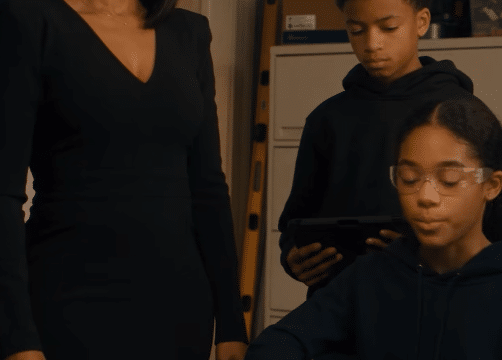
A woman in a long black coat emerged, followed by station security and the ticket counter supervisor. At fifty-nine, station director Margaret Lawson had spent years managing one of the region’s busiest transportation hubs. She knew the pressure of morning crowds, delayed trains, confused travelers, and ticket lines that seemed to grow longer by the minute.
But what she saw beside the counter was not a queue-management problem.
She hurried toward Mr. Miller as security moved between him and the attacker.
“Mr. Miller, I’ll file the federal complaint myself.”
The station supervisor looked stunned. The passengers fell quiet.
Margaret’s gaze moved from the injured man to the number display above the counter, then settled on the man in the blue suit.
The attacker seemed suddenly unsure of himself.
He had expected someone to tell Mr. Miller to move faster. He had expected the station to treat the incident as an argument between impatient passengers.
Instead, the station director was talking about a federal complaint.
“Federal complaint?”
For the first time, the man’s confidence gave way to fear.
He had assumed the man on the floor had no power to challenge him.
He was about to discover that the station had already been examining the very accessibility failures he had just turned into a public assault.
And this time, the evidence would not disappear into a forgotten customer-service report.
Act II
Mr. Miller’s first name was Daniel.
At thirty-three, Daniel Miller had learned how much of the world depended on sounds that other people barely noticed.
A station announcement. A cashier calling a name. A train employee shouting a platform change over the crowd. For hearing passengers, those details often arrived automatically, woven into the background of daily life.
For Daniel, they had to be replaced by visual information, written communication, or deliberate attention to the people and screens around him.
He had been Deaf since childhood and was fluent in American Sign Language. He also used written English to communicate with people who did not sign, especially when traveling alone.
He had spent years becoming an independent traveler.
He planned routes in advance, checked departure boards, kept digital copies of his tickets, and arrived early enough to account for unexpected changes. His small backpack contained his essentials, and he kept his ticket slip where he could reach it quickly.
That morning, he had arrived at the station with time to spare.
The ticket counter was crowded. Travelers were asking about connections, changing reservations, and purchasing tickets for trains leaving within the hour. The number display above the counter updated as the employee called passengers forward.
Daniel watched the screen carefully.
When the employee called a number aloud, Daniel did not react. He was looking down briefly to check his ticket slip and then back up at the display, unaware that the number had been announced.
The man behind him interpreted the missed call as deliberate obstruction.
His name was Peter Harlan, a forty-year-old consultant traveling in an expensive dark blue suit. He had a small rolling suitcase and a schedule he considered nonnegotiable. He had already been irritated by the crowd and worried about making an important meeting in another city.
Peter believed that efficiency meant people should respond immediately when spoken to.
When Daniel did not move, Peter assumed the worst.
He could have tapped the counter and asked the employee what was happening. He could have gestured toward the display. He could have waited another few seconds.
Instead, he attacked a stranger from behind.
That decision changed the morning for everyone in the station.
Margaret Lawson knelt near Daniel while the security team secured the area. She did not try to pull him to his feet. She asked the supervisor to arrange medical assistance and ensure that the path remained clear for responders.
Daniel’s ticket slip lay a short distance away. Margaret signaled for an employee to retrieve it only when the immediate area was safe, then made sure it was placed where Daniel could reach it.
She also made sure someone communicated with him directly rather than shouting questions from behind a crowd.
Daniel looked at her, breathing hard, and explained that he had not heard the number.
Margaret nodded.
She believed him, but belief was not the only reason she was taking the incident seriously. The station’s cameras could establish what had happened, and witnesses could provide their own accounts.
Peter began protesting that Daniel had blocked the line.
Margaret did not let him approach.
“Security will keep you here while the incident is documented,” she told him.
Peter objected that he had a train to catch.
The station director’s expression remained steady.
Daniel had also been trying to catch a train. The difference was that Daniel had not used the delay as an excuse to hurt someone.
Margaret had worked in transportation long enough to know that busy stations could become stressful places. Passengers missed announcements, misunderstood signs, stood in the wrong queue, or needed assistance with tickets. Employees were trained to manage those situations without turning them into personal confrontations.
Accessibility was part of that responsibility.
The station served thousands of travelers, including people who were Deaf or hard of hearing, people with limited mobility, older passengers, and visitors unfamiliar with the building. A system that relied only on spoken announcements could fail people even when everyone involved had good intentions.
Margaret had been reviewing those problems for months.
She had not expected to find one unfolding at her ticket counter in such a violent way.
As the medical team arrived, she asked the supervisor to preserve the camera footage and record the names of witnesses. Security kept Peter separated from Daniel while the authorities were contacted.
The station would not decide the legal case itself.
But it would not pretend this was simply a disagreement about whose turn it was.
Because Margaret knew something Peter had never bothered to consider: a missed announcement could be a communication problem. An assault was a choice.
And the difference would soon become central to everything that followed.
Act III
Margaret Lawson had spent nearly three decades working in transportation.
She began as a station operations coordinator, managing platform changes and passenger complaints at a smaller regional terminal. Later, she moved into senior management, overseeing staffing, safety procedures, and service improvements across several stations.
She had seen the same kinds of delays repeat themselves in different forms.
A train would arrive late, and passengers would crowd the ticket counter demanding explanations. An announcement would change a platform, and travelers unfamiliar with the station would head in the wrong direction. A connection would be missed, and someone already under pressure would look for a person to blame.
Most of those situations could be resolved with clear information and patience.
But Margaret had also learned that systems designed around a single way of communicating often left people behind.
A spoken announcement might be perfectly clear to someone standing nearby while remaining inaccessible to a Deaf traveler. A number display could be helpful, but only if it was positioned where passengers in the queue could actually see it. Staff could be polite and hardworking while still relying on procedures that did not serve everyone equally.
Months earlier, Margaret had commissioned an internal accessibility review after receiving several complaints about communication barriers at the station.
Some travelers had missed ticket calls because the counter relied on names or numbers being spoken aloud. Others had struggled to get clear written information when an announcement changed. The reports were not all evidence of deliberate mistreatment, but together they pointed to weaknesses in the way information was delivered.
Margaret wanted the station to provide reliable visual updates, clearer written guidance, and a consistent process for communicating with passengers who could not hear announcements.
The review was still underway when Daniel arrived.
Now the incident had exposed one of the central issues in the most terrible way possible.
The station cameras had captured Peter standing behind Daniel. They showed the employee calling the number and Daniel remaining focused on the display. They then recorded Peter’s attack and the subsequent kicks while Daniel lay on the floor.
The footage was preserved for the investigation. Witnesses were asked to provide statements, and station security documented the area without moving objects unnecessarily or circulating recordings outside the appropriate process.
Margaret reviewed the available footage with the station’s security lead.
She watched the moments before the attack carefully.
There was no sign that Daniel had threatened Peter. There was no apparent confrontation between them before Peter moved forward. Daniel was simply waiting for his turn, unaware that the employee had called his number aloud.
The recording contradicted the suggestion that the assault had been an accidental collision or a defensive reaction.
It showed a deliberate attack on a passenger who had not heard an announcement.
Margaret turned to the ticket supervisor.
“What are we supposed to do when someone doesn’t respond to a number call?”
The supervisor explained that employees usually repeated the number or called more loudly. If a passenger still did not react, staff might assume the person was distracted or had stepped away from the line.
The display showed the active number, but there was no consistent process for confirming that passengers could see it or for communicating directly with someone who had missed the call.
Margaret was silent for a moment.
The station had invested in digital displays, yet its procedures still depended heavily on announcements over loudspeakers. The system worked for many people, but it did not provide equal access to everyone.
That failure did not make the station responsible for Peter’s violence. No inaccessible sign or imperfect queue system had forced him to kick Daniel.
But it did mean the station had work to do.
Margaret asked the supervisor to document how ticket numbers were called, how the display updated, and whether the counter could offer a simple visual confirmation when a passenger did not respond.
She also directed the operations team to preserve any records relevant to the accessibility review. The complaint would be assessed through the appropriate channels, including consultation with the station’s legal and compliance staff.
Her statement about filing a federal complaint was not a declaration that a particular law had already been violated or that she could decide the outcome herself. It was a commitment to pursue the appropriate formal process, cooperate with the relevant authorities, and ensure that the incident was not buried as a routine passenger dispute.
Margaret understood that legal complaints required evidence and careful review.
She also understood that refusing to act because the process was complicated would send its own message.
Peter had believed the station would see only a delayed line.
Instead, the evidence revealed a passenger who had been assaulted after missing a spoken announcement, a set of witnesses who could describe what they saw, and a communication system that needed closer scrutiny.
Margaret looked toward the ticket counter again.
Above it, the number display continued to change.
For the first time that morning, she saw it not simply as a tool for organizing a queue, but as part of a promise the station had to keep: that passengers should have a fair chance to understand when it was their turn.
And that promise would now be tested beyond the ticket counter.
Act IV
The station’s response unfolded on two separate tracks.
The first concerned Peter’s assault on Daniel. The second concerned the station’s own accessibility procedures.
Margaret insisted that the two issues remain distinct.
The investigation into Peter’s conduct would rely on the preserved footage, witness statements, and other relevant evidence. The authorities would determine whether charges were appropriate and what legal consequences might follow.
The station would cooperate fully.
Peter, meanwhile, continued insisting that Daniel had deliberately stalled the line.
He claimed he had been under pressure and believed the other passenger was ignoring the employee. But the footage showed that Peter had escalated the situation without attempting to clarify what was happening.
He had not asked Daniel whether he had heard the number. He had not alerted the employee that the line was stalled. He had gone straight to violence.
The station removed Peter from the immediate area and restricted his access while the incident was reviewed under its safety policies. Security made sure he could not approach Daniel during the medical response or interfere with the documentation.
Margaret did not threaten to cancel his travel rights herself or promise an outcome beyond the station’s authority. Her responsibility was to protect passengers, preserve evidence, and cooperate with the proper process.
The second track required a different kind of work.
Margaret convened a meeting with the ticket supervisor, security lead, operations staff, and accessibility representatives. She wanted to know how the station could reduce the likelihood that a passenger would miss an important instruction simply because it had been delivered in a form they could not access.
The first change was straightforward: the ticket display would become a more reliable part of the counter process. Staff would ensure that called numbers appeared clearly and promptly, and that the display remained visible from the waiting line.
The team would also develop a procedure for confirming a passenger’s turn visually when the person did not respond to a spoken call. Staff could gesture toward the display, show a written number, or use another appropriate method rather than assuming the passenger was being uncooperative.
The station would review its signage and queue layout to make sure passengers could see the information without having to move into the counter area. Employees would receive guidance on communicating respectfully with Deaf and hard-of-hearing travelers, including how to ask whether written communication would help.
Margaret also wanted the station to examine its announcements beyond the ticket counter.
Platform changes, boarding instructions, and service disruptions could have serious consequences if they were communicated only through sound. The station needed to understand which information was available visually, how quickly displays were updated, and what staff should do when a passenger needed clarification.
These were practical changes, not a promise that every problem could be solved immediately.
Some required new procedures. Others required equipment adjustments, staff training, and regular checks to ensure that the changes remained effective during busy periods.
The accessibility review would also include feedback from Deaf travelers and other passengers who relied on visual information. Margaret did not want the station to assume that managers alone could predict every barrier.
During the meeting, the ticket supervisor admitted that staff had sometimes treated missed calls as inattentiveness.
Margaret listened carefully.
The supervisor had not attacked Daniel, and there was no evidence that the employee had intended to exclude him. But the station had relied on an assumption that was too easy to make and too difficult for some passengers to overcome.
A passenger who failed to respond might not have heard the call. They might not have understood the announcement. They might have been looking at a display that had not updated.
The correct response was to check—not to assume bad intent.
Margaret returned to Daniel once he was stable enough to communicate.
She explained that the station would cooperate with the investigation and that she intended to pursue the appropriate formal accessibility complaint process. She did not promise a particular legal finding or ask him to become the public face of the station’s reforms.
Daniel listened, then made his position clear.
He wanted what happened to be taken seriously, but he also wanted the station to make it easier for Deaf passengers to travel independently.
He did not want someone else to have to endure the same humiliation simply because a number had been called aloud.
Margaret agreed.
The phrase federal complaint had frightened Peter because it suggested that the incident might extend beyond an argument between two passengers. But the formal process was not about making an example of him for dramatic effect.
It was about documenting what happened, assessing the relevant responsibilities, and determining what action was justified by the evidence.
Margaret was prepared to see that process through.
And the station would not wait for its conclusion before correcting the practical problems it had already identified.
Act V
Several weeks later, Daniel returned to the station.
He had another train to catch, and he arrived with his small backpack and a ticket slip held carefully between his fingers. The memory of the assault had not disappeared, but he refused to let one man’s cruelty decide whether he could travel independently.
The ticket counter was busy again.
Rolling suitcases moved across the floor. Travelers checked their phones. An employee helped a family confirm a connection while another passenger waited to change a reservation.
Above the counter, the number display was easier to read from the queue. The active number updated promptly, and the station had introduced a clearer procedure for confirming a passenger’s turn when a spoken call did not reach them.
Daniel took his place in line.
When his number appeared, the employee called it as usual. Daniel did not hear the announcement, but he saw the number on the display.
The employee also gestured toward the counter.
Daniel stepped forward.
The interaction took only a moment. There was no confusion, no confrontation, and no demand that he explain why he had missed a sound.
It was an ordinary transaction.
That was the point.
Margaret watched from the management office doorway, checking the new procedure during the morning rush. She did not approach Daniel immediately or ask him to praise the changes. She wanted to see whether the system worked when no one was staging a demonstration.
It did.
After Daniel had finished at the counter, Margaret greeted him and asked whether the visual updates were clear from where he had been standing.
Daniel confirmed that they were easier to follow. He also suggested that the station continue checking the display during crowded periods, when passengers and luggage could obstruct the view.
Margaret wrote down the suggestion.
She had learned that accessibility was not a single installation or a one-time training session. A display could be well positioned in an empty station and difficult to see when the queue filled. A procedure could look simple in a meeting room and become confusing when employees were dealing with a service disruption.
The station needed to keep testing its systems under real conditions.
The review continued across ticket counters and boarding areas. Staff received guidance on accessible communication, managers checked that visual information was being updated reliably, and the station sought feedback from travelers who used different methods to receive information.
The changes did not erase the assault.
They did not make every station accessible overnight, and they did not guarantee that no passenger would ever be treated unfairly again. But they created a more dependable process for people who could not hear an announcement and reduced the chance that a missed call would be mistaken for deliberate obstruction.
The investigation into Peter’s conduct continued separately, with the available evidence handled through the appropriate channels. Margaret remained prepared to provide her account and cooperate with any formal complaint or proceeding for which her testimony was relevant.
She had not promised to control the outcome.
She had promised not to look away.
That distinction became the foundation of her response.
Peter had believed that because he was impatient, everyone else was obligated to move faster. He had mistaken his schedule for a universal priority and another person’s silence for a personal challenge.
He had treated Daniel as though a missed number were an act of disrespect.
But the ticket display had told a different story. Daniel had been trying to navigate the same system as everyone else, with one important difference: he could not hear the employee calling him.
The station’s job was not to make him prove that fact after something went wrong.
Its job was to provide information in a way passengers could access, and to respond appropriately when confusion occurred.
Margaret returned to her office after the morning review. On her desk lay the accessibility team’s latest report, filled with practical recommendations about displays, signage, queue flow, and staff communication.
She turned to the next page and began reading.
There would be more work. There would be budget decisions, operational questions, and procedures to revise. But the direction was clear.
A busy station would always involve waiting. Trains would be delayed, ticket lines would grow, and passengers would sometimes miss their turn.
None of those ordinary frustrations justified treating another person as less human.
Daniel left the counter and headed toward his platform, checking the visual departure information as he went. His backpack rested securely on his shoulders, and his ticket slip was safely in his pocket.
He was not leaving as a symbol of a legal battle or a lesson in corporate responsibility.
He was leaving as a traveler who had somewhere to go.
That was what the station should have protected from the beginning.
The most important part of Margaret’s promise had never been the word federal. It was her willingness to stand behind the truth, preserve the evidence, and make sure that an accessibility failure was not dismissed simply because the person affected could not hear a shouted number.
Peter had asked, in effect, why Daniel could not behave like everyone else.
The better question was why the system had assumed everyone received information in the same way.
And the answer would shape what the station did next.
A missed announcement is a problem to solve—not a reason to punish the person who couldn’t hear it.