Act I
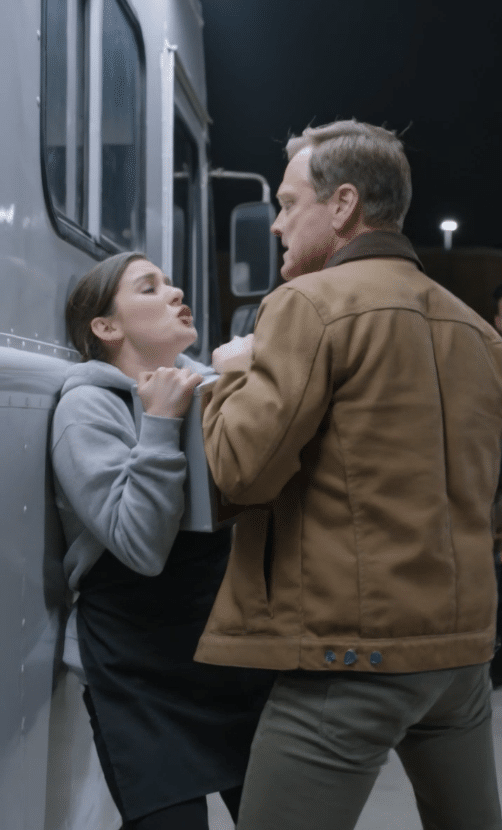
The cash box was almost empty when Frank Carter grabbed it from his daughter’s hands.
“Give it to me,” he snarled, yanking so hard that Emily Carter stumbled against the food truck counter. “I know you made money tonight. Don’t stand there pretending you’ve got nothing.”
Emily tightened both arms around the box.
It was nearly midnight in a small American parking lot. The food truck’s service window was closed, the last customers were preparing to leave, and the cold overhead lights cast long shadows across the concrete. Emily, twenty-four, wore a gray hoodie beneath her black apron, her brown hair tied back after a fourteen-hour shift.
Her feet ached. Her shoulders burned. She had spent the evening taking orders, cleaning the grill, restocking supplies, and serving strangers who rarely noticed how exhausted she was.
But she had counted every dollar twice.
The money was supposed to pay the next installment of her younger brother’s tuition at a military preparatory academy. For months, Emily had been putting aside tips, skipping meals out, and taking extra shifts whenever the owner needed help. She had learned to live with very little because she wanted Noah to have the one thing neither of them had ever possessed: a future that did not depend on their father.
Frank had other plans.
At fifty, he looked older than his years. His brown jacket hung crookedly from his shoulders, his eyes were red, and his unsteady posture carried the unmistakable signs of another night spent drinking. Gambling debts had followed him for years, each one supposedly his last. Every time someone refused to lend him money, he turned toward the people least able to refuse him.
His children.
Emily had once believed that if she worked hard enough, stayed quiet enough, and helped him through enough difficult nights, her father might eventually become the man she remembered from childhood.
That belief had cost her years.
“Dad, please,” she said, pulling the cash box against her chest. “This is for my brother’s tuition.”
Frank’s expression twisted.
“Trash. Your money is mine first.”
Emily stared at him. The words hurt, but not because they were new. She had heard versions of them since she was old enough to earn money of her own.
He had taken her first paycheck when she was sixteen, promising to repay it. He had borrowed from her savings when Noah needed school supplies. He had even sold a secondhand laptop Emily had bought for her brother’s studies, claiming the family needed the money more urgently.
The money was always urgent when Frank wanted it.
The promises were always forgotten afterward.
“Please,” Emily whispered. “Noah needs this. If I don’t pay by Friday, he could lose his place.”
Frank lunged for the box again.
Emily held on.
The slap came so suddenly that she had no time to protect herself. His hand struck across her face, driving her sideways into the metal edge of the truck.
The cash box flipped open.
Bills scattered across the concrete, catching briefly in the cold night breeze before settling beneath the truck and around Emily’s knees. She dropped hard to the ground, one hand flying to her mouth. A thin trace of blood appeared at the corner of her lip.
For a moment, all she could hear was the ringing in her ears.
Then Frank stepped toward her.
Emily curled over the scattered money, shielding the box with her body. He kicked her twice in the back and side, each impact forcing a strained breath from her lungs. She gripped the cash box with trembling fingers, refusing to let it go even as pain spread through her body.
Nearby, the last customers gasped.
A man holding a takeout bag stepped backward. A woman covered her mouth. Someone reached for a phone but hesitated, looking around as though waiting for another person to decide what should happen next.
Frank looked down at his daughter.
“I raised you,” he said viciously. “Now you pay me back.”
Emily lifted her face. Her eyes were wet, but she did not release the money.
She was no longer fighting for herself.
She was fighting for the brother who had spent his childhood hiding in his bedroom whenever their father came home angry. The boy who studied under a desk lamp because Frank had once threatened to sell the household furniture to cover a debt. The boy who had finally earned a chance to leave.
And just as Frank bent to grab the cash box, a pair of headlights swept across the parking lot.
A black sedan braked sharply beside the food truck.
The driver’s door flew open.
A young man in a clean academy uniform jumped out and ran toward them.
“Get away from my sister!”
Frank froze.
Because the boy he had spent years treating like a burden was no longer the frightened child he remembered.
And Noah Carter had not come back alone in spirit. He had come back with a future his father could neither buy nor take away.
Act II
Noah reached Emily in seconds.
He dropped to his knees beside her, placing himself between his father and the scattered bills. His short blond hair was neatly combed, and his academy uniform looked almost painfully out of place against the greasy metal of the food truck and the littered concrete.
He had been on his way home after a scheduled academy event when Emily stopped answering his messages.
At first, he assumed she was finishing her shift. She often worked late, and he knew she disliked texting while handling food or counting the register. But when he called the truck’s number and received no answer, an uneasy feeling began to grow.
Then one of Emily’s coworkers sent him a message.
Your dad is here. Something’s wrong.
Noah had asked the driver of the black sedan to turn around immediately. By the time they reached the parking lot, he could see the customers standing in a frightened cluster beneath the lights.
Then he saw Emily on the ground.
He had spent years imagining what he might do if his father ever hurt her again. In those imagined moments, Noah was always stronger, braver, and ready with the perfect words.
Now, with his sister struggling to breathe in front of him, every thought vanished except one.
Get her away from him.
Noah spread his arms, blocking Frank’s path.
“Don’t touch her.”
Frank stared at him.
For several seconds, neither man moved. Then Frank’s expression hardened into the familiar look he used whenever one of his children challenged him.
“Move aside, boy. This is a family matter.”
Noah did not move.
Emily reached weakly for his sleeve. He turned at once, crouching beside her while keeping his body between them and their father.
“I’m here,” he said softly. “I’ve got you.”
Emily tried to speak, but pain interrupted her. Noah looked at the blood at the corner of her mouth and felt something inside him go cold.
He had seen the aftermath of his father’s temper before. He had heard doors slam, watched plates shatter, and listened to Emily tell him to stay in his room while she tried to calm Frank down.
But he had never seen her on the ground like this.
Frank pointed toward the money.
“She owes me. I fed you both. I kept a roof over your heads. You think you get to walk away from everything I did?”
Noah slowly stood.
“You didn’t feed us for free,” he said. “You made Emily pay for everything you refused to provide.”
Frank gave a disbelieving laugh.
“Listen to yourself. You wear that little uniform for a few months, and now you think you’re somebody?”
Noah glanced down at his uniform.
For years, it had represented a dream that felt too expensive to admit aloud. He wanted to study, train, and build a career that would allow him to support himself without depending on anyone who could use money as a weapon.
Emily had protected that dream when she could barely afford to protect her own needs.
She had worked double shifts when Noah’s school fees increased. She had told him she was fine when she was exhausted. When Frank threatened to take his tuition money, she quietly moved the savings to an account he could not access.
Noah had only recently discovered how much she had sacrificed.
Now the money lay scattered around her, and their father was demanding it as if it belonged to him by birthright.
“You can’t take that money,” Noah said.
Frank’s eyes narrowed.
“It’s family money.”
“No. It’s Emily’s money. She earned every dollar.”
“And who raised her?”
The question had controlled the family for years. Frank used it whenever Emily tried to refuse him, as though bringing a child into the world created an endless debt that the child could never repay.
Noah finally understood that there was no answer his father would accept. Frank did not want repayment. He wanted obedience, and he wanted the right to call his selfishness a sacrifice.
A customer near the parking lot had already called 911. Another was gathering the bills that had blown farther from the truck, placing them on the counter rather than handing them to Frank.
Noah did not notice at first. His entire attention remained on Emily.
“Can you move your legs?” he asked her gently.
She nodded faintly, though she winced when she tried to sit up.
“Don’t try to stand yet. Help is coming.”
Frank scoffed.
“You’re making a scene over nothing.”
Noah looked at him.
“Look at her.”
For the first time, Frank glanced at Emily’s face. Whatever he saw there did not produce remorse. It produced irritation, as though the consequences of his actions were an inconvenience he had not agreed to.
He stepped toward them again.
Noah immediately moved between them.
And the expression on Frank’s face changed when he realized that his youngest child was no longer afraid to stand in his way.
But Noah’s courage had not appeared overnight. It had been built over years of watching Emily absorb the damage that their father left behind.
And the truth about those years was about to come out.
Act III
Their childhood had not always been defined by fear.
When Emily was little, Frank could be charming. He told jokes at the dinner table, brought home cheap toys from gas stations, and promised his children that one day they would have a house with a yard and a car that never broke down.
Their mother, Susan, had believed those promises for a long time.
She worked part-time at a medical office while raising the children, and she tried to shield them from the financial problems Frank created. When he lost money gambling, she found ways to stretch the household budget. When he missed a payment, she negotiated with creditors. When he apologized, she persuaded herself that the apology meant something.
But the cycle never ended.
After Susan died following a sudden illness, the family lost the one person who had been quietly holding everything together. Emily was twenty-one. Noah was fifteen.
Frank’s drinking worsened. His gambling debts grew. Bills went unpaid, and the children learned to recognize the sound of his car pulling into the driveway by the way the tires stopped against the curb.
Emily became the person who kept the household functioning.
She paid the electric bill when she could. She bought groceries. She worked at the food truck during the day and picked up cleaning shifts on weekends. She learned to hide cash where Frank would not think to look.
She also became Noah’s protector.
When he received his academy acceptance letter, he stared at it for nearly a minute before asking Emily if the scholarship was real.
He had earned a partial scholarship through his grades and extracurricular achievements, but tuition, fees, travel, and supplies still cost more than the family could easily afford.
Emily had read the letter over his shoulder.
Then she smiled.
“We’ll figure it out.”
Noah knew what those words meant. They meant extra shifts, cheap dinners, and Emily pretending that her worn-out shoes were still good enough. He tried to tell her that he could choose a less expensive school.
She refused.
“You worked too hard to give up now,” she told him.
Frank, meanwhile, treated the scholarship as another source of money he might eventually access. At first, he asked whether the academy provided a stipend. Then he wanted to know how much Emily had saved. When she refused to tell him, he accused her of hiding money from her own family.
The irony was unbearable.
He had spent years taking money from the family, yet he considered the money they earned to be his property.
Noah eventually learned that Emily had been keeping a notebook of every tuition payment, every deposit, and every expense. She had recorded dates and amounts because she feared Frank might later claim she had taken money that belonged to him.
The notebook was not a dramatic secret ledger. It was a tired young woman’s attempt to protect herself with the only thing she had: proof.
It also helped Noah understand the scale of her sacrifice.
She had been putting money aside for nearly a year. Every tip she saved represented something she had chosen not to buy for herself. Every late shift had been another evening she could have spent resting.
When Noah asked why she never told him how difficult things had become, Emily gave him a small, exhausted smile.
“Because you’re supposed to be worrying about your future, not whether we can afford it.”
That answer stayed with him.
So did the night Frank discovered the tuition envelope hidden in a kitchen cabinet. He demanded to know why Emily had money while he was struggling. When she refused to hand it over, he accused her of betrayal and threatened to make Noah abandon the academy.
Emily stood in front of the envelope until Frank finally stormed away.
Afterward, she moved the money and began depositing it into a separate account. She also told Noah that if Frank ever threatened him over tuition, he should contact her immediately rather than confront their father alone.
Neither sibling imagined that the next confrontation would happen beside a food truck, with strangers watching and the tuition money scattered beneath the parking lights.
Noah had once believed that getting into the academy would solve their problems. He thought distance might soften their father’s anger and that success might eventually make Frank proud.
Now he understood something more painful.
Their father did not resent their failures.
He resented any future he could not control.
And while Noah had been learning discipline and responsibility at the academy, Emily had been fighting to keep that future alive with every dollar she earned.
The cash box on the concrete was not simply a collection of bills.
It was the price of her exhaustion, her hope, and the years she had spent making sure her brother would not have to repeat their childhood.
Frank had attacked her because he believed he could still take everything from them.
He had failed to understand that the two people he had spent years dividing were finally standing together.
And when the police arrived, Noah was ready to make sure the truth could no longer be buried beneath another apology.
Act IV
The flashing lights appeared at the entrance to the parking lot just as Noah helped Emily settle against the side of the truck.
He did not attempt to carry her or force her to stand. He stayed beside her, speaking quietly while the paramedics assessed her injuries. She was frightened and in pain, and he could see her trying to minimize what had happened even now.
“I’m okay,” she whispered.
“You don’t have to be okay right now.”
The words made her eyes fill.
For years, Emily had treated endurance as a responsibility. If Frank shouted, she absorbed it. If he took money, she worked to replace it. If Noah became frightened, she reassured him. She had convinced herself that the family would survive as long as she could keep everything from falling apart.
But sitting beside her brother while strangers gathered evidence of what their father had done, she could no longer pretend that enduring the abuse was the same as protecting her family.
The paramedics recommended further medical evaluation. Noah insisted she accept it, and Emily finally agreed.
Meanwhile, officers separated Frank from his children and began gathering accounts from the witnesses. The food truck’s security camera had captured part of the confrontation, while a nearby business had an exterior camera facing the parking lot.
The scattered money was collected and counted. The cash box was photographed where it had fallen. Witnesses were asked to describe what they had seen independently, without comparing accounts.
Frank immediately began trying to control the story.
“She attacked me first,” he claimed.
One of the officers asked him to explain exactly what he meant.
“She wouldn’t give me money. She grabbed the box. I was trying to get it back.”
“That doesn’t explain why you struck her,” the officer replied.
Frank’s jaw tightened.
“She was disrespecting me.”
Noah heard the words from several feet away.
Disrespect.
It was the word Frank had used whenever Emily refused to give him her paycheck, whenever Noah asked him to stop drinking, whenever either child tried to establish a boundary. It turned every act of self-protection into an offense and every demand for obedience into an alleged debt.
Noah stepped forward, but an officer asked him to remain where he was until they finished taking statements.
He complied.
He had spent years wanting to make his father understand. Now he knew that understanding was not something he could force out of him. What mattered was that the evidence be preserved and the assault reported accurately.
One of the customers who had watched the attack came forward. She had been afraid to intervene while Frank was kicking Emily, but she had recorded a portion of the incident on her phone.
“I should have done something sooner,” she said quietly.
Noah looked at her. He was still furious, but he could see that she was shaken.
“Thank you for staying and telling them what happened,” he replied.
It was not forgiveness for the silence. It was recognition that, at least now, she was helping.
The food truck owner arrived after receiving a call from the employee who had closed the service window. He confirmed that Emily was employed there and that the money in the box represented her earnings and tips, set aside for personal expenses and her brother’s tuition.
He also offered to provide work records and payment information to investigators.
Frank’s claim that the money belonged to him began to collapse under the weight of ordinary facts.
Emily had earned it. She had counted it. She had documented her savings. She had told him what the money was for before he attacked her.
The officers did not need to settle the entire family’s history in the parking lot. They needed to establish what had happened that night, preserve relevant evidence, and follow the appropriate procedures.
As the investigation proceeded, Frank was no longer able to dictate what everyone was allowed to remember.
Noah watched him standing beneath the harsh lights, his brown jacket hanging loosely, his anger slowly giving way to uncertainty.
For the first time, Frank seemed to realize that his son was not going to beg him to calm down or promise to keep the incident private. Noah was willing to answer questions, provide information about earlier incidents where relevant, and let the evidence speak for itself.
“You’d really do this to your own father?” Frank demanded.
Noah’s face tightened.
“You did this to your own daughter.”
Frank looked away.
The words landed harder than any threat Noah could have made. They left no room for the familiar argument about respect, gratitude, or family obligations.
By the time Emily was taken for medical evaluation, the scattered bills had been secured, the witnesses had given their statements, and the initial evidence had been preserved. The legal process would determine the consequences of the assault, while the siblings would decide what contact, if any, was safe for them in the future.
Noah climbed into the sedan to accompany Emily.
Before the door closed, he glanced back at his father.
Frank stared at him, his face drained of the certainty that had sustained him for years.
“You… who are you now?”
Noah paused.
He could have answered with his academy, his scholarship, or the future Emily had sacrificed so much to protect. He could have told his father that he was no longer the boy who hid in his bedroom whenever a door slammed.
Instead, he gave the simplest answer.
“I’m the person who’s done letting you hurt her.”
Then he closed the door.
But the most difficult part of their story was not over. Frank could be investigated and held accountable for what he had done that night. The deeper question was whether Emily and Noah could finally build lives that no longer revolved around managing his next crisis.
Act V
Emily woke the next morning in a hospital room with soreness spreading across her back and side.
For several seconds, she could not remember where she was. Then she noticed Noah asleep in a chair beside the bed, still wearing his academy uniform, his blond head tilted awkwardly against the wall.
She moved slightly and winced.
Noah woke immediately.
“Hey. Don’t try to get up yet.”
“I’m fine,” she began automatically.
He gave her a tired look.
“You don’t have to say that to me.”
Emily turned toward the window.
The words should have been comforting. Instead, they opened something she had been holding shut for years. She began to cry quietly, embarrassed by how quickly the tears came and unable to stop them.
Noah moved his chair closer.
“I thought I could keep it from getting this bad,” she whispered.
“You didn’t make him do this.”
“I should’ve called someone earlier. I should’ve—”
“No.” Noah’s voice was firm, but gentle. “You worked every day to protect me. None of this was your fault.”
Emily covered her face.
She had spent so long believing that if she made the right decisions, she could prevent the worst things from happening. If she hid the money better, chose her words carefully, or waited until Frank was sober, perhaps he would finally leave them alone.
The previous night had destroyed that illusion.
There was no perfect way to manage another person’s cruelty. No amount of patience could turn violence into love, and no amount of sacrifice could guarantee that a person would stop taking.
For the first time, Emily allowed herself to consider a different kind of future.
One in which she did not have to live on alert.
One in which Noah could attend school without worrying about whether his tuition would disappear.
One in which their father no longer had automatic access to their home, their earnings, or their forgiveness.
Over the following days, Emily focused on recovering. The incident was reported, and investigators continued reviewing the witness statements and available footage. The process moved forward according to the evidence, not according to the family’s wishes or Frank’s explanations.
Emily and Noah also began putting practical protections in place. They secured their financial records, changed access to accounts where necessary, and sought advice about keeping Frank away if he attempted to threaten or harass them again.
Noah returned to the academy when he was able, but something in him had changed.
Before that night, he had thought success meant getting far enough away from his childhood that it could no longer touch him. Now he understood that building a future also meant deciding what he would not carry into it.
He would not measure love by how much abuse a person could endure. He would not mistake guilt for responsibility. And he would never again assume that protecting his sister meant allowing her to protect everyone else alone.
Emily, too, began making choices that were not simply reactions to Frank’s demands.
She spoke with her employer about adjusting her schedule while she recovered. She accepted help from trusted friends instead of pretending she could manage everything herself. She continued saving for Noah’s education, but she also started putting a small amount aside for her own plans.
It was the first time in years that her savings had included something for Emily Carter.
Not just the worker in the black apron.
Not just the daughter who was expected to repay the cost of being raised.
A person with a life of her own.
Months later, when Noah returned home for a short break, the siblings sat together at the kitchen table and reviewed the tuition account. The balance was secure. The next payment was covered. The notebook Emily had kept for so long sat beside them, filled with careful figures and dates.
Noah touched the worn cover.
“You shouldn’t have had to do all this by yourself.”
Emily smiled faintly.
“I know that now.”
He looked at her for a moment before speaking again.
“When I graduate, I’m going to help you.”
She started to protest, then stopped.
For years, she had refused to let Noah feel indebted to her because she knew what it was like when love became a bill someone could collect. She did not want him to believe his future belonged to her in exchange for what she had sacrificed.
So she shook her head.
“You don’t owe me your life, Noah.”
“I know,” he said. “That’s why I want to help.”
The distinction mattered.
Frank had demanded repayment for raising his children, using the past as a weapon to control their future. Noah was offering support without a threat attached, gratitude without ownership, love without a price.
Emily reached across the table and took his hand.
Outside, traffic moved past the house, and somewhere in the distance a truck engine rumbled along the road. The sound reminded her of the parking lot, the cold lights, and the money scattered across the concrete.
She remembered how tightly she had clutched the cash box while Frank kicked her. At the time, she had believed that if she let go of the money, she would be surrendering Noah’s future.
Now she understood that she had been protecting something bigger than tuition.
She had been protecting their chance to leave the past behind.
Frank had believed that being their father gave him the right to take whatever they earned. He had mistaken the sacrifices they made for proof that he could demand more. And when Emily finally refused him, he tried to force obedience through fear.
But that night, beneath the parking lot lights, his children stopped accepting the rules he had written for them.
Noah stepped between his father and his sister, not because he had become powerful enough to intimidate Frank, but because he had finally understood that family did not mean standing silently while someone was hurt.
Emily kept the money she had earned. Noah continued toward the future she had worked so hard to protect. And the consequences of Frank’s actions were left to the evidence and the proper legal process—not to another private bargain in which his children were expected to forgive him before he had changed.
The most important thing they reclaimed was not the cash scattered beside the food truck.
It was the right to decide what happened next.
Because a parent may give a child life, but that does not give the parent ownership of every year that follows.
And love is not a debt that can be collected with a raised hand.
Sometimes, the bravest thing a family can do is stop paying for someone else’s mistakes—and finally choose a future of their own.