Act I
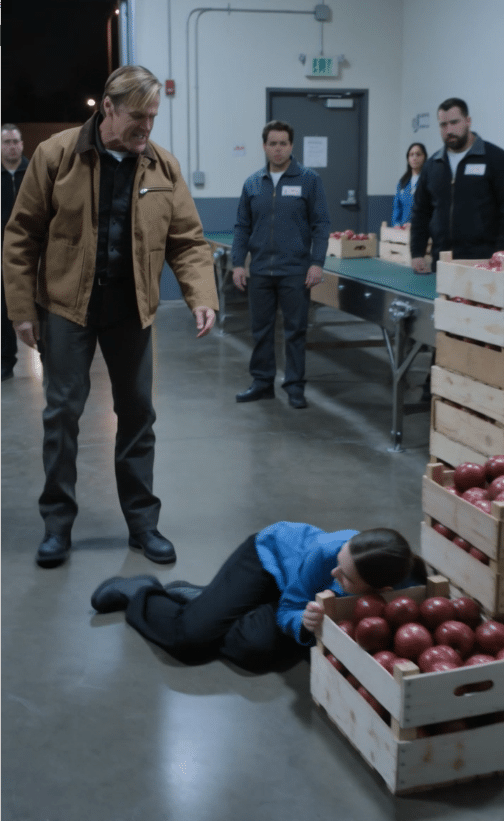
The paycheck was halfway out of Lily Harper’s hand when her father kicked her in the chest.
She flew backward into a stack of low fruit crates, sending apples rolling across the cold concrete floor. The envelope slipped from her fingers and skidded beneath a conveyor belt. For a moment, the only sound in the midnight packing facility was the hollow clatter of fruit bouncing against metal.
Lily struggled to breathe.
At twenty-two, she had already learned how to work through exhaustion, how to stretch a few dollars across a week of groceries, and how to smile at coworkers when she had barely slept. She wore a blue work jacket, black work pants, and gloves stained faintly from hours of handling fruit. Her light brown hair was tied back, and her face carried the gray fatigue of another night shift.
But she had been smiling when she received her paycheck.
It was not a fortune. After deductions, it was barely enough to cover her rent, groceries, and the overdue electric bill waiting on her kitchen counter. Still, it was hers. Every dollar represented hours spent standing beside a conveyor belt, checking fruit for damage, packing boxes, and lifting crates until her arms trembled.
She had counted the money twice before leaving the payroll office.
Now her father, Ray Harper, stood over her as though he had every right to take it.
“Get up and give it to me,” he demanded.
Ray was fifty-two, broad-shouldered, and dressed in an old brown jacket that smelled faintly of stale cigarettes and cheap liquor. His expression carried the familiar certainty of a man who had spent years treating other people’s boundaries as personal insults.
Lily pressed a hand against her chest and reached toward the scattered apples.
“Dad, please.” Her voice shook. “I need this for rent and food.”
Ray stared at her with contempt.
“Trash. I fed you first.”
A few yards away, the remaining night-shift workers had stopped moving. One man stood beside a stack of cardboard boxes with his mouth slightly open. A woman covered her lips with one hand and backed away between two fruit crates.
No one stepped forward.
They had seen Ray block Lily’s path near the exit. They had watched him grab for the envelope. And now they had watched him knock his own daughter to the floor because she refused to surrender the money she had earned.
Lily crawled toward the paycheck.
Ray stepped in front of her.
“That paycheck belongs to me.”
She looked up at him, stunned by the ease with which he said it.
He spoke as though he had personally stood beside her through every exhausting shift. As though he had paid her rent, packed her lunches, and worried about whether she could afford to eat.
The truth was that Lily had been supporting herself for nearly two years.
Ray had contributed little beyond excuses, demands, and the occasional promise that he would repay the money he borrowed. Whenever she resisted, he reminded her that he had raised her, as if childhood were a debt that could never be paid off.
Lily had spent years trying to believe that one day he might understand how much he was hurting her.
Tonight, she had only wanted to take her paycheck home.
She reached beneath the conveyor belt, her fingers brushing the edge of the envelope.
Ray kicked her again.
Lily curled around her side, grimacing as pain spread through her back. She still tried to reach for the money. The envelope had become more than a piece of paper. It was the difference between paying her landlord and facing another humiliating conversation about overdue rent.
“Stop,” she whispered.
Ray did not listen.
He delivered another forceful kick into her side, and Lily drew her arms around herself. A thin trace of blood marked her forearm where it had struck the crate. She closed her eyes, trying to breathe through the pain.
Then she heard an engine outside.
A white company pickup braked hard beyond the facility doors.
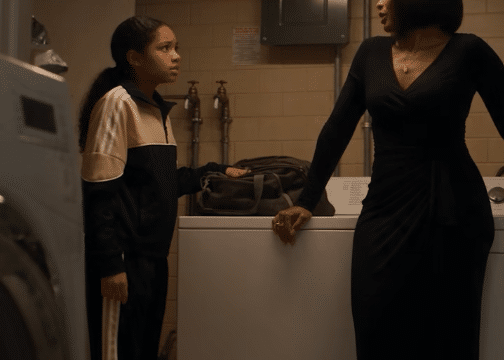
The headlights swept across the silent conveyor belts and illuminated the scattered apples. A moment later, the doors opened, and a silver-haired woman in a long black coat strode inside.
She saw Lily on the floor.
She saw Ray standing over her.
And she saw the paycheck envelope beneath the conveyor belt.
Her expression changed.
“Put her paycheck in my hand.”
Ray turned toward the unfamiliar voice.
For the first time that night, he looked uncertain.
He had expected frightened workers, a daughter too exhausted to resist, and perhaps a supervisor who would tell everyone to stop making a scene.
He had not expected the owner of the entire facility to walk through the doors and take an interest in the envelope he was trying to steal.
And he was about to discover why Margaret Stone had come to the plant after midnight.
Act II
Margaret Stone crossed the floor without hesitation.
At fifty-eight, she had spent decades building the fruit-packing business from a modest regional operation into a company supplying grocery stores across several states. She wore a dark work suit beneath her coat, and there was nothing hurried or uncertain about the way she moved.
Yet when she reached Lily, her first concern was not the broken rhythm of the night shift or the fruit scattered across the floor.
It was the young woman struggling to sit up.
Margaret signaled for the facility supervisor to call emergency services and instructed security to keep Ray away from Lily. Only then did she turn toward the envelope.
“Put it in my hand,” she repeated.
Ray glanced from Margaret to the paycheck.
“Who do you think you are?”
“Margaret Stone. I own this facility.”
The words seemed to travel through the room faster than any announcement over the loudspeaker.
The workers straightened. The supervisor hurried forward. A man near the time clock lowered the phone he had been holding, finally understanding that the person who had arrived was not another employee who could be intimidated into silence.
Ray’s face tightened.
“This is a family matter.”
Margaret looked at Lily, who was still trying to reach the envelope.
“No,” she said. “A family relationship does not give you the right to assault someone or take money they earned.”
Ray let out a short, bitter laugh.
“You don’t know anything about us. I raised her. I put a roof over her head. I fed her when she couldn’t do anything for herself.”
Lily flinched at the familiar words.
For years, Ray had used her childhood as a weapon. He could turn any refusal into an accusation of ingratitude, any boundary into betrayal. Even when Lily was the one paying for groceries, he spoke as though she were a dependent child who owed him obedience.
Margaret had heard versions of this excuse before. Sometimes it came from a manager defending mistreatment. Sometimes from a customer demanding special privileges. Sometimes from someone who believed that providing the bare minimum entitled them to control another person’s entire life.
She did not argue about what Ray claimed to have done years earlier.
She focused on what he had done now.
“You can explain your relationship to the police,” she said. “Right now, you’re standing over an injured employee.”
Ray looked around, searching the faces of the workers for someone who might agree with him.
No one did.
He turned back toward Lily.
“Tell her what’s going on. Tell her you owe me.”
Lily swallowed painfully.
She wanted to say that she owed him nothing. She wanted to list every bill she had paid, every shift she had worked, and every time she had lent him money only to discover that it had gone toward another gambling loss or another night of drinking.
But she was exhausted, hurt, and afraid of what would happen after Margaret left.
So she reached for the envelope instead.
Margaret noticed.
“Don’t try to stand yet,” she told Lily gently. “Let the medical team check you first.”
Lily’s eyes filled with tears.
“It’s my paycheck,” she whispered.
“I know.”
“Rent is due.”
“I know,” Margaret repeated. “We’re going to make sure your wages are protected.”
The promise was simple, but Lily had rarely heard an adult make one without attaching a demand to it.
Margaret turned to the supervisor and instructed him to preserve the security footage, record the incident, and keep the payroll documentation available. She wanted the paycheck accounted for, not simply handed around until someone claimed it belonged to them.
Ray took a step backward.
“You can’t just take my daughter’s money away from me.”
Margaret met his gaze.
“It was never yours to begin with.”
The room fell silent.
For the first time, Ray seemed to realize that his usual tactics were not working. He could not intimidate Margaret with accusations of family loyalty, and he could not convince the workers that Lily’s paycheck belonged to him simply because he had once been her parent.
Still, he was not ready to surrender.
He pointed toward Lily.
“She wouldn’t even have a job if she hadn’t been raised right. She should be grateful.”
Lily looked down at her hands.
She had heard those words at the kitchen table, in the driveway, and outside her bedroom door. She had heard them when she refused to lend Ray money, when she asked him to stop entering her apartment without permission, and when she finally told him she would no longer cover his debts.
Every time, he had made her feel as though she were the one committing an offense.
But Margaret had begun asking the supervisor questions, and the answers were exposing something Ray had not considered.
The facility’s records could show exactly who had earned Lily’s wages. The payroll system could show where the money belonged. The security footage could show how the envelope had ended up on the floor.
For once, Ray’s version of events would not be the only one anyone heard.
And as the supervisor returned with the payroll records, Margaret learned that Lily’s struggle had begun long before that night.
Act III
Lily Harper had not always been afraid of her father.
When she was a little girl, Ray carried her on his shoulders at county fairs and bought her ice cream after school. He could be funny and affectionate when life was going his way. He told stories about working hard, standing by family, and never turning away from someone who needed help.
Lily believed him.
Her mother, Diane, used to say that Ray had a good heart buried beneath a difficult temper. For years, she encouraged Lily to remember the good days whenever the bad ones became overwhelming.
But the good days grew less frequent.
Ray lost one job, then another. He began borrowing money from relatives and making excuses when they asked for it back. After his gambling debts mounted, he started drinking more heavily. Arguments over bills became arguments over respect, and soon almost any disagreement could end with Ray shouting that no one appreciated what he had done for them.
When Diane died, the household changed completely.
Lily was nineteen. She had been taking community college classes and working part-time at a grocery store. She wanted to study accounting, perhaps eventually manage a small business of her own. Her mother had encouraged her to keep going, even when money was tight.
After Diane’s death, Ray stopped paying several household bills and began treating Lily’s income as a family resource he could access whenever he needed it.
At first, she agreed to help.
She paid the electricity bill. She bought groceries. She covered a car repair that Ray promised to repay. She told herself that grief had made him unstable and that, given enough time, he would return to the father she remembered.
But the requests never stopped.
When Lily moved into a small apartment near the packing facility, Ray called it abandonment. When she refused to hand over her debit card, he accused her of becoming selfish. When she asked him to stop coming by without warning, he reminded her that he had once paid for her school clothes.
It did not matter that she now paid her own rent.
It did not matter that she worked nights so she could take occasional classes during the day.
In Ray’s mind, her independence was an insult.
Lily had learned to avoid arguments rather than win them. She kept her apartment spare and inexpensive, bought groceries on sale, and saved whatever she could after rent and utilities. Her dream of returning to school had not disappeared, but she postponed it each semester because something always seemed more urgent.
Usually, the urgent thing was one of Ray’s problems.
The packing facility became the first place where her effort translated into something dependable. She could clock in, do her work, and see the results reflected in her paycheck. Her supervisor valued her reliability. She rarely missed a shift, and she learned enough about the packing process to help train new employees.
She took pride in that.
The paycheck she had received that night represented more than money for rent and food. It was proof that she could build a life on her own terms.
Ray had learned when payday came.
He had called her earlier that evening, asking whether she would be home after her shift. Lily told him she would be working late. He appeared at the facility anyway, waiting near the exit where he knew she would have to pass.
She had tried to walk around him.
He demanded the envelope.
When she refused, he accused her of forgetting everything he had done for her. He told her she was a bad daughter, that she owed him, that he had sacrificed his life to raise her.
Then he attacked her.
Inside the packing facility, Margaret listened as the supervisor explained Lily’s work history. She learned that Lily had been dependable, that her wages were processed normally, and that there was no record of any arrangement authorizing Ray to collect them.
The supervisor also confirmed that the envelope belonged to Lily and had been issued directly to her.
Margaret asked whether Lily had ever complained about being harassed at the facility.
The supervisor shook his head.
“She usually just tries to avoid trouble. She doesn’t like asking for help.”
Margaret looked toward the young woman sitting near the crates while paramedics examined her.
She recognized the pattern. People who were repeatedly told they were selfish for protecting themselves often became skilled at hiding the cost of keeping everyone else comfortable.
Lily had not been weak. She had been carrying too much for too long.
When the paramedics asked whether she felt safe returning home, she hesitated.
That hesitation told Margaret more than a long explanation could have.
Lily finally admitted that Ray sometimes showed up at her apartment demanding money. She had changed her locks once after he entered without permission, but he continued to pressure her by phone and through relatives who believed she should help him because he was her father.
She had never reported the behavior.
She feared that doing so would make the family situation worse. She also worried that no one would take her seriously unless the violence became impossible to deny.
Now the violence had happened in a workplace filled with witnesses, under industrial lights, with security cameras recording the truth.
Margaret could not undo what Lily had endured. She could, however, make sure the facility did not become another place where her wages and safety were treated as negotiable.
And the records in the supervisor’s hands would help ensure that Ray could no longer disguise theft as family obligation.
Act IV
By the time the first officers arrived, the facility had become a carefully preserved scene.
The conveyor belts remained silent. Fruit crates were left where they had shifted during the assault, and the paycheck envelope had been secured for documentation. The workers who had witnessed the confrontation were asked to provide their accounts separately.
Ray immediately tried to explain everything away.
“She wouldn’t give me money,” he insisted. “I was trying to get what my family owes me.”
One officer asked him what he meant by owes.
“I raised her.”
“That doesn’t establish ownership of her wages,” the officer replied.
Ray’s face darkened.
He tried to argue that Lily was ungrateful, that he had sacrificed for her, and that Margaret was interfering in a private dispute. But the more he spoke, the clearer it became that he was offering justifications for his demands rather than an explanation for the violence.
The witnesses described the confrontation. The security footage was preserved for review. The supervisor provided the payroll records confirming that the paycheck had been issued to Lily.
No single document told the whole story, but the evidence was consistent on the central point: Ray had tried to take money that did not belong to him, and he had assaulted Lily when she refused.
Margaret did not attempt to conduct a criminal investigation herself. She made sure the company cooperated with law enforcement and that the workers were not pressured to change or soften their statements.
She also asked the supervisor to ensure Lily’s employment and pay records were secure, and that she would not lose wages or face disciplinary action because the incident had occurred after her shift.
It was a small but important distinction.
Lily had already been hurt. She should not have to fear that reporting the assault would cost her the job she depended on.
Ray watched Margaret speaking to the supervisor and grew increasingly agitated.
“You’re acting like she’s some kind of victim,” he said. “She’s my daughter.”
Margaret turned toward him.
“She can be your daughter and still have the right to say no to you.”
He scoffed.
“You don’t understand family.”
“I understand that people use the word family to demand things they would never be entitled to take from a stranger.”
Ray opened his mouth, but for once, no answer came quickly enough.
Margaret continued, her voice calm.
“Your daughter’s wages belong to her. Her home belongs to her. Her decisions belong to her. None of those things changes because you raised her.”
The words landed in the silence.
Lily looked up. She had heard people tell Ray he was wrong before, but rarely in a way that did not end with someone asking her to compromise to keep the peace.
Margaret was not asking her to forgive him. She was not asking her to reconsider what had happened or to protect the family name.
She was simply stating that Lily had rights that did not disappear because her father disliked them.
The officers continued their work. Ray was given the opportunity to respond to the allegations, and the evidence was handled through the appropriate process. Any criminal consequences would be determined by the authorities and the courts, not by Margaret’s personal anger.
But the workplace had its own responsibilities.
Margaret instructed management to document the incident formally and review access procedures for visitors after shifts. She wanted the facility to establish clear steps for employees who faced harassment or threats, including a direct way to contact security without having to confront an aggressive person alone.
She also arranged for Lily to receive her paycheck through a secure process once the evidence requirements had been addressed. The company would not allow the envelope’s temporary loss or the incident itself to interfere with the payment of wages she had earned.
When the supervisor brought the envelope back, Margaret checked that the payroll information was intact.
Then she handed it to Lily.
Lily held it in both hands.
For a few seconds, she could not speak. She had spent the entire night fighting to keep something that should never have been in danger. Now the money was back where it belonged, but the realization that she had been forced to defend it from her own father hurt almost as much as the injuries.
Margaret crouched slightly so they were at eye level.
“You don’t have to decide everything about your family tonight,” she told her. “Right now, you need medical care and a safe place to recover.”
Lily nodded, tears slipping down her face.
Ray stood several feet away, watching the envelope in her hands. It was only paper and numbers, but to him it had represented control. If he could take Lily’s paycheck, he could force her to listen, force her to negotiate, and force her to remain tied to him through guilt.
Now the envelope was back in her possession, and the people around him had stopped treating his demands as normal.
He looked at Margaret, bewilderment replacing the anger in his face.
“Who are you?”
She did not answer with her title or her business success.
“Someone who knows that a paycheck belongs to the person who earned it.”
For the first time, Ray had no authority to invoke, no familiar accusation that could immediately silence his daughter, and no crowd willing to look away forever.
But Lily’s real turning point would come later, when she had to decide whether she would continue organizing her life around the possibility that he might change.
Act V
Lily spent the next few days recovering from her injuries and trying to understand how quickly an ordinary night had changed her life.
The physical pain was manageable with medical care, but the memories returned at unexpected moments. She would reach for her keys and remember Ray waiting near the exit. She would hear a heavy footstep behind her and feel her shoulders tighten. When payday approached again, she found herself checking the locks on her apartment twice.
She had never imagined being afraid of receiving her own wages.
Margaret’s staff followed up with her after the incident. The company confirmed that the paycheck had been accounted for and that Lily’s employment would not be affected. Her supervisor also made sure she could take the time she needed to recover, without being pressured to return before she was ready.
For once, help did not arrive with a demand attached.
The investigation continued through the proper channels. Witness accounts and the available footage were reviewed, and Ray’s actions were handled as an assault allegation rather than dismissed as a disagreement between relatives. The company provided records when requested and did not interfere with the process.
Lily also began taking steps to protect herself outside work.
She spoke with a local support service about the repeated financial pressure and unwanted visits. She changed her routines, limited Ray’s access to her personal information, and made it clear to relatives that she would no longer give him money simply because he demanded it.
Some family members were supportive. Others told her she was going too far.
“He’s still your father,” one relative said during a phone call.
Lily closed her eyes.
For years, that sentence had been enough to make her reconsider every boundary she tried to set. It made her feel that the violence, the demands, and the fear were all secondary to a title Ray had earned when she was born.
This time, she answered differently.
“Being my father doesn’t give him the right to hurt me.”
The relative fell silent.
Lily did not explain herself further. She was tired of presenting a complete legal argument for why she deserved to feel safe.
The packing facility changed in smaller ways, too. Management established clearer procedures for employees leaving late shifts, reviewed how visitors could enter the facility after hours, and made sure workers knew whom to contact if someone threatened them near the exit.
Margaret did not describe those changes as a grand victory. She knew no procedure could prevent every act of violence. But a worker should not have to rely on the unlikely arrival of the company owner to receive protection.
That was the lesson she carried from the incident.
A workplace had responsibilities beyond paying people on time. It also had to take reasonable steps to protect them when danger appeared on its premises.
Lily returned to work when she was ready.
The conveyor belts were moving again. Fruit rolled down the line in neat rows, and the cold industrial lights shone across the crates. The familiar rhythm of the facility helped her settle into the shift, though she occasionally glanced toward the exit.
Her supervisor greeted her without asking her to recount the incident. A coworker left a cup of coffee beside her station. Another quietly told her that the witnesses had appreciated the chance to give their statements.
No one treated her as a problem that needed to be managed.
They treated her as Lily.
On payday, she collected her wages and deposited most of the money directly into her bank account. She paid her rent, bought groceries, and set aside a little for the accounting course she had postponed for years.
The first evening she sat down with the course information, she felt almost foolishly nervous. She had spent so long postponing her own plans that choosing one for herself seemed unfamiliar.
Then she remembered her mother’s voice.
You don’t have to solve your entire life in one day.
Lily registered for the course.
It was not a dramatic transformation. She still had bills to pay, work to do, and difficult decisions ahead. She did not suddenly become fearless, and the harm Ray had caused did not vanish because she had taken a positive step.
But her future no longer belonged entirely to the demands of the past.
Months later, Margaret visited the packing facility during a routine review. Lily was checking a shipment near the end of the line when the owner stopped beside her.
“How are you doing?” Margaret asked.
Lily considered the question instead of giving the automatic answer she once used to keep people from worrying.
“Better,” she said. “I’m working. I’m studying again. And I’m learning that I don’t have to fix everything for everyone.”
Margaret smiled.
“That sounds like progress.”
Lily looked down the conveyor belt, where apples moved steadily toward the packing stations.
For years, she had believed that being a good daughter meant giving until there was nothing left to give. She had mistaken endurance for loyalty and self-denial for love. When Ray told her that he had fed her first, she had felt the old instinct to apologize—even while she lay injured on the floor.
Now she understood that gratitude did not require surrender.
She could remember the good moments of her childhood without pretending the bad ones had never happened. She could care about her father without giving him control of her paycheck. She could wish that he would change without making her safety dependent on that hope.
And she could build a life that belonged to her.
The paycheck that night had been small compared with the losses Ray had caused over the years. But it marked a boundary that could no longer be ignored.
He had believed that raising a child gave him permanent ownership of the adult she became. He had treated her wages as his property, her exhaustion as weakness, and her refusal as betrayal.
Margaret’s intervention did not erase the past or decide every consequence that followed. It did something more immediate: it made clear that Lily’s work, her safety, and her money were not his to take.
The real victory came afterward, when Lily began to believe it herself.
She was no longer the frightened young woman who thought peace depended on keeping her father satisfied. She was a worker who had earned her wages, a student returning to her ambitions, and an adult who could decide who was allowed into her life.
The next time she left the packing facility at midnight, she carried her paycheck in her bag and her keys in her hand.
The conveyor belts had gone quiet. The fruit crates stood stacked beneath the industrial lights, and the parking lot was cold and still.
Lily walked toward her car without looking over her shoulder.
Her father had spent years insisting that she owed him everything because he had raised her.
But a paycheck was not a debt, and a daughter’s life was not an inheritance a parent could claim.
She had earned every dollar. She had survived the night. And at last, she was free to decide what her future would cost—and what it would be worth.