Act I
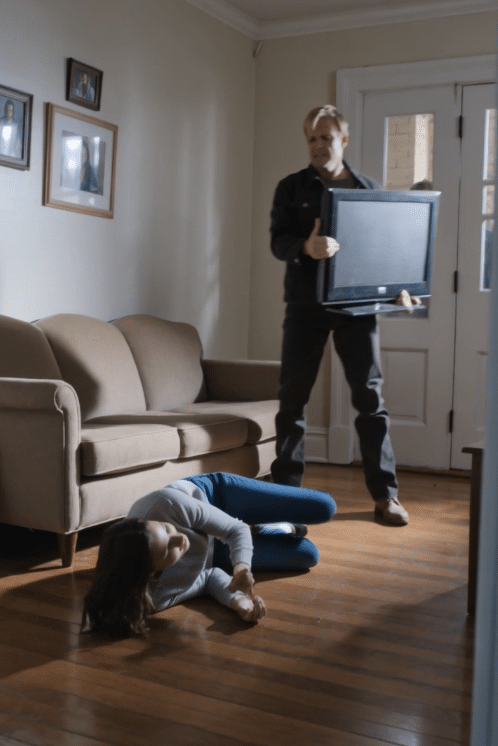
Dennis Brooks was carrying the television out of the apartment when his daughter tried to stop him.
The old TV was bulky, its plastic casing scratched from years of use, but Dennis held it tightly against his chest as he forced his way toward the open front door. Anna Brooks, twenty-four, stood between him and the exit, her gray sweater rumpled and her blue jeans brushing against the edge of the worn sofa.
“Put it down,” she said.
Dennis tightened his grip.
“Move.”
“Everything here belongs to Mom.”
For a second, he stared at her as if she had said something ridiculous. Then his mouth twisted into a contemptuous smile.
“Trash. I can take what I want.”
Anna felt her stomach turn. She had known her father could be selfish, but she had never imagined he would walk into the apartment where she and her mother lived and start carrying away their belongings while her mother was out.
She stepped into the narrow doorway, blocking his path.
“You can’t just come in here and take things.”
Dennis adjusted the television against his chest. He was fifty-three, unshaven, and dressed in an old dark jacket that smelled faintly of stale cigarettes. He had been estranged from the family for years, appearing only when he wanted something or when he believed he could get away with taking it.
Today, he had come for the television.
He had already found a secondhand electronics dealer willing to buy it. The money would not have been much, but Dennis had a bill due and no patience for earning what he needed. In his mind, the television was an opportunity waiting to be claimed.
Anna was the only obstacle.
She reached for the doorframe, trying to keep him from squeezing past her. Dennis shifted his weight, kept both arms locked around the television, and drove one leg forward in a forceful kick to her chest.
Anna was thrown backward beside the sofa.
A family photograph fell from the wall and shattered against the floor. Her forearm struck the edge of a small table, leaving a thin line of blood as pain flashed through her arm.
For a moment, she could not catch her breath.
Dennis did not put the television down.
He stepped over the scattered pieces of the photograph and kicked her twice more in the back and side as she struggled to crawl toward the doorway. Anna gasped, grimacing, but she kept trying to block the exit.
“Everything here belongs to Mom,” she repeated.
Dennis looked down at her.
“She won’t stop me, and neither will you.”
Two neighbors had gathered outside the open apartment door. One covered her mouth. The other stared in shock, then stepped back when Dennis turned toward them.
Neither moved forward.
Anna saw them standing there, heard their startled breaths, and felt the terrible loneliness of being hurt in front of people who were too frightened to intervene.
She tried to push herself upright.
Dennis shifted the television again, preparing to leave.
Then the front door swung wider.
Helen Brooks had come home.
The fifty-five-year-old woman stopped just inside the entrance, her simple cardigan hanging loosely from her shoulders. Her face was pale from exhaustion, but the moment she saw Anna on the floor and Dennis holding the television, something in her expression hardened.
She rushed toward her daughter first.
“Anna!”
Then she turned to Dennis.
“Take your hands off my daughter’s home.”
Dennis froze.
For years, he had assumed Helen would eventually back down, as she had during so many arguments in the past. He had counted on her exhaustion, her limited money, and her desire to avoid another confrontation.
But Helen was no longer looking at him like a woman preparing to negotiate.
She was looking at him like someone who had finally understood that there was nothing left to negotiate.
Dennis tightened his arms around the television.
“Her home?”
And for the first time in years, he began to wonder whether he had walked into the wrong apartment.
Act II
Helen knelt beside Anna, her hands hovering uncertainly as she tried to determine where her daughter was hurt.
“Can you breathe?” she asked.
Anna nodded, though the movement made her wince. Her forearm stung, and her chest ached where Dennis had kicked her. She looked past her mother toward the television, still trapped in her father’s arms.
“He was taking it,” she whispered.
“I can see that.”
“He said he could take whatever he wanted.”
Helen closed her eyes for one brief second.
Those words were painfully familiar.
Dennis had always treated other people’s boundaries as inconveniences. When they were married, he borrowed money without asking, sold belongings without discussing it, and insisted that anything purchased under the same roof was automatically his to do with as he pleased.
When Helen objected, he accused her of keeping score.
When she refused, he accused her of being ungrateful.
And when she tried to leave, he promised to change.
For a while, she had believed him.
They had met when Helen was in her early twenties. Dennis could be charming in those days, quick with a joke and full of plans. He spoke about owning a business someday, buying a house, and giving their future children a life more comfortable than the one he had known.
When Anna was born, Helen believed those dreams had finally become something real.
But Dennis’s promises rarely survived contact with responsibility.
He moved between jobs, blaming managers, coworkers, and bad luck whenever one ended. He borrowed money from relatives and delayed repayment. He began selling small household items, first things no one seemed to need and later things Helen had specifically asked him to leave alone.
The arguments grew louder.
Eventually, Helen realized that her daughter was learning to listen for the sound of her father’s footsteps before deciding whether it was safe to speak.
That was the moment she knew she had to leave.
She moved with Anna into a small rented apartment, taking what they could carry and leaving most of their old life behind. It was not a dramatic escape. There were no grand speeches, no sudden windfall, and no guarantee that things would become easier.
There was only a key to a modest apartment, a narrow living room, an old sofa, and the hope that peace might finally be possible.
Helen worked long hours to keep the rent paid. Anna found work after finishing school and contributed whenever she could. They repaired what they could not replace, saved for emergencies, and learned to appreciate the simple luxury of knowing that a quiet evening would remain quiet.
The television had been part of that life from the beginning.
It was not valuable in any meaningful resale market. The picture occasionally flickered, and the remote had been repaired with tape. But Helen and Anna had watched old movies on it during their first winter in the apartment, sitting shoulder to shoulder beneath a blanket while the heating struggled to warm the room.
They had watched the news there when Helen’s mother died.
They had laughed at cooking shows while trying to stretch their grocery budget.
And when Anna had been sick and too tired to get out of bed, Helen had moved the television closer to the sofa so her daughter could watch something comforting.
It was a cheap television.
It was also theirs.
Dennis knew none of that mattered to him. He remembered the apartment as a place where he might still find something worth taking.
After the separation, he had appeared irregularly, sometimes asking for money and sometimes claiming he had come to retrieve belongings he had left behind. Helen had repeatedly told him that he could not enter the apartment without permission.
Each time, he treated the boundary as a temporary inconvenience.
Today, Helen had stepped out to collect groceries and pick up a prescription. Anna had stayed home, planning to clean the apartment and prepare dinner.
Dennis had arrived while Helen was away.
He had not called ahead. He had not asked whether he could take the television. He had simply walked in and begun carrying it out.
When Anna tried to stop him, he had treated her refusal as a challenge to his authority.
Now Helen stood between him and her daughter, taking in the fallen photograph, the damaged table, and the blood on Anna’s forearm.
“Put the television down,” she said.
Dennis looked toward the neighbors.
“She’s exaggerating. I was just taking something that belongs to me.”
Helen’s eyes narrowed.
“Then explain why you had to kick her to get past her.”
Dennis opened his mouth.
Nothing came out.
And Helen realized that the television was only the beginning of what she would have to confront.
Act III
Helen had spent years trying to make Dennis understand that leaving a marriage did not mean abandoning every boundary she had ever established.
She had changed the locks after the separation. She had kept records of unwanted visits and saved messages in which he demanded money. When he claimed that he still had a right to enter her home, she sought advice about her options and made sure the lease and household accounts were clearly in her name.
She had done all of this quietly.
She did not want a public fight. She wanted to raise her daughter, pay her bills, and build a life in which every disagreement did not become a crisis.
Dennis interpreted that quietness as weakness.
He believed that because Helen avoided confrontation, she would eventually surrender. He believed that because Anna was young, she would be frightened into obeying him. And he believed that because the apartment was rented and the furniture was old, the life they had built there was somehow less deserving of protection.
He was wrong about all three.
Helen reached for her phone and called emergency services. She told the dispatcher that her daughter had been assaulted and that the person responsible was still inside the apartment, holding property he was attempting to remove.
Then she asked the neighbors to remain available as witnesses.
The woman nearest the doorway nodded quickly. She looked shaken, but now that Helen had spoken up, she seemed less afraid to stay.
Dennis’s face darkened.
“You’re calling the police on me?”
“You kicked my daughter.”
“She got in my way.”
“She was standing in her own home.”
“Our home,” Dennis snapped.
Helen stared at him.
“No. You left this home years ago.”
Dennis shifted the television higher against his chest.
“I helped pay for things here.”
Helen almost laughed, but there was no humor in it.
“You stopped contributing before I finally asked you to leave. Anna and I paid for this television. We paid for the sofa. We pay the rent. You don’t get to walk in and decide that our belongings are yours.”
“You can’t prove that.”
“I don’t have to prove every item in this room belongs to you before you can be told not to steal it.”
His expression changed at the word.
“Steal?”
Helen held his gaze.
“What else would you call taking something without permission?”
Dennis looked toward the door again. The neighbors were still there, and he could hear a siren somewhere in the distance.
His confidence began to fracture.
He tried a different approach.
“Helen, listen. I have a problem. I needed some money. I thought I could sell the television and sort everything out later.”
For the first time, his voice carried something close to desperation.
Helen knew that tone. It was the voice he used whenever he had run out of excuses and wanted sympathy to do the work that honesty had failed to accomplish.
“What problem?” she asked.
Dennis hesitated.
“It’s complicated.”
“Is it a bill?”
“Something like that.”
“Did you ask me for help?”
He looked away.
“No.”
“Did you ask Anna if you could take the television?”
“No, but—”
“Then why did you hurt her?”
Dennis tightened his jaw.
“She shouldn’t have tried to stop me.”
The answer landed harder than a shouted threat.
Even now, with his daughter injured and the neighbors watching, Dennis could not bring himself to admit that he had made a choice. He spoke as if Anna’s refusal had forced his hand, as if the existence of a boundary were an act of aggression against him.
Helen looked down at Anna.
Her daughter was trying to sit upright against the sofa. Her face was pale, and she was breathing carefully through the pain.
Helen had spent years worrying that the damage from Dennis’s behavior would follow Anna into adulthood. She feared her daughter would become so accustomed to appeasing difficult people that she would struggle to recognize when she was being mistreated.
Now she watched Anna look up at her.
“I wasn’t going to let him take it,” Anna said quietly.
Helen squeezed her hand.
“You shouldn’t have had to fight him for it.”
Anna’s eyes filled with tears.
“I thought if I moved, he’d take everything.”
Helen felt something inside her break—not because Anna had failed to protect the television, but because her daughter had been forced to make that calculation at all.
She had wanted Anna to grow up knowing that home was a place where she could put down her guard. Instead, the old fear had followed her into the apartment, teaching her that even an ordinary object might have to be defended against violence.
Helen turned back to Dennis.
“You need to put it down and step away from her.”
He looked at the television, then at the door.
For a moment, he seemed to consider making another attempt to leave.
Then he heard the siren grow louder.
The television suddenly looked heavier in his arms.
But the real weight was not the object he had tried to steal. It was the growing realization that the people he had spent years intimidating were no longer willing to keep his secrets for him.
Act IV
The officers arrived within minutes.
One went directly to Anna and asked what had happened. Another kept Dennis near the entrance while confirming the identities of the people present. The neighbors described what they had witnessed, including the moment Anna tried to block the doorway and Dennis kicked her while holding the television.
Helen gave her statement, then showed the officers the damaged table and the fallen photograph frame.
Dennis tried to interrupt.
“She attacked me first by blocking the door.”
An officer looked at him.
“Did she strike you?”
“No.”
“Did she threaten you?”
“She said I couldn’t take the television.”
“That’s not what I asked.”
Dennis fell silent.
The television was eventually placed safely on the floor, where it could remain while the officers documented the incident. Dennis was not permitted to simply carry it away. The ownership dispute and the alleged assault would be handled through the appropriate process rather than settled by whoever could force their way through the doorway.
Anna was assessed by medical professionals, and the officers documented her account of the kicks and the injuries to her chest and forearm. Helen provided the information she had kept about previous unwanted visits and any relevant messages.
No one promised that every past incident would automatically lead to a particular legal outcome. But this time, there were witnesses, visible damage, and a clear account of what had happened.
Dennis seemed to understand that the situation had moved beyond an argument he could control.
He looked at Helen.
“You’re really going to do this to me?”
She stood beside Anna.
“You did this to yourself.”
“I came here because I needed help.”
“Then you could have asked.”
“You would have said no.”
Helen’s expression tightened.
“Maybe I would have. That still wouldn’t give you the right to hurt my daughter.”
Dennis glanced at Anna.
“Tell them this got out of hand. Tell them you don’t want to press anything.”
Anna looked back at him.
For most of her life, she had been the person who smoothed things over after her father caused a scene. She apologized when he embarrassed her. She explained his behavior to relatives. She stayed quiet when he demanded money from her mother, afraid that any objection would trigger another argument.
The habit was still there, waiting for her to fall back into it.
But then she remembered the moment she had been on the floor, struggling to breathe while Dennis stood over her with the television in his arms.
She remembered that he had not stopped when she fell.
She remembered trying to crawl back toward the door because she was afraid he would take away one more piece of the life she and Helen had built.
Anna took a slow breath.
“I want to tell them what happened,” she said.
Dennis stared at her.
“You’re my daughter.”
“I know.”
“After everything I’ve done for you?”
Anna’s eyes shone, but her voice did not break.
“You hurt me because I wouldn’t let you take Mom’s television.”
He shook his head as if she had failed to understand the complexity of his situation.
“You’re making me sound like a monster.”
“No,” Anna replied. “I’m telling them what you did.”
The room fell quiet.
It was the first time Anna had ever refused to help him rewrite an event while it was still happening.
Helen felt her daughter’s hand find hers. She did not speak over Anna or answer on her behalf. She simply stayed beside her while the officers continued their work.
Dennis’s anger shifted into panic.
He asked Helen to reconsider. He said he had been under pressure. He promised to repay the value of the television, although no one had asked him to purchase it. Then he claimed that the family was overreacting to a single bad moment.
But the officers had already heard the witnesses.
The neighbors were willing to provide statements, and Helen had begun gathering the records she had previously kept in case Dennis returned uninvited. The immediate incident was being documented, and the next steps would be determined through the investigation.
Dennis was no longer able to end the confrontation simply by declaring that he was the father.
Before leaving, he turned toward the television one last time.
It was still there, resting on the floor beside the old sofa.
He had come to the apartment believing he could sell it, pocket the money, and leave Helen and Anna to deal with whatever consequences followed. Instead, he had exposed the very behavior he had spent years trying to excuse.
Helen watched him go.
She did not feel triumphant.
Her daughter was hurt. The apartment had been turned into a scene of fear. A family photograph lay broken on the floor, and the quiet afternoon they had planned was gone.
But when Helen turned back to Anna, she saw something else beneath the pain.
Her daughter was no longer looking at the floor.
She was looking straight ahead.
And that was when Helen understood that protecting her home meant more than keeping Dennis from taking a television. It meant making sure he could never again convince Anna that defending herself was the same as doing something wrong.
Act V
The next morning, the apartment felt strangely quiet.
Sunlight slipped through the curtains and settled across the old sofa. The television remained where the officers had left it, its dark screen reflecting the family photographs that still hung on the wall.
Helen had spent the evening checking on Anna, arranging medical follow-up, and making sure the incident had been documented. She also sought advice about how to handle any future unwanted visits and whether additional legal protections might be appropriate.
The process would take time.
There would be statements to give, decisions to make, and questions about how to keep Dennis from returning without permission. Helen knew that one difficult afternoon could not erase years of conflict, and she refused to pretend otherwise.
But she was no longer going to manage the problem by keeping everything quiet.
Anna sat at the kitchen table with a mug of tea between her hands. Her forearm was bandaged, and she moved carefully when she reached for the sugar.
“Do you think he’ll come back?” she asked.
Helen sat opposite her.
“I don’t know.”
Anna looked down.
“I should have just let him take it.”
“No.”
The answer came so quickly that Anna raised her eyes.
Helen leaned forward.
“You were trying to protect our home. You didn’t make him hurt you.”
“But if I’d moved—”
“He might have taken the television,” Helen interrupted gently. “Or he might have found something else to demand later. We can’t know what he would have done. But nothing you said or did made those kicks your fault.”
Anna swallowed hard.
She had spent the night replaying the confrontation, searching for the point where she might have acted differently. Perhaps she should have called the police sooner. Perhaps she should have moved away from the door. Perhaps she should never have tried to reason with Dennis while he was angry.
The questions kept circling because imagining a different choice made the event feel less frightening. If she could identify the mistake, perhaps she could prevent it from happening again.
But her mother was asking her to recognize a different truth.
She was not responsible for controlling Dennis’s behavior.
That responsibility belonged to him.
Helen reached across the table and covered Anna’s hand with her own.
“We’re going to make a plan,” she said. “We’ll keep records, we’ll get advice, and we’ll decide what to do if he contacts us again. You don’t have to handle him alone.”
Anna nodded, and tears slipped down her cheeks.
For years, she had thought being an adult meant taking care of problems without burdening her mother. She had tried to be the strong one, the reasonable one, the person who could withstand Dennis’s anger long enough for everyone else to get through the day.
Now she understood that strength did not mean standing in front of every threat by herself.
Sometimes it meant telling the truth and letting other people stand beside her.
Over the following weeks, Helen and Anna made practical changes. They reviewed who had access to the apartment, kept copies of important documents, and agreed not to open the door to Dennis if he appeared without permission. Helen also spoke with the property manager about the locks and documented the incident in case further steps became necessary.
The damaged table was repaired.
The broken photograph frame was replaced.
Anna’s injuries gradually improved, though she still felt uneasy whenever someone knocked unexpectedly.
The television remained in the living room.
One evening, Helen found Anna sitting on the sofa, trying to get the old set to display a movie. The picture flickered twice before settling into a slightly crooked image.
Anna laughed.
“Still works.”
Helen sat beside her.
“It’s stubborn.”
“Must be a family trait.”
For the first time since the assault, they both laughed without immediately checking whether the other person was all right.
It was a small moment, but it felt precious.
They watched the movie together, sharing a bowl of popcorn and a blanket that had survived years of washing. The apartment was still modest. The sofa still sagged in the middle, and the television still made a faint buzzing sound when the volume was turned too high.
Nothing about the room would have impressed a stranger.
But no one in it had to earn the right to feel safe.
Dennis did not return that evening. Whatever legal and personal consequences followed the incident would be handled separately, and Helen made no promises about reconciliation. She understood that forgiveness, if it ever came, could not be demanded as the price of peace.
Anna also stopped measuring herself against the daughter Dennis claimed she should be.
She could remember the good moments from childhood without using them to excuse the harm he had caused. She could hope he might one day take responsibility without giving him another opportunity to hurt her. And she could love the idea of family without accepting the belief that family members were entitled to take whatever they wanted.
A few months later, Helen replaced the television with a newer model after the old one finally stopped working. She did not sell it to make money or hand it over to someone who demanded it. She and Anna carried it to an electronics recycling center together.
Before they left, Anna took one last look at the battered screen.
“That thing survived everything,” she said.
Helen smiled.
“It did its job.”
They drove home with the empty space in the living room waiting for something new.
This time, the replacement was chosen together, paid for with their own money, and brought through the front door without fear.
The apartment did not become a different place overnight. It remained the small rented home where they paid bills, worried about expenses, and worked hard to keep their lives moving forward.
But the meaning of that home had changed.
Dennis had walked in believing the old television was his to take because he wanted it. He had treated Anna’s refusal as an insult and her mother’s absence as an opportunity. He had believed that years of family history gave him the right to ignore the people who actually lived there.
Helen’s return had shattered that illusion.
When she said, “Take your hands off my daughter’s home,” she was not claiming ownership of the walls or the furniture. She was drawing a line around the life they had struggled to build—a life in which love could no longer be used as a weapon and family ties could no longer excuse violence.
Anna had tried to protect a television.
What she was really protecting was the right to say no inside her own home.
And Helen, standing between her daughter and the man who had hurt her, finally made that right impossible to ignore.
Dennis had come to take the last television in the apartment. He left having lost something far more important: the illusion that being family gave him permission to take everything.