Act I
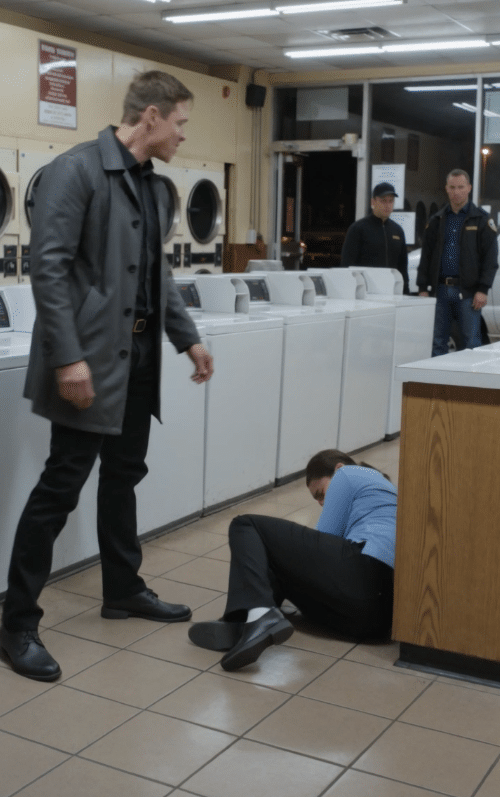
Mia Collins was still reaching for her rent envelope when her father kicked her again.
The late-night laundromat smelled of detergent and damp clothes. Cold fluorescent lights flickered above rows of washing machines, and a handful of customers stood frozen between the aisles, watching a fifty-year-old man in a wrinkled gray coat attack the exhausted young woman in a light blue uniform.
Mia was twenty-three. Her shift had lasted nearly ten hours, and her low ponytail had begun to loosen around her face. Her feet hurt, her back ached, and all she wanted was to finish counting her tips and go home.
She had just slipped the money into an envelope marked RENT when Gary Collins appeared.
Her father smelled of alcohol. His red eyes moved immediately to the cash in her hands.
“Give it to me,” he demanded.
Mia tightened her grip.
“Dad, please. I have to pay rent tomorrow.”
Gary lunged for the envelope.
She pulled it against her chest, and the paper tore slightly between their hands. A few coins rolled off the folding counter and scattered across the tile.
“Let go!” he shouted.
“No. I need that money.”
Gary’s expression hardened.
“Trash. My debt comes first.”
Mia stared at him, unable to believe he had said it so casually. He was talking about her rent money as if it were already his—as if the hours she had spent washing, drying, folding, and cleaning meant nothing.
She tried to step around him.
He blocked her path.
When she refused to surrender the envelope, Gary drove a forceful kick into her chest, knocking her backward into the folding counter. The impact sent a stack of folded towels tumbling to the floor. Mia struck her elbow against the counter’s edge, leaving a thin streak of blood on her skin.
The envelope slid away.
She gasped, clutching her side, and tried to crawl toward it.
Gary followed.
He kicked her twice more in the back and side as she reached for the money. Mia curled around herself, grimacing in pain, but her hand kept stretching toward the envelope.
The customers watched in horror. A woman standing beside a washing machine covered her mouth. A man near the vending machines took a frightened step backward.
Nobody moved.
Gary looked down at his daughter with an expression that frightened her more than his shouting.
“You live because I let you.”
Mia’s eyes filled with tears.
She had heard versions of those words for years. Every time she tried to become independent, Gary reminded her that she had once depended on him. Every time she refused to give him money, he treated her refusal as a personal betrayal.
Now he was standing over her in a laundromat, trying to take the money that would keep her housed.
Mia reached the envelope and pulled it beneath her hand.
“Please,” she whispered. “That’s all I have.”
Gary bent toward her.
“You don’t need it as much as I do.”
Then a white van braked sharply outside.
The headlights swept across the laundromat windows.
The driver’s door flew open, and a man in a black jacket jumped out. He crossed the parking lot at a run and burst through the entrance, his gaze moving from the scattered coins to Mia on the floor.
Evan Price, the thirty-eight-year-old owner of the laundromat, did not stop to ask what had happened.
He saw Gary standing over an injured young woman.
He saw the rent envelope beneath her hand.
And he understood enough.
Evan charged forward and drove Gary backward with a forceful kick to the chest. Gary fell hard onto the tile, clutching his chest as the anger drained from his face.
Evan positioned himself between him and Mia.
“Enough.”
The single word cut through the humming machines.
Gary stared up at the man standing over him. His mouth opened, but no insult came out.
For the first time that night, he looked afraid.
“Who are you?” he whispered.
He had come to steal his daughter’s rent money.
He had never imagined the person who stopped him would know exactly how much she had sacrificed to earn it.
Act II
Evan did not take another step toward Gary.
He had already intervened physically, but now he focused on making sure Mia was safe and that the situation did not escalate further. He told Gary to remain where he was while he turned toward the customers.
“Someone call 911,” he said. “And please don’t touch anything on the floor.”
A woman near the washers immediately reached for her phone. Another customer moved closer to Mia but stopped when Evan asked everyone to give her room.
Mia was still curled beside the folding counter, one hand pressed against her side and the other gripping the rent envelope.
Evan crouched nearby.
“Mia, can you hear me?”
She nodded.
“Don’t try to get up yet. Help is coming.”
She looked at the envelope.
“My rent,” she whispered.
“I see it.”
“I can’t lose that money.”
“You won’t have to explain anything right now. Let’s make sure you’re okay first.”
Mia’s lower lip trembled. She had worked at the laundromat for almost two years, and Evan had never seen her cry at work. She was the employee who stayed late when a customer forgot a load of laundry, who cleaned the lint traps without being reminded, and who quietly covered shifts when someone else had a family emergency.
She never talked about her personal life.
Evan knew she rented a small apartment nearby and worked extra hours whenever the laundromat was busy. He had assumed she was simply saving for a better future.
He had not known that her father regularly tried to take her money.
Gary struggled to sit up.
“This is none of your business,” he snapped.
Evan turned his head.
“You attacked someone in my business. That makes it my business.”
“She owes me.”
Mia closed her eyes.
There it was again.
Gary always began with an accusation. If he needed money, she was ungrateful for refusing. If she asked him to repay what he had borrowed, she was disrespectful. If she tried to leave an argument, she was abandoning her family.
The details changed. The conclusion never did.
He believed that being her father gave him permanent access to her life.
Evan looked at him.
“Owes you what?”
Gary hesitated.
“That’s between me and my daughter.”
“Then explain it to the police.”
Gary’s face changed.
“You called the police?”
“No one is going to pretend this didn’t happen.”
The woman who had called emergency services gave the dispatcher the laundromat’s address. Evan asked the customers who had witnessed the assault to remain nearby if they felt safe doing so.
He then asked Mia whether she wanted him to retrieve the envelope.
She nodded.
Carefully, he picked it up and placed it on a clean section of the counter, away from the scattered coins and towels. He did not open it or count the money. The envelope belonged to Mia, and she would decide what happened to it.
Gary watched every movement.
“You don’t get to keep that,” he said.
Evan straightened.
“It’s not yours.”
“You don’t know anything about us.”
“Then tell the officers your side of the story.”
Gary muttered something under his breath and tried to push himself to his feet. Evan told him to remain still until help arrived. This time, Gary did not argue.
Mia looked around the laundromat.
The machines were still running. A dryer beeped at the end of an aisle, and water moved through a washing machine behind the counter. Ordinary sounds continued in a place that suddenly felt unfamiliar.
She had spent so many nights here that the laundromat had become a second home. She knew which machines needed extra time to drain and which customers preferred their clothes folded a certain way. She could tell from the sound of the front door when the late-night regulars came in.
It had been one of the few places where she felt useful and independent.
Now her father had turned it into another place where she was afraid.
“I’m sorry,” she whispered to Evan.
He looked genuinely confused.
“For what?”
“For causing trouble.”
Evan glanced at the scattered coins, the fallen towels, and Gary sitting on the floor.
“You didn’t cause this.”
Mia looked away.
She had heard those words before, usually from people who did not understand how difficult it was to believe them. Gary had spent years convincing her that his anger was a response to something she had done wrong.
If he shouted, she had provoked him.
If he borrowed money, she had failed to help him.
If he hurt her, she had pushed him too far.
The explanations had become so familiar that she sometimes repeated them to herself before anyone else could.
Evan remained beside her until the sirens grew louder outside.
He had no idea how much of Mia’s life had been shaped by a man who treated her earnings as his personal emergency fund.
But the story he was about to hear would explain why she had been so terrified of losing one small envelope.
Act III
Mia had been saving her tips for months.
Her rent was due on the first of every month, and the amount she earned from the laundromat barely left room for surprises. She lived in a modest studio apartment with a narrow kitchen, a secondhand bed, and a window that rattled whenever the weather turned cold.
She liked the apartment because it was hers.
It was the first place she had lived where she could close the door and decide who was allowed inside. She paid the rent herself, bought her own groceries, and kept a small emergency fund hidden in a separate savings account.
None of it had come easily.
Mia had grown up watching her father move from one financial crisis to another. Gary could be funny and generous when he was in a good mood, but his temper sharpened whenever money became scarce. He blamed employers for firing him, friends for refusing to lend him more, and relatives for failing to understand how much pressure he was under.
Gambling had made those crises worse.
At first, Mia did not know how much he was losing. She only noticed that he began asking for small amounts of money before payday. A few dollars for gas. Twenty dollars for a bill. Fifty dollars until Friday.
When she was still a teenager, she sometimes gave him what he asked for because she believed helping her father was what a good daughter did.
He rarely repaid her.
Instead, the requests grew larger.
By the time Mia was twenty, Gary had learned that guilt was more effective than honesty. He would remind her that he had raised her, bought her clothes, and put food on the table when she was little.
He never mentioned the money she had already given him.
He never acknowledged the nights she had stayed awake listening to him argue on the phone with creditors.
And he never asked whether she could afford to help.
When Mia finally moved out, she believed the distance might change things. She found the laundromat job, rented her studio, and began building a life one paycheck at a time.
For several months, she barely heard from Gary.
Then he began appearing again.
Sometimes he called to say he was in trouble. Sometimes he claimed he had found a way to recover his gambling losses if he could just borrow a little more. Once, he arrived at her apartment and demanded money for a debt he insisted would become dangerous if he did not pay it.
Mia gave him what she could afford.
He returned for more.
Eventually, she stopped lending him money. She changed her banking passwords and refused to tell him exactly when she received her pay. When he called, she let the phone ring if she was working or too exhausted to deal with another demand.
Gary responded by accusing her of abandoning him.
He told her she was selfish. He said she had become arrogant because she had a job and an apartment. He reminded her that she would never have survived without him.
Mia tried to explain that she was barely surviving herself.
He did not listen.
The night at the laundromat began with a message sent shortly before her shift ended.
Gary said he needed money immediately. He claimed he had a debt to settle that evening and warned that the people waiting for payment would not be patient.
Mia did not reply.
She had heard the same story too many times to believe that another payment would solve anything. Her rent was due the next morning, and she had already counted her tips carefully.
She placed the money in an envelope and wrote RENT across the front.
She thought that if she could get through the night without another confrontation, she would be safe.
But Gary knew where she worked.
He arrived shortly before closing, unsteady on his feet and furious that she had ignored his messages. He saw the envelope on the counter and demanded it.
Mia refused.
The rest happened in seconds.
As she explained the history to the responding officers, she kept apologizing for how long the story was taking. She seemed embarrassed that there were so many details, as if the complexity of her father’s behavior made her less credible.
One of the officers told her that she could take her time.
Evan listened from nearby.
He had owned the laundromat for six years. He had seen customers argue over lost clothing and unpaid machine balances. He had dealt with broken windows, attempted theft, and people who mistook a small business for a place where rules did not apply.
But this was different.
Mia had not been involved in a dispute with a stranger over a few dollars. She had been attacked by someone who knew exactly how much the money meant to her.
Evan remembered how often she worked late.
He remembered that she rarely bought food during her shifts, choosing instead to bring a sandwich from home. He remembered seeing her count tips carefully at the end of the night and place them in a small envelope before locking the register.
He had thought she was saving for something special.
Now he understood she was trying to protect the basics of her life.
After the officers had documented the scene and spoken with witnesses, Evan gave them access to the laundromat’s security footage. The cameras covered the folding counter and the main aisle, and the recording showed the confrontation from the moment Gary reached for the envelope.
The footage would help establish what happened, alongside Mia’s statement and the accounts of the customers who had witnessed the assault.
Gary continued insisting that the situation had been exaggerated.
He said he had only wanted to borrow the money. He claimed Mia had refused to listen to reason. He argued that a family disagreement should never have become a police matter.
But the recording did not show a calm request for help.
It showed him grabbing for the envelope, kicking his daughter when she refused to surrender it, and continuing the assault while she tried to reach the money.
For once, his version of events could not erase what everyone had seen.
And when the officers asked him about the debt he had claimed was so urgent, Gary struggled to give a consistent explanation.
The debt might have been real.
His belief that Mia was obligated to pay it was not.
Act IV
By the time the officers finished their initial investigation, the laundromat had become almost completely silent.
The customers who had witnessed the assault gave their accounts. Evan provided the security footage and confirmed that Mia was working her scheduled shift when Gary arrived. The scattered coins and damaged envelope were documented, and Mia received medical attention for her injuries.
Gary was no longer shouting.
He sat near the entrance with his hands resting on his knees, staring at the tile floor. Every so often, he glanced toward Mia, as though expecting her to look back and rescue him from the situation.
She did not.
When an officer asked whether he wanted to provide his account, Gary immediately returned to the same explanation.
“She knows I have problems. She’s supposed to help me.”
The officer asked whether Mia had agreed to give him the money.
Gary said no.
“Did you take it without her permission?”
“I was trying to get her to understand.”
“Did you kick her?”
Gary looked toward the door.
For several seconds, he said nothing.
Then he muttered that he had been drinking and that things had gotten out of hand.
It was the closest he came to acknowledging what he had done.
Mia sat near the counter, wrapped in a clean jacket one of the employees had brought from the back room. She was exhausted, and the adrenaline that had carried her through the confrontation was beginning to fade. Every time she moved, her side hurt.
Evan stood nearby, keeping the area clear while the officers completed their work.
Gary noticed the way he remained beside Mia.
“What’s she told you?” he demanded.
Evan answered calmly.
“Enough to know that she didn’t deserve this.”
“You think you’re some kind of hero?”
“No.”
“Then stay out of my family.”
Evan glanced at Mia before replying.
“You brought this into my business. And you hurt someone who works here.”
Gary shook his head.
“She belongs to me.”
The words came out so naturally that even he seemed not to notice what they revealed.
Mia slowly lifted her head.
“No, Dad.”
Gary stared at her.
She swallowed, trying to steady her voice.
“I don’t belong to you.”
He looked as though she had struck him.
“You wouldn’t have anything without me.”
“I have a job. I pay my rent. I take care of myself.”
“After everything I did for you?”
“I didn’t ask you to pay my rent tonight. I didn’t ask you to gamble. I didn’t ask you to hurt me.”
Gary’s face tightened.
“You’re making me sound like a terrible father.”
Mia looked down at the envelope resting on the counter.
For years, she had believed that if she could find the right words, she might finally persuade him to understand. She had tried explaining her budget, her rent, and the fact that she could not keep giving him money.
She had tried pleading.
She had tried ignoring him.
She had tried giving him smaller amounts in the hope that he would stop demanding larger ones.
None of those choices had made her safe, because the problem was not that she had failed to explain herself.
The problem was that Gary believed his needs mattered more than her right to refuse.
“I don’t need to make you sound like anything,” she said. “I just need to tell the truth.”
Gary looked away.
That was when Evan understood the real meaning of the word he had shouted when he entered the laundromat.
Enough.
Not because he could erase Mia’s past. Not because one confrontation could cure Gary’s addiction or settle every debt. And not because the owner of a small business had the power to decide what the legal consequences should be.
Enough meant that the violence would not be ignored.
Enough meant that Mia’s rent money would remain hers.
Enough meant that the people who witnessed the assault would have the opportunity to tell the truth without being pressured into silence.
Evan had already given his statement about his own intervention. He cooperated with the investigation and made no attempt to use his position as the business owner to dictate the outcome. The officers would determine the appropriate next steps based on the evidence and applicable law.
But he could make decisions about the laundromat.
He instructed his staff to ensure that Mia would not be left alone if Gary returned during a future shift. He reviewed the late-night closing procedure and arranged for employees to have a clear way to summon help if a customer became threatening.
He also told Mia that she would not lose her job because she needed time to recover.
“You don’t have to come in until you’re ready,” he said.
Mia looked at him, surprised.
“But I need the hours.”
“We’ll work out your schedule. Your rent matters, and so does your health.”
She blinked rapidly.
No one had offered to make room for her needs in a long time. Usually, she was the one expected to adjust—to work around Gary’s problems, absorb his anger, and find a way to make everything function despite the damage he caused.
Now someone was offering help without asking her to surrender anything in return.
Gary watched the exchange with growing disbelief.
He had arrived expecting Mia to obey him because she was frightened of what would happen if she did not. Instead, he was leaving with witnesses, a documented investigation, and a daughter who had finally stopped apologizing for protecting herself.
Before he was escorted away, he turned toward her.
“Mia, you can’t do this to me.”
She looked at him for a long moment.
“You did this to yourself.”
For once, she did not take the words back.
Act V
The rent was due the next morning.
Mia had been terrified that the money would disappear before she could make the payment. She had imagined herself standing in front of her landlord, trying to explain why her rent was late, while the consequences of an assault she had not caused spread into another part of her life.
But the envelope was still there.
After the scene had been documented, the money was returned to her, and she checked the contents carefully. A few coins had rolled beneath a machine, but the bills she had saved remained intact.
The next day, she paid her rent.
It was an ordinary transaction: a receipt, a confirmation, a few brief words exchanged with the property manager. Yet when Mia returned to her apartment, she sat on the edge of her bed and cried.
For the first time since Gary had arrived at the laundromat, she could breathe without wondering whether she would lose her home because she had refused him.
The following weeks were not easy.
Her injuries needed time to heal, and she felt anxious whenever the laundromat door opened unexpectedly. The sound of a customer raising his voice could make her shoulders tighten. She sometimes caught herself watching people’s hands when they approached the folding counter.
Healing did not happen in a straight line.
But she was no longer facing everything alone.
Evan adjusted her shifts while she recovered and made sure another employee was available during late-night closing. The laundromat preserved its footage and cooperated with the investigation. Mia also sought advice from a local support organization about safety planning, unwanted contact, and the options available to her if Gary continued threatening her.
She changed a few routines and stopped telling her father where she would be after work. She made it clear to relatives that she would not hand over money simply because he demanded it.
Some family members understood.
Others told her that Gary was still her father and that she should not let one terrible night destroy their relationship.
Mia had heard that argument for years.
This time, she answered differently.
“I’m not the one who kicked someone to get money.”
The conversation usually ended there.
She did not need everyone to agree with her before she could protect herself.
Gary’s gambling problems did not vanish after the incident. The debts still had to be addressed, and any legal consequences would follow the appropriate process. Mia could not control whether he accepted responsibility, sought treatment, or continued blaming other people.
She could only decide what she would allow in her own life.
For years, she had confused love with rescue. If Gary was in trouble, she believed she had to help. If he was angry, she felt responsible for calming him down. If he accused her of abandoning him, she questioned whether independence made her a bad daughter.
Now she began to understand that caring about someone did not mean financing their choices or accepting violence in exchange for peace.
She could hope that her father would change without making her safety dependent on that hope.
She could remember the good moments of childhood without pretending the bad ones had never happened.
And she could refuse him.
A month after the assault, Mia returned to her regular schedule at the laundromat.
The fluorescent lights still buzzed overhead. The washing machines still rattled during the spin cycle, and the folding counter still had a small mark where her elbow had struck it. Evan had arranged for the damaged edge to be repaired, and the staff had reviewed the new closing procedures.
Mia stood behind the counter in her light blue polo, counting the tips left in the jar at the end of her shift.
For a moment, she felt the old fear rise in her chest.
She imagined Gary appearing at the door, his red eyes fixed on the money, his voice demanding that she give him what he wanted.
Then she looked around.
The machines were running. A customer was folding a clean shirt. Another was gathering laundry from a dryer. Outside, the parking lot was quiet beneath the streetlights.
She placed her tips in an envelope.
This time, she wrote RENT across the front without shaking.
Evan passed the counter on his way to check the front door.
“Everything okay?”
Mia nodded.
“Yeah. Just counting.”
He smiled.
“See you tomorrow.”
When he left, Mia slipped the envelope into her bag and zipped it closed.
There was no dramatic announcement. No sudden fortune. No promise that the future would be free of hardship.
There was simply a young woman who had worked a long shift, earned her money, and decided where it would go.
That was enough.
Later that night, she drove home and parked outside her small apartment. She carried her bag upstairs, unlocked the door, and stepped into the quiet room she had worked so hard to keep.
She paid the rent. She bought groceries. She put a little money into savings.
And when her phone lit up with a message from Gary, she did not open it immediately.
She sat down, took a breath, and reminded herself that she was allowed to choose when—or whether—to respond.
Her father had once told her, “You live because I let you.”
For years, she had carried those words like a debt she could never repay.
Now she understood how wrong they were.
Her life was not his gift. Her paycheck was not his property. Her future was not a gambling stake he could demand whenever he found himself in trouble.
Gary had tried to take her rent money because he believed fear would always make her surrender.
But the night he attacked her, other people saw what he had done. The evidence remained. The truth was documented. And Mia finally began to believe that protecting herself was not an act of betrayal.
It was an act of survival.
The next time she walked into the laundromat, she carried the same worn work bag and wore the same light blue uniform. Her job had not changed, and she still had to count every dollar carefully.
But she no longer believed that being a good daughter required her to sacrifice the life she was building.
Gary had arrived at the laundromat convinced that his debt came first.
Evan’s intervention had stopped the immediate violence, but Mia’s decision to stop accepting blame changed something deeper.
She was no longer going to pay for her father’s choices with her own safety.
And she would never again mistake his desperation for her responsibility.
He had told her that she lived because he allowed it. But the rent envelope she carried home that night proved something he could never take away: Mia was building a life of her own, and she no longer needed his permission to live it.