Act I
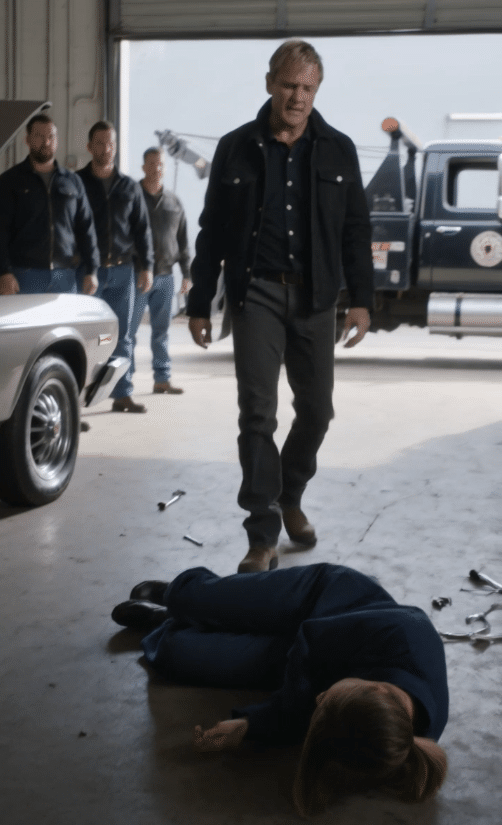
The car keys skidded across the garage floor just as Rachel Turner hit the tool chest.
Wrenches rattled against metal. A socket rolled beneath an old sedan, and the half-open rolling door shuddered in the late-afternoon wind. Rachel lay on the concrete in her dark blue mechanic coveralls, struggling to catch her breath while her father stood over her with the keys clenched in his fist.
Walt Turner, fifty-four, had come to sell her car.
Rachel, twenty-seven, had spent nearly two years saving for the battered old vehicle parked beside the garage’s main workbench. She had bought it with her own wages, repaired its engine with money earned from weekend shifts, and spent countless evenings learning how to replace worn belts, diagnose electrical faults, and coax a failing transmission into working again.
The car was far from beautiful.
Its paint had faded beneath the sun, the passenger door had a dent near the handle, and the driver’s seat was held together with a patch of dark fabric. But Rachel knew every mark on it. She knew which mornings it struggled to start and exactly how long she needed to let the engine warm before driving away.
More importantly, it was hers.
Now Walt was holding the keys as if the years of work behind them meant nothing.
“Give them back,” Rachel said, pushing herself up on one elbow.
Walt laughed.
“You really think you can tell me what to do?”
“I bought this car myself.”
He looked at her with open contempt.
“Trash. You are my daughter.”
Rachel reached toward the keys.
Walt drove a forceful kick into her chest, knocking her backward into the tool chest again. The impact sent more tools clattering onto the floor. Her forearm scraped against a metal edge, leaving a thin streak of blood, but she barely noticed it.
She was watching the keys.
They had landed several feet away, close to the front tire of her car.
Rachel tried to crawl toward them.
Walt followed and kicked her twice more in the back and side as she struggled across the concrete. She grimaced, breathing hard, one arm wrapped around her ribs. Still, she kept reaching toward the place where the keys had stopped.
“Stop!” she gasped.
Walt stood over her.
“That means I can sell it.”
The words seemed to hang in the garage longer than the metallic echoes of the tools.
A mechanic near the workbench froze with a wrench in his hand. Another worker stepped backward behind a tool cabinet. A customer waiting beside the office door covered his mouth.
They all knew Rachel. They had watched her spend her lunch breaks working on the old car and seen her stay after closing to finish repairs. Some had joked that she knew the vehicle better than its original manufacturer.
But none of them had expected her father to attack her in front of them.
Walt glanced toward the tow truck waiting outside the garage. He had already arranged for the car to be hauled away, and he was convinced that once it was gone, Rachel would have no choice but to accept what he called a family decision.
He bent to retrieve the keys.
Then a tow truck braked sharply outside the rolling door.
The driver jumped down.
Hank Dawson, the sixty-one-year-old owner of the garage, strode inside wearing a brown leather jacket, his gray beard catching the light from the open doorway. His eyes moved from Rachel on the floor to Walt holding the keys.
Hank did not ask why the tools were scattered.
He did not ask whether there had been a misunderstanding.
He saw an injured employee and a man who had taken her car keys.
Hank crossed the garage and struck Walt hard enough to send him staggering backward.
“Give her car keys back. Now.”
Walt clutched his mouth, stunned.
Hank stepped between him and Rachel, pointing directly at the keys on the concrete.
For several seconds, Walt could only stare at the older man.
The confidence drained from his face. The garage workers had seen Hank angry before, but never like this.
Walt had expected Rachel to be alone.
He had expected everyone else to mind their own business.
Instead, the man who controlled the garage stood between him and the car he intended to steal.
“Who are you?” Walt asked, his voice suddenly uncertain.
Hank’s gaze did not move.
He had known Rachel for two years.
But Walt was about to discover that he knew far less about his daughter’s life than he had ever imagined.
Act II
Hank’s first concern was Rachel.
He crouched beside her without taking his eyes off Walt for long.
“Rachel, don’t try to stand yet. Can you breathe normally?”
She nodded, then winced as she attempted to straighten her back.
“My car,” she whispered.
Hank looked toward the keys.
“I see them. We’re not letting anyone take it.”
He asked one of the mechanics to call emergency services and instructed another to keep the tow truck driver outside until the situation could be clarified. The customer near the office agreed to remain as a witness.
Walt, meanwhile, was trying to recover his composure.
“You’ve got no idea what’s going on here,” he said. “This is a family matter.”
Hank rose slowly.
“You attacked her in my garage.”
“She was refusing to listen.”
“That doesn’t give you the right to kick her.”
“She owes me.”
Hank looked at Rachel, then back at Walt.
“For what?”
Walt’s expression tightened.
“For raising her. For everything I did when she was a kid. You think a car just makes her independent?”
Rachel closed her eyes.
She had heard those arguments since she was old enough to earn money. Every time Walt wanted something, he reached into the past and pulled out a memory of her childhood. He spoke about food, clothes, school supplies, and the roof over her head as if every ordinary responsibility of parenthood had been an investment he could collect on whenever he pleased.
Hank was not impressed.
“Raising your child isn’t a contract giving you ownership of everything she earns.”
Walt pointed at Rachel.
“She wouldn’t have anything if it weren’t for me.”
Rachel slowly lifted her head.
“I worked for this car.”
Her voice was hoarse, but she made herself continue.
“I saved for it. I paid for it. I fixed it.”
“You think that makes you better than me?”
“No,” she said. “It makes it mine.”
Walt looked as though the answer offended him more than the injuries he had caused.
He had always believed Rachel’s independence was temporary. In his mind, she could earn money, pay bills, and make her own decisions as long as those decisions did not interfere with what he wanted.
The car had become the clearest symbol of that independence.
It was the first major thing Rachel had purchased without his help, and it represented more than transportation. It meant she could accept a job across town without begging for a ride. It meant she could take evening classes and stay late at the garage. It meant she could leave a conversation whenever it became unbearable.
Walt had noticed those changes.
He had also noticed that she was no longer handing him money whenever he demanded it.
A few weeks earlier, he had asked her for several hundred dollars, claiming he needed it to settle an overdue bill. Rachel had refused because she was saving for a transmission repair.
He accused her of being selfish.
When she explained that she could not keep paying his expenses, he told her she had forgotten who had raised her.
Then he began talking about the car.
He insisted that she owed him for the years he had supported her. He claimed he could sell the vehicle and use the money to settle what he considered a family debt.
Rachel told him the title was in her name.
Walt dismissed the paperwork as a technicality.
He believed that a father had rights that no document could erase.
Now, standing in the garage, he was discovering that his belief did not make it true.
Hank asked Rachel whether the car’s title and registration were available.
“They’re in my locker,” she replied.
“Good. Leave them there until the officers arrive.”
Walt snapped his head around.
“She’s not calling the police over this.”
Hank’s expression hardened.
“She doesn’t need your permission.”
A siren sounded faintly in the distance.
Walt glanced toward the open door. The tow truck driver was standing outside with his hands visible, looking increasingly uncomfortable. He had apparently expected a routine vehicle pickup, not an assault investigation.
Hank told him not to move the vehicle or attempt to hook it up to the car. The tow driver nodded and stepped farther away.
Rachel watched the exchange through the pain.
For years, she had assumed that protecting her independence meant doing everything herself. She had hidden her struggles, worked extra hours, and refused help because she did not want anyone to think she was incapable.
Yet the moment she needed someone to stand beside her, Hank did not ask her to prove that she deserved it.
He simply made sure she was not alone.
And as the sirens grew louder, Rachel began to realize that the fight over her car was only the latest chapter in a much longer struggle.
Act III
Rachel had learned to fix engines before she fully understood how to protect herself from her father.
When she was sixteen, she used to sit beside Walt in the driveway while he worked on an aging pickup truck. Back then, he seemed almost patient. He showed her how to check the oil, identify a loose belt, and listen for the difference between an engine that needed a tune-up and one that was about to fail.
Rachel loved the work.
Machines made sense to her. If something broke, there was usually a reason. You could inspect the parts, trace the fault, and decide what needed to be repaired. Even when a job was difficult, the problem did not become personal simply because you had failed to solve it immediately.
People were harder.
As Rachel grew older, Walt’s patience began to disappear whenever she made choices he disliked. He expected her to take whatever work was available, contribute money when he asked, and keep her plans flexible in case he needed something.
If she wanted to save for a course, he said she was wasting money.
If she worked overtime, he accused her of caring more about strangers than family.
If she refused to lend him cash, he reminded her that he had once bought her school shoes and paid for groceries when she was a child.
Rachel tried to keep the peace.
She gave him money when she could afford it and avoided telling him about purchases that might provoke another argument. When she finally moved into a small apartment, she hoped the distance would improve their relationship.
For a while, it did.
She found work as a mechanic trainee and took evening classes at a community college. The garage paid modestly, but Hank was willing to teach her. He showed her how to diagnose problems instead of replacing parts at random, how to explain repairs to customers, and how to recognize when a vehicle’s apparent failure was only a symptom of something deeper.
Rachel took the work seriously.
She studied manuals after her shifts and practiced on her own car whenever Hank allowed her to use an open bay. She made mistakes, but she learned from them. Within a year, she could handle jobs that had once intimidated her.
The old car was part of that education.
She found it through a private seller who wanted to get rid of a vehicle with high mileage and a stubborn starting problem. Rachel inspected it carefully, saved for the purchase, and negotiated a price she could afford.
The car was not a miracle bargain. It needed repairs, and some weeks Rachel wondered whether she had underestimated the cost. But she worked on it herself, buying parts gradually and asking Hank for guidance when she reached a problem she could not solve alone.
Every repair made the vehicle more reliable.
Every payment reminded her that she was building something through her own effort.
The title was issued in her name. She kept the paperwork in a folder at the garage and made sure the insurance and registration stayed current.
Walt called it a foolish purchase.
Then he began asking whether she would sell it.
Rachel refused.
He asked again, claiming that a daughter who loved her father would find a way to help him. When she refused a third time, he accused her of believing she was too good for the family that raised her.
The pressure intensified when he learned that she had nearly finished paying off the repairs.
He began insisting that the car was partly his because he had taught her about engines. He said that without his early lessons, she would never have been capable of buying or maintaining it.
Rachel reminded him that he had not paid for the vehicle.
Walt called her ungrateful.
That argument ended with him walking out of her apartment, promising that she would regret humiliating him.
Rachel thought he was bluffing.
She should have taken the threat more seriously, but she had grown accustomed to his anger fading once he found another target. She went back to work, kept saving, and tried to focus on the future she was building.
Then, one afternoon, Walt appeared at the garage.
He claimed he wanted to talk.
Rachel was working beside her car when he approached. He asked for the keys, saying he had found someone willing to buy the vehicle. She refused and told him that he had no authority to sell it.
Walt grabbed the keys from the workbench.
When she blocked his path, he attacked her.
Now, as the responding officers entered the garage, Rachel realized how close she had come to losing more than the car. If Hank had not arrived when he did, she might have been left injured on the concrete while Walt drove away with the only vehicle she owned.
An officer took Rachel’s statement while another spoke with witnesses. The garage workers described the confrontation, and Hank explained what he had seen when he entered.
The keys were recovered and secured. Rachel’s title and registration were retrieved from her locker, providing documentation that the vehicle was registered in her name. The tow truck driver also explained that he had been called to remove the car but had not yet attached it to his truck.
Hank provided the garage’s available security footage.
The investigation would determine the legal consequences of the assault, but the ownership question was no longer a matter of Walt’s insistence.
The paperwork told a clear story.
Rachel had purchased the car.
She had paid for its repairs.
She was the registered owner.
Walt had taken the keys without permission and tried to remove the vehicle despite her refusal.
When an officer asked Walt why he believed he could sell a car registered to his daughter, he returned to the same answer.
“Because she’s my daughter.”
The officer looked at him.
“That doesn’t establish ownership.”
Walt’s face darkened.
He had spent years using fatherhood as the final word in every dispute. He had believed that if he repeated the claim often enough, everyone would eventually accept it.
But the title did not change because he was angry.
And Rachel was no longer a child who could be frightened into surrendering what belonged to her.
Act IV
The garage fell quiet while the officers documented the scene.
Rachel sat on a low stool near the office, waiting to be evaluated for her injuries. Her forearm had been cleaned and bandaged, but she still held herself carefully because of the pain in her chest and back.
Hank remained nearby.
He was furious about what had happened, but he understood that his own decision to strike Walt would also need to be addressed honestly. He cooperated with the officers, explained the sequence of events, and did not try to use his position as garage owner to dictate the investigation.
His priority was to protect Rachel and preserve the evidence.
Walt sat near the entrance, his expression shifting between anger and disbelief. He had arrived expecting to leave with a car and perhaps a few hundred dollars. Now he was being asked to explain his actions to officers while several witnesses stood ready to describe what they had seen.
He looked toward Rachel.
“Tell them this was a misunderstanding.”
She did not answer.
“Rachel.”
She raised her eyes.
“You need to tell them you don’t want to make trouble.”
Rachel stared at him for a moment.
The request sounded familiar because it was familiar. Every time Walt crossed a line, he expected her to help restore the appearance of normality. He wanted her to describe his behavior in the gentlest possible terms, to remove the parts that made him look cruel, and to carry the discomfort so he would not have to.
She had done it for years.
She had told relatives that he was under stress. She had explained away his demands for money. She had accepted apologies that lasted only until his next crisis.
But this time, she had no intention of changing the truth.
“I didn’t take the keys,” she said. “You did.”
Walt shook his head.
“You know what I meant.”
“I know what you did.”
“I’m your father!”
“And I’m the person who bought that car.”
He looked at Hank, expecting the older man to interrupt or dismiss her. Instead, Hank stood silently beside the office door, allowing Rachel to speak for herself.
Walt’s voice rose.
“You think these people are your family now? You think a garage makes you something special?”
Rachel’s eyes stung, but she did not look away.
“No. I think my work belongs to me.”
For several seconds, Walt seemed unable to respond.
That sentence reached beyond the car. It challenged the belief he had used to control her for years: that everything Rachel achieved remained subject to his approval.
Her wages belonged to him if he needed money.
Her time belonged to him if he wanted help.
Her choices belonged to him if he disagreed with them.
And now, in front of people who knew how hard she worked, Rachel was refusing the entire premise.
Hank finally spoke.
“Walt, you need to stop talking to her and let the officers do their job.”
Walt turned sharply.
“You think you can order me around?”
“No,” Hank said. “But I can tell you that you don’t get to intimidate her here.”
The tow truck driver provided his statement and confirmed that the car had not been moved. The mechanic who had witnessed the first kick described how Rachel fell into the tool chest. Another worker confirmed that Walt kicked her again while she was trying to reach the keys.
The available footage supported their accounts.
Walt tried to argue that he had only wanted to sell the vehicle and use the proceeds to deal with a personal financial problem. He insisted that Rachel would eventually forgive him and that the garage workers had misunderstood a family dispute.
But wanting to sell the car did not make it his property.
And being related to the victim did not make the assault disappear.
The officers continued their investigation and explained the next steps to those involved. Walt would have to answer for his actions through the appropriate process, while Hank’s own intervention would also be documented.
No one could promise Rachel an instant resolution.
She would still have to recover from her injuries, manage her work schedule, and decide how much contact she wanted with her father. There might be further statements and legal proceedings. She would need to consider how to protect herself if Walt tried to approach her again.
But the immediate threat was over.
The keys were in safe custody until they could be returned to their rightful owner, and the car remained in the garage.
When the officers finished the initial documentation, Hank asked Rachel if she wanted to go to the hospital.
She nodded.
As they prepared to leave, Walt called after her.
“Rachel, don’t do this. I’m still your father.”
She paused at the doorway.
For years, that sentence had been enough to make her turn around. It had made her feel guilty for leaving arguments, guilty for keeping her money, and guilty for wanting a life that did not revolve around his demands.
This time, she looked at him and answered quietly.
“Then you should have treated me like your daughter.”
She walked out before he could respond.
Hank followed at a respectful distance.
Behind them, the garage lights shone across the old car’s faded paint. It had survived years of neglect, countless repairs, and one afternoon when someone tried to take it away from the woman who had worked so hard to own it.
Rachel had spent two years rebuilding that car.
Now she had to rebuild something else: her belief that she was allowed to keep what she had earned without apologizing for it.
Act V
Rachel did not return to the garage for several days.
Her injuries needed time to heal, and she followed medical advice before attempting heavy work again. Hank adjusted the schedule so she could recover without losing all her hours, and the other mechanics helped cover the jobs she could not yet handle.
No one treated her as a burden.
When she finally returned, the old car was still parked where she had left it.
Hank had made sure it remained untouched while the incident was being documented. The keys were returned to Rachel through the appropriate process, and she checked the vehicle herself before taking them home.
She stood beside the driver’s door for a long time.
The faded paint, the dent near the passenger handle, and the patched driver’s seat looked exactly as they had before. Yet the car seemed different to her now.
It had always represented independence.
Now it also reminded her of the day she had refused to surrender that independence, even when the person demanding it was her own father.
Hank approached with a cup of coffee.
“How’s your back?”
“Better.”
“Ready to work on the transmission?”
Rachel smiled faintly.
“Give me another day.”
“Take two if you need them.”
She looked at him.
“Thank you for not letting him take it.”
Hank shook his head.
“You did the work to buy that car. You don’t owe anyone an apology for keeping it.”
Rachel lowered her eyes.
It was a simple statement, but it reached a place in her that had remained sore long after the physical injuries began to heal.
She had always believed independence meant never needing help. If she could earn enough money, fix her own vehicle, and pay her own bills, then perhaps she could finally avoid the arguments that had followed her throughout her life.
But she was learning that independence did not mean standing alone in every emergency.
It meant having the right to make her own choices, including the choice to accept help without surrendering control.
Over the following weeks, Rachel worked with the appropriate authorities as the investigation continued. She kept copies of her vehicle documents, made sure her insurance and registration remained current, and sought advice about protecting herself if Walt attempted to interfere with her property again.
She also changed the way she handled contact with him.
She stopped answering calls when he was angry or demanding money. She told trusted people what had happened, and she made it clear that she would not meet him alone to discuss the car or any supposed family debt.
Some relatives accused her of taking things too far.
They said Walt had made a mistake. They reminded her that he had taught her about cars when she was young and that he had once worked hard to provide for the family.
Rachel did not deny the good memories.
She remembered sitting beside him in the driveway, watching him explain how an engine worked. She remembered the pride she felt when she correctly diagnosed her first mechanical problem. She could acknowledge that those moments had mattered.
But they did not erase what he had done.
“He taught me how to work on a car,” she told one relative. “He didn’t buy this one. And he doesn’t get to hurt me because he wants it.”
The conversation ended without agreement.
For the first time, Rachel did not spend the rest of the evening wondering whether she should call back and apologize.
She had finally learned that another person’s disappointment was not proof that she had done something wrong.
The garage returned to its familiar rhythm. Customers arrived with engine problems, mechanics argued over the best way to remove a stubborn bolt, and the air filled with the sounds of tools and running motors.
Rachel continued her training.
She learned to handle more complicated repairs and became more confident explaining technical problems to customers. Hank began trusting her with jobs that had once been reserved for more experienced mechanics.
She was not promoted overnight, and her life did not suddenly become easy. She still had rent to pay, bills to manage, and long days that left her exhausted.
But she was building a future that belonged to her.
One Saturday morning, Rachel finally finished the repair she had been putting off before the assault. She turned the key, listened to the engine catch, and waited for the familiar vibration to settle into a steady idle.
The old car ran smoothly.
She checked the dashboard, listened for unusual sounds, and stepped outside to inspect the engine one last time.
Hank stood by the open garage door, watching her with a small smile.
“Sounds good.”
Rachel wiped her hands on a rag.
“Better than good.”
She climbed into the driver’s seat and adjusted the mirror. The interior smelled faintly of old upholstery and the cleaning solution she had used the previous evening.
For a moment, she remembered Walt holding the keys.
She remembered the cold concrete, the rattling tools, and the fear that she might lose the one thing she had built entirely through her own effort.
Then she started the engine again.
The sound was steady.
Rachel looked through the windshield at the open road beyond the garage.
She did not know whether Walt would ever understand what he had done. She did not know whether he would take responsibility or continue insisting that fatherhood gave him rights he had never earned.
Those questions no longer determined what she would do next.
She had the title in her name. She had the keys in her hand. She had work to return to and a future she could keep building, one decision at a time.
Hank stepped aside as she drove toward the open door.
The afternoon sun caught the faded paint, making the old car shine just enough to reveal the care Rachel had put into it.
She slowed beside him and lowered the window.
“See you Monday,” she said.
“See you Monday, Rachel.”
Then she drove away.
Walt had believed that being her father gave him the right to sell the car she had bought with her own money. He had mistaken her patience for permission and her determination for defiance.
But the truth was much simpler.
He had not built that car.
He had not paid for it.
And he had not earned the right to take it.
Rachel had.
The car was never just a car. It was the proof that she could learn, work, save, repair what was broken, and build something meaningful without depending on the man who kept telling her she owed him everything.
Hank had stopped Walt that afternoon, but Rachel was the one who had reclaimed her future.
And when she drove away from the garage, she carried something more valuable than the keys in her pocket.
She carried the certainty that her life belonged to her.
Her father had told her that being his daughter meant he could sell her car. Rachel’s answer was written in the title, proven by her work, and sealed the moment she turned the key and drove away.