Act I
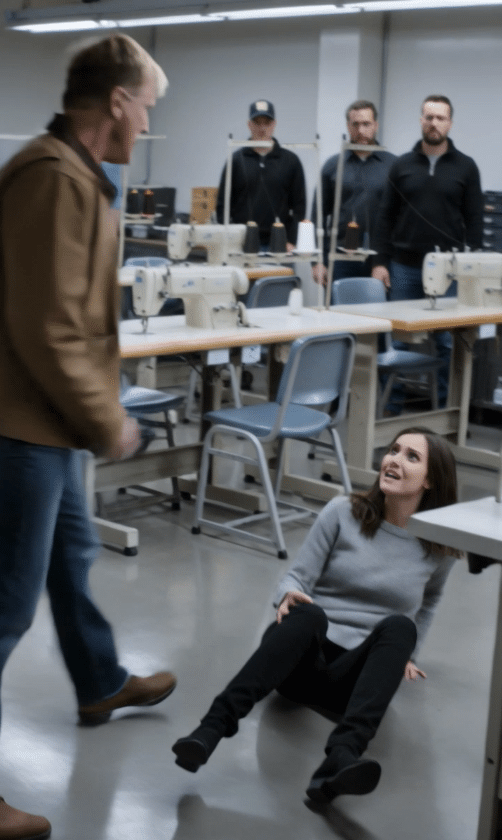
The phone was still clutched in Carl Allen’s fist when his daughter crashed into a row of sewing chairs.
Thread spools scattered across the factory floor. One rolled beneath a long worktable, another bounced against a metal machine, and a third spun in a slow circle before falling on its side. Sophie Allen lay on the concrete in her gray sweater and black pants, struggling to catch her breath while her father stood over her, holding the new phone she had spent months saving to buy.
“Give it back,” she whispered.
Carl, fifty-two, looked down at her with contempt.
Sophie was twenty-three, exhausted from another long shift at the garment factory. Her hands were rough from handling fabric, her eyes were heavy from too many early mornings, and a small thread spool remained trapped between the fingers of one hand.
But she was not looking at her father.
She was looking at the phone.
It was the first new phone she had ever purchased entirely with her own money. Nothing about it was luxurious. She had chosen a modest model, waited for a discount, and paid for it only after setting aside enough to cover her rent and groceries.
To someone else, it might have been an ordinary purchase.
To Sophie, it was a lifeline.
Her mother, Margaret, had been receiving treatment for a serious illness. Medical appointments often ran late, and sometimes Margaret needed to call Sophie with an update, a question, or a request for help getting home.
The phone meant Sophie could answer.
It meant her mother did not have to sit in a waiting room wondering whether her daughter would hear the call.
And it meant that if something went wrong, Margaret had a reliable way to reach the one person she trusted to come.
Carl knew that.
He also knew how much the phone could fetch if he sold it.
He had arrived at the factory near the end of Sophie’s shift, claiming he needed to speak with her about a family problem. Instead, he had walked straight to her sewing station, spotted the phone beside a stack of folded garments, and picked it up.
Sophie had asked him to put it down.
He refused.
When she reached for it, he turned away and tightened his grip.
“Dad, please. That’s mine.”
Carl gave a bitter laugh.
“You think buying one little phone makes you independent?”
“It’s the only way Mom can call me.”
He stared at her as though she had said something ridiculous.
“Trash. A phone is money.”
Sophie stepped closer.
“Please. Mom needs it.”
Carl’s face hardened. He drove a forceful kick into her chest, knocking her backward into the sewing chairs. The impact sent them scraping across the floor, and several more thread spools tumbled from the edge of the worktable.
Sophie landed hard, a thin trace of blood appearing along her forearm where it scraped against a metal chair.
Carl still had the phone.
She tried to push herself up, wincing as pain tightened through her chest. Her gaze remained fixed on the device in his hand.
“Dad, stop.”
He moved toward her.
She reached for the phone again, and he kicked her twice more in the back and side as she struggled across the floor.
A worker near the next sewing line gasped and covered her mouth. Another stepped behind a worktable, staring in disbelief. Several employees had already shut down their machines for the end of the shift, but none of them moved forward.
Carl looked around at the silent workers.
“What are you all staring at?”
No one answered.
Sophie pressed one hand against her side and reached toward him with the other.
“Please,” she whispered. “It’s the only way Mom can call me.”
Carl lifted the phone slightly, examining it as though he were considering the price he could get.
“She can call someone else.”
The words hurt more than Sophie expected.
For a moment, she could not speak.
Her father knew that her mother was frightened of being alone during medical appointments. He knew that Margaret often called Sophie simply to hear her voice when the day became overwhelming.
He knew all of it.
And he was still willing to sell the phone.
A door at the far end of the factory swung open sharply.
Victor Lane, the fifty-nine-year-old factory manager, stepped out of his office. His black blazer was neatly buttoned, his steel-gray hair was combed back, and his expression changed the moment he saw Sophie on the floor.
He crossed the room without hesitation.
Carl barely had time to turn before Victor seized his wrist, clamping one hand around it and freezing the phone in his grip.
“Give her phone back.”
Victor’s voice was quiet.
That made it more frightening.
Carl tried to pull away, but Victor held firm. Their eyes met, and the older man’s expression gave nothing away.
For the first time, Carl seemed to realize that the factory was no longer a place where he could intimidate his daughter without consequence.
He stared at Victor, his anger giving way to confusion.
“Who are you?”
Victor did not release his wrist.
And before Carl could demand another answer, the manager looked past him toward the injured young woman on the floor.
“Sophie,” he said, his voice softening. “Stay where you are. We’re getting you help.”
Carl’s face went pale.
He had come to take a phone.
He was about to discover what that phone meant to the woman he had just hurt—and why the manager who had spent years protecting his workers would not allow him to walk away as though nothing had happened.
Act II
Victor Lane had managed the garment factory for eleven years.
He had seen workers arrive with injured fingers, exhausted parents struggle through double shifts, and families try to survive on wages that seemed to disappear before the next payday. He knew that people sometimes carried problems into the factory that no manager could solve.
But he had always believed there was a line between personal hardship and the deliberate abuse of another person.
Carl had crossed it.
Victor released Carl’s wrist only after making sure the phone was no longer being pulled away. He took the device, placed it safely on a nearby worktable, and ordered a supervisor to call emergency services.
Then he crouched beside Sophie.
“Can you tell me where you’re hurting?”
“My chest,” she said, breathing carefully. “And my side.”
“Don’t try to stand yet.”
He asked another employee to clear the area and keep the sewing machines shut down. A third worker was instructed to preserve any available security footage and identify the employees who had witnessed the assault.
Carl scoffed.
“This is ridiculous. She’s my daughter.”
Victor rose slowly.
“That doesn’t give you permission to hurt her.”
“She was trying to take something from me.”
“Was it yours?”
Carl opened his mouth, then closed it.
Victor glanced toward the phone.
Sophie had bought it herself. Victor knew that much because he had approved her request to adjust a break once so she could collect the package from a nearby delivery point before the store closed. She had been so pleased with the purchase that she had shown it to a coworker during lunch.
She had told them she had finally found a phone with a battery that would last through a long shift.
More importantly, she had said her mother could now reach her whenever she needed to.
Victor had remembered that detail because Sophie rarely spoke about herself. She worked quietly, followed instructions, and often stayed a few minutes late to help prepare a production line for the next morning.
When coworkers asked why she looked tired, she usually smiled and said she had been busy.
Victor had once seen her using her break to arrange a medical appointment for her mother. She had apologized for making the call in the break room, even though she was well within her permitted break time.
He had told her she had nothing to apologize for.
Now she was on the factory floor, injured because her father had decided that her belongings were his to sell.
Carl glanced at the workers gathering near the aisle.
“You people don’t know anything about our family.”
One of the employees lowered her eyes, but another remained still, watching him with visible disgust.
Victor did not argue about the family history.
He focused on what had happened in front of him.
“You took her phone. She asked you to return it. You kicked her.”
“She was being difficult.”
“That isn’t an explanation.”
Carl’s jaw tightened.
He had spent years using the same strategy with Sophie. He would demand something, ignore her refusal, and then claim she was causing trouble when she tried to protect what belonged to her.
If she questioned him, she was disrespectful.
If she refused him money, she was selfish.
If she asked him to leave her belongings alone, she was acting as though she were better than her family.
He had never considered the possibility that Sophie might simply be entitled to make decisions about her own life.
When she was younger, he had controlled the money she earned from weekend jobs. He told her that the household needed it and that a good daughter should contribute without complaining. Sophie had believed him, at least for a while.
As she grew older, she started keeping a little money aside for emergencies.
Carl noticed.
The first time she bought herself a pair of work shoes, he asked why she had not given him the money instead. When she purchased a winter coat, he complained that she was wasting her wages. When she began paying for her own phone service, he accused her of keeping secrets.
The new phone became the latest target.
Carl had accumulated debts he struggled to explain. He owed money to acquaintances, had fallen behind on several bills, and was increasingly desperate for cash. He had already sold a few household items that were not his to sell, insisting that he would replace them once his finances improved.
Sophie had learned to hide anything she could not afford to lose.
But she had underestimated how far he would go.
Victor turned to the supervisor.
“Make sure the footage is preserved. Write down who was here and what they saw. Don’t delete or alter anything.”
The supervisor nodded.
Carl gave a sharp, disbelieving laugh.
“You’re treating me like a criminal.”
“I’m treating this as a serious incident that happened in my workplace.”
“You can’t tell me how to deal with my own daughter.”
Victor looked directly at him.
“I can tell you that she is injured on my factory floor, and you are not going to intimidate her or anyone else while we get help.”
Carl looked toward Sophie.
“Tell him to back off.”
She flinched at the sound of his voice.
Victor noticed.
He moved slightly so that Carl could not stand directly over her.
“Sophie doesn’t need to settle anything with you right now.”
Her father stared at him with growing resentment.
For years, Sophie had tried to manage Carl’s moods because she believed it was the only way to protect her mother from further stress. She had learned to speak carefully, hide disappointment, and make herself smaller whenever his temper began to rise.
Victor had no intention of demanding that she suddenly become fearless.
He simply made sure she had room to breathe.
And as the sound of approaching emergency personnel reached the factory entrance, Sophie looked at the phone on the worktable.
She wanted to call her mother.
She wanted to tell Margaret that she was safe, that the phone was still there, and that she would not disappear without warning.
But before she could reach for it, Victor asked a question that made her eyes fill with tears.
“Has he done something like this before?”
Sophie looked down.
Her silence answered more than she could bring herself to say.
Act III
Sophie had spent most of her life trying to make her father’s behavior sound less frightening than it was.
When relatives asked why she seemed distant from Carl, she said he was under financial pressure. When he borrowed money and failed to return it, she described it as a temporary problem. When he shouted at her for refusing to hand over her wages, she told herself that everyone argued sometimes.
It was easier to explain his behavior than to accept that the person she had been taught to trust was becoming someone she feared.
Her mother, Margaret, had always been the person Sophie turned to when she needed comfort. Margaret worked hard, spoke gently, and remembered small details that other people overlooked.
But after Margaret became seriously ill, the balance of the household changed.
Medical appointments consumed entire mornings. Prescriptions needed refilling. Some days Margaret felt strong enough to prepare a meal, while on others she struggled to manage ordinary tasks without resting.
Sophie began taking extra shifts.
She learned which bills could be paid a few days later without penalties and which ones could not. She kept a small notebook of appointment dates, pharmacy numbers, and the instructions Margaret needed to remember.
She also learned to answer the phone quickly.
Sometimes Margaret called because she needed help arranging a ride home. Sometimes she wanted Sophie to clarify something the clinic had explained. Occasionally, she simply wanted to hear her daughter’s voice after a difficult appointment.
Sophie never minded.
She could not be at every appointment, but she could at least be reachable.
Her old phone had become unreliable. Its battery drained quickly, the charging port worked only at certain angles, and calls sometimes disconnected without warning. Sophie had tried replacing the cable and cleaning the port, but the problems continued.
Buying a new device meant postponing other purchases and saving carefully for several months.
She compared prices, read reviews, and waited until she found an affordable model that met her needs. She did not buy the most expensive phone or add accessories she could live without.
She bought the one she could pay for.
The day it arrived, Margaret had been sitting at the kitchen table sorting appointment papers. Sophie showed her the new device and explained how to use the emergency contact shortcut.
Margaret smiled.
“Now I won’t have to worry about whether your old phone is charged.”
Sophie laughed.
“Now you can call me whenever you need me.”
Neither of them knew how important that promise would become.
Carl had noticed the new phone almost immediately.
He asked how much it cost, whether she had paid for it in full, and whether she could sell it if she needed cash. Sophie answered the first question and ignored the others.
He began suggesting that she did not need a new phone when the old one could still turn on.
When she explained that the old phone often failed during calls, he dismissed the problem.
“People managed perfectly well before all this technology.”
“Mom needs to be able to reach me,” Sophie replied.
“She can call the house.”
“The house phone doesn’t always work.”
Carl waved away the explanation.
A few days later, he asked Sophie for money. She told him she had already committed her remaining savings to household expenses and could not lend him anything.
He accused her of hiding money.
Then he noticed the new phone on the table.
Sophie saw the look in his eyes and immediately picked it up.
“Don’t even think about it,” she said.
Carl laughed as though she had made a joke.
But he remembered.
At the factory, when he saw the phone beside her sewing station, he decided that he could turn it into cash before she had a chance to stop him. He did not ask whether she was using it. He did not consider why she might need it.
He simply took it.
And when Sophie refused to let him leave with it, he attacked her.
Now, with emergency personnel assessing her injuries, Sophie finally began explaining the pattern to Victor.
She spoke slowly, pausing whenever her breathing became uncomfortable. She told him about the money Carl had borrowed and never returned, the belongings he had sold, and the arguments that followed whenever she refused to give him something else.
She admitted that she had sometimes hidden cash in different places because she feared he would take it.
“I kept thinking he’d stop,” she said. “I thought if I just got through this month, things might settle down.”
Victor listened without interrupting.
“Did you tell anyone at work?”
Sophie shook her head.
“I didn’t want everyone knowing my problems.”
“You didn’t cause this problem by keeping it private.”
She looked at him.
“I should have said something.”
“No,” Victor replied. “The person who hurt you is responsible for hurting you. Not you for failing to predict it.”
The words left Sophie staring at him.
She had blamed herself for so many things that she could no longer easily distinguish responsibility from guilt. If Carl was angry, she wondered what she had said wrong. If he demanded money, she wondered whether she should have saved more. If he threatened to sell something she owned, she wondered whether keeping it was worth another argument.
Victor was not offering a magical solution to her family situation.
He was simply refusing to make her responsible for her father’s choices.
The emergency personnel advised Sophie to receive further medical evaluation, and she agreed. Victor arranged for her personal belongings to be kept secure while she was away, including the new phone.
He also explained that the factory would document the incident and cooperate with the appropriate authorities. He would not promise an outcome he could not control, but he would make sure the available evidence was preserved and that Sophie would not be pressured into returning to work before she was ready.
Carl listened from the other side of the aisle, growing more agitated with every minute.
“You’re making her think she can turn against her own family,” he snapped.
Sophie turned her head.
For once, she did not immediately apologize.
“I’m not turning against you,” she said. “I’m asking you to stop taking things from me.”
Carl stared at her as though she had betrayed him.
But the people around them were beginning to understand what Sophie had spent years trying to hide.
The phone was not merely an object.
It was one of the few ways she could care for her mother without being physically present. It represented months of careful choices and the hope that one small problem in their lives might finally be solved.
Carl had known that.
He had taken it anyway.
And now the entire factory had seen what happened when Sophie refused to surrender.
Act IV
Carl tried one last time to regain control of the situation.
As the medical personnel prepared to take Sophie for further evaluation, he stepped toward her.
“Give me a minute with my daughter.”
Victor moved into his path.
“Not right now.”
“You can’t keep me away from her.”
“No one’s making a permanent decision about your relationship. But she’s injured, and she doesn’t need you pressuring her.”
Carl’s face tightened.
“I only wanted to sell the phone. I was going to give her the money.”
Sophie looked at him from the chair where she was waiting.
“You never asked.”
“I knew you’d say no.”
“That’s why you took it?”
Carl had no answer.
The admission was not explicit, but it was there in his silence. He had not taken the phone because he misunderstood who owned it. He had taken it because he knew Sophie would refuse to sell it.
He had decided that her refusal did not matter.
Victor held his gaze.
“You knew she didn’t want you to take it. You took it anyway, and then you hurt her when she tried to stop you.”
Carl shook his head.
“You don’t know what it’s like to have debts piling up.”
Victor’s expression remained controlled.
“I know that financial trouble doesn’t give you ownership of another person’s belongings.”
Carl glanced around at the workers.
He had expected them to remain silent, as they had during the assault. He had mistaken their fear and shock for agreement. Now, with the manager standing between him and Sophie, he seemed to realize that no one was going to help him rewrite what had happened.
The supervisor confirmed that the relevant footage had been preserved. Several employees were prepared to provide statements. The factory’s incident report recorded the time, location, and immediate response, while the responding authorities would handle their own investigation.
Victor made clear that no one should confront Carl or interfere with the process.
He also arranged for Sophie to receive support through the workplace’s normal procedures. Her immediate safety and medical needs came first; questions about scheduling, leave, and any further workplace arrangements could be addressed when she was ready.
Carl tried to dismiss the entire process as an overreaction.
“It’s a family argument.”
Victor looked at him steadily.
“A family argument doesn’t make it acceptable to kick someone who is lying on the floor.”
The words silenced the nearby workers.
For Sophie, the most difficult part was not hearing her father deny what he had done. She had heard him deny responsibility before.
It was watching him try to make her feel guilty for what happened afterward.
He had hurt her, and now he was angry that other people knew.
He had taken her phone, and now he was furious that she might get it back without his permission.
He had placed her in danger, yet he expected her to protect him from the consequences.
Sophie finally understood that she could not find the right words to make him become reasonable. She could not save him from every debt or force him to accept the boundaries he had spent years ignoring.
She could only decide what she would allow next.
When Carl approached again, she spoke before Victor had to intervene.
“Don’t come near me.”
Her voice shook.
But the words were clear.
Carl froze.
“I’m your father.”
“I know.”
“You can’t treat me like a stranger.”
Sophie swallowed, fighting the urge to retreat into an apology.
“You can’t treat me like something you own.”
For the first time, Carl seemed genuinely uncertain about what to say.
He had built his authority over Sophie on the assumption that she would always return to the same position: frightened, apologetic, and willing to make peace if he demanded it loudly enough.
Now she was refusing to play that part.
Victor remained nearby, but he did not speak for her.
The medical personnel took Sophie for evaluation, and the factory manager made sure her phone was returned to her belongings rather than left within Carl’s reach. The device had not been dropped or damaged during the confrontation, and when Sophie checked it, she found her mother’s contact information still on the screen.
She pressed the phone against her chest.
It was such a small gesture that no one else seemed to notice.
But Victor understood.
For Sophie, getting the phone back meant more than recovering something she had purchased. It meant restoring a connection that Carl had tried to sever because he needed money.
Before leaving, she called Margaret.
Her mother answered after the second ring.
“Sophie?”
“I’m here, Mom.”
There was a pause.
“I was worried. You didn’t answer my last message.”
Sophie closed her eyes.
“I know. I’m sorry.”
“Are you all right?”
She hesitated, then decided not to pretend.
“I got hurt at work. I’m getting checked out, but people are helping me.”
Margaret’s voice trembled.
“What happened?”
Sophie looked at the phone in her hand.
“Dad came for it. He wanted to sell it.”
The silence on the other end was immediate.
Then Margaret asked the question Sophie had been afraid to hear.
“Did he hurt you?”
Sophie could have lied.
Instead, she told the truth.
“Yes.”
And in that moment, the secret that had governed their family for years finally became something neither of them had to carry alone.
Act V
Sophie did not return to the sewing line the next morning.
She followed medical advice, attended the recommended follow-up appointments, and took the time she needed to recover. Victor made sure the factory handled her absence through its normal procedures and that she was not pressured to resume work before she was ready.
For the first time in months, she had permission to rest without feeling that every hour away from the sewing machine endangered her mother’s future.
It was an unfamiliar feeling.
At home, Margaret listened as Sophie explained what had happened in the factory. She was devastated, but she did not ask her daughter why she had resisted Carl or whether she could have handled the situation differently.
Instead, she reached for Sophie’s hand.
“You shouldn’t have had to protect yourself from your own father.”
Sophie looked down.
“I thought if I kept things calm, he might stop.”
Margaret’s eyes filled with tears.
“I thought the same thing.”
They sat together for a long time.
Neither woman could undo the years of arguments, financial pressure, and broken promises. But they could stop pretending that silence had protected them.
Margaret acknowledged that her illness had made her dependent on Sophie in ways neither of them had expected. She had worried about becoming a burden, and she had sometimes accepted Carl’s assurances because challenging him felt like one more crisis she could not afford.
Sophie admitted that she had hidden the worst arguments because she did not want to add to her mother’s stress.
Both had been trying to protect the other.
And in the process, they had become isolated.
They began talking about practical changes.
Margaret would keep copies of her appointment information and important phone numbers somewhere accessible. Sophie would make sure another trusted person could be contacted if she was unavailable. They would review the household budget together, including the costs of medication and transportation, rather than leaving Sophie to manage everything alone.
They also agreed that Carl would not be allowed to take money or belongings from either of them without permission.
That boundary would not be enforced by another promise.
It would be enforced by their decisions.
In the days that followed, Sophie cooperated with the investigation into the assault. The factory provided the relevant documentation and witness information, and the authorities determined the next steps. Victor made sure the workplace’s response remained focused on safety, evidence preservation, and appropriate procedures rather than rumors or retaliation.
He also spoke with employees about what they should do if they witnessed violence or a serious confrontation at work. They were reminded to seek help, alert management, and contact emergency services when needed rather than putting themselves in danger by intervening physically.
Several workers later approached Sophie privately.
One apologized for not knowing what to do when Carl attacked her. Another admitted that she had frozen in fear and had been ashamed of herself afterward.
Sophie did not blame them.
“I was scared, too,” she told them.
The conversation helped the workers understand that witnessing violence could leave people shaken, even when they were not the target. The factory arranged for employees to raise safety concerns without fear of being mocked or dismissed.
Victor did not present himself as a hero.
He had stepped in because a worker was being hurt in front of him. He had used his position to stop the immediate threat, preserve evidence, and make sure Sophie received help.
The rest required a process.
There would be statements to give, decisions to make, and difficult boundaries to maintain. No single conversation could guarantee that Carl would change.
Sophie understood that now.
When Carl eventually contacted her, he began with anger.
He complained that people were treating him unfairly. He said the factory manager had humiliated him and that Sophie had made a private matter public.
Then he told her he still needed money.
Sophie read the message several times.
In the past, she would have tried to explain her decision until he understood. She would have reminded him that her mother needed medication, that the phone was essential, and that there was nothing left to lend.
This time, she did not argue.
She replied that she would not give him money, and that he was not to take her belongings or approach her at work. Any further threats or unwanted confrontations would be documented and handled through the appropriate channels.
Then she put the phone down.
Her hands were trembling, but she had not taken back a single word.
A week later, Sophie returned to the factory.
The sewing machines hummed as the morning shift began. Thread spools stood in neat rows beside the workstations, and the long tables were ready for another day of production.
Her phone rested beside her folded fabric.
Victor stopped by her station before the line started.
“How are you feeling?”
“Better,” she said. “Still sore, but better.”
“Don’t push yourself. Let your supervisor know if you need an adjustment.”
“I will.”
He nodded toward the phone.
“Your mother been able to reach you?”
Sophie smiled.
“Every day.”
She had begun keeping the device charged during breaks and had set up a second trusted contact in case she was unable to answer. The phone remained modest, with a plain protective case and no unnecessary accessories.
But every time it rang and her mother’s name appeared on the screen, Sophie felt a quiet relief.
One evening, Margaret called after a medical appointment.
“I wanted to tell you the doctor says the current plan is working as expected,” she said. “We’re going to keep monitoring it.”
Sophie leaned back in her chair after her shift and let out a breath she had not realized she was holding.
“That’s good, Mom.”
“And I wanted to tell you something else.”
“What?”
“You don’t have to give up your whole life to take care of me.”
Sophie closed her eyes.
“I know.”
“Do you?”
This time, Sophie smiled through the tears.
“I’m learning.”
They spoke for several more minutes about ordinary things—the groceries they needed, a neighbor who had offered to help with transportation, and a recipe Margaret wanted to try when she felt stronger.
Nothing dramatic happened.
No miraculous fortune arrived. No one appeared to erase the family’s financial difficulties. Sophie still had long shifts, bills, and the uncertainty of a future she could not completely control.
But she was no longer carrying every responsibility alone.
And she was no longer confusing love with surrender.
The phone that Carl had tried to sell remained beside her at work, its screen lighting up whenever Margaret called. It had become a reminder of what Sophie had protected that afternoon: not simply a piece of technology, but her ability to answer when someone she loved needed her.
Carl had looked at the device and seen cash.
Sophie had looked at it and seen her mother waiting for a familiar voice.
Victor had looked at the scene and seen a worker who needed someone to intervene before she was hurt any further.
Those were three very different ways of understanding the same object.
Only one of them recognized its true value.
On a quiet evening after the factory had emptied, Sophie finished arranging her station for the next shift. She checked that her phone was charged, slipped it into her bag, and turned off the light above the sewing machine.
Victor was standing near the office door.
“Good night, Sophie.”
“Good night, Mr. Lane.”
She walked toward the exit, then paused to check her phone one last time.
A message from Margaret waited on the screen.
Home safe. Call me when you get there.
Sophie typed back.
I will. Love you, Mom.
Then she stepped outside.
For months, she had believed that being a good daughter meant sacrificing whatever she had until everyone else was safe. She had worked through exhaustion, hidden her fear, and tried to keep her family together by absorbing every problem herself.
Now she understood that caring for her mother did not require surrendering her own safety.
She could be loving without being controlled.
She could be generous without allowing someone to take everything she earned.
And she could refuse her father without becoming the cruel person he claimed she was.
Carl had kicked her down because she would not surrender the phone.
But he had failed to take the one thing he had been trying to control all along: her right to decide what happened to her own life.
The next time Margaret called, Sophie would answer.
Not because her father had allowed it.
Not because anyone had given her permission.
But because the phone was hers, the choice was hers, and the connection between mother and daughter belonged to neither Carl’s debts nor his anger.
It belonged to them.
And that was something he could never sell.