Act I
The laptop was halfway out of Hannah Lee’s backpack when she grabbed it with both hands.
“Dad, no! You can’t take that!”
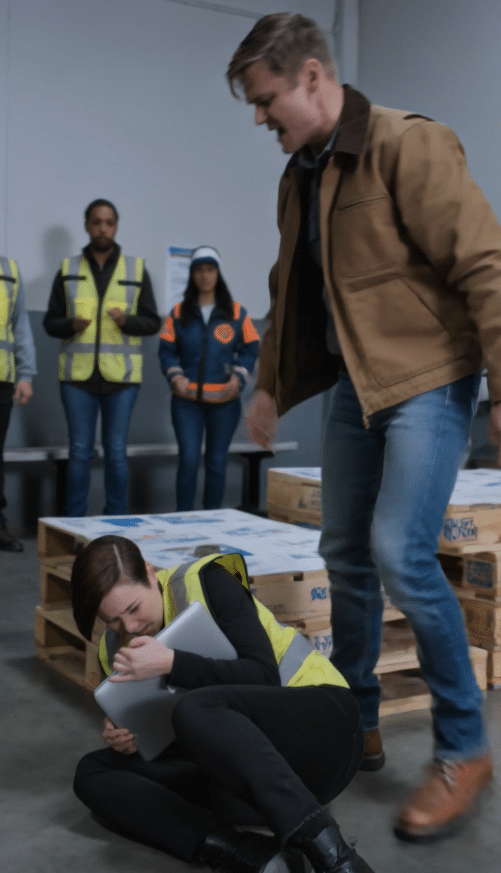
Ed Lee tightened his grip on the new computer. His old brown jacket hung loosely over his shoulders, and his rough fingers dug into the edges of the laptop as he tried to wrench it away from her.
The warehouse was nearing the end of its overnight shift. Cold industrial lights stretched across rows of pallet stacks, and the break area smelled faintly of coffee and cardboard. A few workers stood between the shelves, watching the confrontation unfold without daring to move closer.
Hannah was twenty-four, wearing a yellow safety vest over her work clothes. Her black pants were dusty from the shift, and exhaustion had settled into her face. She had spent months taking extra hours at the warehouse, often volunteering for the shifts nobody else wanted.
All of it had been for one thing.
The laptop.
“My sister needs it for school,” Hannah pleaded.
Ed scoffed.
“Trash. School doesn’t pay me.”
“It’s not yours!”
He yanked the laptop harder.
Hannah held on.
Her younger sister, Emily, was seventeen and approaching the final year of high school. She had been borrowing a neighbor’s old computer to complete assignments, writing essays late at night whenever the machine was available. Sometimes the battery died halfway through a project. Sometimes the computer froze and erased her work.
Hannah had promised her a better one.
Not an expensive gaming machine or some luxury device. Just a reliable laptop that would let Emily finish her assignments, attend online tutoring sessions, and apply for college without constantly worrying that the computer would fail.
Hannah had saved a little from every paycheck. She skipped takeout, stopped buying new clothes, and accepted extra shifts until the money was finally enough.
She had brought the laptop home only two days earlier.
Now her father had discovered it in her backpack.
“I can sell it before sunrise,” Ed said.
Hannah stared at him.
“You haven’t even asked what it is for.”
“I don’t have to ask. I know what it’s worth.”
“You know what it’s worth to someone who wants to buy it. You don’t know what it means to her.”
Ed’s face hardened.
“What it means to her doesn’t pay my bills.”
“Then find another way!”
The words echoed across the break area.
For a moment, even the conveyor noise in the distance seemed to fade beneath the tension.
Ed had spent years treating other people’s belongings as emergency money whenever his own decisions caught up with him. He could turn almost anything into a debt argument: a phone, a paycheck, a household appliance, even the money Hannah had saved for necessities.
But this laptop was different.
It represented months of effort that had finally produced something good for someone Hannah loved.
She refused to let him carry it away.
Ed made one final attempt to wrench it from her hands. When she would not release it, he stepped back and drove a forceful kick into her chest.
Hannah was knocked backward into a stack of low cardboard boxes.
The laptop skidded across the floor, still closed and intact. Her worker badge snapped loose and fell beside her, its plastic edge scraping against the concrete. A thin trace of blood appeared on her forearm as she landed.
For a moment, Hannah could not get her breath.
Then she saw the laptop lying a few feet away.
She pushed herself toward it.
“Please,” she gasped. “Just leave it alone.”
Ed followed her.
He kicked her twice more in the back and side as she tried to shield the computer with her body.
Hannah cried out, curling around the laptop. Pain flashed through her chest and side, but she stretched one arm toward the machine, trying to pull it closer.
A worker behind the pallet racks covered his mouth.
Another took a step backward, his face pale.
Nobody intervened.
Ed looked down at his daughter with open contempt.
“School doesn’t pay me,” he repeated. “You keep wasting money on her while I’m the one who needs it.”
Hannah’s eyes filled with tears.
“She has a future.”
“And what about me?”
“You’re her father, too!”
He laughed bitterly.
“Then you should know whose side you’re supposed to be on.”
Hannah stared at him, stunned by the idea that he could turn her attempt to help her sister into a betrayal of him.
She had worked through aching feet, missed family dinners, and nights when she was so tired she could barely keep her eyes open. She had done it because she wanted Emily to have options neither of them had possessed growing up.
Ed had contributed nothing to that dream.
Now he was trying to sell it before sunrise.
A sudden braking sound came from outside the warehouse.
The heavy door swung open.
Robert Kane, the fifty-eight-year-old operations manager, stepped inside wearing a dark company jacket. His gray hair was slightly disheveled, and his expression changed the instant he saw Hannah on the floor.
He had arrived early to review an unexpected inventory discrepancy and speak with the overnight supervisor.
Instead, he found a worker curled around a laptop while a man stood over her.
Robert crossed the break area with long, decisive strides.
He did not strike Ed.
He did not need to.
He stepped between the man and Hannah, looked directly into his eyes, and spoke with a voice that carried through the warehouse.
“I want to see who dares sell her laptop.”
Ed froze.
The aggression drained from his face, replaced by confusion and sudden uncertainty.
Robert stood motionless, his gaze fixed on him.
Ed looked at the company jacket, then at the workers watching from behind the pallets.
For the first time that morning, he seemed unsure whether anyone would believe him.
“Who are you?”
Robert glanced down at Hannah, then back at the man.
“The person responsible for this warehouse. And you’re going to explain why one of my employees is lying on the floor.”
Ed had come expecting to steal a laptop from a tired young woman.
He had not expected to find someone who knew her worth before he ever knew her name.
And he had no idea that the laptop he wanted to sell was about to expose a much larger truth about the family he had spent years exploiting.
Act II
Hannah Lee had never considered herself particularly brave.
She was the person who volunteered to cover an extra shift because someone else had a sick child. The person who stayed late to help a new employee understand the inventory system. The person who said she was fine even when her back ached and her bank account was nearly empty.
She had learned early that if she wanted something to happen, she usually had to make it happen herself.
Her mother had worked long hours when Hannah and Emily were younger. Their father, Ed, was unpredictable. Sometimes he found temporary work and brought home enough money to make the household feel almost normal. Other times, he disappeared for days, returning angry, broke, and full of explanations.
Hannah remembered the arguments over bills.
She remembered her mother quietly counting grocery money at the kitchen table after Ed had promised to pay a utility bill and failed to do so.
Most of all, she remembered Emily trying not to ask for anything.
When the younger girl needed new school supplies, she would insist that the old ones were good enough. When her shoes became too small, she would say she could wait another month. When the family computer finally stopped working reliably, she told Hannah she could complete her assignments at the library.
Hannah knew what that meant.
It meant Emily had begun shrinking her dreams to fit the family’s circumstances.
And Hannah could not bear to watch that happen.
At twenty-four, she had postponed her own plans more times than she could count. She had considered taking community college courses, but tuition and household expenses made it difficult to reduce her working hours. She told herself she would return to school later, when things were more stable.
For now, she focused on getting Emily to the next stage of her life.
The warehouse offered regular pay, overtime opportunities, and enough hours to save if she was careful. The work was physically demanding, but Hannah understood the routine. She knew how to handle incoming shipments, scan inventory, and keep track of orders when the floor became chaotic.
Her supervisor had once joked that Hannah could find a missing pallet faster than the tracking system.
She had smiled, then returned to work.
The laptop savings took almost five months.
Hannah created a separate budget and refused to touch it except for genuine emergencies. She brought lunch from home, walked when she could instead of paying for a ride, and accepted additional shifts during busy periods.
When she finally ordered the computer, she checked the specifications repeatedly. She chose a reliable model with enough memory for schoolwork, video calls, and college applications. She bought a protective sleeve and saved the receipt in case anything went wrong.
When the package arrived, she placed it on the kitchen table.
Emily stared at the box.
“What is that?”
“Open it.”
Her sister lifted the lid carefully, as though she were afraid the contents might disappear if she moved too quickly.
For several seconds, she said nothing.
Then she looked at Hannah.
“You bought this for me?”
Hannah shrugged, trying to make the moment seem smaller than it was.
“You need it.”
Emily threw her arms around her.
“I don’t know what to say.”
“You can start by doing your homework on something that doesn’t crash every twenty minutes.”
Emily laughed through her tears.
That evening, she set up the laptop at the kitchen table. She logged into her school account, opened her assignments, and started organizing the files she had been struggling to keep straight on the borrowed computer.
Hannah stood in the doorway and watched.
For once, her sister wasn’t asking someone else when she could use a computer. She wasn’t rushing through an assignment before the battery died or worrying that the machine would freeze.
She had something dependable.
Hannah went to bed that night feeling more satisfied than she had after any purchase she had made for herself.
She never imagined Ed would find out about it so quickly.
He had been living in unstable circumstances for some time, drifting between acquaintances and temporary arrangements. His money problems had followed him, and he had grown increasingly resentful of anyone who refused to help.
When he learned Hannah had bought a laptop, he didn’t ask about Emily’s schoolwork.
He asked how much it cost.
Then he demanded to see it.
Hannah should have recognized the danger immediately. But part of her still hoped that, confronted with a concrete explanation, her father might understand.
She told him Emily needed the computer for school.
Ed barely listened.
He saw an object that could be converted into cash.
He did not see the months of overtime. He did not see the exhausted young woman who had eaten cheap meals to save enough money. He did not see Emily’s face when she opened the box.
He saw a quick solution to his own problem.
That was why he had come to the warehouse before dawn.
He knew Hannah had brought the laptop in her backpack because she planned to take it home after work and give Emily some help setting up a school account. He had followed her there, waited until the shift was nearly finished, and confronted her in the break area.
He assumed that once he demanded it, she would eventually give in.
She always had before.
But Hannah had reached a point where the cost of giving in was too high.
Now Robert Kane stood between them, and the workers who had watched the assault were beginning to step closer—not to fight Ed, but to make it clear that Hannah was no longer alone.
Robert turned toward the nearest employee.
“Call emergency services. Let the supervisor know what’s happened, and keep the area clear.”
Then he looked at Hannah.
“Don’t try to stand yet. Help is coming.”
She nodded, one hand still resting on the closed laptop.
Robert’s gaze moved to Ed.
“Step away from her.”
Ed straightened his jacket.
“This is a family issue.”
“No. This is an assault that happened in my workplace.”
“You don’t know anything about my daughter.”
Robert looked at Hannah’s fallen badge.
“I know she came here to work. I know she was hurt on this floor. And I know you’re standing over her instead of asking whether she’s okay.”
Ed’s mouth tightened.
For the first time, he seemed to understand that the story he had planned to tell might not survive the people who had witnessed the truth.
But Robert had not yet heard the most important part of Hannah’s story.
And when he did, the way he understood the young woman on the floor would change completely.
Act III
Robert Kane had managed warehouses for more than three decades.
He had seen employees come to work exhausted after caring for sick relatives. He had watched parents take overtime to cover school expenses, and he had known workers who quietly paid another person’s bills without telling anyone.
He understood that a paycheck could mean more than money.
Sometimes it meant rent.
Sometimes it meant medication.
And sometimes it meant the difference between a young person continuing their education and abandoning it.
Robert had met Hannah several months earlier during a staffing review. She had been working through a difficult inventory cycle, when several shipments arrived late and the night crew was short-handed.
Rather than complain, Hannah reorganized the staging area with two other workers and helped prevent a costly mix-up.
Robert remembered her because she had never tried to turn the achievement into a personal victory. When he thanked her, she mentioned that the team had done the work together.
That was the sort of employee he valued.
He also remembered that she had once requested a small scheduling adjustment so she could help her younger sister prepare for school examinations.
She had not asked for special treatment. She had simply explained the situation and offered to make up the hours elsewhere.
Robert approved the adjustment.
He did not know the full story of Hannah’s family, and he had never asked her to share details she wanted to keep private.
Now, standing in the warehouse break area, he saw the consequences of a burden she had carried quietly for years.
The paramedics arrived and began assessing Hannah’s injuries. Robert made sure they had room to work, then directed the supervisor to preserve the security footage from the break area and the nearby warehouse entrance.
The laptop remained closed on the floor.
Hannah kept looking at it.
“Is it okay?” she asked.
Robert followed her gaze.
“It looks intact, but let the responders take care of you first.”
“My sister needs it.”
“We’ll make sure it stays here until the scene is documented.”
Ed let out an impatient breath.
“You’re acting like I tried to steal a truck.”
Robert turned toward him.
“You took something that wasn’t yours, then hurt someone who tried to stop you.”
“I was going to sell it and give her the money.”
Hannah lifted her head.
“You were going to sell it for yourself.”
Ed pointed at her.
“Don’t start lying.”
Robert stepped between them again.
“Do not intimidate her.”
Ed’s hand dropped.
The manager’s voice remained firm, but he was careful not to turn the encounter into a personal fight. He knew the incident needed to be documented properly, and the people who responded would need clear accounts rather than competing threats.
He asked the supervisor to identify the employees who had witnessed the confrontation. They would be given an opportunity to provide statements without being pressured by Ed or by one another.
The security footage would be retained.
The laptop and Hannah’s worker badge would be documented as part of the scene.
Any criminal allegations would be handled through the appropriate authorities.
Robert’s job was to protect his employee, secure the workplace, and cooperate with that process.
Ed, however, had no intention of making things easy.
“You can’t keep me here,” he snapped.
“No one said you were being detained by the company,” Robert replied. “The responding authorities will determine what happens next. Until then, stay away from Hannah and leave the laptop alone.”
Ed looked around for support.
The workers who had been watching him were no longer looking away. Some appeared shaken, others angry, but none seemed willing to validate his claim that he had done nothing wrong.
That silence unsettled him.
For years, Ed had controlled family arguments by making them feel private. If he raised his voice enough, other people would withdraw. If he accused someone of disrespecting him, they might spend the rest of the conversation defending themselves instead of discussing what he had done.
But the warehouse was not his living room.
The employees were not his children.
And Hannah’s paycheck, belongings, and future were not his to claim.
Robert looked at Hannah.
“Why was he looking for the laptop here?”
She hesitated.
“He knew I had it in my backpack. I brought it in because I wanted to help my sister finish setting up her school account after work.”
“Has he tried to take your things before?”
Hannah looked down at her hands.
The question opened a door she had kept closed for a long time.
“He asks for money a lot,” she said. “Sometimes he says he’ll pay it back. Sometimes he just says I owe him because I’m his daughter.”
Robert waited.
“He’s taken money from me before. Not always a lot at once. But if I say no, he gets angry. I thought if I kept things calm, he would stop.”
“Has he threatened you at work before?”
“No. Not here.”
Hannah swallowed.
“I didn’t want anyone to know what things were like at home.”
Robert understood.
Employees often kept personal problems private because they feared being treated differently. Some worried that a manager would see them as unreliable. Others simply wanted one place in their lives where they could be known for their work rather than their difficulties.
Hannah had been trying to keep the warehouse separate from the problems waiting for her at home.
Now those problems had followed her through the door.
Robert glanced toward the laptop.
“Your sister knows you bought that for her?”
Hannah nodded.
“She thinks I’m giving it to her as a surprise. I haven’t told her exactly how long I saved.”
“Why not?”
A faint, embarrassed smile appeared on Hannah’s face.
“Because I don’t want her to feel like she owes me anything.”
Robert considered that answer.
Then he looked at Ed.
His expression was no longer simply that of a manager confronting an incident. It was the expression of someone who had recognized a pattern: one person working quietly to build a future, another trying to take that future away because he believed his own needs came first.
Robert had seen that pattern destroy promising workers before.
He would not allow it to go unchallenged here.
Act IV
By the time the warehouse supervisor finished securing the area, the first rush of panic had begun to fade.
Hannah was receiving medical attention. The responders were evaluating her injuries and determining what further care she needed. Robert had made sure no one attempted to move her prematurely or pressure her into answering questions while she was in pain.
Ed stood near the entrance under observation, his confidence unraveling.
He tried one final argument.
“I raised her. I have a right to ask for help.”
Robert faced him.
“You can ask. She can say no.”
“She wouldn’t even be working if it weren’t for me.”
Hannah looked at him from where she sat with assistance.
“You weren’t there when I needed help.”
Her voice was quiet, but every worker nearby heard it.
Ed’s face darkened.
“You think you’re better than me now?”
“No.”
Hannah took a breath.
“I think Emily deserves a chance.”
He shook his head in disgust.
“Emily, Emily, Emily. Everything is always about her.”
“She’s seventeen. She’s trying to finish school.”
“And I’m supposed to starve?”
“You haven’t asked me for food. You’ve asked me for money you won’t explain.”
Ed stared at her.
For once, Hannah did not rush to soften the accusation.
She had spent years anticipating his reactions. She knew the exact moment his frustration might turn into shouting, the phrases that would make him accuse her of disrespect, and the guilt that would follow if she tried to end the conversation.
But she was tired of being the person who had to make every difficult moment comfortable for him.
Robert remained beside her, not speaking for her, simply ensuring that Ed did not crowd or threaten her.
The responding officers took statements from the witnesses and reviewed the circumstances of the incident. The warehouse’s security footage was preserved for the investigation, and the company documented the damage-free condition of the laptop as well as the location of Hannah’s badge and the surrounding boxes.
Robert gave his own account of what he had seen.
He made no attempt to decide the legal outcome himself. He did not promise Ed would lose his freedom, and he did not threaten to use his position to secure a particular punishment.
He knew that the facts needed to speak for themselves.
But he could control what happened inside his company.
Ed would not be permitted to use the warehouse as a place to intimidate Hannah. The supervisor would be informed that any future attempt to enter restricted work areas or approach employees in a threatening manner needed to be handled through established security procedures.
Hannah’s employment would not be jeopardized because she had been assaulted.
Her medical needs and recovery would be handled with appropriate consideration, and her schedule could be discussed when she was ready.
Most importantly, she would not be told to settle the matter privately to protect the company’s reputation.
Robert had seen companies make that mistake before.
They worried about disruption, paperwork, and uncomfortable questions. They sometimes pressured employees to keep quiet because it seemed easier than confronting a serious problem.
He believed the opposite approach was necessary.
A workplace could not claim to value its employees while asking them to endure violence in silence.
After the initial response, Robert sat beside Hannah while she waited to be cleared for further care.
“I’m sorry this happened here,” he said.
Hannah looked surprised.
“You didn’t do it.”
“No. But you’re part of this operation, and your safety matters to us. We need to take what happened seriously.”
She studied him for a moment.
“Am I going to lose my job?”
The question came out so quickly that Robert understood she had been carrying it since the moment she fell.
“No.”
She looked down.
“I couldn’t afford to lose it. Not with Emily starting her final year.”
“Your job is not in question because someone attacked you.”
Hannah blinked hard.
“I don’t know how I’m supposed to tell her.”
“Tell her the truth when you’re ready. You don’t have to solve every part of this tonight.”
She nodded, though tears had begun to gather in her eyes.
Robert gave her time.
Eventually, Hannah told him that Emily had been planning to apply to several colleges. The laptop would help her complete applications, organize deadlines, and participate in virtual information sessions.
Hannah had even saved a little extra to cover a basic software subscription and a protective case.
She had not told Emily because she wanted the surprise to be complete.
“I wanted her to feel like the world was opening up a little,” Hannah said. “Not like she had to keep making do with whatever was left.”
Robert looked toward the laptop, now secured for documentation.
“That was a good thing to do.”
Hannah wiped her cheek.
“I thought if I worked hard enough, I could make things easier for her.”
“You did make things easier for her. What your father chose to do doesn’t erase that.”
The words settled slowly.
Hannah had been measuring her success by whether she could prevent every problem from reaching Emily. She had assumed that if something went wrong, it meant she had failed to plan well enough or save enough money.
But she had done everything she reasonably could.
She had worked. She had saved. She had bought the laptop with care. She had tried to explain its purpose.
Ed’s decision to attack her belonged to him.
It was not a failure of Hannah’s love.
When the responding officers finished the initial documentation, the company made arrangements for Hannah to get home safely once medical staff determined she could leave. Her backpack and personal belongings were kept secure, and the laptop was handled according to the documented process.
Before Robert returned to his office, he spoke to the overnight crew.
He thanked them for cooperating with the responders and reminded them not to speculate about the investigation or share private details about Hannah. They were to report any future safety concerns directly to management.
He also made it clear that employees should never be expected to intervene physically in a violent confrontation. Calling for help, creating space, and preserving evidence were appropriate responses.
Then he turned back to Hannah.
“Your sister is still getting that laptop,” he said.
Hannah looked up.
Robert continued, “We’ll make sure it’s returned to you as soon as the documentation process allows. And if you need help sorting out the work arrangements while you recover, talk to us. You don’t have to choose between healing and keeping your job.”
For the first time since Ed had entered the break area, Hannah allowed herself to believe that the next few days might be manageable.
But the hardest conversation was still waiting at home.
Emily had no idea what had happened.
And Hannah had to decide how to tell a seventeen-year-old girl that the gift meant to open her future had nearly been taken away by their own father.
Act V
Hannah returned home after receiving medical attention and instructions to rest and seek further care if her symptoms worsened.
Emily was awake when she arrived.
The younger girl had been waiting for her, expecting Hannah to come home with the laptop so they could finish setting up her school accounts together. A notebook sat open on the kitchen table, filled with college deadlines and reminders written in neat handwriting.
When Emily saw Hannah’s condition, she stood so quickly that her chair scraped across the floor.
“What happened?”
Hannah tried to smile.
“I’m okay. I just need to sit down.”
Emily’s eyes moved to her sister’s bruised expression, then to the empty space beside her backpack.
“Where’s the laptop?”
That question nearly broke Hannah.
She sat at the table and explained what had happened. She told Emily that Ed had found the computer, tried to take it, and attacked her when she refused to let him sell it.
She explained that the warehouse manager had intervened, that medical help had arrived, and that the incident was being handled through the appropriate process.
She did not soften what her father had done.
But she also did not tell Emily that she should be afraid of every person who came through a door. She wanted her sister to understand the seriousness of the situation without feeling that the future was suddenly unsafe.
Emily listened without interrupting.
When Hannah finished, her sister stared at the table.
“He knew you bought it for me?”
“Yes.”
“And he still tried to sell it?”
Hannah nodded.
Emily pressed her lips together, fighting tears.
“I should have told him I didn’t need it.”
“No.”
The answer came immediately.
Hannah reached across the table and took her sister’s hand.
“You do need it. You deserve to have something that helps you learn. You don’t have to make yourself smaller because Dad refuses to think about anyone but himself.”
Emily began to cry.
“I didn’t want you to work so much for me.”
“I wanted to do it.”
“But you got hurt.”
Hannah squeezed her hand.
“His decision hurt me. Helping you wasn’t the mistake.”
For a long time, neither sister spoke.
Then Emily leaned forward and hugged Hannah carefully, afraid of hurting her.
“I wish I could do something.”
“You can,” Hannah whispered. “Keep studying. Keep applying to schools. Don’t give up because someone tried to take something away from you.”
Emily held her tighter.
Hannah had imagined this moment so differently. She had pictured Emily opening the laptop, laughing at how quickly it started, and immediately organizing her assignments. She had expected to spend the next evening helping her sister choose a desktop background and showing her how to back up school files.
Instead, they sat at the kitchen table with tears on their faces, trying to understand how a father could treat his own daughter as though her hard work existed for his benefit.
But the night did not end there.
A few days later, after the laptop had been documented and returned through the appropriate process, Robert arranged for Hannah to collect it from the warehouse office.
The computer was undamaged.
Its screen lit up normally. The keyboard worked. The protective sleeve had kept it safe from the rough slide across the warehouse floor.
Hannah checked it carefully, then placed it back in the box.
Robert watched her.
“Everything working?”
She nodded.
“Everything.”
“Good.”
He handed her the documentation related to the incident and confirmed that the company had recorded her absence as recovery time rather than a performance problem. The details of her return to work could be adjusted based on her needs.
Hannah looked at the laptop again.
“Thank you for not treating me like I caused trouble.”
Robert frowned slightly.
“You didn’t cause this trouble. You were doing your job, and you were protecting something you bought for your sister.”
She took a slow breath.
“I didn’t know if anyone would believe me.”
“The witnesses saw what happened. The footage was preserved. You deserve to be heard.”
There was no grand ceremony.
No announcement over the warehouse speakers. No public speech about Hannah’s sacrifice.
Robert understood that she did not need to become a symbol for the entire company. She needed time to recover, the protection of a fair process, and the chance to continue building the future she had worked for.
The company reviewed its security procedures for visitors and family members entering work areas. Supervisors were reminded to report unauthorized access and to ensure that overnight workers knew how to request help quickly.
Those measures could not guarantee that no one would ever behave violently again.
But they addressed a real vulnerability, and they made clear that Hannah’s experience would not be dismissed as a private inconvenience.
The investigation into Ed’s conduct continued separately. Hannah provided her account, and the witnesses’ statements and security footage were available to the appropriate authorities. Robert cooperated with the process, leaving any legal decisions to those responsible for making them.
Hannah did not know exactly what her father would do next.
She only knew that she would no longer give him money or belongings because she was frightened of what might happen if she refused.
When she brought the laptop home, Emily was sitting at the kitchen table with her college notebook open.
Hannah placed the box in front of her.
Emily looked at it, then at her sister.
“You got it back.”
“I did.”
Emily opened the lid carefully.
The laptop looked exactly as it had on the day it arrived. The protective sleeve was still in place, and the charging cable sat neatly beside it.
For several seconds, Emily simply stared.
Then she began to cry again.
Hannah sat beside her.
“Hey. It’s okay.”
“I thought it was gone.”
“So did I.”
Emily wiped her cheeks and touched the keyboard.
“I don’t know how I’m ever going to pay you back.”
Hannah shook her head.
“You don’t owe me.”
“But you worked for months.”
“I worked because I wanted you to have a chance. That’s not a debt.”
Emily looked at her sister.
“What if I don’t get into college?”
“Then we’ll figure out what comes next. But you don’t have to give up before you even try.”
Emily leaned against her shoulder.
Together, they turned the laptop on.
The screen brightened, and the setup process began. Emily entered her school email, changed her password, and opened the college application page she had been trying to access on the borrowed computer.
The room filled with the soft clicking of keys.
Hannah sat beside her, tired but relieved.
It was such a small sound.
Yet after the violence, the fear, and the hours spent wondering whether the laptop would ever return, it felt like a door opening.
Over the following weeks, Emily used the computer to complete assignments, organize her application materials, and attend a virtual meeting with a college adviser. Hannah returned to her warehouse shifts when she was ready, continuing to save while making sure she took her own recovery seriously.
She did not suddenly become wealthy. Her family did not escape every financial problem. And Ed did not transform into a different man simply because someone had finally challenged him.
The difference was that Hannah no longer mistook his demands for obligations.
She could care about her father without funding his choices.
She could love her sister without believing she had to shield her from every hardship alone.
And she could be proud of her own hard work without apologizing for what she wanted it to accomplish.
One evening, after a long day of schoolwork, Emily came into the kitchen holding the laptop.
“I submitted the first application,” she announced.
Hannah looked up from her dinner.
“You did?”
Emily nodded, grinning.
“And I saved a copy of everything. Twice.”
Hannah laughed.
“Look at you, being responsible.”
Emily sat beside her.
“I wouldn’t have been able to do it like this without you.”
Hannah reached over and squeezed her hand.
“You’re the one doing the work.”
“But you helped me get here.”
For once, Hannah let herself accept the gratitude without brushing it aside.
She had spent months earning that laptop one shift at a time. She had carried the weight of family problems she never created, and she had endured a night when the person who should have protected her tried to turn her love for her sister into quick cash.
But the laptop had survived.
More importantly, Hannah’s determination had survived.
Robert Kane had not rescued her future by making a dramatic promise. He had stepped in when he witnessed violence, ensured that help arrived, protected the evidence, and made sure his company did not abandon an employee because her life had become complicated.
That intervention mattered.
So did the witnesses who eventually gave their accounts. So did the medical team that treated Hannah. So did the small decisions she made afterward: telling the truth, accepting support, and refusing to keep paying for her father’s choices.
The laptop was never just a computer.
It was the result of five months of early mornings, aching feet, skipped luxuries, and a promise made to a younger sister who deserved the chance to imagine a different life.
Ed had looked at it and seen a way to solve his own problems before sunrise.
Hannah had looked at it and seen Emily’s future.
And when Robert stepped through the warehouse door, he saw what Ed had refused to see: a young woman trying to build something meaningful for someone she loved.
The laptop sat open on the kitchen table that night, its screen glowing beneath the warm light.
Emily worked on her application.
Hannah sat beside her.
Neither of them knew exactly what the future would bring. But for the first time in a long while, they were making plans that belonged to them.
And no one was going to take those plans away simply because they believed they had a right to.