Act I
“Serve from the floor if you are that slow.”
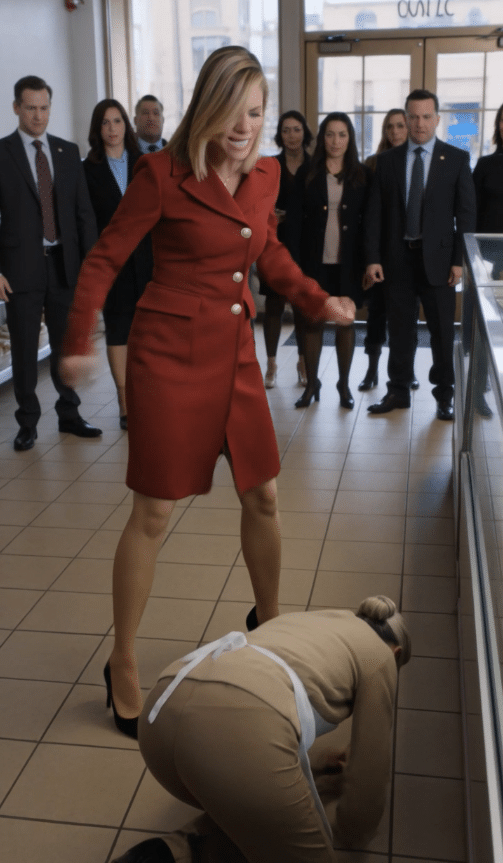
The words had barely left the wealthy woman’s mouth when she kicked the elderly baker hard enough to send her crashing onto the floor beside the glass cake counter.
A decorated cake box slid across the counter. Its satin ribbon slipped loose, and a small gasp rippled through the bakery as the old woman’s hands reached instinctively toward the fallen edge of the display.
For a moment, nobody moved.
The elderly woman lay on the polished floor, her beige sweater twisted beneath her, her white apron stained with flour. A thin trace of blood marked her forearm where it had struck the edge of the counter. She grimaced, struggling to catch her breath, her eyes wide with disbelief.
She had not shouted at the customer.
She had not refused an order.
She had simply taken a few extra seconds to tie a ribbon around a cake box.
“I am tying it so the cake stays safe,” she had explained moments earlier.
Her name was Eleanor Whitmore, and she was seventy-four years old. Her silver hair was arranged in a neat bun, and the lines around her warm face had been earned through decades of early mornings, sleepless nights, and sacrifices nobody in the bakery had ever thought to ask about.
She owned the small neighborhood bakery where the incident was unfolding.
The woman standing over her was Vanessa Reed, a forty-two-year-old customer dressed in an expensive red coat, black heels, and oversized designer sunglasses. A white handbag hung from her arm, and a luxury watch gleamed beneath her sleeve.
Vanessa had ordered a cake for an important private event.
She had arrived expecting immediate service, flawless packaging, and the kind of attention she was accustomed to receiving at upscale hotels and exclusive boutiques.
When Eleanor spent a few extra seconds securing the ribbon, Vanessa checked her watch.
Then she sighed loudly.
“Is this really so difficult?”
Eleanor looked up with a polite smile.
“I’m almost finished, dear. I just want to make sure the box closes properly.”
“Almost finished?” Vanessa repeated. “I’ve been waiting forever.”
It had been less than three minutes.
A small line of customers stood behind her. One man was holding a paper bag of croissants. A young mother waited with her little boy, who was staring through the glass counter at the rows of pastries.
Nobody else seemed bothered by the delay.
Vanessa was.
“My order should not take this long,” she snapped.
Eleanor’s smile faded.
“I’m sorry. The cake is delicate, and I don’t want it to slide around in the box.”
Vanessa stepped closer.
“Do you know how much I paid for it?”
Eleanor glanced at the receipt.
“Yes, ma’am.”
“Then perhaps you should act like it matters.”
The old baker’s fingers tightened around the ribbon.
She had been making cakes for almost fifty years. She knew how easily a careless movement could damage delicate icing, how a poorly secured box could ruin an expensive celebration, and how much disappointment could hide behind the phrase It arrived damaged.
She was trying to protect Vanessa’s purchase.
Vanessa saw only an elderly woman who was making her wait.
“Honestly,” she muttered, “this is what happens when people refuse to retire.”
Eleanor lowered her eyes.
“I can finish it another way if you’d prefer.”
Vanessa laughed sharply.
“Trash. My order should not take this long.”
The customers behind her exchanged uneasy glances.
Eleanor looked genuinely hurt now, but she kept her voice gentle.
“There’s no need to speak to me like that.”
That was the moment Vanessa’s expression changed.
She had expected an apology. She had expected the old woman to shrink back, accept the insult, and hurry to finish the order.
Instead, Eleanor had quietly reminded her that she was a person.
Vanessa took a full step forward.
“Excuse me?”
Eleanor remained beside the counter, one hand resting on the cake box.
“I said I’m trying to help you.”
Vanessa’s face tightened.
Then she kicked Eleanor in the chest.
The elderly woman fell backward onto the floor with a hard impact. The cake box slid away, its ribbon loosening as it scraped across the glass. Eleanor’s forearm struck the edge of the counter, leaving a thin trace of blood.
She gasped and tried to sit up.
Vanessa stepped closer and delivered two more forceful kicks to her back and side while she was down.
A customer covered her mouth.
The young mother pulled her son behind her. One of the bakery’s employees froze near the kitchen doorway, too shocked to react.
Eleanor curled instinctively around herself, her breathing uneven.
“Please,” she whispered. “What have I done?”
Vanessa stood over her.
“Serve from the floor if you are that slow.”
The words hung in the air.
Then a deafening crash shook the bakery.
The front glass entrance shattered as a black SUV burst through it and stopped near the doorway.
Glass scattered across the floor.
The engine fell silent.
A door slammed open, and a tall man in a premium black suit and long navy coat rushed into the bakery.
He looked at the elderly woman on the floor.
Then he looked at Vanessa.
His voice trembled with controlled fury.
“You… kicked… my… mother?”
Vanessa’s face went white.
She knew exactly who had just walked through the shattered entrance.
And suddenly, the cake was the least of her problems.
Act II
Eleanor Whitmore had never imagined that her little bakery would become the place where her son would one day confront the ugliest side of the world he had spent his life trying to rise above.
For nearly five decades, she had built her business one loaf, one birthday cake, and one early morning at a time.
The bakery occupied a narrow storefront on a quiet American street. Its windows were often fogged by the warmth of the ovens, and the air carried the comforting smell of cinnamon, vanilla, and fresh bread.
There were no marble floors or gold-plated signs.
The display counter was old, the wooden shelves had been repaired more than once, and the handwritten specials board was updated whenever Eleanor found a new recipe she wanted to try.
But people came from across the neighborhood because her cakes tasted like something money alone could never buy.
They tasted like home.
Eleanor had opened the bakery shortly after her husband died, when their son, Michael Whitmore, was still a teenager.
Her husband had been a hotel maintenance supervisor who dreamed of opening a small family business with her. He never lived long enough to see that dream realized.
After his death, Eleanor faced a choice.
She could sell what little they owned and find a more secure job, or she could take the recipes she had collected over the years and attempt to build something of her own.
She chose the bakery.
The first year nearly broke her.
She worked before sunrise and stayed long after closing, learning how to manage suppliers, calculate costs, and decorate cakes that looked beautiful enough to justify their price.
Sometimes, she went home with barely enough money to cover the bills.
Sometimes, she sold the final loaf of bread and sat alone in the kitchen, exhausted beyond tears.
But she never allowed her son to see how frightened she was.
Michael remembered the warmth of the bakery more than the hardship.
He remembered doing homework at a small table near the kitchen, the smell of fresh cinnamon rolls drifting past his books. He remembered his mother cutting strawberries for his birthday cake even when business was slow, and how she would save the most beautiful pastry for him whenever he returned home after a difficult day.
When he asked why she worked so hard, she gave him an answer that never changed.
“Because I want you to have a choice.”
Michael took that gift seriously.
He studied business, worked his way through college, and eventually entered the hospitality industry. His early career was not glamorous. He worked long shifts, learned the details of hotel operations, and discovered that success often depended on thousands of small decisions nobody noticed unless something went wrong.
He remembered his mother’s standards.
A guest who waited too long deserved an explanation. A worker who made a mistake deserved a chance to correct it. A business that promised quality had a responsibility to deliver it.
Michael advanced through the industry until he became a director at one of the country’s largest hotel chains.
By fifty, he was responsible for major operations, international partnerships, and decisions that affected thousands of employees. He traveled constantly and attended meetings where a single contract could be worth more than his mother’s bakery would earn in several lifetimes.
Yet he still called Eleanor every morning.
And whenever he was in town, he visited her bakery.
He had offered to buy her a larger property, modernize the kitchen, or arrange for a manager to handle the daily operations.
Eleanor refused.
“I know how to run my own bakery,” she told him.
“You could take a break, Mom.”
“I take breaks.”
“When?”
“When the bread is in the oven.”
He laughed, but she was serious.
The bakery was not simply a business she refused to abandon. It was the life she had built after grief threatened to take everything from her. It was the place where she had raised Michael, where neighbors had supported her during difficult years, and where she could still make something with her own hands.
She did not need to be the richest person on the street.
She needed to feel that her life remained her own.
Michael understood, even if he worried.
He knew his mother was getting older. He knew her hands sometimes ached after hours of kneading dough, and he had noticed that she occasionally needed to sit down after carrying heavy trays.
But Eleanor still found joy in her work.
The morning Vanessa arrived, Eleanor had been preparing for a busy day of custom orders. The cake in question was a delicate creation decorated with pale flowers and a smooth layer of ivory frosting.
She had spent hours making it.
She wanted the box to be secure because she knew the customer was taking it to an important event.
Vanessa had no idea what that effort meant.
She did not know Eleanor had risen before dawn. She did not know the old baker had already prepared dozens of pastries for the morning rush. She did not know that the woman she was insulting had spent decades earning the trust of customers who considered her part of the neighborhood’s history.
And she did not know that Michael Whitmore had planned to visit his mother that very morning.
He had finished an early meeting nearby and decided to surprise her with breakfast.
When his driver was delayed, Michael took the black SUV himself. As he approached the bakery, he saw a commotion through the front windows.
He saw people stepping backward.
He saw his mother fall.
The impact seemed to stop the world.
In the first instant, he did not think about the hotel chain, his position, or the consequences of what he was about to do.
He thought about the woman who had worked until midnight to make sure he had a birthday cake when they could barely afford one.
The woman who had sold her wedding jewelry to pay for his education.
The woman who had never asked him to repay a single sacrifice.
And now she was lying on the floor of her own bakery while a stranger stood over her.
Michael had no time to consider how the moment would look in the news.
He had only one thought.
Get to his mother.
Act III
Michael crossed the bakery in seconds.
“Mom!”
Eleanor turned her head toward his voice.
For a moment, she looked confused, as though she could not understand why her son was standing amid the shattered glass.
“Michael?”
“I’m here.”
He dropped beside her, careful not to move her unnecessarily. His hands hovered near her shoulders as he tried to assess whether she could respond clearly.
“Don’t try to get up,” he told her. “Help is coming.”
Eleanor winced.
“My arm.”
Michael glanced at the thin blood trace along her forearm. His face tightened, but he kept his voice steady.
“Just stay still, Mom. Let me get someone to help you.”
He immediately called emergency services and asked a bakery employee to keep the area clear. Then he rose and turned toward Vanessa.
The woman who had been shouting moments earlier was now struggling to find words.
“Mr… Mr. Whitmore?”
Michael stared at her.
“You kicked my mother?”
Vanessa took half a step backward.
“I didn’t know she was your mother.”
The answer came too quickly.
Michael’s expression changed.
“You didn’t know?”
“I mean, I didn’t know who she was. There was a problem with my order, and she was being difficult.”
He glanced at the cake box on the counter.
“The problem was that she was tying a ribbon?”
“She was taking too long.”
“So you kicked her?”
Vanessa looked toward the customers, as though she expected someone to support her explanation.
Nobody spoke.
She adjusted the strap of her designer handbag.
“Mr. Whitmore, please. I think we’re all a little upset. This doesn’t need to become something bigger than it is.”
Michael slowly straightened.
“My mother is seventy-four years old. She was doing her job. You attacked her.”
Vanessa’s lips parted.
“I was angry. I lost my temper.”
“You lost your temper three times?”
The question silenced her.
Michael did not need to shout. His controlled voice carried across the bakery, and every word made Vanessa’s attempt to minimize the attack sound more desperate.
He turned toward the nearest employee.
“Please call the police as well as the ambulance. Make sure the security footage is preserved.”
The employee nodded and hurried away.
Vanessa’s face tightened.
“The police? Surely that isn’t necessary.”
Michael looked at her.
“Why shouldn’t it be?”
“Because I’m willing to pay for everything. Her medical bills, the damaged equipment, the entrance. Whatever it costs.”
For one moment, Michael said nothing.
Then he shook his head.
“You still think this is about money.”
“That’s not what I meant.”
“Then explain what you meant.”
Vanessa could not.
The customers behind her remained silent, but their expressions had changed. Some were frightened by the violence. Others were angry that she was still trying to turn an assault into a financial inconvenience.
A young man near the entrance stepped forward.
“I recorded part of it,” he said. “I have the video.”
Vanessa turned sharply.
“Delete it.”
The young man stared at her.
“No.”
Michael looked toward him.
“Please preserve it and provide it to the authorities if they request it.”
The man nodded.
Vanessa’s composure began to fracture.
She had spent years moving through the world believing that the right clothes, the right connections, and the right amount of money could make uncomfortable situations disappear.
She had expected Eleanor to apologize.
She had expected the other customers to stay quiet.
She had expected that, once she explained herself, everyone would accept her version of events.
Instead, the room was full of witnesses.
And the man standing before her was not interested in bargaining.
Michael returned to his mother.
Eleanor was breathing more steadily, though pain remained visible on her face.
“I’m sorry,” she whispered.
Michael stared at her in disbelief.
“For what?”
“The cake box. I didn’t finish tying the ribbon.”
His eyes filled with tears he struggled to hold back.
“Mom, forget the cake.”
“But the order—”
“Mom.”
He took her hand.
“You are more important than every cake in this bakery.”
Eleanor looked at him, and for a moment, her expression softened.
Then her gaze drifted toward Vanessa.
“Please don’t let this become a fight,” she whispered.
Michael squeezed her hand.
“I’m not going to fight her.”
He glanced toward the shattered entrance, then back at the woman who had raised him.
“I’m going to make sure the truth is told.”
The paramedics arrived and began assessing Eleanor’s injuries. Michael remained beside her, answering questions and explaining what he had witnessed.
Before they transported her, he made sure someone had documented the damage to the bakery and the location of the cake box.
He would later have to account for his own decision to drive the SUV through the glass entrance. His mother’s emergency had frightened him, but that did not erase the risks his actions had created. The property damage would need to be assessed, and the authorities would determine what, if anything, followed from it.
For now, he went with his mother to the hospital.
Vanessa remained in the bakery with the responding officers.
As they began collecting witness statements, her expression grew increasingly anxious.
She had recognized Michael Whitmore immediately.
She knew his hotel chain operated properties where she regularly attended business events. She knew his company dealt with influential investors, executives, and wealthy clients.
But the most frightening thing was not that he could damage her reputation.
It was that he had witnessed the attack himself.
And unlike the people she had intimidated in the past, he had no reason to pretend it had never happened.
Act IV
By noon, the bakery had become the center of a growing investigation.
The responding officers collected witness statements and secured the available security footage. The young man who had recorded the attack preserved his video, and several other customers agreed to provide accounts of what they had seen.
The evidence was straightforward.
Vanessa had complained about the delay. Eleanor had explained that she was securing the cake box. Vanessa had insulted her, attacked her, and continued the assault while she was down.
There was no indication that Eleanor had threatened her or behaved violently.
She had been doing what she had done for decades: trying to deliver a cake in good condition.
Michael did not direct the investigation. His company had no authority over the police, and he understood that his position could create the appearance of influence if he tried to interfere.
Instead, he provided his statement as a witness and allowed the authorities to follow the evidence.
Vanessa’s attorney soon arrived.
He attempted to frame the incident as an emotional confrontation that had escalated unexpectedly. But the available recordings made it difficult to argue that Eleanor had initiated the violence.
The legal process would determine the appropriate charges and any subsequent consequences.
Michael focused on his mother.
At the hospital, doctors examined Eleanor and monitored her closely because of her age and the force of the assault. Her injuries were painful, and the first hours were filled with uncertainty as the medical team assessed her condition.
Michael sat beside her bed, still wearing the same navy coat he had worn when he entered the bakery.
He had not gone home.
He had not returned the calls from his executive team.
He had barely looked at his phone.
For the first time in years, the meetings and negotiations that normally dominated his life seemed absurdly distant.
Eleanor opened her eyes.
“Michael?”
He leaned forward immediately.
“I’m here.”
“Did you leave the bakery?”
“It’s being taken care of.”
“And the cake?”
He closed his eyes for a moment.
“Mom, please stop worrying about the cake.”
She gave a faint smile.
“Someone paid for it.”
Michael laughed despite himself, though the sound broke halfway through.
“You’re unbelievable.”
“It’s called being a business owner.”
Then her expression grew serious.
“Are you angry?”
He looked at her.
“Yes.”
“Good. That means you understand something terrible happened.”
She paused.
“But don’t let your anger decide what happens next.”
Michael stared at his mother.
He had spent years making decisions that affected thousands of people. He had negotiated with difficult executives, handled public crises, and learned to keep his emotions out of important conversations.
Yet no business lesson had prepared him for the sight of Eleanor lying injured on the floor.
“I can’t believe someone would do that to you,” he said.
Eleanor turned toward the window.
“Some people believe kindness is weakness.”
Michael’s jaw tightened.
“Then they should learn otherwise.”
“Yes,” she replied. “But not because you can hurt them back. Because you can stop them from hurting someone else.”
Those words stayed with him.
Over the following days, the bakery received an extraordinary wave of support. Longtime customers arrived with flowers and cards. Neighbors offered to help with cleaning and repairs. A retired teacher sent Eleanor a letter explaining that the bakery had been where she bought birthday cakes for her children for more than twenty years.
The notes moved Eleanor more than the public attention did.
She had never thought of herself as important.
She had simply made cakes, remembered names, and tried to treat people well.
Now strangers were telling her that those small acts had mattered.
Meanwhile, Vanessa began discovering that the consequences of her behavior extended beyond one ruined morning.
Her name spread through the local community as people discussed the incident. Business acquaintances questioned her judgment, and the video forced those who knew her to confront a side of her they might previously have dismissed as impatience or arrogance.
Her legal team advised her not to make impulsive public statements.
But Vanessa had difficulty accepting that she could no longer control the story.
She wanted to explain that she had been stressed. She wanted people to know that the cake was for an important event, that she had paid a great deal of money, and that she had not intended for things to become so serious.
Each explanation returned to the same problem.
None of them answered the question of why she had kicked an elderly woman.
The hotel chain also faced questions from employees and business partners about how Michael would respond. Some assumed he would use his influence to ensure that Vanessa faced the harshest possible outcome.
He did nothing of the kind.
He asked his company’s communications team to avoid sensational statements. He refused to speculate publicly about the legal case and made it clear that the company would not use its business relationships to pressure the authorities.
He wanted the investigation to be fair.
He also wanted people to understand that fairness did not mean pretending the attack had been trivial.
The bakery’s broken entrance was repaired, and the damaged counter was replaced. The cake box was carefully set aside while the evidence was documented, its loose ribbon a small but painful reminder of how an ordinary task had become an act of cruelty in someone else’s eyes.
When Eleanor was finally able to return home, Michael arranged for help with the heaviest work at the bakery while she recovered.
She protested immediately.
“I don’t need an entire army.”
“It’s two people, Mom.”
“Two people too many.”
“They’re there to help you.”
“I know how to tie a ribbon.”
Michael smiled.
“I know you do.”
But this time, he did not withdraw the offer.
He had learned that respecting his mother’s independence did not mean leaving her to carry every burden alone.
And Eleanor had learned that accepting help did not make her less capable.
Together, they began preparing for the day the bakery would reopen.
Neither of them knew that the final chapter of the story would begin with something far smaller than a public apology or a legal decision.
It would begin with a cake.
Act V
The bakery reopened on a cool Saturday morning.
The new glass entrance reflected the early sunlight, and the repaired counter gleamed beneath the familiar display lights. The scent of fresh bread drifted through the storefront, just as it had for decades.
Eleanor arrived before sunrise.
Michael had offered to drive her, but she insisted on walking the final block herself. She wanted to see the street, hear the familiar sounds of the neighborhood, and enter her bakery without feeling as though she were returning to a place that belonged to someone else’s story.
When she unlocked the door, she stood quietly for a moment.
The assault had left her more cautious. Certain sudden noises still made her tense, and she sometimes remembered the impact of the fall when she reached for a tray.
But she was determined not to let one person’s cruelty erase the meaning of her life’s work.
The first customers arrived shortly after opening.
A regular customer brought a bouquet of yellow flowers. A little girl presented Eleanor with a handmade card decorated with pink frosting and crooked hearts. Several neighbors stopped simply to ask how she was feeling.
Eleanor thanked each of them.
Then she tied on her white apron and returned to the counter.
Michael arrived later that morning, carrying a small paper bag from a nearby coffee shop.
He paused when he saw his mother carefully arranging a row of cupcakes.
“You’re already working?”
She looked at him over her shoulder.
“Someone has to.”
He shook his head, smiling.
“I brought you breakfast.”
“Put it in the kitchen. I’ll eat when I have a minute.”
“Mom.”
She gave him a stern look.
“Michael.”
He raised both hands in surrender.
“Fine. But I’m staying until you eat.”
She laughed.
For a moment, the bakery felt exactly as it had before.
Then the door opened, and a woman entered carrying a small envelope.
She was one of the customers who had witnessed the assault. She approached Eleanor hesitantly, as though she were afraid of disturbing something fragile.
“I wanted to give you this,” she said.
Inside the envelope was a handwritten letter.
The woman explained that she had been standing in line that morning. She had seen Vanessa attack Eleanor, and she had been ashamed that fear had kept her from moving forward immediately.
“I keep thinking I should have done something sooner,” she said. “I’m sorry.”
Eleanor listened without interrupting.
Then she reached across the counter and took the woman’s hand.
“You were frightened,” she said. “But you came forward afterward. That matters.”
The woman wiped her eyes.
“I hope I would be braver next time.”
“I hope none of us ever has to find out.”
The exchange was quiet, but Michael watched it with a new understanding of his mother.
She had been injured, humiliated, and frightened. Yet she was still able to see the fear in someone else without allowing it to excuse what had happened.
That was the strength she had always possessed.
It was the same strength that had carried her through years of grief and financial uncertainty. The same strength that had helped her raise a son who believed responsibility mattered more than status.
And it was the strength Vanessa had mistaken for weakness.
In the weeks that followed, the legal case proceeded through the appropriate channels. Evidence and witness statements were considered, and the authorities determined the next steps independently of Michael’s personal involvement.
Vanessa could no longer dictate how the incident was perceived simply by offering to pay for the damage.
The attack had consequences that money could not automatically erase.
Her reputation suffered, and some of her social and business relationships changed. People who had once admired her polished appearance and confident manner began asking whether those qualities had concealed a much uglier sense of entitlement.
But the most important consequence belonged to Eleanor.
She had reclaimed her bakery.
She no longer felt compelled to apologize whenever a customer became impatient. She still treated people with warmth, but she had learned that kindness did not require accepting humiliation.
When a customer complained about a wait, she explained the situation calmly.
When someone behaved disrespectfully, she set boundaries.
And when people asked whether she was afraid to work behind the counter again, she gave them the same answer.
“This is my bakery. I’m not giving it up because someone forgot how to behave.”
One afternoon, several months after the assault, Michael visited during a quiet moment between orders.
Eleanor was decorating a small birthday cake, smoothing the icing with a careful hand.
He watched her for a while.
“You know,” he said, “I could still buy you that larger bakery.”
She didn’t look up.
“No.”
“A newer kitchen?”
“No.”
“Someone to manage everything?”
She finally turned toward him.
“Michael, are you trying to get me fired from my own bakery?”
He laughed.
“I’m trying to make your life easier.”
“I know.”
She set down the icing spatula and looked at him with affection.
“And I love you for it. But I don’t need you to turn my life into something I never asked for.”
He nodded.
Then he noticed a satin ribbon lying beside the cake box.
His expression changed.
“Is that for an order?”
“Yes. The customer is picking it up this afternoon.”
“Do you want me to tie it?”
Eleanor considered him for a moment.
“You can try.”
He stepped behind the counter and picked up the ribbon.
He was a successful hotel director, accustomed to overseeing large teams and managing complicated operations. Yet after several awkward attempts, he had produced a bow that looked as though it had survived a minor storm.
Eleanor burst out laughing.
Michael stared at the ribbon.
“This is harder than it looks.”
“Now imagine doing it fifty times a day.”
He shook his head.
“I owe you an apology.”
“For what?”
“For every time I complained that you were taking too long to finish something.”
Her smile softened.
“You were a child.”
“I was a very impatient child.”
“You still are.”
They laughed together.
Then Eleanor carefully untied the ribbon and showed him how to secure it properly, guiding his fingers until the bow sat neatly on top of the box.
It was a small moment.
No cameras recorded it. No reporters stood outside the bakery. Nobody applauded.
But for Michael, it carried more meaning than the shattered glass or the confrontation that had followed.
He understood, finally, what his mother had been trying to protect all along.
Not just a cake.
Not just a business.
The dignity of doing something well, even when the world was impatient.
He looked at the finished bow.
“Perfect,” he said.
Eleanor smiled.
“Now you understand.”
The bakery continued serving its neighborhood, one order at a time. The repaired entrance became an ordinary part of the storefront, and the morning’s violence gradually gave way to the familiar rhythms of business.
Eleanor never forgot what happened.
But she refused to let the memory become the only story told about her.
She wanted people to remember the cakes she made, the customers she welcomed, and the years she spent building something with her own hands.
She wanted them to remember that she had been a baker long before a wealthy customer attacked her.
And she would remain one long after the headlines faded.
Vanessa had looked at a seventy-four-year-old woman tying a ribbon and seen someone whose time did not matter.
She believed her money entitled her to demand, insult, and punish.
She never stopped to consider the person behind the apron.
The mother who had sacrificed everything to raise a son.
The business owner who had served generations of families.
The woman who understood that a cake delivered safely could become part of someone’s happiest memory.
Vanessa had mistaken a few extra seconds for disrespect.
She had mistaken patience for weakness.
And she had mistaken the ability to pay for something as the right to control everyone involved in providing it.
The moment Michael stepped through that shattered entrance, her assumptions collapsed.
But the truth had been there from the beginning.
Eleanor deserved respect before anyone knew her son’s name.
She deserved kindness before anyone recognized the Whitmore family.
She deserved to finish tying that ribbon without having to fear the person standing across the counter.
And no amount of money, status, or influence could change that.
Because the true measure of a person is not how politely they treat someone powerful.
It is how they treat someone they believe has nothing to offer them.
And sometimes, the smallest act of patience—a few extra seconds spent tying a ribbon—reveals more about a person’s character than a lifetime of expensive clothes ever could.