Act I
“Trash. You thought I wouldn’t catch you.”
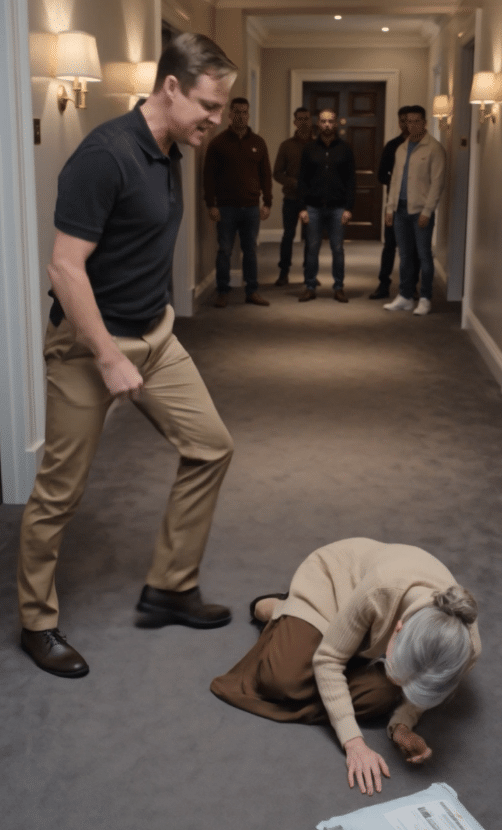
The words exploded through the luxury apartment hallway just as the man ripped a cardboard package from an elderly woman’s hands.
She barely had time to respond.
One moment, Margaret Hayes was standing outside apartment 1408, holding a parcel that had been delivered to her door by mistake. The next, the man who had opened the neighboring apartment was staring at her as though he had caught a criminal in the act.
“I can explain,” she began.
He didn’t let her finish.
Wearing a black polo shirt, khaki pants, and an expensive watch, Richard Cole stepped directly in front of her. His eyes narrowed with suspicion, his jaw tightening as he looked from the package to her face.
Then he drove a forceful kick into her chest.
Margaret fell backward onto the gray hallway carpet. Her elbow struck the floor, leaving a thin trace of blood, and the package landed beside the apartment threshold with a dull thud.
For a second, she could only gasp.
Her silver hair had loosened from its bun. One hand pressed against her chest while the other searched for something solid to hold. She tried to sit up, but pain forced her back down.
Several apartment doors stood along the corridor.
Behind one partially opened door, a young woman covered her mouth. Across the hall, an older man stared in disbelief before slowly retreating into his apartment.
Nobody moved toward Margaret.
Richard looked down at her with open contempt.
“It was delivered to my door,” Margaret managed to say. “I brought it back.”
Her voice trembled, but she continued trying to explain.
She had found the package outside her own apartment minutes earlier. The shipping label clearly displayed a different apartment number, so she had carried it down the hall to return it to its rightful owner.
It was the simplest act of courtesy imaginable.
Richard had turned it into an accusation.
“Trash,” he repeated. “You thought I wouldn’t catch you.”
Margaret stared at him, stunned by the certainty in his voice.
“Please, sir. I wasn’t stealing anything.”
He stepped over the fallen package.
Then he kicked her twice more in the back and side while she struggled to rise.
Margaret recoiled, drawing her arms close to her body. Her breathing became uneven, and she squeezed her eyes shut as another wave of pain passed through her.
Richard leaned over her.
“Try stealing from someone else.”
Behind the apartment doors, the neighbors remained silent.
They could hear everything. They could see enough through the narrow openings to understand that an elderly woman was being hurt in the hallway.
But Richard was known for his temper, and nobody wanted to become his next target.
Margaret looked toward the nearest door.
For a fleeting moment, her eyes met those of the young woman watching from inside.
The young woman looked frightened.
Then she slowly pulled the door closer to its frame.
Margaret lowered her gaze.
She had spent seventy-two years believing that if she treated people with kindness, they would at least give her the chance to explain herself.
Now she was lying on the floor of her own building, being punished for returning something that did not belong to her.
Then a sharp mechanical sound came from the end of the corridor.
The private elevator doors opened.
A tall man in a black suit and navy overcoat strode out, moving quickly enough that his polished shoes struck the carpet with heavy, hurried steps.
He looked toward the commotion.
Then he saw the woman on the floor.
“Mom?”
The single word seemed to drain the warmth from the hallway.
The man rushed forward, positioning himself between Margaret and Richard. He pointed toward the package lying beside the threshold, then raised his eyes to the man standing over his mother.
His voice was controlled, but the anger beneath it was unmistakable.
“You attacked my mother after she returned your package?”
Richard froze.
He looked at the man, then at the package, then back at Margaret.
For the first time, his certainty began to crack.
The newcomer was Michael Hayes, the owner of the property management company responsible for the entire luxury building.
And the woman Richard had just attacked was the reason Michael had spent his life believing that character mattered more than money.
Richard swallowed hard.
“She…” he stammered.
His eyes dropped to the parcel.
“She returned it?”
He had accused an innocent woman of stealing.
He had attacked her before allowing her to finish a sentence.
And now the person standing between him and the consequences was the one man in the building he could not intimidate with a threatening look or an expensive watch.
But Richard was about to discover that Michael’s anger was only the beginning of his problems.
Act II
Margaret Hayes had moved into the building only four months earlier.
At seventy-two, she had decided that the old family house was becoming too difficult to maintain. Her husband, Arthur, had died several years before, and the quiet rooms had gradually become more burden than comfort.
She had raised two children there, hosted Thanksgiving dinners, celebrated graduations, and watched her husband repair everything from a leaking faucet to a broken garden fence.
After he died, she kept the house almost exactly as it had been.
His reading glasses remained in the drawer beside his favorite chair. His old gardening gloves hung in the garage. The kitchen clock he had installed decades earlier continued ticking above the refrigerator.
Eventually, Michael convinced her to consider a smaller apartment.
He owned a property management company that oversaw several upscale residential buildings, and he wanted his mother to live somewhere comfortable, secure, and close enough that he could visit without planning an entire afternoon around the drive.
Margaret had resisted at first.
“I don’t want to live in a place where everyone thinks money makes them better than everyone else,” she told him.
Michael smiled.
“Then we’ll find a place where people understand that it doesn’t.”
He chose a quiet building with warm hallway lights, attentive maintenance staff, and a private elevator. He offered to arrange a larger apartment, but Margaret selected a modest two-bedroom unit with enough room for her books, her photographs, and the small wooden desk where she wrote letters to old friends.
She did not ask for special treatment.
She did not tell the other residents who her son was.
When the concierge greeted her, she thanked him by name. When delivery drivers struggled with heavy boxes, she held the lobby door open. If a neighbor dropped something in the elevator, she bent to retrieve it before the doors closed.
Those habits were not calculated.
They were simply how Margaret had lived.
Michael had learned them from her long before he understood the importance of contracts, property values, or financial risk.
His father had worked as a maintenance supervisor for most of his life. He and Margaret had never possessed much money, but they had managed their household carefully and taught their children to respect the people whose work made everyday life possible.
When Michael was sixteen, he once laughed at a delivery driver who had accidentally brought the wrong groceries.
His father had taken him aside afterward.
“That man is doing his job,” Arthur had said. “If he makes a mistake, tell him. If he fixes it, thank him. But never make him feel small just because he can’t afford to make you feel important.”
Michael never forgot the lesson.
Years later, when he built his company, he tried to create the kind of organization his father would have respected. He insisted that maintenance workers be treated fairly, that complaints be documented, and that residents receive clear answers rather than empty promises.
But a large company was never as simple as the values written into its policies.
There were hundreds of tenants, dozens of employees, and countless small interactions that management could not personally witness.
Richard Cole had taken advantage of that distance.
At thirty-nine, Richard had the outward appearance of a man who had made it. He drove an expensive car, wore carefully selected clothes, and spoke about his career as though his income were evidence of his superiority.
He had moved into the building eight months earlier after selling his previous home.
He liked the polished lobby and the attentive concierge. He liked the quiet hallways and the knowledge that most of his neighbors were professionals who preferred privacy to confrontation.
But Richard’s confidence had a fragile foundation.
He interpreted ordinary mistakes as personal disrespect. He assumed that people who worked in service roles were obligated to anticipate his preferences. And when something went wrong, his first instinct was to identify someone he could blame.
The package incident was not his first confrontation.
Several weeks earlier, a delivery driver had left a parcel near the wrong door. Richard had accused the concierge of incompetence and demanded an explanation, even though the driver had later corrected the mistake.
On another occasion, he had shouted at a maintenance worker who asked him to move a box blocking a fire exit.
The worker apologized simply to end the confrontation.
Richard considered that victory.
When residents complained about his behavior, they often did so privately. They did not want to create tension in a building where they expected to live for years.
And because few formal complaints had reached the property management company, Richard had come to believe that nobody would challenge him.
Margaret knew none of this.
She knew only that a package had arrived at her door with someone else’s name on it.
She had carried it down the hallway because she thought the neighbor might be waiting for it.
When Richard opened his door, she expected a simple exchange.
Instead, he had seen what he wanted to see: an opportunity to accuse someone, establish control, and prove that nobody could take advantage of him.
Now, as Michael knelt beside his mother, Richard was beginning to understand that his assumptions had collided with something far more serious than a misplaced delivery.
Michael checked that Margaret was conscious and urged her not to attempt to stand until help arrived.
“I’m here, Mom,” he said, keeping his voice gentle. “You’re not alone.”
Margaret looked at him, struggling to hold back tears.
“I was only bringing it back.”
“I know.”
“I didn’t want him to think I had taken it.”
Michael’s jaw tightened.
“You don’t have to prove your innocence to someone who refuses to listen.”
He glanced toward the package.
The label was clearly visible.
The delivery address belonged to Richard’s apartment.
Margaret’s explanation had been true from the beginning.
Michael slowly rose to his feet.
And as he turned toward the man responsible, he realized that the package was only one part of the story he needed to uncover.
Act III
Richard recovered enough to begin defending himself.
“She came to my door holding my property,” he said quickly. “What was I supposed to think?”
Michael stared at him.
“You could have asked her why she had it.”
“She could have been stealing.”
“She told you she was returning it.”
“I didn’t believe her.”
Michael glanced toward the package again.
“You didn’t believe her, so you kicked her?”
Richard’s face reddened.
“Don’t twist my words.”
“I don’t need to twist anything. My mother is lying on the floor.”
The hallway seemed to shrink around them.
Behind the apartment doors, residents watched through narrow gaps. Nobody spoke. The only sounds were Margaret’s uneven breathing and the distant hum of the elevator machinery.
Michael turned toward the nearest open doorway.
“Did anyone witness what happened?”
The young woman who had watched the attack lowered her eyes.
Richard immediately seized on the silence.
“You see? Nobody knows what happened.”
Michael did not respond to the provocation.
He waited.
The young woman slowly opened her door a little farther.
“I saw it,” she whispered.
Richard turned sharply.
“You saw nothing.”
She flinched, but Michael’s presence seemed to give her enough courage to continue.
“I saw him take the package. Then he kicked her.”
A second door opened.
An older man stepped into the corridor, his face pale.
“I heard her say she was returning it,” he added. “I heard her explain that it had been delivered to the wrong apartment.”
Richard looked from one witness to the other.
“You people are making this into something it isn’t.”
The older man shook his head.
“No. You did that yourself.”
The sentence landed with unexpected force.
For months, residents had avoided challenging Richard because they feared the unpleasantness that followed. They had mistaken the absence of confrontation for the absence of a problem.
Now they were watching an elderly woman struggle to recover from an attack that had begun with a simple misunderstanding Richard had refused to investigate.
Michael asked the witnesses to preserve any relevant recordings and provide their accounts to the responding authorities.
He did not tell them what to say. He did not ask them to embellish anything. He wanted the truth recorded as accurately as possible.
Then he turned back to Richard.
“Did you look at the shipping label?”
Richard hesitated.
“What?”
“The label. Did you look at it before you attacked her?”
Richard’s eyes moved toward the package.
For the first time, he seemed to notice how clearly the address was printed.
“No,” he muttered.
“Did you ask her a single question?”
Richard said nothing.
Michael took a slow breath.
“My mother is seventy-two years old. She carried your package to your door because she thought you should receive something that belonged to you. You didn’t even give her enough time to explain.”
Richard’s face hardened again.
“She shouldn’t have touched it.”
“It was delivered to her door by mistake.”
“She should have left it alone.”
Michael looked at him with disbelief.
“So returning it was wrong, leaving it there would have been wrong, and the only acceptable option was apparently for her to know what you wanted before you did?”
Richard opened his mouth, then closed it.
His usual certainty was failing him.
He glanced toward the neighbors, hoping to find someone who would support his version of events. But the people who had once avoided eye contact were now watching him directly.
One of them spoke.
“She was trying to help you.”
Another nodded.
“I saw her carry it down the hallway.”
Richard’s face began to change.
The suspicion that had fueled his anger was turning into something more uncomfortable. The package was still sitting beside his door, exactly where it had fallen. Its label contradicted his accusation. The witnesses contradicted his account.
And the elderly woman he had treated like a thief had done precisely what she said she had done.
Michael looked down at his mother.
She was still on the carpet, her face strained with pain, waiting for the medical responders.
Something inside him settled.
He was no longer interested in hearing Richard explain why he had been angry.
He wanted to know whether Richard understood what he had done.
“Look at her,” Michael said.
Richard did not move.
“Look at my mother.”
Slowly, Richard lowered his eyes.
Margaret was not shouting. She was not threatening him. She was not demanding that anyone punish him.
She was simply hurt.
And for the first time, Richard seemed unable to hide behind the story he had invented.
But he still had not apologized.
Instead, he whispered the question that revealed how completely he had misunderstood the situation.
“She… returned it?”
Michael’s expression remained cold.
“Yes.”
Richard stared at the package.
Then he looked at Margaret again.
And the truth finally reached him: the person he had attacked had been trying to do him a favor.
The realization should have been enough to make him ashamed.
But Michael was about to show him that the consequences of his actions went far beyond one parcel and one hallway.
Act IV
The responding officers arrived soon afterward, accompanied by medical personnel who attended to Margaret and arranged further evaluation.
Michael remained nearby, answering questions and explaining what he had witnessed after entering the hallway.
He made no attempt to direct the investigation.
He identified himself as the victim’s son and as the owner of the property management company, then provided the names of the witnesses who had volunteered to speak.
The package was left where it could be documented, and the residents were asked to preserve any relevant evidence.
Richard stood near his doorway, his arms folded tightly across his chest.
He had begun the afternoon convinced that he was the victim of someone else’s dishonesty. Now he was being asked to account for an assault witnessed by several people.
When an officer approached him, Richard immediately started explaining.
“I thought she was stealing from me.”
The officer asked him what Margaret had said before he attacked her.
Richard looked away.
“She said something about bringing it back.”
“Did you inspect the label?”
“No.”
“Did you ask her to leave?”
Richard hesitated.
“No.”
The questions were ordinary.
That was what made them so difficult for him.
Nobody was asking him to explain his entire life or defend his reputation. They were asking what had happened in the hallway, and each answer left less room for the story he had told himself.
Michael watched from a distance.
He was angry enough to feel the temptation to make a public example of Richard. He could imagine the satisfaction of ordering him out of the building immediately and telling every resident what had happened.
But anger was not a substitute for a lawful process.
The property management company would review the incident, preserve relevant records, and determine what action was available under the lease and applicable law. The authorities would handle the assault investigation.
Richard would not receive special treatment because he was wealthy.
He would not be punished outside the law because Michael was furious.
And the fact that Michael owned the company would not change the basic principle that allegations had to be addressed through the proper procedures.
As Margaret was helped toward medical care, Michael walked beside her.
She reached for his hand.
“Don’t do anything reckless,” she whispered.
He looked down at her.
“I won’t.”
“I know you’re angry.”
“I’m very angry.”
Margaret gave him a faint, tired smile.
“Then let the truth do the work.”
The words followed him long after she had left the hallway.
Over the next several days, Michael reviewed the building’s existing complaint records with the management team. He discovered that Richard had been the subject of earlier reports involving verbal aggression toward staff and residents.
None had involved an allegation identical to the assault on Margaret. Some had been handled as ordinary disputes, while others had never been formally escalated.
The records did not automatically prove every accusation, and Michael insisted that each report be treated according to its evidence. But they showed that the building had a communication problem.
Residents did not always believe their complaints would be taken seriously.
Some feared retaliation. Others thought nothing would change. A few had decided that avoiding a difficult neighbor was easier than reporting him.
Michael could not promise that every complaint would lead to action.
He could ensure that serious allegations were documented, reviewed, and answered.
He introduced clearer reporting procedures and required management to distinguish between routine disagreements and allegations involving threats, intimidation, or physical harm. Residents were informed how to report urgent safety concerns and how to preserve evidence without circulating private material unnecessarily.
The changes did not turn the building into a perfect place.
They made it harder for serious problems to disappear because nobody wanted to deal with them.
Richard, meanwhile, attempted to contact Michael privately.
He sent messages describing the incident as a misunderstanding and asked for a meeting.
Michael declined to discuss the investigation outside the appropriate process.
When Richard finally confronted him in the lobby, he looked exhausted.
“I made a mistake,” he said. “I know that now.”
Michael studied him.
“Do you?”
Richard frowned.
“What does that mean?”
“It means I still haven’t heard you acknowledge what you did to her. Every time you speak to me, you talk about your reputation, your apartment, your future. You haven’t asked once how she’s doing.”
Richard looked toward the lobby doors.
“I didn’t know she was your mother.”
Michael’s expression hardened.
“That isn’t the point.”
Richard said nothing.
“If she had been a stranger, you still would have been wrong. If she had been a delivery driver, a cleaner, or someone who couldn’t afford to fight back, you still would have been wrong.”
Michael stepped closer, his voice low.
“My mother didn’t deserve respect because of who I am. She deserved it because she’s a human being.”
Richard lowered his eyes.
For once, he had no immediate answer.
The investigation and any tenancy-related proceedings would take their proper course. Michael refused to promise an outcome before the evidence and applicable rules had been considered.
But one thing had already changed.
Richard could no longer pretend that his behavior was invisible.
And the residents who had once hidden behind their apartment doors had begun to understand that silence was not the only way to protect themselves.
Still, Michael knew that no policy, meeting, or legal consequence could immediately undo what his mother had experienced.
The question that mattered most was whether she would ever feel safe walking down her own hallway again.
Act V
Margaret returned home after receiving medical attention and following the guidance of her healthcare providers.
Her injuries required rest, and for several days, she moved carefully around her apartment. Michael visited every evening, bringing groceries and helping with whatever she needed.
He never asked her to describe the attack unless she wanted to talk about it.
Sometimes she did.
Sometimes she preferred to discuss the weather, an old movie, or the neighbor who had recently planted flowers on her balcony.
Michael learned to let those ordinary conversations happen without trying to turn each one into a lesson about resilience.
His mother did not need to become a symbol.
She needed time to recover.
One evening, he found her sitting at the kitchen table with a small stack of letters. The beige knit coat she had worn during the attack hung over the back of her chair.
She was sorting through the mail when she suddenly paused.
“Do you remember your father telling you never to judge a person by the way they dress?”
Michael smiled faintly.
“He told me that about a hundred times.”
“He was worried you’d become too impressed with expensive things.”
“He had good reason.”
Margaret laughed softly, then grew serious.
“Your father worked hard all his life. He knew what it felt like when someone looked at him and decided he wasn’t important.”
Michael pulled out the chair beside her.
“That’s why he taught me to pay attention to how people treat those who can’t do anything for them.”
Margaret nodded.
“That man looked at me and decided I was guilty before I had finished a sentence.”
She turned one of the letters over in her hands.
“I keep thinking about how quickly it happened. I was trying to do the right thing. Then suddenly I was on the floor, wondering what I had done wrong.”
Michael felt his throat tighten.
“You did nothing wrong.”
“I know.”
She looked at him.
“But knowing it and feeling it aren’t always the same thing.”
He reached for her hand.
“No. They’re not.”
For a while, they sat quietly together.
Then Margaret asked whether the young woman who had witnessed the attack had been in touch.
Michael told her that several residents had provided statements and that the building’s management team was following up on its procedures. He did not share private details from the investigation, but he explained that the witnesses had helped establish what happened.
Margaret listened carefully.
“I hope they’re not blaming themselves forever.”
Michael raised an eyebrow.
“Mom, they stood behind their doors while you were hurt.”
“I know.”
“Some of them could have called for help sooner.”
“I know that too.”
She squeezed his hand.
“But shame doesn’t help anyone become braver. What matters is what they do the next time.”
Michael thought about the neighbors who had spoken up after the first witness stepped forward.
They had not acted perfectly.
Neither had the building’s management team, which had failed to recognize how intimidating Richard had become to some residents.
But acknowledging those failures had made it possible to address them.
Margaret looked toward the window.
“I don’t want people to remember me as the old woman who got attacked over a package.”
“Then what do you want them to remember?”
She considered the question.
“That I was trying to return something that wasn’t mine.”
Michael smiled sadly.
“I think they’ll remember that.”
A few weeks later, Margaret decided she was ready to walk through the hallway alone.
Michael offered to accompany her to the elevator.
She accepted his company as far as the apartment door, then asked him to wait inside while she went to collect her mail.
He watched her walk down the corridor.
Her steps were measured. Her silver hair was neatly gathered into a loose bun, and her beige coat rested comfortably around her shoulders.
When she reached the row of apartment doors, she paused briefly.
The memory was still there.
She could almost hear Richard’s accusation, sharp and certain, and feel the shock of realizing that no explanation would be enough to stop him.
But this time, the hallway was quiet.
A neighbor opened a door and greeted her.
“Good morning, Margaret.”
She returned the greeting.
“Good morning.”
The neighbor held the door open while Margaret passed, then asked how she was feeling.
Margaret answered honestly.
“Better. Not completely, but better.”
The neighbor nodded.
“I’m glad.”
There was no dramatic speech. No grand apology that erased the past. Just an ordinary exchange between two people who had decided to treat each other with consideration.
Margaret collected her mail and returned to her apartment.
When she stepped inside, Michael stood up from the kitchen table.
“How was it?”
She placed the envelopes on the counter.
“Quiet.”
He smiled.
“That’s good.”
Margaret looked at him for a moment.
“You know, Michael, the package was never the important part.”
He waited.
“It could have been a box of books or a bag of groceries. I would have returned it just the same. It wasn’t mine.”
She paused.
“What frightened me wasn’t that he thought I had stolen something. It was that he was so certain I was a bad person that he didn’t think I deserved to speak.”
Michael felt the weight of those words settle over him.
Richard had seen a package in an elderly woman’s hands and invented a crime to explain it. He had trusted his suspicion more than her words, his anger more than the evidence, and his sense of superiority more than the possibility that he might be wrong.
He had attacked first and questioned nothing.
And when the truth emerged, he had been shocked not simply because Margaret was innocent, but because the person he had dismissed as insignificant was connected to someone whose authority he recognized.
That was the deepest failure in his thinking.
He had believed that a person’s worth could be determined by appearance, status, or usefulness to him.
Margaret had never believed such a thing.
She had returned the package because it belonged to someone else. She had offered an explanation because she believed the truth should be enough. And even after she had been hurt, she had asked her son to respond fairly rather than recklessly.
She had shown more dignity in those few moments than Richard had shown throughout the entire confrontation.
The legal and administrative consequences would follow their proper course. They would not be decided by a dramatic exchange in the hallway or by Michael’s personal anger.
But the truth was already clear.
A package had been delivered to the wrong door.
An elderly woman had tried to return it.
A man had chosen to see theft where there was only kindness.
And the person he attacked had never needed to be wealthy, connected, or related to the owner of the building to deserve protection.
Michael walked to the window beside his mother.
Outside, residents crossed the courtyard, carrying groceries and talking on their phones. A delivery driver stopped near the entrance, checked a label, and headed toward the lobby.
For a moment, Michael watched him carefully.
Then he turned back to Margaret.
“You were right about Dad,” he said.
She smiled.
“About what?”
“People show you who they are by how they treat someone they think doesn’t matter.”
Margaret looked down at the letters in her hands.
“Then let’s make sure this building is a place where people matter, even when nobody important is watching.”
Michael nodded.
He had built a successful company by learning how to manage properties.
Now he understood that the harder responsibility was managing the space between people: the assumptions, the resentments, the small cruelties that could grow when everyone believed someone else would deal with them.
And he understood that the most revealing moment in the hallway had not been when he arrived.
It had been the moment before that, when Richard had been given the simplest opportunity to behave decently.
He could have read the label.
He could have listened.
He could have said, “Thank you.”
Instead, he had chosen cruelty.
Richard thought he had caught a helpless old woman stealing his package. What he had actually exposed was something far more damaging: a man so blinded by entitlement that he attacked kindness before he even bothered to recognize it.