Act I
“That route fails the exercise.”
Lieutenant Emily Carter stood beside the tactical map table, one finger resting on a narrow mountain pass marked in red. Around her, a dozen cadet officers watched the final review of Captain Andrew Mitchell’s promotion exercise. The room was cold beneath the overhead lights, and every route marker on the paper map represented a decision that could determine whether a simulated unit completed its mission or walked into a disaster.
Andrew stared at Emily.
“Say that again.”
She didn’t withdraw her hand.
“The route takes your unit through a restricted corridor with no secure withdrawal option. The opposing force can cut off the eastern approach, and your team would be trapped between two exposed positions. Under the exercise criteria, this plan fails.”
A cadet near the far end of the table glanced down at his notes.
Another stopped writing.
Andrew was thirty-seven, an experienced officer with an impressive record of field assignments and a reputation for demanding absolute obedience. His next promotion would place him closer to senior command, and he had spent months preparing for the evaluation that would determine whether he was ready.
He had expected questions.
He had expected scrutiny.
What he had not expected was to have a woman identify a fundamental flaw in his plan in front of the entire class.
“You’re confusing caution with strategy,” he said.
Emily remained composed.
“I’m applying the evaluation criteria.”
“I’m the one who built this plan.”
“And I’m the one assigned to evaluate it.”
The distinction hung between them.
Emily was thirty, with brown hair secured in a tight bun and a uniform so neatly arranged that even her identification badge sat perfectly straight. She wasn’t trying to embarrass Andrew. She had no personal stake in his promotion, and she had no reason to dislike him.
Her job was to assess the plan accurately.
If the route failed, she had to say so.
Andrew leaned over the map, tracing the route with a stiff finger.
“You think you understand the terrain better than I do?”
“I think the terrain doesn’t care who designed the route.”
A faint murmur passed through the cadets.
Emily immediately returned her attention to the map, pointing out the exposed approach and the lack of a viable fallback under the exercise’s stated assumptions.
Andrew’s face flushed.
“Trash. Don’t correct my plan.”
Emily looked at him steadily.
“Captain, the assessment is about whether the plan works, not who created it.”
For a second, Andrew seemed to lose the ability to speak.
He had spent his career learning how to project authority. He knew how to command a room, how to make his voice carry, and how to turn hesitation into compliance. But Emily’s calm refusal to back down made those familiar tactics feel useless.
Then his anger took control.
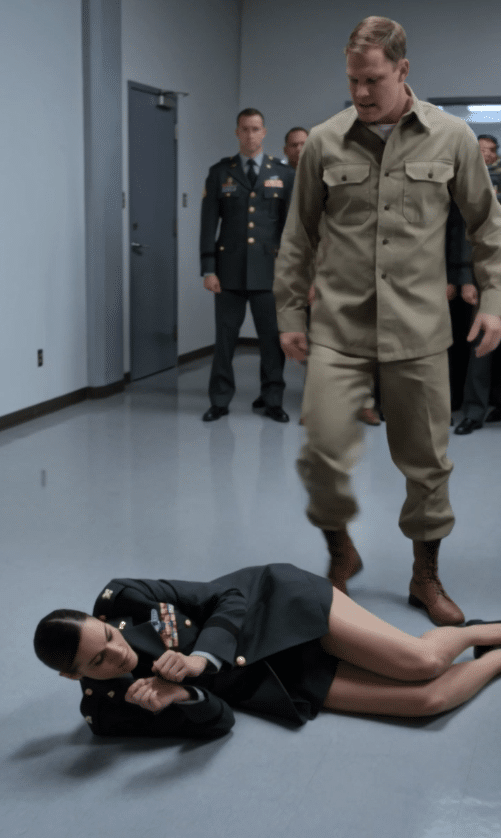
He stepped hard toward her, jumped, and drove a forceful kick into her chest.
Emily was knocked backward beside the map table. The table edge shifted slightly as she fell, and her elbow struck the floor. A thin trace of blood appeared where it hit, and she winced as pain shot through her arm.
The cadets gasped.
Emily struggled to breathe comfortably, trying to push herself upright without putting too much weight on her injured elbow.
Andrew stepped over the edge of the scattered papers and kicked her twice more in the back and side.
She curled instinctively against the pain, but her eyes remained fixed on the map.
Even on the floor, she was looking at the route that had started the confrontation.
“Learn your place before you speak,” Andrew snapped.
Nobody moved.
The cadets stood frozen around the table, shocked by what they had witnessed and frightened by what might happen if they intervened. Some stared at Andrew. Others looked away, unable to reconcile the uniform he wore with the violence he had just committed.
Then the map room door burst open.
The academy commander entered.
General Robert Hayes was fifty-six, with severe eyes, a dark green uniform, and the kind of commanding presence that could silence a room before he uttered a word.
He took in the scene in a single glance: Emily on the floor, the shifted map, the cadets standing rigidly around the table, and Andrew looming over the officer he had attacked.
The general moved between them.
His voice was cold enough to make the room feel even smaller.
“Do you know you just kicked down your own promotion?”
Andrew’s face lost its color.
He looked at the general, then at Emily, and finally at the map.
“My promotion?” he whispered.
Until that moment, he had believed his greatest threat was a woman who had dared to challenge him in public.
Now he was beginning to understand that her correction had been the least damaging part of the afternoon.
Because the failed route wasn’t merely a mistake in a classroom exercise.
It was the final test of whether Andrew Mitchell possessed the judgment required for greater responsibility.
And the way he had responded to being corrected had just become more revealing than anything written on that map.
Act II
Emily Carter had learned early that a mistake was not necessarily a failure.
Refusing to acknowledge one could be.
Her father had been a high school history teacher who loved military biographies and kept a collection of old campaign maps in the study of their modest home. When Emily was young, he would spread the maps across the dining table and explain how commanders had made decisions with incomplete information, shifting conditions, and lives depending on their judgment.
He never told her that the best leaders were the ones who were always right.
He told her the best leaders were the ones who recognized when they weren’t.
“Confidence gets you moving,” he used to say. “Honesty keeps you from walking off a cliff.”
Emily carried that lesson into her military career.
She was drawn to tactical analysis because it demanded both precision and humility. A plan could look elegant on paper and still fail when its assumptions were tested. A route that seemed efficient could become dangerous if it ignored terrain, timing, opposing forces, or the possibility that a unit might lose its preferred line of retreat.
She learned to examine not only what a plan proposed, but what would happen if its central assumptions proved wrong.
That habit made her a strong evaluator.
It also made her difficult to intimidate.
At the academy, Emily had earned a reputation for being fair but exacting. She didn’t fail candidates because she disliked their personalities, and she didn’t award passing marks because someone wore a more impressive rank.
She explained her findings, cited the criteria, and gave candidates an opportunity to defend their reasoning.
If their arguments were sound, she listened.
If the evidence contradicted them, she documented the discrepancy.
Andrew Mitchell had initially seemed like a promising candidate.
His service record was strong, his briefings were polished, and he knew how to speak about leadership in a way that appealed to senior officers. He used words such as accountability, discipline, and mission readiness with convincing confidence.
But Emily noticed a gap between the principles he described and the way he behaved when challenged.
During an earlier planning session, a junior officer had questioned one of Andrew’s assumptions about the opposing force. Andrew had dismissed the concern without fully addressing it. Later, when the exercise results exposed a weakness in his approach, he blamed the scenario for being unrealistic.
In another review, he had insisted that a subordinate’s alternative route was unnecessary. When the instructor demonstrated why the alternative offered greater flexibility, Andrew accepted the adjustment but never acknowledged the reasoning behind it.
Each incident was small enough to explain away.
Together, they suggested a troubling pattern.
Andrew treated disagreement as a contest to be won rather than information to be evaluated.
That was especially dangerous in a leadership role, where people had to be able to report bad news without fearing retaliation.
Emily did not immediately conclude that Andrew was unfit for promotion. She wasn’t interested in turning a personality concern into a verdict. Instead, she paid close attention to how he responded when the stakes became more demanding.
The final exercise was designed to test precisely that.
Candidates had to build a route plan under specified constraints, identify risks, explain their assumptions, and demonstrate that they could adapt when new information changed the situation.
The exercise was not a test of who could draw the most aggressive line across a map.
It was a test of judgment.
Andrew knew that passing would strengthen his promotion prospects. He had spent months preparing, studying the terrain models, reviewing the evaluation framework, and rehearsing how he would present his decisions.
He also believed the promotion was overdue.
In his mind, he had already demonstrated that he deserved it. The exercise was supposed to confirm what he considered obvious.
When he laid out his route, he presented it with certainty.
Emily listened without interrupting.
She examined the route markers, compared the plan with the exercise assumptions, and asked him to explain how his unit would respond if the eastern approach became unavailable.
Andrew gave an answer that relied on the same route remaining accessible.
Emily asked what would happen if that assumption failed.
He repeated his original point.
She reviewed the map again and identified the problem: under the scenario’s conditions, the route left the unit vulnerable to being cut off, without a secure withdrawal option that satisfied the exercise criteria.
She explained the failure clearly.
Andrew heard only that she had contradicted him.
The room was full of cadets who might soon become officers themselves. He could imagine them repeating the story later: Captain Mitchell had been corrected by a woman during the most important evaluation of his career.
His fear of embarrassment overwhelmed his ability to think.
Instead of defending his plan with evidence, he tried to force the evaluator into silence.
And when she refused, he crossed a line that no professional disagreement could justify.
The attack did not emerge from the tactical map.
It emerged from the belief that his pride mattered more than her right to speak.
What Andrew did not know was that General Hayes had already been watching his progress with particular interest.
The commander wasn’t looking for a candidate who never made mistakes.
He was looking for someone who could be trusted with greater responsibility after making one.
And Andrew’s final exercise was about to reveal exactly why that distinction mattered.
Act III
General Hayes had spent more than three decades learning that the most dangerous failures rarely began with someone openly announcing that they intended to make a bad decision.
They began with small compromises.
A question was dismissed because the schedule was tight. A concern was ignored because the person raising it lacked seniority. A flawed assumption survived because no one wanted to embarrass the officer who had proposed it.
Then, when the consequences arrived, everyone acted surprised.
Hayes had seen the pattern in training exercises and operational reviews throughout his career. He had also seen outstanding officers make serious mistakes, recognize them, and emerge stronger because they took responsibility rather than searching for someone to blame.
That was why the academy’s promotion evaluations mattered.
Technical competence was essential, but it wasn’t enough. A senior officer had to know how to listen to people who possessed different information, how to revise a plan when the evidence demanded it, and how to maintain discipline without turning authority into personal domination.
The academy’s assessment system was designed to evaluate those qualities alongside tactical knowledge.
Andrew had performed well in several areas.
But his earlier reviews had raised questions about his willingness to reconsider his decisions. Those concerns had not automatically disqualified him. They had made the final exercise especially important.
Hayes wanted to see whether Andrew could accept a rigorous challenge without treating it as an attack on his dignity.
The general had not entered the map room intending to stop the exercise.
He had come to observe the final evaluations and review the candidates’ readiness for advancement. When he heard the commotion outside the room, he moved toward the open doorway and arrived just as the confrontation escalated.
What he saw removed any remaining ambiguity about Andrew’s judgment.
Emily lay injured beside the table.
The cadets stood motionless.
Andrew had used physical violence against an officer whose assigned duty was to evaluate his work.
And the map that had provoked him remained spread across the table, displaying the very flaw she had attempted to explain.
Hayes first ensured that medical assistance was requested and that the immediate situation was controlled. He did not allow the moment to become a public argument between two officers. The assault had to be documented, the witnesses had to be heard, and the relevant authorities had to determine the appropriate consequences.
But the promotion question could no longer be treated as an ordinary academic matter.
Andrew had not simply failed to respond well to criticism.
He had demonstrated a willingness to use violence when someone challenged his authority.
The general looked at the route again.
“Lieutenant Carter identified a failure in your plan?”
“Yes, sir,” Andrew replied stiffly.
“And you disagreed with her assessment?”
“I believed the route was viable.”
“That is not what I asked.”
Andrew’s jaw moved.
“Yes, sir.”
“Did you address her technical concerns?”
Andrew hesitated.
“No, sir.”
“Did you request a second review?”
“No, sir.”
“Did you use the procedures available to you to challenge the evaluation?”
Andrew lowered his eyes.
“No, sir.”
Hayes allowed the answers to settle.
“You attacked her instead.”
Andrew attempted to speak, but the general stopped him with a raised hand.
“You will have an opportunity to provide a formal statement. This is not the time for excuses.”
The commander’s voice remained measured.
That made it more intimidating, not less.
Andrew had expected anger to be something he could counter with an explanation. He had expected the general to hear his side, weigh the pressure of the evaluation, and perhaps conclude that the incident had been an unfortunate outburst.
But Hayes was not interested in whether Andrew felt humiliated.
He was interested in what Andrew had done with that feeling.
The distinction was fundamental.
Every officer experienced frustration. Every leader had moments when a subordinate questioned a decision or pointed out a flaw in a plan. The test of leadership was not whether those moments occurred, but whether the officer could respond without sacrificing judgment, discipline, or the safety of others.
Andrew had failed that test in front of the people he might one day command.
And the evidence was not limited to the physical attack.
The attack had begun immediately after Emily identified the route’s weaknesses. Andrew had not offered a credible tactical rebuttal, requested clarification, or sought a second opinion. He had turned a professional evaluation into a personal confrontation and used violence to silence the person responsible for the assessment.
His response exposed the precise weakness the exercise was designed to reveal.
He wanted authority without accountability.
He wanted his decisions respected without having to prove they were sound.
And he wanted a promotion that would place more responsibility in his hands, despite demonstrating that he could not tolerate the basic process of being corrected.
General Hayes looked toward the cadets.
“An officer who cannot receive information he dislikes cannot make reliable decisions,” he said. “And an officer who punishes people for raising legitimate concerns will eventually ensure that nobody raises them.”
No one moved.
The cadets understood that the general wasn’t simply condemning Andrew’s behavior. He was explaining the danger it represented.
In a classroom, a flawed plan could be corrected before it affected anyone beyond the exercise.
In a real operation, the same refusal to listen could have consequences that could not be undone.
Hayes turned back to Andrew.
“Your promotion is no longer the only question being examined.”
For the first time, Andrew seemed to realize how far the situation had moved beyond the argument he thought he was having.
The general’s warning was not an impulsive threat.
It was the beginning of a formal reckoning.
Act IV
Andrew Mitchell had imagined his promotion ceremony many times.
He pictured standing before senior officers, hearing his name announced, and receiving the recognition he believed his career had earned. He imagined the congratulations afterward, the respectful nods from colleagues, and the satisfaction of knowing he had finally reached the next stage of his military life.
He had never imagined that the same academy would become the place where his ambition began to unravel.
“Sir,” he said, forcing his voice into a steadier register, “I made a mistake.”
General Hayes regarded him without expression.
“Which mistake?”
Andrew blinked.
“I lost my temper.”
“That is a description of your emotional state. What did you do?”
Andrew looked toward Emily, who remained on the floor while medical personnel assessed her injuries.
“I assaulted Lieutenant Carter.”
“Why?”
Andrew swallowed.
“She challenged my plan in front of the class.”
Hayes’s eyes hardened.
“She evaluated your plan in front of the class. That was her assignment.”
Andrew said nothing.
“You were free to challenge her findings through the proper process. You were free to explain your assumptions, present supporting evidence, or request a review. You were not free to attack her.”
“I understand, sir.”
“Do you?”
The question left Andrew with no easy response.
Hayes had seen officers apologize because they feared losing something. They apologized for the consequences, the embarrassment, the suspension, or the possibility that a promotion would be delayed.
A sincere acknowledgment of wrongdoing required something more difficult: accepting that the harm mattered even if no career consequence followed.
Andrew had not yet shown that he understood the difference.
The general instructed that the incident be reported and investigated through the appropriate military channels. Witness statements would be collected, the circumstances of the assault would be documented, and the relevant command authorities would review Andrew’s conduct.
His promotion recommendation would be placed on hold pending the required review.
The decision was not an instant declaration of guilt on every possible charge. Nor was it a personal promise that his career would end. The outcome would depend on the findings, the applicable regulations, and the authorities responsible for deciding the matter.
But there would be no pretending that the incident was merely a heated disagreement.
The academy could not credibly evaluate candidates for senior leadership while overlooking a violent response to legitimate professional criticism.
Andrew looked from the general to the tactical map.
The route was still there, marked in red.
Its weaknesses had not changed because he had become angry. The evaluation criteria had not changed because he felt humiliated. Emily’s technical observations had not become less valid because he had refused to hear them.
He had tried to destroy the credibility of the person delivering the message.
Instead, he had made the message impossible to ignore.
As medical personnel prepared to move Emily for further evaluation, she turned her head toward the map.
“The withdrawal option,” she said quietly. “Make sure it’s included in the review.”
One of the staff officers assured her that the assessment materials would be preserved.
Emily nodded.
She did not ask whether Andrew would lose his promotion. She did not demand that he be punished in front of the cadets. She did not use the moment to make a speech about how he had underestimated her.
She was still focused on the exercise.
That quiet professionalism unsettled Andrew more than any insult could have.
He had treated the evaluation as a contest over who deserved to be respected.
Emily had treated it as a responsibility that existed independently of either person’s pride.
Even after he attacked her, she was thinking about the quality of the assessment and the lesson the cadets needed to learn.
Andrew had wanted to silence her because her findings threatened his image.
Now her work was becoming central to the questions facing the academy.
The formal review examined the assault, the witness accounts, and Andrew’s conduct during the exercise. Evaluators also revisited the route itself, confirming that the plan did not satisfy the stated criteria under the scenario’s assumptions.
The review of the tactical plan and the investigation into the assault were distinct processes, but together they revealed the seriousness of the afternoon.
Andrew had failed to address a legitimate criticism of his work.
Then he had attacked the officer who raised it.
The academy commander could not ignore either fact when considering whether Andrew was ready for greater responsibility.
The promotion process remained suspended while the appropriate authorities assessed the incident. Andrew was required to answer for his actions through the formal process, and any disciplinary measures would follow the relevant procedures.
The consequences were real, even before a final decision was made.
His immediate professional future was uncertain.
His judgment had become a subject of serious concern.
And the cadets who had watched him attack Emily now had to consider whether the man they had seen was someone they would trust to lead them.
For the first time, Andrew could not command his way out of a problem.
He could not intimidate the witnesses into forgetting what they had seen.
He could not make the tactical map say something different.
All he could do was face the evidence—and confront the possibility that the person he had tried to humiliate had exposed a flaw far deeper than the one in his route plan.
Act V
Emily returned to the academy after recovering from her injuries.
The map room looked almost exactly as it had before the confrontation. The tactical table had been restored to its usual position, the route markers had been organized, and the overhead lights cast the same cold glow across the paper maps.
But the room no longer felt ordinary.
The cadets remembered the sound of the impact. They remembered the sudden silence after the attack. And they remembered the general standing between Andrew and the officer he had hurt.
Emily noticed the difference in their behavior.
They were more attentive during evaluations. When an instructor questioned an assumption, they were less likely to treat the challenge as an insult. Some began asking more precise questions about the reasoning behind their plans.
She did not mistake those changes for proof that everyone had learned the lesson.
People could behave respectfully when senior leadership was watching and revert to old habits when the pressure returned.
Real change required something deeper than temporary fear.
Still, she welcomed the questions.
During the next tactical exercise, a cadet presented a route that depended heavily on one narrow approach. Another student noticed that the plan lacked a clearly defined alternative if the route became unavailable.
The cadet presenting the plan looked uncomfortable.
Then he took a breath.
“That’s a fair concern,” he said. “Let me review the assumptions.”
Emily watched quietly as the group reconsidered the route.
Nobody was humiliated.
Nobody lost authority by admitting that a plan needed work.
Instead, the exercise improved.
Afterward, the cadet approached Emily.
“I almost argued with him,” he admitted, nodding toward the student who had challenged his route. “I thought he’d make me look incompetent.”
“What changed your mind?” she asked.
He hesitated.
“I remembered what happened here.”
Emily studied him.
“Being wrong about a plan doesn’t make you incompetent,” she said. “Refusing to examine the evidence can make you dangerous.”
He nodded slowly.
That was the lesson she hoped the cadets would remember.
Not that they should fear public correction.
Not that one mistake could define an entire career.
But that responsibility demanded the ability to separate personal pride from professional judgment.
General Hayes later met with Emily to discuss the academy’s evaluation process. He thanked her for applying the criteria consistently and confirmed that the incident had been referred through the proper channels.
Andrew’s promotion was not approved at that time. His conduct was reviewed through the military’s formal disciplinary procedures, and the academy took the incident into account when assessing his readiness for greater responsibility.
The final consequences followed the findings and the applicable regulations, not the commander’s anger alone.
For Andrew, the experience was devastating.
He had spent years believing that success meant maintaining an image of certainty. He had treated disagreement as a threat, and he had used intimidation when his confidence failed him.
Now he faced a professional record that could not be repaired by a polished briefing or a confident speech.
If he hoped to rebuild his career, he would have to do more than apologize.
He would have to demonstrate that he could accept scrutiny, exercise self-control, and take responsibility for his decisions.
Whether he could make that change was no longer something he could answer with words.
He would have to prove it through his conduct over time.
The academy did not turn Emily into a celebrity. She did not receive a magical promotion simply because she had been attacked, and she did not ask to be treated as untouchable.
She returned to the work she had always done.
She reviewed tactical plans. She questioned weak assumptions. She explained why certain routes failed the exercise criteria and helped candidates understand how to strengthen their reasoning.
Some officers found her standards demanding.
That was fine.
Her responsibility was not to make every candidate comfortable.
It was to ensure that the evaluation meant something.
One afternoon, General Hayes found her standing beside the tactical table, studying a revised route.
“Anything troubling you, Lieutenant?”
Emily pointed to a section of the map.
“The primary approach works under the initial conditions, but the plan still needs a better alternative if the eastern route becomes unavailable.”
The general leaned over to examine it.
“Have you told the candidate?”
“Yes, sir.”
“And?”
“He’s revising it.”
Hayes nodded.
“Good.”
Emily looked at him.
“Sir, can I ask you something?”
“Go ahead.”
“Do you think Captain Mitchell would have passed if he’d accepted the correction?”
The general considered the question.
“The evaluation would have been completed on its merits. One flawed route does not automatically determine whether an officer is ready for advancement.”
Emily waited.
“But the way a candidate responds to a flaw tells us something important,” he continued. “Especially when the flaw is pointed out by someone who has been assigned to evaluate it.”
He straightened.
“We’re not looking for officers who never need correction. We’re looking for officers who can be trusted with the consequences of their decisions.”
Emily looked back at the map.
She understood.
A leader’s worth could not be measured only by the plans that succeeded. It had to be measured by what happened when the plan failed, when the evidence changed, when a subordinate spoke up, or when pride made it tempting to ignore an inconvenient truth.
The best officers were not those who demanded silence.
They were those who created conditions in which people could speak before a mistake became a tragedy.
Andrew had believed his promotion was threatened because Emily had corrected him in public.
But his promotion had never depended on whether he could prevent anyone from questioning his judgment.
It depended on whether he could demonstrate the judgment required to lead others.
Emily’s correction had given him an opportunity to do exactly that.
He could have examined the route, acknowledged the flaw, and improved the plan. He could have shown the cadets that competence included the humility to revise a decision when the evidence demanded it.
Instead, he attacked the person who told him the truth.
That was the decision that changed everything.
Months later, the map room continued to fill with cadets preparing for their own evaluations. They spread out paper maps, placed route markers, challenged assumptions, and learned to consider what could go wrong before committing people to a course of action.
The room remained a place of pressure.
It was supposed to be.
But pressure was not an excuse for cruelty, and authority was not permission to silence the truth.
Emily kept her standards.
The general kept the promotion process accountable.
And the cadets learned that the most important moment in a leader’s career might not be the moment when everyone agrees with him.
It might be the moment when someone quietly points to the map and says, “That route fails the exercise.”
Because a good officer will examine the route.
A great one will thank the person who found the flaw.
And a dangerous one will attack the messenger rather than face the truth.
Andrew Mitchell had wanted a promotion that would give his decisions greater weight.
Instead, he exposed why greater authority could not safely be entrusted to someone who treated correction as humiliation.
The general’s words had sounded like a verdict when he first entered the room.
“Do you know you just kicked down your own promotion?”
But the deepest consequence was not the delay, the investigation, or the loss of recognition he had expected.
It was the realization that the future he had worked so hard to claim had been undermined by the one person he had been unwilling to listen to.
Emily had not destroyed his career by challenging his plan.
She had given him the chance to show what kind of leader he was.
He lost his promotion not because a woman dared to correct him, but because he proved that when the truth threatened his pride, he was willing to hurt the person delivering it.