Act I
“Trash. Doctors do not drive junk like that.”
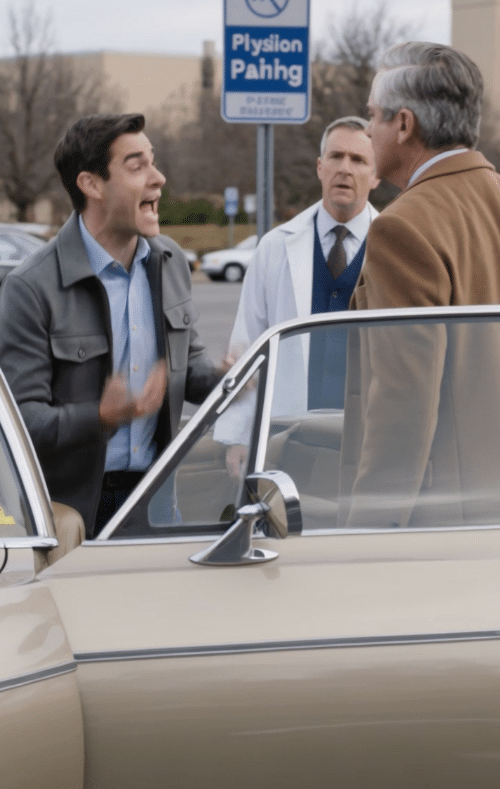
The insult cut through the hospital parking lot just as the man in the gray jacket reached for his medical bag. Behind him sat an aging sedan with faded paint, a dent near the rear bumper, and one headlight that had clearly seen better days. Beside it, a silver-haired man in a black suit and camel coat looked as though he had stepped out of a luxury car advertisement—and was furious that he had to share the parking lot with someone who hadn’t.
“I’m a surgeon. I need to get inside.”
The man in the gray jacket spoke quickly but calmly. His name was Dr. Daniel Hayes, and he had arrived at the hospital after receiving an emergency call. His short dark hair was still damp from the rain, his light blue shirt was wrinkled beneath his jacket, and the worn shoes on his feet suggested someone who had spent far more time standing in operating rooms than shopping for new clothes.
He was already late.
A patient was waiting inside the hospital. The emergency surgical team had been assembled, and Daniel’s phone had been vibrating almost continuously since he pulled into the physician parking zone.
The other man didn’t care.
“You expect me to believe you’re a surgeon?” he demanded, gesturing toward the old sedan. “Look at this thing. It belongs in a junkyard.”
Daniel glanced toward the sign beside the parking spaces.
PHYSICIAN PARKING.
“My badge is inside my jacket,” he said. “I’m not here to argue. Please let me through.”
The stranger stepped closer, blocking the path between Daniel’s driver door and the emergency entrance. His silver hair was immaculate, his black suit perfectly fitted, and his polished shoes reflected the lights shining from the hospital windows.
His name was Richard Caldwell, a wealthy investor whose donations had helped fund several hospital expansion projects. He was accustomed to being recognized, accommodated, and treated as a man whose time mattered more than anyone else’s.
He looked at Daniel’s old car and saw a person he believed he could dismiss.
“Doctors are supposed to have standards,” Richard said. “You make this place look cheap.”
Daniel tightened his grip on the medical bag.
“I don’t care what you think of my car. I need to get inside.”
Richard’s face reddened.
He had expected an apology. Instead, this plainly dressed man had refused to be intimidated by him.
“You’re not listening to me.”
“I am listening. Now please move.”
For a second, the two men stood facing each other between rows of luxury vehicles. A hospital employee near the entrance slowed down. A visitor beside a black SUV turned to watch. The security attendant at the parking booth looked up, uncertain whether the confrontation was about to become something worse.
Richard took one hard step forward.
Then he drove a powerful kick straight into Daniel’s chest.
Daniel fell backward near the sedan’s front wheel. His forearm struck the asphalt, leaving a thin trace of blood along the skin. His medical bag slipped from his hand and skidded across the pavement, stopping just beyond his reach.
Before Daniel could gather himself, Richard stepped closer and delivered exactly two more kicks, one into Daniel’s back and the other into his rib side.
A woman near the entrance covered her mouth. A man standing beside a parked car froze with his phone in his hand. The security attendant stared, visibly shaken.
Richard looked down at the surgeon.
“Move your junk before I tow it.”
Daniel tried to draw a full breath. Pain tightened his face as he reached toward the medical bag, still thinking about the operation waiting inside.
Then the emergency entrance doors burst open.
A man in a white hospital coat hurried into the parking lot, his navy suit visible beneath it. He was sixty years old, with a bald crown, an urgent expression, and a hospital badge swinging against his chest.
He saw the medical bag on the asphalt.
Then he saw Daniel beside the front wheel.
The director stopped so abruptly that the staff member behind him nearly collided with his shoulder.
For one suspended second, he seemed unable to believe what he was seeing.
Then he rushed toward the fallen surgeon, knelt beside the medical bag, and looked up at Richard with an expression that drained the color from the investor’s face.
“Your wife is waiting for the man you just kicked.”
Richard’s mouth fell open.
“My wife…?”
And suddenly, the old car no longer seemed like the most important thing in the parking lot.
Act II
Daniel Hayes had never been particularly interested in looking successful.
He was thirty-eight years old, a trauma surgeon who had spent most of his adult life learning how to make decisions when other people were too frightened to think clearly. His work required concentration, patience, and the ability to remain calm while a room filled with alarms, urgent instructions, and the consequences of a single mistake.
It did not require a luxury vehicle.
Daniel’s sedan was eleven years old. He had bought it used during his residency, when his student loans were substantial and his salary was barely enough to cover rent, food, and the occasional emergency expense. He had kept it because it ran reliably and because he had never found a convincing reason to replace it.
The car had carried him to overnight shifts, early-morning rounds, and countless calls that came just as he was about to sit down for dinner.
It had also carried him home to his wife, Emily.
Emily Hayes was forty years old and had been admitted to the hospital two days earlier after a sudden medical crisis. Her condition had deteriorated that morning, and the doctors caring for her had discovered a complication that required urgent intervention.
Daniel had not been scheduled to operate on her. In fact, he had deliberately avoided involving himself in her treatment beyond providing medical history and supporting the team. He understood the dangers of trying to become both a physician and a spouse in the same moment.
But he had been called in for an emergency surgical case elsewhere in the hospital when the director learned that Daniel was on his way. The director had also received an update about Emily’s condition.
He wanted Daniel inside as quickly as possible—not because Daniel was the only doctor in the building, but because he needed to speak with him about a difficult decision involving his wife’s care.
Daniel had driven straight from home after receiving the call.
He hadn’t changed into a more impressive outfit. He hadn’t stopped for coffee. He hadn’t even noticed that the old sedan’s exterior looked particularly shabby beneath the parking lot lights.
His mind had been on Emily.
They had been married for eleven years. Before the hospital, before the long nights and exhausting shifts, they had been two young people trying to build a life that didn’t depend on appearances. Emily had worked as a public school teacher, and Daniel had been the medical student who sometimes fell asleep over textbooks at the kitchen table.
When money was tight, they had made their own compromises.
They delayed vacations. They bought secondhand furniture. They learned to cook inexpensive meals and found reasons to celebrate even when there wasn’t much left in the bank account.
When Daniel finally became a surgeon, Emily had teased him that he would probably drive the same car until the wheels came off.
He had laughed.
“Why replace it if it works?”
“Because one day,” she had said, “you’ll have enough money to buy something nice.”
“Then I’ll buy you something nice.”
She had shaken her head. “Buy yourself something first.”
He never did.
Not because he couldn’t afford it eventually, but because other things kept taking priority. They had helped Daniel’s younger sister finish college. They had contributed to a medical fund for a former classmate’s child. Emily had quietly supported students whose families struggled to afford school supplies.
They had built their life around the belief that money was useful when it relieved someone else’s burden.
It wasn’t a philosophy Daniel advertised. He didn’t talk about his finances at work, and he rarely mentioned the sacrifices he and Emily had made. His colleagues knew him as a focused surgeon who stayed late when necessary and volunteered for difficult shifts without making a performance of it.
Some knew about his old car.
Most didn’t care.
Richard Caldwell, however, believed a person’s possessions were a public declaration of worth.
He was fifty-five, an investor who had accumulated a considerable fortune through real estate and private equity. He wore expensive clothes because he liked the way people reacted to them. He drove vehicles that made an entrance before he did. He had learned to measure respect by the speed with which strangers stepped aside.
His relationship with the hospital was complicated by years of donations and private fundraising dinners. He had contributed money to an expansion project and enjoyed hearing his name mentioned in the same breath as the hospital’s achievements.
That morning, he had arrived to visit his wife, Margaret, who was receiving treatment inside.
Margaret had been in the hospital for several days after complications from a serious cardiac condition. Richard had spent much of that time speaking with administrators, asking questions about facilities, and insisting that every detail be handled to his satisfaction.
He was frightened, although he would never have described himself that way.
Fear made him feel powerless.
Powerlessness was something he had spent a lifetime trying to escape.
So he had found small things to control: the temperature in Margaret’s room, the timing of appointments, the way staff addressed him, the location of his car. When people complied, he felt reassured. When they didn’t, he became angry.
Seeing Daniel’s old sedan in the physician parking zone gave him a new target.
He had not asked whether the driver was a doctor. He had not checked for a parking permit. He had simply decided that someone who drove such a car could not possibly belong in a space reserved for physicians.
And when Daniel calmly told him otherwise, Richard interpreted the refusal to submit as an act of disrespect.
He never considered that the man he had stopped might be racing against time for a reason far more important than parking.
Now, as the hospital director knelt beside Daniel, Richard was about to learn that the old car had brought him face-to-face with someone whose life was already intertwined with his own.
Act III
Dr. Samuel Bennett had served as hospital director for nearly fifteen years.
He had overseen expansions, difficult budget negotiations, medical crises, and the kind of decisions that rarely appeared in fundraising brochures. He knew Richard Caldwell as a generous donor with a difficult personality. He also knew Daniel Hayes as one of the most capable trauma surgeons on the hospital’s staff.
But the sight of Daniel on the pavement had stripped every administrative concern from his mind.
“Daniel, can you hear me?”
Daniel nodded, breathing carefully.
“My bag,” he said.
Samuel glanced at the bag beside the front wheel. “We’ll get it. Don’t try to stand yet.”
He signaled to the security attendant and instructed him to call for medical assistance. Then he turned toward the entrance and called for the emergency response team to come outside.
Only after he was satisfied that help was on the way did Samuel face Richard.
“What happened here?”
Richard recovered just enough of his composure to begin defending himself.
“He parked that wreck in the physician zone. I told him to move it.”
Samuel stared at him.
“And then?”
“He became difficult.”
“I asked him to move his car,” Richard repeated. “He should have listened.”
Samuel looked down at Daniel’s injured arm, then at the medical bag that had slid across the asphalt.
“You kicked him.”
Richard’s expression tightened.
“I was trying to make him understand.”
“Understand what?”
“That he can’t behave like this.”
Samuel rose slowly.
“You have no idea who you’re talking about, do you?”
Richard scoffed, but there was uncertainty in it now.
“Some doctor who apparently thinks the rules don’t apply to him.”
Samuel looked toward the emergency entrance. Behind the glass, staff members were gathering with visible concern. Several had recognized Daniel. One nurse had already started toward the parking lot with a medical kit.
Then Samuel spoke the words that changed the entire confrontation.
“Your wife is waiting for the man you just kicked.”
Richard stared at him.
“My wife?”
“Margaret is waiting for an update from the surgical team. Daniel was called in because we need him for an emergency case, and I was coming out to meet him.”
Richard’s face went still.
He knew Margaret had been waiting for news. He knew the doctors had warned him that her condition could become complicated. He had been told that a specialist would be involved in the next stage of her care.
But he hadn’t remembered the name.
Or perhaps he had heard it and failed to connect it to the man standing beside the old sedan.
“Daniel Hayes?” Samuel continued. “He’s one of our senior trauma surgeons. He’s been working here for years.”
Richard looked down at Daniel again.
The gray jacket. The worn shoes. The old car.
None of those details had changed.
Only Richard’s understanding of them had.
He opened his mouth, then closed it.
Samuel’s voice became colder.
“Your wife is receiving care from a team that includes people you apparently believe can be judged by their cars. Daniel was on his way to do his job when you attacked him.”
Richard’s hands began to tremble.
“My wife is waiting for him?”
“She is waiting for the medical team. And right now, the surgeon you attacked needs to be assessed.”
For a moment, the only sound was the distant traffic beyond the hospital grounds and the hurried footsteps approaching from the emergency entrance.
Richard looked toward the building as if he expected Margaret to appear in a wheelchair and explain that the director had misunderstood. He wanted someone to tell him that the incident was a mistake, that the man on the pavement was not connected to his wife’s care, that he had not just endangered the person he needed most.
But the hospital director did not soften.
He knelt again beside Daniel, asking him to remain still while the medical team assessed him. A nurse approached with a kit, followed by two emergency staff members who moved carefully around the car.
Daniel tried to speak.
“Samuel, the case—”
“We’ll handle the case,” Samuel replied. “Your health comes first.”
Daniel looked frustrated, not because he was worried about his own reputation, but because he knew a patient was waiting.
“There’s an operation scheduled.”
“And the hospital has other qualified surgeons. We will make sure the patient is cared for.”
It was the first moment Daniel allowed himself to stop trying to rise.
Richard watched the exchange in silence.
He had spent years believing that influence meant being able to force the world to move at his pace. Yet now, in a hospital parking lot, his own wife’s future depended on the judgment of the people he had treated with contempt.
And the most frightening realization was that none of them needed to punish him to make him powerless.
His actions had already done that.
Act IV
The medical team assessed Daniel beside the car before moving him inside for further examination.
He was conscious and able to answer questions, but the impact had left him in significant pain. His forearm had a superficial scrape, and the staff wanted to evaluate his chest and ribs carefully before clearing him for any duties.
Samuel stayed with him until the team was ready to move.
Richard stood several feet away, his camel coat open and his face drained of color. The confidence that had carried him through the confrontation had vanished, replaced by the growing realization that the situation could not be controlled with a donation, a demand, or an angry phone call.
He finally spoke.
“Samuel, we need to discuss this.”
Samuel didn’t look at him.
“We will discuss the incident after Daniel has received care.”
“I didn’t know he was—”
“Would that have made it acceptable?”
Richard stopped.
Samuel turned toward him.
“Would you have treated him differently if he had arrived in a luxury car? If his suit had cost ten thousand dollars? If you had recognized his name?”
Richard looked away.
He had no answer that could survive the question.
The security attendant began taking statements from the people who had witnessed the attack. The hospital’s surveillance footage was preserved, and the appropriate authorities were contacted. Samuel instructed the administrative team to document the incident and ensure that no one attempted to interfere with the process because Richard had donated money to the hospital.
His contributions were real. They had funded useful work, and the hospital did not intend to pretend otherwise.
But donations did not purchase immunity.
Richard tried another approach.
“I was under a lot of stress. Margaret has been sick for days. I haven’t slept properly.”
Samuel’s expression softened by the smallest degree, but his voice remained firm.
“I understand that you’re frightened for your wife. That does not excuse what you did.”
The words struck closer to home than Richard expected.
He was frightened. He was exhausted. He had spent days imagining the worst, and he had been unable to fix the one thing that mattered most to him.
But instead of admitting that fear, he had turned it into anger toward a stranger.
He had found someone who looked less powerful than himself and treated him as though he were an obstacle to be kicked out of the way.
Now that stranger was a surgeon whose judgment mattered to the hospital, a man who had arrived to help others despite having his own family in crisis.
And Richard had nearly prevented him from doing it.
A nurse approached Samuel with an update. Daniel would need further evaluation and rest. Another surgeon was being assigned to cover the emergency case, while the hospital team coordinated the remaining clinical responsibilities.
Samuel nodded and thanked her.
Richard listened, waiting for the director to mention Margaret.
Finally, he asked, “How is my wife?”
“She is being cared for,” Samuel replied. “Her team is monitoring her closely.”
“Will Daniel still see her?”
“That depends on his medical assessment and the treatment plan. We will not compromise his health or Margaret’s care to accommodate your wishes.”
Richard’s face tightened at the word wishes.
He had spent his adult life believing that money gave him options when other people had none. If a meeting was delayed, he demanded a new one. If a contract became complicated, he called someone who could make it simpler. If a service disappointed him, he expected an apology and a remedy.
But a hospital could not be managed like a private transaction.
Doctors could not be ordered to ignore their injuries. Patients could not be guaranteed outcomes. And no donation could erase an assault from a security recording.
The consequences of his actions would be handled through formal procedures. The hospital would review his conduct, restrict his access as necessary, and cooperate with the investigation. His relationship with the institution would be evaluated on the facts, not on the size of his checks.
Richard looked toward the entrance.
Behind those doors was the woman he loved. Somewhere inside, Margaret was waiting for information about her health. He wanted to run to her, tell her that everything was under control, and reassure her that he had done everything possible.
But the lie would have been too large.
He had not done everything possible.
He had attacked a man who was trying to get inside to help someone.
And he had done it because he thought the man’s car made him unworthy of respect.
Samuel turned to follow the medical team inside.
Before he went, he paused.
“Richard, your wife needs you to be honest with her. Not to protect your reputation. To help her understand what is happening.”
Then he walked away.
Richard remained beside the old sedan, surrounded by the vehicles he had once considered symbols of status. Their polished surfaces reflected the morning light, but they offered him no comfort.
He looked at Daniel’s medical bag, now being carried toward the entrance by a staff member.
For the first time, he understood that the object he had seen as proof of a man’s importance—or lack of it—had told him nothing at all.
He had judged Daniel by the car.
He had judged his own power by the way strangers reacted to him.
And he had confused fear with respect until the distinction no longer mattered to him.
Now he was about to face the one person whose opinion he could not bear to lose.
Act V
Margaret Caldwell was awake when Richard finally entered her room.
She looked tired, her face pale against the white pillow, but she was alert enough to notice the expression he carried. She had known him for nearly thirty years. She could usually tell when he was angry, when he was hiding a disappointment, and when he had already decided how a conversation should end before it began.
This time, he looked like a man who had run out of explanations.
“Richard?” she asked. “What happened?”
He stopped beside her bed.
For several seconds, he couldn’t bring himself to answer.
He had imagined this conversation dozens of times during the days of her hospitalization. In those imagined versions, he reassured her, told her that the doctors were excellent, and promised that he would take care of everything.
He had never imagined standing beside her while knowing that he had attacked the surgeon the hospital had called in that morning.
“I had an incident in the parking lot,” he said at last.
Margaret watched him.
“What kind of incident?”
He told her.
Not gracefully. Not in the carefully edited language he might have used with a business partner. He described the argument over the old car, the insults, and the moment he had kicked Daniel to the ground.
He told her about the two additional kicks.
He told her that the hospital director had come outside and recognized the surgeon.
And finally, he told her the words that had frightened him most.
“Samuel said you were waiting for the man I had just kicked.”
Margaret remained silent.
Richard looked at the floor.
“I didn’t know who he was.”
Her expression changed.
“Would that have made it better if you had known?”
He closed his eyes.
It was the same question Samuel had asked him, and it hurt more coming from his wife.
Margaret had spent years supporting his ambitions. She had attended the dinners, endured the endless phone calls, and watched him become increasingly convinced that his success entitled him to special treatment. She had often challenged him privately when he was dismissive toward service workers or impatient with people who couldn’t give him what he wanted.
Sometimes he listened.
More often, he accused her of making too much of small things.
Now she looked at him with a sadness that was more difficult to face than anger.
“You saw a man who didn’t look rich,” she said. “And you decided you could do whatever you wanted to him.”
Richard tried to speak, but she continued.
“What if he had been a janitor? What if he had been a delivery driver? What if he had been someone with no influence at all? Would you have thought it was acceptable then?”
He had no answer.
Margaret turned her face toward the window.
“I am frightened enough about my health, Richard. I shouldn’t have to be frightened about the kind of person you are becoming.”
The words left him motionless.
For years, he had believed that providing for Margaret meant making money, building a secure future, and ensuring that no one could look down on their family. He had bought expensive things because he wanted her to enjoy the life they had built. He had pursued influence because he believed it would protect them.
But somewhere along the way, he had begun treating people as though they existed in categories: useful or useless, important or insignificant, worthy of his attention or beneath it.
He had become the kind of man he once claimed to despise.
And his wife had seen it long before he did.
The days that followed were difficult. Daniel’s injuries required evaluation and recovery time, and the hospital’s investigation proceeded separately from the decisions surrounding Margaret’s treatment. Her care continued under the supervision of her medical team, with another qualified surgeon covering the clinical responsibilities.
Daniel did not return to Margaret’s bedside simply because Richard wanted him to. He returned to work only when he had been medically cleared and when his responsibilities could be handled safely.
There was no shortcut.
Richard’s conduct was documented, the witnesses were interviewed, and the matter was referred through the appropriate legal and institutional channels. The hospital reviewed the restrictions needed to protect its staff and patients, regardless of his financial contributions.
He faced the consequences of his actions without the dramatic rescue he had once expected his money to provide.
But the most important reckoning took place away from the parking lot.
Margaret recovered gradually, and as her condition improved, Richard began visiting her without demanding that every staff member rearrange the world around his schedule. He learned the names of the nurses. He listened when they explained the plan. When a procedure was delayed, he asked questions rather than issuing threats.
The change was not immediate, and it did not erase what he had done.
An apology could not undo the kicks. Regret could not make the security footage disappear. And Richard understood, at least for the first time, that the people he had frightened were not obligated to forgive him simply because he had begun to feel ashamed.
Eventually, he asked to speak with Daniel.
The meeting took place only after Daniel had recovered enough to decide whether he wanted it. Richard arrived without his usual entourage, carrying no gift and making no reference to his donations.
He stood across from the surgeon and struggled to meet his eyes.
“I owe you an apology,” he said. “I judged you by your car, insulted you, and attacked you. There is no excuse for it.”
Daniel listened without interrupting.
“I was frightened about Margaret,” Richard continued. “But that doesn’t excuse what I did. I made my fear someone else’s problem, and I chose someone I thought I could intimidate.”
He paused.
“I’m sorry.”
Daniel studied him for a moment.
“I accept that you’re apologizing,” he said. “But I want you to understand something. I wasn’t entitled to use that parking space because I’m a famous surgeon. I was entitled to be there because I was authorized to park there. And I deserved not to be attacked because I’m a person.”
Richard lowered his eyes.
Daniel continued, his voice steady.
“My car has nothing to do with my ability to do my job. Neither does my jacket. You didn’t know me, and you didn’t need to know me to understand that.”
“I know,” Richard whispered.
“Then remember it when the next person doesn’t look important enough for you to notice.”
Daniel ended the conversation there.
He did not promise friendship. He did not offer Richard an easy path back into good standing. He returned to his work, where patients needed him and the consequences of his decisions mattered far more than the appearance of his vehicle.
Months later, the old sedan was still parked in the physician zone.
Its paint was still faded. The dent near the bumper remained. Daniel still had no particular interest in replacing it.
One morning, he stepped out with his medical bag and headed toward the emergency entrance. A young employee near the parking booth held the door for him.
“Morning, Doctor.”
“Morning,” Daniel replied.
That was all.
No one applauded. No one announced his worth. No luxury car appeared to validate his place in the world.
He walked inside because patients were waiting.
And behind him, the old car sat quietly beneath the sign that had started the confrontation.
Richard had looked at that car and decided its owner was trash.
But the man he had kicked was a surgeon, a husband, and a person who had built his life around helping others—even when doing so left him exhausted, underdressed, and driving a vehicle he could easily have replaced.
The hospital director had revealed the connection to Richard’s wife, and that truth had shattered the investor’s confidence.
Yet the deepest lesson was not that Richard had attacked the wrong man.
It was that he never had the right to attack anyone in the first place.
And the old car that had seemed so embarrassing to him would remain a reminder of the day he learned, far too late, that a person’s worth was never parked in the driveway.