Act I
“Trash. Do not block people who matter.”
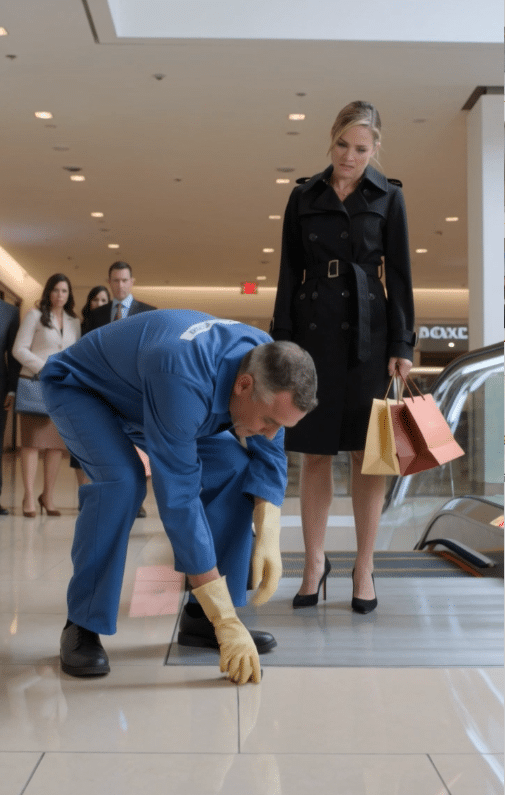
The woman in the black coat delivered the insult without even lowering her designer shopping bags. Beneath the glittering lights of an upscale American shopping mall, she stood at the base of an escalator, staring at a sixty-second inconvenience as if it were a personal attack on her entire life.
The man in the blue janitor uniform was bent over the polished tile, reaching for a small red toy car a child had dropped near the escalator. His gray hair was damp with sweat, his rubber gloves were worn at the fingertips, and his black work shoes squeaked softly against the floor.
He looked up at her.
“A child dropped this. One second.”
His voice was gentle, almost apologetic.
That only seemed to irritate her more.
The woman, whose name was Vanessa Whitmore, was forty-two and accustomed to having people move when she approached. Her glossy hair fell perfectly around her face. Her high heels clicked sharply against the tile, and the designer bags hanging from her wrists carried the logos of boutiques she had visited that afternoon.
She had spent thousands of dollars shopping and expected the world to make room for her.
Now a janitor was standing between her and the escalator because he had decided that a child’s lost toy mattered more than the few seconds she might lose.
“Do you people always have to get in the way?” she demanded.
The cleaner straightened slowly, holding the toy in his gloved hand.
“I’m just picking it up so nobody slips on it.”
Vanessa looked at his uniform, then at the rubber gloves, and finally at his face. She didn’t see a man who had spent twenty-seven years working in the mall. She didn’t see someone who had quietly helped lost children, carried heavy bags for elderly visitors, or stayed after closing to clean up messes no one else wanted to touch.
She saw a person she believed existed to make her life easier.
“Then clean from somewhere else.”
“Ma’am, I’m almost finished.”
That was the wrong answer.
Vanessa stepped closer, her expression hardening. Shoppers slowed around them. A boutique employee glanced through the store entrance, watching the exchange with growing unease.
The cleaner turned slightly, intending to place the toy on a nearby counter where the child’s family might find it.
Vanessa moved behind him.
Then, with a sudden burst of anger, she drove one hard kick into his back.
The man stumbled forward and fell beside the escalator base. His elbow struck the tile, leaving a thin trace of blood along his skin, but his gloved hand remained closed around the little red toy car.
For a moment, the shoppers seemed unable to understand what they had witnessed.
Then Vanessa stepped closer and delivered exactly two more forceful kicks, one into his back and another into his rib side.
A woman near the escalator covered her mouth. A young employee froze with a stack of folded shirts in her arms. Several shoppers stepped backward, their eyes wide, as the cleaner struggled to draw a steady breath.
Vanessa looked down at him.
“Clean from somewhere else.”
The words hung in the air, colder than the polished stone beneath him.
The cleaner did not shout. He did not threaten her. He barely moved, except to tighten his fingers around the little toy he had been trying to save from being lost.
Then a door marked MANAGEMENT swung open at the end of the corridor.
A man in a dark gray suit strode out, his gray temples catching the overhead light. He was fifty-four, carried an executive badge, and had the unmistakable bearing of someone used to making decisions that affected thousands of people.
His name was Adrian Cole.
He was the owner of the mall.
Adrian had been heading toward the main atrium to inspect preparations for an upcoming charity event when he heard the commotion. But the moment he saw the man on the floor, the hurried expression on his face vanished.
He looked at the blue uniform.
Then at the small red toy.
And finally, at the woman standing above the fallen cleaner.
Adrian stopped dead.
For a heartbeat, he seemed to forget everyone else in the corridor.
Then he walked toward the man on the floor, his face filled with a kind of respect that made Vanessa’s confidence falter.
“This mall still owes him a life,” Adrian said.
Vanessa blinked.
She looked from the executive to the janitor, then back again.
“Owes him?”
For the first time that afternoon, she had no idea what to say.
And she was about to discover that the man she had treated as invisible was the reason the entire property existed in its present form.
Act II
His name was Thomas Bennett.
To most shoppers, he was simply Tom, the older cleaner who pushed a gray cart through the mall before sunrise and stayed long after the last boutique had locked its doors. He knew which tiles became slippery after rain, which escalator made a faint clicking sound, and which store managers left cardboard boxes in the service corridors despite repeated reminders.
He also knew the mall’s people.
He knew the security guard who was raising two grandchildren. He knew the café worker who sent money home to her parents. He knew which shop assistants skipped lunch when the holiday crowds became overwhelming and which elderly visitors came every Tuesday just to sit beneath the skylights.
Tom had worked there for twenty-seven years.
He had never considered himself remarkable.
He was fifty-eight, a widower, and a man who had learned to measure a good day in small ways: a clean floor, a repaired cart, a lost child reunited with a parent. His wife, Eleanor, had once told him that he had the unusual gift of noticing people everyone else overlooked.
She had been right.
They had met long before the mall became the gleaming shopping destination it was today. Back then, Tom worked maintenance for a struggling commercial property on the edge of town. The building had leaky pipes, flickering lights, and more empty storefronts than occupied ones.
Tom could fix almost anything.
He was the man who stayed overnight when a burst pipe threatened to flood the lower level. He was the one who found a way to keep the heating system running through a bitter winter when the owners couldn’t afford a full replacement. And when a small boutique nearly lost its inventory because a damaged loading door wouldn’t close, Tom repaired the mechanism himself before morning.
He didn’t do these things because he expected a reward.
He did them because people depended on the building to earn their living, and he couldn’t stand the thought of watching their livelihoods disappear over something he might be able to fix.
One of the people who noticed him was Adrian Cole’s father, William Cole.
William had purchased the property when it was nearly bankrupt. He dreamed of transforming it into a modern shopping center, but his plans were threatened by mounting debt, construction delays, and a series of costly mechanical failures.
The first winter was disastrous.
A heating failure forced several tenants to close. A damaged drainage system flooded storage rooms. The building’s investors were ready to abandon the project, and the bank had begun preparing to seize the property.
Tom was working the overnight maintenance shift when he discovered that a major drainage valve had failed. If the problem went unnoticed until the morning, water would spread through the lower service level and damage electrical equipment that had already been struggling.
He could have called the emergency contractor and waited.
Instead, he shut down the affected system, rerouted the flow through a temporary line, and worked through the night with two maintenance colleagues to prevent the worst of the damage.
By morning, the property was still standing.
William Cole arrived expecting a disaster and found a tired maintenance worker sitting on an overturned bucket beside a functioning pump.
“What do I owe you?” William asked.
Tom wiped his hands on a rag.
“Just get the heating fixed properly. The shop owners shouldn’t have to keep worrying about it.”
William never forgot that answer.
Over the next few years, he came to rely on Tom’s judgment. Tom knew the building better than the consultants, better than the contractors, and sometimes better than the people who had designed it. When the redevelopment plans changed, he could explain which old structures were worth preserving and which hidden problems would become expensive mistakes.
But his greatest contribution wasn’t technical.
It was human.
When William proposed raising rents sharply to cover construction costs, Tom told him what would happen to the small businesses that had survived the property’s worst years. He described the family-owned bookstore that had stayed open through the winter crisis, the bakery that supplied food to a nearby shelter, and the elderly tailor who had worked in the same unit for three decades.
“You can fill a building with expensive stores,” Tom told him once, “but that doesn’t mean people will feel welcome inside it.”
William took the words seriously.
He restructured the leasing plan, kept several smaller businesses in place, and created a fund to help long-term tenants weather the redevelopment period.
The project eventually succeeded.
The struggling property became one of the most profitable shopping destinations in the region. The Cole family expanded the business, adding new wings, restaurants, and luxury boutiques. The mall’s reputation grew, and so did its value.
Tom remained in maintenance.
William offered him a supervisory role more than once. Tom accepted additional responsibilities when necessary, but he never wanted to leave the work he understood. He liked being able to solve a problem with his own hands. He liked knowing that when a visitor walked across a clean floor, the building was working as it should.
When William died, Adrian took over the business.
He had inherited his father’s wealth, but he had also inherited his father’s memory of the man who had helped save the property before it became a success.
Adrian knew that Tom had done far more than repair pipes and clean floors.
He knew that the mall’s first tenants had survived partly because Tom had spoken up for them. He knew the original building would likely have been lost without Tom’s overnight work. And he knew his father had privately described the maintenance worker as one of the few people who had never confused the value of a building with the value of the people inside it.
What Adrian didn’t know was that, on an ordinary afternoon beneath the escalators, someone would attack Tom for taking a moment to return a child’s toy.
That moment would force him to confront a question he had avoided for too long.
Had the mall grown so successful that the people who made it possible had become invisible?
Vanessa Whitmore was about to become the answer.
But first, Adrian would reveal why Tom’s small act of kindness meant more to him than every luxury store in the building.
Act III
Adrian reached Tom and crouched beside him.
“Tom. Can you hear me?”
Tom nodded, wincing as he shifted his arm.
“I’m all right,” he murmured.
“No, you’re hurt. Don’t try to get up yet.”
Adrian glanced toward the management corridor and called for security and medical assistance. The nearest guard hurried forward, while a staff member contacted the mall’s response team.
Only then did Adrian turn to Vanessa.
She had begun to recover from her initial shock, and her expression had shifted into the defensive indignation of someone who believed she could still talk her way out of trouble.
“He was blocking the escalator,” she said.
Adrian stared at her.
“He was picking up a child’s toy.”
“He was in the way.”
“So you kicked him?”
Vanessa tightened her grip on the shopping bags.
“He was being disrespectful.”
Tom looked up from the floor, bewildered by the accusation.
“I only said I needed one second.”
Adrian’s jaw tightened.
The surrounding shoppers had gone quiet. A few boutique employees stood at the edges of the corridor, watching with frightened expressions. No one had intervened before Adrian arrived, and the silence now seemed to make the incident even uglier.
Adrian rose.
“Do you know who this man is?”
Vanessa gave a brittle laugh.
“He’s a cleaner.”
The answer seemed to settle something in Adrian.
“Yes,” he said. “He is. And he has done more for this property than you could possibly understand.”
Vanessa looked toward the mall’s executive badge clipped to Adrian’s jacket. Recognition began to dawn on her face.
“You’re Adrian Cole.”
“I am.”
Her posture changed instantly.
She had seen his photograph in business magazines and local news articles. She knew he owned the mall, along with several other commercial properties. She had even attended a charity gala where his company had sponsored a table, although she doubted he remembered her.
She had assumed that being wealthy enough to shop in his mall put her closer to his world than a man in a janitor’s uniform.
Now she was standing in front of the person whose opinion mattered most to the property, and he was looking at her as though she had revealed something deeply unpleasant about herself.
Vanessa tried to smile.
“I think there’s been a misunderstanding.”
Adrian glanced at Tom’s injured elbow.
“I don’t see one.”
“He was blocking my path, and I reacted badly.”
“You attacked him.”
“I was upset.”
“Being upset doesn’t give you the right to hurt another person.”
Vanessa’s mouth tightened.
She looked around, perhaps hoping the crowd would support her. But the shoppers who had watched the assault were no longer looking at Tom with uncertainty. They were watching her.
One woman shook her head.
A boutique employee lowered her eyes, ashamed that she had frozen instead of calling for help. The security guard stepped closer, ready to separate the parties and preserve the scene for the investigation.
Adrian turned back to Tom.
The older man was still holding the little red toy car.
“Why do you still have that?” Adrian asked softly.
Tom glanced at his hand, almost surprised to find it there.
“I didn’t want it to get lost. The little boy was walking with his mother. I think it fell out of his pocket.”
Adrian’s expression changed.
He remembered a story his father had told him years earlier, one that he had never fully understood until that moment.
During the mall’s earliest days, a little boy had become separated from his mother near the old food court. The child had been frightened and crying, and the security team was struggling to locate his family in the crowded building.
Tom had found him.
The boy carried a small red toy car and refused to let it go. Tom had crouched beside him, talked to him about the toy, and stayed with him until his mother was found.
But that was not the part William had remembered most.
The child’s mother had been a young woman who worked at one of the mall’s struggling stores. She had been on the verge of losing her job because she couldn’t afford childcare and had brought her son with her for part of the afternoon. When the boy disappeared, she had panicked, convinced that a single mistake would cost her everything.
Tom hadn’t blamed her.
He had helped her find the boy, then quietly spoke with the store manager about arranging a more flexible schedule. Later, he convinced William to support a small employee assistance fund for workers facing emergencies.
That fund eventually became one of the mall’s earliest community programs.
Over time, it grew into a larger initiative supporting employees, local families, and neighborhood organizations.
Tom had never claimed credit.
He had simply kept noticing the people who needed help.
Adrian looked at the toy in Tom’s hand, and the old story returned with startling clarity.
“This mall still owes him a life,” he repeated, this time with a weight that made the words impossible to misunderstand.
Vanessa’s face paled.
“What does that mean?”
Adrian looked directly at her.
“It means this place exists in part because he cared about people when it would have been easier not to. My father built this business, but Tom helped make it worth building.”
Vanessa stared at him.
For the first time, she understood that the janitor’s uniform was not the whole story.
But the truth was larger than a single act of kindness, and Adrian was about to explain just how much Tom had shaped the mall she had treated as her private playground.
Act IV
The medical response team arrived and began assessing Tom’s injuries.
He remained conscious, though the pain in his back and side made him reluctant to move. A staff member carefully took the red toy car from his hand so he could rest his arm, setting it on a nearby counter where it would remain safe.
Adrian stayed beside him until the medical team was ready to move him for further evaluation.
Then he turned to Vanessa.
“You need to understand something,” he said. “This building isn’t just glass, stone, and expensive storefronts. It’s thousands of people working every day to make it function.”
Vanessa said nothing.
“The people who clean the floors, repair the escalators, stock the shelves, unload the deliveries, and keep the lights on are not beneath the people who shop here. They are the reason anyone can shop here at all.”
Vanessa looked away.
Adrian continued.
“My father understood that. Tom taught him things no consultant could. When the mall was close to failing, Tom worked through the night to protect the building. When we were deciding whether small businesses could afford to stay, he reminded my father that the tenants were families, not just numbers on a spreadsheet.”
He paused, glancing toward the boutiques around them.
“And when we started our employee assistance program, it grew out of problems Tom had spent years helping people solve quietly. He never demanded recognition. He never asked for a title. He simply saw a need and did what he could.”
Vanessa swallowed.
“I didn’t know any of that.”
“You didn’t need to know it to treat him like a human being.”
The words landed harder than a public insult.
Vanessa had spent the afternoon believing that money gave her the right to decide who deserved patience. She had assumed that the cleaner’s time was less valuable than hers, that his work made him available for her irritation, and that his uniform somehow excused her cruelty.
She had not asked what he was doing.
She had not considered why he was bending down.
She had not even waited long enough to discover that he was picking up something that belonged to a child.
Now her designer bags hung from her wrists like props from a life she had thought made her untouchable.
Adrian turned toward the security guard.
“Preserve the surveillance footage. Get statements from the witnesses, and contact the appropriate authorities. I want the incident documented properly.”
The guard nodded.
Vanessa’s eyes widened.
“Wait. You’re calling the police?”
“An assault has taken place on this property. We will follow the proper process.”
“But I shop here all the time.”
“That doesn’t change what happened.”
“My family knows people on the board.”
Adrian’s expression hardened.
“Then they can understand why we are documenting an assault instead of pretending it never happened.”
Vanessa looked at the shoppers surrounding them. Some had already begun speaking quietly among themselves. Others watched with expressions that held no satisfaction, only disbelief that someone could behave so viciously over a few seconds of inconvenience.
She had wanted the world to see a janitor as insignificant.
Instead, everyone had seen her.
A mall manager arrived and asked Adrian whether Vanessa should be escorted away from the scene. He instructed the manager to follow security procedures and ensure that she did not interfere with the investigation or approach Tom.
Any decision about her future access to the property would be made through a documented review, not an impulsive public spectacle.
Vanessa looked stunned.
“You can’t do this to me.”
Adrian’s voice remained even.
“This isn’t being done to you. It’s the consequence of what you chose to do to him.”
For a moment, she seemed ready to argue again. Then she saw the security guard watching her and the manager waiting for instructions.
Her anger began to give way to fear.
She looked toward Tom, who was being prepared for transport to the medical area. He had not shouted at her, threatened her, or demanded revenge. He had barely spoken beyond explaining why he had picked up the toy.
Somehow, that made the situation harder to dismiss.
He had been trying to protect a child from losing a small possession.
She had responded by trying to make him feel like he didn’t belong in the building he had helped save.
Adrian stepped toward Tom one last time.
“I’m sorry this happened to you,” he said.
Tom gave a faint shake of his head.
“You didn’t do it.”
“No. But we have a responsibility to make sure people who work here are treated with dignity.”
Tom looked toward the little red car on the counter.
“Could someone make sure that gets back to the boy?”
Adrian glanced at the toy.
Even now, Tom was thinking about someone else.
“I promise,” he said.
As the medical team moved Tom away, Adrian remained standing beside the escalator, watching the place where the older man had fallen.
The crowd gradually began to disperse. The shoppers returned to their errands, but the atmosphere had changed. The polished floor and glowing boutique windows looked exactly as they had before, yet the illusion of effortless luxury had been broken.
Every immaculate storefront depended on work most customers never saw.
Every clean tile had been cleaned by someone.
Every safe escalator had been inspected by someone.
Every comfortable shopping experience had been built from thousands of ordinary acts of responsibility.
Vanessa had believed those people existed in the background.
Now she had discovered that the person she had tried to humiliate stood at the center of a story she had never bothered to learn.
And the consequences would follow her long after she left the mall.
Act V
Tom spent the next several hours undergoing medical evaluation.
His injuries were painful, and the doctors advised him to rest while they assessed the impact of the assault. The scrape on his elbow was cleaned and dressed, and he was given time to recover without the expectation that he should return to work simply because the floor needed cleaning.
Adrian visited him later that evening.
He found Tom sitting in a quiet room, wearing a clean shirt borrowed from the staff office. The blue uniform had been set aside for the medical team to examine, and the little red toy car rested on the table beside him.
“You kept it safe,” Adrian said.
Tom smiled faintly.
“I’d hate for the kid to go home without it.”
Adrian sat across from him.
“The staff found the family. The boy’s name is Noah. His mother was worried sick when she realized the toy was missing.”
Tom’s face brightened.
“Did he get it back?”
“Not yet. I thought you might want to be the one to return it.”
Tom looked at the toy for a moment.
“That would be nice.”
Adrian hesitated before speaking again.
“I’ve been thinking about what happened today. About how long you’ve worked here, and how many things you’ve done that nobody ever saw.”
Tom shifted carefully in his chair.
“I was doing my job.”
“You were doing more than your job.”
Adrian explained that the mall’s management team would review its employee protection procedures, including how staff could summon assistance when faced with aggressive customers. He also wanted to revisit the employee recognition program, not to turn Tom into a symbol for a publicity campaign, but to make sure the people who kept the property running were not treated as invisible.
Tom listened quietly.
“Don’t make a big fuss over me,” he said at last.
Adrian smiled sadly.
“You’ve spent twenty-seven years asking for less than you deserve. I think we can afford to make a little fuss.”
Tom gave a soft laugh, then looked down at his hands.
“I never needed anyone to know my name.”
“I know.”
“But I always hoped people would remember that everyone in this place was somebody’s family.”
Adrian nodded.
“That’s what we’re going to remember.”
The incident was investigated, and the surveillance footage and witness statements were preserved. Vanessa faced the appropriate legal and institutional consequences, while the mall reviewed whether she would be permitted to return. Her wealth and social connections did not exempt her from the process.
There was no miraculous reversal in which Tom suddenly became rich or Vanessa lost everything overnight. Life was not that simple, and Adrian had no intention of using the incident to stage a theatrical punishment.
The real consequence was more grounded.
Vanessa could no longer pretend that nothing had happened. The people who had witnessed the assault had seen her choices clearly, and the record of the incident could not be erased by a complaint or a generous offer.
She had to face the fact that her behavior was not a moment of harmless impatience.
It was a decision to hurt someone she considered beneath her.
Weeks later, Tom returned to work after being cleared to resume his duties. Adrian offered him time to recover and the option to move into a less physically demanding role, but Tom chose to return gradually, with adjustments to his workload.
On his first morning back, he walked through the service corridor with his familiar gray cart.
A young employee at a boutique door spotted him and smiled.
“Good to see you, Tom.”
He nodded.
“Good to be back.”
Nothing about his uniform had changed. His shoes were still black, his gloves still rubber, and his name badge still read THOMAS BENNETT — FACILITIES.
But people greeted him differently.
Not because he had suddenly become important, but because they had begun to recognize that he had always been.
Later that afternoon, Adrian arranged for Noah and his mother to meet Tom near the escalator. The little boy ran forward when he saw the red toy car.
“You found it!”
Tom crouched carefully and handed it to him.
“Sure did. It was waiting right here for you.”
Noah grabbed the toy with both hands and held it against his chest.
“My mom said I shouldn’t lose it.”
“Then you’d better keep it somewhere safe.”
The boy nodded solemnly, as if Tom had entrusted him with a priceless treasure.
His mother thanked Tom, then turned to Adrian, who had come to witness the reunion. She had heard about the assault and was still struggling to understand how someone could attack a worker for trying to help her child.
Tom waved away her gratitude.
“It was just a little toy.”
Adrian watched him, remembering the stories his father had told him about the early days of the mall.
For Tom, it had always been just a little toy, just a broken pump, just a struggling shopkeeper, just a child who needed help finding his mother. Each small problem had seemed ordinary when it appeared in front of him.
But over twenty-seven years, those small moments had helped shape the place.
He had protected the building when it was failing. He had spoken up for the people who worked inside it. He had helped create a culture of care that Adrian’s father had once hoped would become the mall’s greatest strength.
And when a wealthy shopper tried to humiliate him, Tom’s first concern was still that a child might go home without his favorite toy.
Vanessa had looked at the blue uniform and seen someone who didn’t matter.
Adrian had looked at the same uniform and seen the history of the entire property.
The difference was never Tom’s worth.
It was the willingness to see it.
As the afternoon crowds moved beneath the skylights, shoppers passed the escalator base without knowing the full story. The boutiques glowed, the polished tiles shone, and the mall continued its ordinary rhythm.
But the little red toy had found its way back to the child who loved it.
And the man who had picked it up returned to his work, carrying no title beyond his own name.
Tom Bennett had never asked the mall to owe him anything.
That was precisely why Adrian believed it did.
Because a place is not made great by the price of the bags people carry through it, the shine of its floors, or the wealth of the customers who walk its corridors.
It is made great by the people who care for it when nobody is watching.
And the woman who had kicked a janitor for being in her way had learned the truth too late:
The man she believed did not belong in her path was one of the reasons there was a path worth walking at all.