Act I
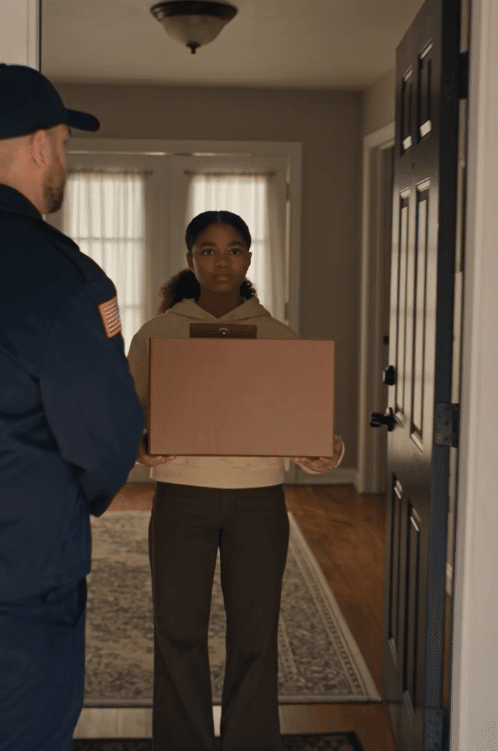
Nia froze in the doorway when she saw the small parcel in her stepmother’s hands.
The shipping label was already attached. A courier waited outside, one hand resting on his delivery bag, unaware that the package contained something Nia had not seen in months: the velvet jewelry box her late mother used to keep beside her bed.
“That was my mom’s necklace,” Nia said quietly.
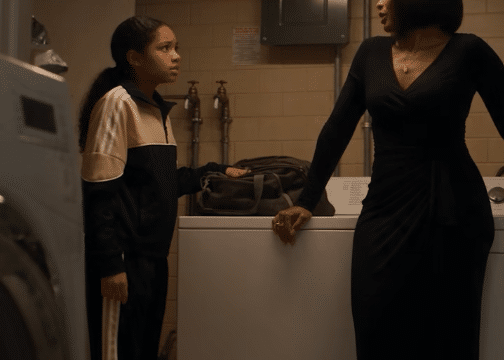
Her stepmother barely glanced at her. Dressed in a sleek black V-neck dress, her glossy bob perfectly arranged, she held the package as if it were nothing more than unwanted clutter.
“It’s clutter, and I sold it.”
Nia reached for the box before the courier could take another step. Her fingers trembled, but her voice remained steady as she opened it and found the delicate gold necklace still nestled inside.
“She gave it to me before she died.”
“Sentiment doesn’t pay bills,” her stepmother replied.
The courier stopped moving. For the first time, the ordinary front entryway felt like a room where something terrible had just been exposed.
But Nia wasn’t crying. She was looking at the necklace, remembering the last person who had fastened it around her neck.
And someone else was about to hear exactly what had happened.
Act II
The necklace had never been particularly expensive by the standards of the people her stepmother wanted to impress.
It was a fine gold chain with a tiny pendant, delicate enough to disappear beneath a shirt collar. But Nia’s mother had worn it on birthdays, family photographs, and the quiet evenings when she sat beside her daughter and brushed the curls away from her face.
On Nia’s last birthday together, her mother had placed the necklace around her neck and told her it was a gift she could carry wherever life took her.
Nia had been younger then, still believing that promises made by people who loved you could protect you from almost anything.
After her mother died, the necklace became one of the few things Nia could hold when the house felt unfamiliar. Her stepmother had gradually moved her mother’s belongings out of sight, calling them old, impractical, or emotionally unhealthy.
Nia had learned to choose her battles. She had learned that arguing rarely changed her stepmother’s mind, and that staying calm sometimes kept a bad day from becoming worse.
But seeing the jewelry box packed for shipment was different. This wasn’t a disagreement over furniture or photographs. Someone had decided that a piece of Nia’s childhood could be sold without even asking her.
From the garage, Marcus entered in his dark-brown suit, his shoulder-length dreadlocks falling neatly around his shoulders. He noticed the courier first, then the shipping label, then the open velvet box in his daughter’s hands.
His expression changed.
“Why are you shipping her necklace?”
His wife turned toward him instantly, her cold expression replaced by a polished, almost wounded smile.
“It was always mine.”
Marcus did not answer immediately.
Nia looked at her father. She had already told him that some of her mother’s belongings were missing, but she had never wanted to make him feel as though he had failed to protect her. Now she wondered whether silence had only made it easier for someone else to decide what belonged to her.
Her stepmother lifted her chin, waiting for Marcus to accept her explanation.
Then Ava, standing farther down the hallway, stepped forward with a phone in her hand.
“I have something you need to see.”
Act III
Ava was only thirteen, but she had spent enough time watching her mother manage the household to recognize the difference between a misunderstanding and a deliberate lie.
She had seen Nia search for the necklace weeks earlier. She had also heard her mother dismiss the question with a casual remark about misplaced belongings.
At first, Ava had said nothing. She had been afraid of what might happen if she challenged her mother, especially over something that seemed small to everyone except Nia.
But when she noticed the shipping parcel that morning, she remembered the old birthday video saved on the family phone.
She opened it and turned the screen toward Marcus.
The recording was shaky, filled with the ordinary noise of a family gathering. Nia’s younger face appeared in the frame, her curls falling over her forehead as her mother knelt in front of her with the gold necklace in her hands.
The woman in the video smiled as she fastened the chain around her daughter’s neck.
It was not a vague memory or a story passed between relatives. The camera had captured the moment clearly: the necklace, the gift, and the unmistakable tenderness between mother and daughter.
Ava looked from the screen to her father.
“The video says it belongs to Nia.”
For a moment, nobody spoke.
Nia watched her mother’s face on the screen, and the years seemed to collapse into a single instant. She could almost remember the warmth of her mother’s hands, the way she had adjusted the pendant so it sat just right, and the quiet confidence in her voice when she said it was Nia’s.
Marcus stared at the recording. Then he looked at his wife.
The stepmother’s smile tightened.
“It was a family gift,” she said, trying to recover her composure. “That doesn’t mean—”
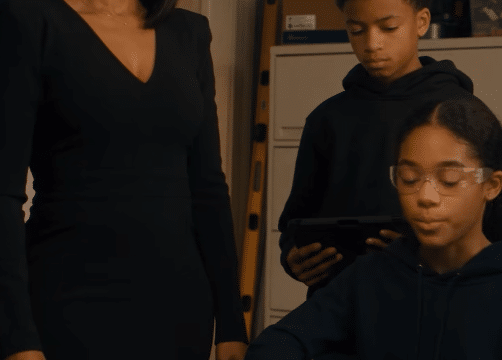
Caleb appeared beside Ava, holding a tablet against his black hoodie. He was ten, quiet by nature, and rarely interrupted the adults. But he had been watching the argument unfold, and he had found something that made him unwilling to stay silent.
He held out the tablet.
“Mom listed it under her account.”
His mother turned toward him so quickly that the gold chain at her neck caught the light.
For the first time that morning, she looked less concerned about the necklace than about what her son had found.
And Caleb had not finished showing them the screen.
Act IV
The listing displayed a photograph of the same necklace.
Beneath it was a sale price, a description, and the name of the account used to offer it for sale. The details were specific enough to leave little room for confusion.
The description included the exact serial number recorded in the necklace’s appraisal photograph.
Marcus leaned closer to the tablet. His face remained controlled, but his eyes moved slowly across the screen, taking in each detail.
The necklace had not simply been misplaced. It had been photographed, described, priced, and prepared for a transaction.
The courier shifted his weight outside the open doorway. He still had not taken the parcel, and now he seemed to understand that delivering it would mean stepping into a family dispute he had never agreed to enter.
Nia held the velvet box close to her chest.
She had spent months wondering whether she had somehow misunderstood where her mother’s belongings had gone. She had questioned her own memory, wondering if grief had made her too attached to things that everyone else had already moved beyond.
Now the evidence was sitting in Caleb’s hands.
Her stepmother glanced at the phone displaying the old birthday video, then at the tablet, then at Marcus. Her carefully arranged composure began to fracture.
“You’re making this sound much worse than it is,” she said.
Marcus did not raise his voice.
He looked at the listing again, then at the parcel waiting beside the door. His attention stopped on a phrase displayed next to the sale price: “vacation upgrade.”
It was a small detail, almost casually entered into the listing. But it changed the meaning of everything around it.
This was not merely about clearing space or selling an unwanted object. The necklace had belonged to a dead woman, had been given to her daughter, and had been placed on the market under someone else’s account.
And now the person who had arranged the sale was standing in front of the only people who could prove it.
Marcus slowly lifted his eyes from the screen.
His wife took a half-step back.
Act V
For a few seconds, Marcus said nothing.
Nia could hear the faint rustle of the courier’s jacket and the soft tap of Caleb’s finger against the tablet. The ordinary sounds of the house seemed suddenly too loud.
Ava lowered the phone, but the birthday video remained frozen on the screen. Nia’s mother was still there, smiling in a moment that had once seemed too ordinary to preserve and had now become the clearest evidence in the room.
Marcus looked at the necklace in his daughter’s hands.
Then he looked at the sale listing again.
His wife opened her mouth, perhaps ready to explain the account, the price, or the words she had chosen to describe the sale. Whatever excuse she had prepared seemed to disappear when Marcus turned fully toward her.
Nia did not speak.
She did not need to. For once, she was not the person being asked to prove that her memories were real or that something precious had ever belonged to her. The video had recorded the gift. The appraisal photograph matched the listing. The shipping label showed what had been about to happen.
The truth was no longer trapped inside Nia’s grief.
Marcus held the tablet in one hand, his expression unreadable. His wife’s polished confidence faltered beneath his gaze, and the courier remained at the threshold, waiting without touching the parcel.
Then Marcus asked the question that none of them could pretend not to understand.
“You sold her mother’s gift for your vacation?”
His wife flinched.
Her lips parted, but no answer came.
For the first time since Nia had entered the hallway, the silence belonged to someone else.
HARD CUT.