Act I
The wine hit his face before anyone in the convention hall had time to react.
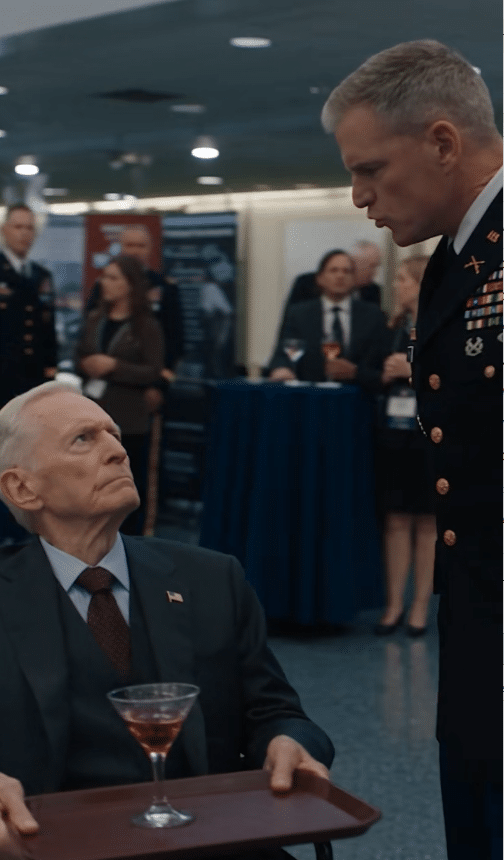
A seventy-one-year-old man sat in his wheelchair, dressed in a dark navy suit, a crisp white shirt, and a burgundy tie. A few drops of red wine had spilled onto the uniform of the man standing in front of him. It was an accident. A minor collision in a crowded veterans’ convention center.
But the man wearing the decorated Major General’s uniform wasn’t interested in explanations.
He looked down at the elderly veteran with open disgust, his eyes fixed on the stain.
“You ruined my uniform.”
The older man slowly lifted his eyes. His silver hair was neatly combed, and his weathered face showed no sign of intimidation.
“It barely touched you.”
That calm response made the younger general even angrier.
Around them, conversations began to fade. Veterans standing near historical military displays turned toward the confrontation. A few families stopped walking, sensing that something ugly was about to happen.
The Major General stepped closer.
He was fifty-two, tall, broad-shouldered, and accustomed to people moving out of his way. His uniform carried rows of ribbons and decorations, each one carefully arranged. He wore his rank like a shield, as though the stars on his shoulders gave him permission to treat everyone else as inferior.
The man in the wheelchair didn’t move.
He simply looked at him.
That was apparently the final insult.
The Major General raised the glass and threw the remaining wine directly into the old man’s face and across his expensive suit.
Gasps erupted from the surrounding crowd.
Before anyone could intervene, he stepped forward and struck the seated veteran hard across the cheek. The elderly man’s head turned with the impact. His cheek began to swell, and a faint trace of blood appeared at the corner of his mouth.
Still, he didn’t beg.
He didn’t apologize.
He didn’t even look away.
The Major General took a step backward, gathered momentum, and drove a brutal kick into the man’s chest.
The wheelchair tipped sideways.
The elderly veteran was thrown onto the carpet, landing on his back and shoulder. His wheelchair crashed onto one side, its wheel spinning helplessly.
For a moment, the entire convention center seemed to stop breathing.
The old man remained conscious, struggling to draw air into his lungs.
The Major General looked down at him.
“You should’ve stayed home.”
Nobody laughed.
Nobody applauded.
And nobody in that room yet understood how badly the Major General had miscalculated.
Because the man lying on the floor was not simply another elderly veteran attending a reunion.
And the people who knew his name were about to arrive.
Act II
For nearly three decades, the convention center had been a place where military history came alive.
Veterans returned to reconnect with old comrades. Retired officers walked past photographs of campaigns they had once commanded. Families listened to stories about sacrifices that had shaped generations.
The elderly man in the navy suit had arrived early that morning.
He hadn’t come to make a speech or receive an award. He had declined the organizers’ offer of a reserved reception table and requested only a quiet place near the historical exhibits.
He was comfortable being overlooked.
In fact, he preferred it.
His name was Daniel Whitmore.
For most of his adult life, Daniel had served in the United States Army. He had spent years moving between command posts, military hospitals, and operational bases. His career had taken him far from home, and the responsibilities he carried had often cost him more personally than he ever admitted.
He had been a husband, a father, a mentor, and eventually a grandfather.
But military service had never been a performance for him.
He believed that rank was a responsibility, not a privilege. He believed that the strongest person in a room was the one who could protect someone weaker without needing recognition for doing it.
Those beliefs had followed him into retirement.
They had also followed him into the wheelchair.
Years earlier, a devastating military accident had permanently changed his mobility. He had survived the incident, but the physical consequences remained. Since then, he had learned to navigate the world differently, accepting help when necessary without surrendering his independence.
He never considered his wheelchair a symbol of weakness.
Unfortunately, some people did.
The Major General confronting him that afternoon was named Richard Caldwell.
Caldwell had built a reputation for demanding absolute respect. His subordinates knew better than to challenge him publicly. At military gatherings, he enjoyed being recognized, introduced, and photographed.
He liked the attention that came with his rank.
What he disliked was anyone who failed to provide it.
When Daniel had accidentally brushed against him, Caldwell had expected an immediate apology. When Daniel answered calmly instead, Caldwell interpreted it as disrespect.
He had no idea who the older man was.
And that ignorance had become dangerous.
Across the hall, a retired colonel watched Daniel struggle to breathe. His hands tightened into fists, but he hesitated.
Caldwell was still an active senior officer.
Challenging him could mean serious consequences.
Yet the colonel knew that remaining silent was becoming its own kind of betrayal.
He took one step forward.
Then the main doors opened.
What entered next changed the atmosphere of the entire building.
Act III
The first indication was the sudden movement near the entrance.
Several conversations stopped at once. People turned toward the main doors as a group of uniformed officers entered the convention hall.
There were five of them.
They walked in disciplined formation, their polished boots striking the floor with unmistakable purpose. Their formal uniforms carried an impressive collection of decorations, but none of them seemed interested in the exhibits or the watching crowd.
They were following someone.
At the center of the group was a senior general.
The camera of attention seemed to move with him. His decorated shoulders, distinguished rank insignia, and rows of medals immediately set him apart. His face remained obscured as he crossed the hall.
He wasn’t smiling.
He wasn’t greeting anyone.
Then he saw the overturned wheelchair.
He saw the elderly man lying on the carpet, his navy suit stained with wine, his cheek swollen, and one hand pressed against his chest.
The senior general stopped.
For a second, he didn’t move at all.
One of the officers behind him followed his gaze. Another looked toward Caldwell, whose expression had begun to change.
The senior general walked forward.
His officers followed.
The crowd instinctively moved aside.
Daniel slowly turned his head toward the approaching group. Even through the pain, something in his expression changed. It wasn’t surprise.
It was recognition.
He knew exactly who had just entered the room.
The senior general stopped beside him, looking first at the overturned wheelchair and then at the man struggling on the floor.
His jaw tightened.
He had known Daniel Whitmore for years.
Not as a name on a retirement list.
Not as an old photograph in an office.
He knew him as the officer whose judgment had helped shape careers, whose leadership had protected countless soldiers, and whose influence had continued long after he left active service.
There were people who received respect because of the stars on their shoulders.
And then there were people who earned respect so deeply that even the highest-ranking officers remembered what they had taught them.
Daniel was one of those people.
The senior general looked at the wheelchair again.
Then his attention shifted to Caldwell.
His voice cut through the silence.
“Who kicked him out of that chair?”
Nobody answered.
Not immediately.
Caldwell looked at the senior general’s insignia.
Then at the five officers standing behind him.
Something in his expression collapsed.
He had spent the afternoon believing he was the most powerful person in the room.
Now he was beginning to understand that he might have just attacked someone whose name carried far more weight than his own.
But the worst part was still coming.
Because the senior general hadn’t come to the convention center to admire military decorations.
He had come to see Daniel.
And Caldwell had just given him a reason to remember this day for the rest of his career.
Act IV
Caldwell swallowed.
His eyes moved between the senior general’s decorated uniform and the elderly veteran on the floor.
He recognized the authority standing in front of him.
He recognized the significance of the entourage.
And suddenly, the man he had treated as an inconvenience no longer looked insignificant.
Daniel Whitmore had once served as a Lieutenant General.
A three-star officer.
A commander whose experience, decisions, and leadership had earned him the respect of generations of soldiers.
His retirement hadn’t erased his service.
His disability hadn’t diminished his achievements.
And his quiet demeanor had never meant that he was someone to be pushed around.
Caldwell’s face began to lose its color.
He had struck a retired Lieutenant General in front of witnesses. He had thrown wine over him, punched him, and kicked him out of his wheelchair.
But the revelation went deeper than rank.
The senior general now standing over Daniel had personally served under Whitmore years earlier.
Daniel had been one of the officers who taught him that command was not about making people fear you.
It was about making sure they never had to.
That lesson had stayed with him throughout his own career.
And now he was looking at the man who had taught it to him, lying injured on a convention center floor.
The five accompanying officers stood in rigid silence.
One of them glanced toward the wheelchair, then back at Caldwell. Another moved closer to Daniel, ready to assist.
Nobody needed to explain what they were witnessing.
The contrast was impossible to ignore.
One man had spent his career demanding respect.
The other had spent his career earning it.
Caldwell tried to find something to say.
Perhaps an explanation.
Perhaps an apology.
Perhaps a way to convince the senior general that the incident had been misunderstood.
But the facts were visible to everyone.
The wine-covered suit.
The swollen cheek.
The overturned wheelchair.
And dozens of witnesses who had watched the entire assault.
For the first time that afternoon, Caldwell seemed unable to rely on his uniform.
The stars on his shoulders suddenly felt very small.
He looked back at Daniel.
The old man was still on the floor, breathing through the pain, his expression controlled despite everything that had happened.
Daniel didn’t look triumphant.
He didn’t look satisfied.
He simply looked disappointed.
That expression unsettled Caldwell more than anger ever could.
Because anger could be challenged.
Disappointment suggested that someone had already seen exactly what kind of person he was.
The senior general remained standing between them.
And Caldwell finally understood that the next words out of his mouth might determine far more than his reputation at a veterans’ convention.
Act V
The convention hall remained silent.
Daniel Whitmore had entered the building that morning expecting an ordinary reunion.
He had wanted to see old friends, walk past familiar military exhibits, and spend a few quiet hours remembering the people who had shared his journey.
Instead, he had become the victim of a public assault by an officer who believed a decorated uniform made him untouchable.
But the most revealing moment wasn’t the arrival of five officers.
It wasn’t even the presence of a senior general.
It was what happened inside Caldwell when he finally understood whom he had attacked.
His confidence disappeared.
His posture changed.
The contempt that had filled his face only minutes earlier was replaced by disbelief and fear.
The man who had thrown wine at a wheelchair user now seemed unable to meet the eyes of the people standing around him.
The senior general looked down at Daniel.
The officers moved closer, preparing to help him safely back into position while ensuring his injuries could be assessed.
Daniel remained conscious.
His hand rested against his chest, and his breathing was still difficult. Yet when he looked toward the approaching officers, his expression softened.
They weren’t seeing a helpless old man.
They were seeing someone they had every reason to respect.
Caldwell stood frozen a few feet away.
The crowd that had once hesitated to intervene was now watching him with unmistakable disapproval.
His decorations hadn’t changed.
His rank hadn’t disappeared.
But the authority he had assumed those things guaranteed was gone.
And somewhere in that silence, the truth became painfully clear.
A man’s character is not measured by how he treats people who can challenge him.
It is measured by how he treats people he believes cannot.
Daniel Whitmore had never needed to prove his worth by humiliating someone else.
Caldwell had just demonstrated the opposite in front of an entire convention center.
The senior general turned slightly toward him.
Caldwell’s lips parted.
His eyes widened as he finally found the only word he could manage.
“General…?”
His voice was barely audible.
For the first time in his military career, Richard Caldwell looked genuinely afraid.
And the man he had kicked out of a wheelchair had not needed to raise his voice once.
The uniform had given Caldwell authority. But it was the man on the floor who had earned the respect of everyone in the room.