Act I
The plate flew across the table before anyone could stop it.
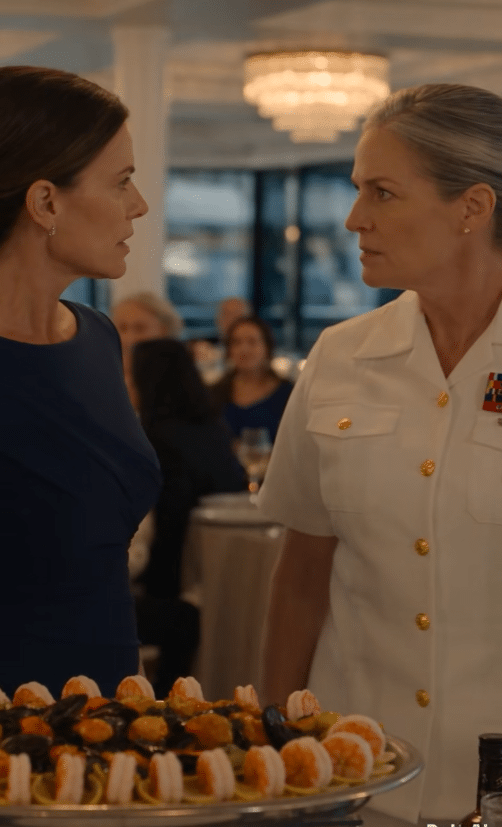
Seafood, sauce, and shattered pieces of porcelain scattered across a midnight-blue evening dress. A woman with dark hair arranged in an elegant low bun stood frozen beneath the glittering chandeliers, her silver clutch still in one hand.
Standing in front of her was a silver-blond woman wearing a heavily decorated naval dress uniform.
Her expression was furious.
“You ruined my plate.”
The woman in the evening dress looked down at the mess, then calmly met her eyes.
“I’ll replace it.”
That answer only made the uniformed woman angrier.
She was fifty-five, a Rear Admiral accustomed to being recognized and obeyed. Her uniform was immaculate, her ribbons carefully arranged, and her posture radiated the kind of authority she expected everyone around her to respect.
But the woman in the midnight-blue dress didn’t appear intimidated.
The Rear Admiral stepped closer.
“Civilians don’t touch admirals.”
Before anyone could intervene, she struck the woman hard across the cheek.
A shocked gasp rose from the nearest tables.
The victim’s face turned with the impact. Her cheek reddened, and a faint trace of blood appeared at the corner of her mouth.
Then the Rear Admiral grabbed her by the hair and violently pulled her off balance, throwing her onto the carpet.
A waiter dropped his tray.
A couple near the waterfront windows stood abruptly.
Several naval officers looked toward the confrontation in disbelief.
The woman on the floor remained conscious. She slowly pushed herself up, one hand against the carpet, her midnight-blue dress stained with food and sauce.
She didn’t scream.
She didn’t beg.
She simply looked at the woman who had attacked her.
The Rear Admiral adjusted her uniform and looked around as though she expected everyone to agree that the incident was justified.
But nobody applauded.
Nobody supported her.
And she had absolutely no idea that the woman she had just assaulted was the most important guest at the entire charity ball.
Act II
The evening was supposed to celebrate the finest traditions of the United States Navy.
The waterfront restaurant had been transformed into an elegant ballroom. Chandeliers reflected across polished surfaces, naval flags stood beside the entrance, and large windows offered a spectacular view of the marina.
The guest list included senior naval officers, retired admirals, military families, philanthropists, and influential supporters of veterans’ organizations.
Every table had been carefully arranged.
Every detail had been planned.
And the woman in the midnight-blue dress had been invited as the evening’s most distinguished guest.
Her name was Claire Bennett.
At forty-eight, Claire had built a remarkable military career without developing the need to advertise her accomplishments.
She had served through difficult assignments, navigated complicated command responsibilities, and earned the trust of people who understood how much responsibility came with senior leadership.
She believed that authority was not something to display at every opportunity.
It was something to exercise carefully.
That philosophy shaped the way she treated everyone around her, regardless of rank, background, or profession.
It also explained why she had responded so calmly when the collision happened.
She hadn’t wanted an argument.
She had offered to replace the damaged plate.
That should have ended the matter.
But the woman confronting her had a different philosophy.
Her name was Patricia Monroe.
Monroe had spent years building her reputation as a formidable Rear Admiral. Her uniform was covered in decorations, and she took considerable pride in the recognition her position brought her.
Unfortunately, she had developed a habit of treating people outside her immediate military circle as though they were beneath her.
Waiters, event organizers, civilian employees, and junior personnel all knew how quickly her temper could change.
She expected immediate attention.
She expected apologies.
And she believed that her rank entitled her to more respect than anyone else in the room.
When Claire accidentally touched her table, Monroe saw an opportunity to demonstrate that authority.
She never considered that the woman in the elegant dress might have an important position of her own.
She never asked her name.
She never bothered to understand why so many senior naval officers had been looking toward the entrance earlier that evening.
And now, after the assault, she was standing confidently beside the ruined dinner table.
She thought the incident was over.
Then the master of ceremonies walked toward the stage.
The microphone came alive.
And the next announcement would turn the entire evening upside down.
Act III
The orchestra fell silent.
The master of ceremonies stepped into the center of the stage and looked toward the long aisle running through the restaurant.
He waited until the conversations stopped.
Then he spoke.
“To honor tonight’s guest, please clear the center aisle.”
Guests began standing.
Chairs moved backward across the floor. Waiters stepped aside. Senior naval officers adjusted their uniforms and formed two lines along the aisle.
Monroe looked toward the stage.
She assumed the honored guest was some wealthy donor or distinguished visitor.
Perhaps someone from Washington.
Perhaps a retired commander.
She casually straightened her own uniform, expecting to participate in the ceremony.
Meanwhile, Claire slowly pushed herself upright.
Her midnight-blue dress was stained with sauce. A few strands of dark hair had fallen loose from her bun, and her cheek was visibly red.
She accepted a clean napkin from a nearby table and carefully wiped the corner of her mouth.
She didn’t explain herself to anyone.
She didn’t announce her position.
She simply composed herself.
The master of ceremonies raised the microphone again.
“Admiral Claire Bennett, please join us.”
The reaction was immediate.
Several officers straightened almost simultaneously.
A retired naval commander near the front table turned toward Claire with unmistakable recognition.
One of the senior guests smiled respectfully.
Another officer stood perfectly still, his attention fixed on the woman in the midnight-blue dress.
Monroe stopped adjusting her uniform.
Her expression changed.
She looked toward the stage.
Then toward Claire.
Then back toward the stage.
Admiral Claire Bennett.
The name was unmistakable.
The woman she had just humiliated wasn’t an ordinary civilian attending a charity dinner.
She was the evening’s honored guest.
She was an admiral.
And the entire ballroom was now waiting for her to enter the ceremonial aisle.
Monroe’s face began to lose its color.
But the most devastating part wasn’t the announcement itself.
It was what happened when Claire started walking.
Act IV
Claire took a moment to straighten her dress.
She carefully adjusted the fabric around her waist, secured her silver clutch, and smoothed the loose strands of hair near her face.
Then she lifted her head.
The pain from the assault was still visible, but her expression remained controlled.
She stepped toward the center aisle.
The officers standing along both sides instinctively straightened.
A senior commander near the front table adjusted his posture and watched her approach. Another officer stepped back to give her additional room.
There was no confusion about who deserved recognition.
Claire walked between the two lines without rushing.
The midnight-blue dress, despite the stains, still carried an unmistakable elegance. Her silver heels clicked against the polished floor.
Guests watched in silence.
Some appeared saddened by what had happened.
Others looked toward Monroe with open disbelief.
The Rear Admiral remained beside the table, motionless.
Only minutes earlier, she had been demanding respect from a woman she believed was an insignificant civilian.
Now she was watching that same woman receive the respect of the entire naval community.
Monroe looked down at her own decorations.
Her ribbons were still perfectly arranged.
Her rank insignia was still visible.
Nothing about her uniform had changed.
But everything about the way people looked at her had changed.
She suddenly seemed smaller.
A waiter who had witnessed the assault stood near the wall, watching Claire with concern. Several guests who had previously hesitated to intervene now appeared ready to speak about what they had seen.
There was no escaping the truth.
Monroe had attacked the wrong person.
More importantly, she had revealed something about herself that no collection of medals could conceal.
She had used her rank to humiliate someone who had offered to replace a damaged dinner plate.
Claire, meanwhile, had endured a public assault without using her position to threaten anyone.
The difference was impossible to miss.
As Claire approached the front of the ballroom, the master of ceremonies stepped slightly aside.
The guests remained standing.
And Monroe finally understood that the evening she had expected to dominate had become a moment she would never be able to erase.
Act V
Claire reached the front of the ceremonial aisle.
The master of ceremonies waited respectfully as she approached the stage.
The naval officers remained standing.
For a brief moment, Claire turned toward the ballroom.
Her eyes passed across the tables, the guests, and finally the woman in the decorated uniform.
She didn’t smile.
She didn’t point.
She didn’t demand an apology.
Her expression was calm, but there was something unmistakably serious in her eyes.
She had been invited to celebrate service, sacrifice, and leadership.
Instead, she had witnessed someone use a position of authority to demonstrate the exact opposite.
Patricia Monroe stood frozen.
She had built her identity around being an admiral.
She had believed that her uniform made her untouchable.
But the ballroom was now showing her the difference between holding a title and earning genuine respect.
Claire Bennett hadn’t needed to raise her voice.
She hadn’t needed to reveal her rank during the confrontation.
She had simply remained composed while the truth revealed itself.
Monroe looked around.
The guests who had once appeared intimidated by her now watched with disappointment.
The officers standing along the aisle showed unmistakable respect for Claire.
And the master of ceremonies remained beside the stage, waiting for the honored guest.
Monroe’s lips parted.
Her eyes moved from Claire’s face to the senior officers standing around her.
The realization finally became unavoidable.
She had thrown an entire dinner into the face of the woman the Navy had gathered to honor.
She had struck her.
She had dragged her to the floor.
And she had done it while boasting that civilians should never touch admirals.
Now the woman she had called a civilian was walking toward the stage as Admiral Claire Bennett.
Monroe’s confidence vanished completely.
Her voice emerged as little more than a whisper.
“Admiral… her?”
Nobody answered.
They didn’t need to.
The entire ballroom had already seen the truth.
Patricia Monroe had spent years demanding that people respect her uniform. Claire Bennett had earned the respect of an entire room without ever having to mention hers.
Fix the Admiral Rank RevealReduce Repetitive Moral Commentary