Act I
“Sir, he’s limping.”
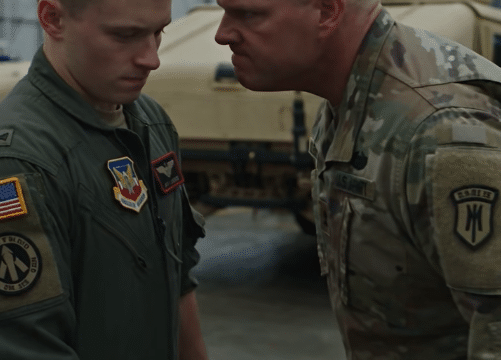
The young handler tightened his grip on the leash as the military working dog shifted its weight away from an injured front paw. The German Shepherd stood on the training turf, ears alert, but its movements were uneven.
The Colonel barely glanced at the animal.
“Then make him work.”
Around the scent-training lane, several handlers exchanged uneasy looks. They knew the dog. They knew how hard it worked, how reliably it responded, and how unusual it was for the animal to favor its paw.
The twenty-six-year-old Sergeant tried again. “Sir, he’s not putting weight on it.”
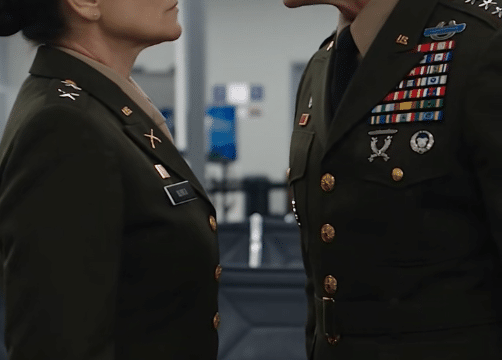
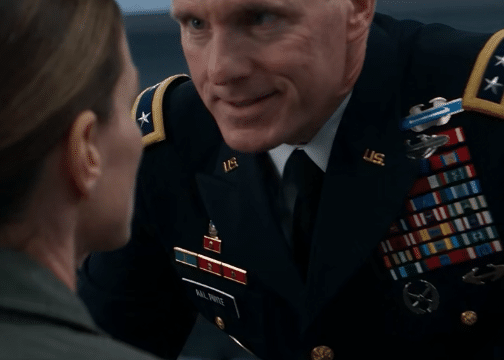
The Colonel’s silver eagle insignia gleamed against his Army uniform as he stepped closer. At forty-five, he had built his command style around one rule: nobody questioned him in front of his people.
But someone did.
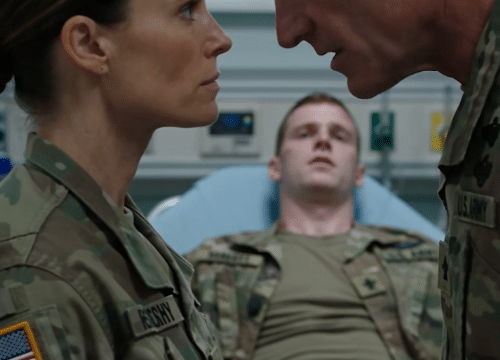
A woman in OCP uniform stood a few feet away, watching the dog with quiet concern. Her brown hair was tied neatly back, and her expression was composed. A small one-star patch sat on her uniform, easy to overlook if someone was not paying attention.
“Pull the dog,” she ordered.
The Colonel turned toward her.
For a second, his expression suggested disbelief. Then came irritation.
“Dogs work. Soldiers obey.”
The handler looked at the woman, then at the Colonel. He knew the dog needed to be removed from the drill, but he also knew what happened to soldiers who openly challenged the officer running the yard.
The woman did not retreat.
She had seen enough. The dog was injured, the handler had reported it, and the Colonel was demanding that they continue anyway.
This was no longer a disagreement about training standards.
It was a test of whether anyone in that yard would protect a working animal when doing so meant challenging a powerful officer.
The Colonel made his answer clear.
He shoved the handler aside, turned toward the woman, and struck her across the face.
The entire training yard froze.
And the Colonel had no idea whose authority he had just challenged.
Act II
The dog had a reputation.
He was one of the most dependable military working dogs in the unit, trained to detect scents under difficult conditions and remain focused amid noise, confusion, and pressure. His handler had spent months learning the smallest changes in his behavior.
A slight hesitation. A change in breathing. A paw placed carefully on the ground.
Those details mattered.
A military working dog could not explain pain in words. Its handler had to recognize the signs and speak for it. That was part of the responsibility, not an optional act of kindness.
The Sergeant understood that responsibility.
He had noticed the limp before the drill began. The dog had been favoring its front paw after moving through the obstacle area, and the handler had immediately reported it.
The correct response was simple: stop the exercise, assess the injury, and keep the animal out of further work until it was cleared.
But the Colonel saw the situation differently.
He had scheduled the scent drill as part of a demonstration for visiting personnel. The unit was expected to perform flawlessly, and he had already made it clear that no one would be allowed to disrupt the schedule.
The dog’s limp threatened the demonstration.
So did the handler’s refusal to ignore it.
The Colonel had a habit of treating hesitation as disobedience. He believed that if soldiers were allowed to question an order, discipline would unravel. He rarely distinguished between a subordinate refusing to work and a subordinate warning him about a genuine safety problem.
That attitude had made the handlers cautious around him.
They followed instructions. They avoided arguments. They learned to keep concerns brief and private.
The woman watching the exchange had noticed the same pattern during her inspection.
She was not there to admire the unit’s performance. As a Brigadier General overseeing K9 standards, she was responsible for ensuring that the training program met the requirements expected of it. That included the welfare of the animals and the judgment of the people responsible for them.
A successful drill meant nothing if the dog was pushed through an injury.
She had already observed the handler trying to communicate the problem. She had also watched the Colonel dismiss him without examining the animal.
When she intervened, she expected resistance.
She did not expect violence.
The Colonel’s shove sent the Sergeant stumbling away. The handler managed to keep hold of the leash, but his attention was now divided between the dog and the woman standing in front of the officer.
Then came the slap.
The woman’s head turned sharply. Her cheek reddened almost immediately, and a faint trace of blood appeared at the corner of her mouth.
Before she could steady herself, the Colonel drove a hard kick into her abdomen.
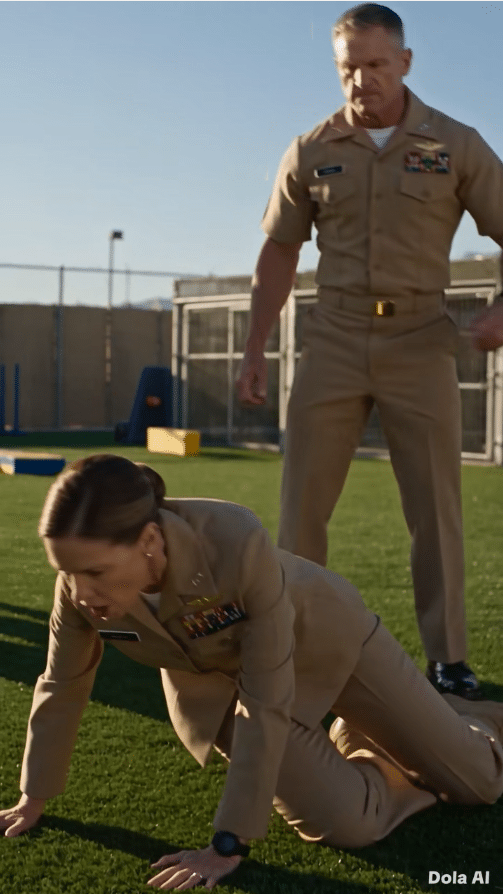
She fell backward onto the turf.
The handlers stared in disbelief. The Sergeant instinctively shifted forward, but the Colonel’s presence kept everyone frozen.
The woman tried to brace herself.
The Colonel delivered a second hard kick, this time to her side. She curled briefly from the pain, struggling to regain her breath.
The dog strained against the leash.
And the Colonel still believed he was in control.
Act III
The woman remained on the turf, one arm guarding her abdomen as she fought to breathe.
Her cheek was swollen and red. A faint line of blood remained at the corner of her mouth. The pain was obvious, but she did not plead with the Colonel or ask him to stop.
She looked directly at him.
The Colonel stood over her, satisfied with what he believed he had accomplished. He had silenced the challenge in front of his unit. In his mind, the matter was settled.
The handlers did not share his confidence.
Some stared at the ground. Others watched the woman, visibly struggling to understand how an officer could have gone so far in the middle of a military training yard.
The Sergeant was still holding the leash.
The dog had stopped looking toward the scent boxes. Its attention had shifted entirely to the woman on the turf.
The Colonel glanced down at the animal, then back at the handlers.
“Dogs work. Soldiers obey.”
The words landed differently now.
They no longer sounded like a command about training. They sounded like an explanation for everything the handlers had just witnessed: the ignored injury, the dismissed warning, and the assault on the officer who had tried to stop it.
The woman slowly lifted her head.
She was hurt, but her expression had changed. The initial shock had given way to something controlled and unmistakably firm.
The Sergeant looked down at the leash.
He knew the dog wanted to move. He also knew that the animal’s training demanded calm, deliberate handling. The dog was not supposed to charge at people or respond to chaos without direction.
But the woman was on the ground.
And the dog had recognized her.
The handler loosened his grip.
The leash slackened.
The German Shepherd moved immediately.
It left the Colonel’s side of the training lane, crossed the turf, and went straight to the woman. Rather than rushing past her or reacting aggressively, it stopped beside her and sat protectively at her shoulder.
The dog lowered its head slightly, staying close.
For the first time since the assault began, the Colonel looked uncertain.
The animal had ignored the man who had ordered the drill to continue. It had left the person who controlled the exercise and chosen to stay beside the person who had tried to protect it.
But the dog was not the only one who recognized her.
At the far end of the lane, the lead handler had been watching the entire exchange.
His eyes moved from the woman’s face to the one-star patch on her uniform.
Then his posture changed.
Act IV
The lead handler stepped forward.
He did not rush. He did not shout. He simply stopped, straightened his uniform, and snapped to attention.
“Ma’am.”
The word carried across the training yard.
The Colonel turned sharply.
The lead handler raised his hand in a formal salute. The other handlers followed his movement, one after another, standing upright beside their dogs and equipment.
The recognition spread through the line.
The woman on the turf was not an ordinary officer visiting the training area. She was the Brigadier General responsible for overseeing K9 standards.
The Colonel stared at her.
His expression shifted from irritation to confusion, then toward something much closer to fear.
The one-star patch that he had barely noticed now seemed impossible to ignore.
The dog remained seated beside her.
The General slowly pushed herself into a more upright position. Her breathing was still difficult, and she kept one arm close to her side. The swelling on her cheek and the blood at the corner of her mouth made the assault impossible to dismiss as a misunderstanding.
Yet she did not look toward the handlers for help.
She looked at the dog first.
The animal stayed close, calm and attentive. Its injured paw remained visible against the turf.
The General’s expression softened for just a moment.
Then she looked back at the Colonel.
He had spent the drill treating the dog as equipment and the handler as someone who existed only to carry out orders. He had treated her intervention as an insult because he assumed the only authority that mattered was his own.
Now the entire unit was standing at attention.
The lead handler remained saluting. The others had straightened in recognition. No one was looking at the Colonel for permission to acknowledge her.
He glanced toward the Sergeant.
The young handler stood beside the dog, still holding the loosened leash. His expression was no longer simply frightened. He was watching the General with the quiet respect of someone who had finally seen a senior officer act on the standards everyone else had been expected to uphold.
The Colonel’s jaw tightened.
He tried to recover his composure, but the confidence had drained from his posture. His shoulders stiffened, then shifted uneasily. His eyes moved between the dog, the handlers, and the woman he had just attacked.
He had expected everyone to obey him.
Instead, the entire unit had recognized someone else.
And the animal he had ordered to keep working had made its own choice.
Act V
The Colonel stared at the woman.
“The whole unit knows you…?”
The question came out quietly.
There was no command in it now. No contempt. Only disbelief.
The General remained beside the dog, breathing carefully through the pain. The animal sat close to her, its attention fixed on her movements.
The handlers held their positions.
The lead handler’s salute had become the moment that changed everything. The others had followed because they knew who she was and what her responsibility meant. They also knew that the Colonel had crossed a line that could not be explained away as a disagreement over training.
The General had not asked them to salute.
She had not needed to.
The dog shifted slightly, then settled again beside her. Its injured paw was still a concern, but at least it was no longer being forced through the drill.
The Sergeant looked down at the animal and then toward the General. He had spoken up because he believed the dog deserved protection, even when the officer in charge did not want to hear it.
Now he was watching a Brigadier General receive the same respect the Colonel had demanded for himself.
The difference was unmistakable.
The Colonel’s authority had depended on fear and unquestioned compliance. Hers was being recognized without a single order.
The dog had not understood the stars on her uniform. It had not needed to know her title or position. It had responded to the person who had noticed its pain and tried to stop the drill.
The handlers understood something similar.
They knew the General’s responsibility was not simply to inspect training records or approve standards. It was to make sure those standards meant something when following them became inconvenient.
That was why they recognized her.
And that was why the Colonel’s question sounded so small.
He had believed the entire yard belonged to him. He had believed the dog was merely a tool, the handler merely a subordinate, and the woman merely an interruption.
Now he stood in front of the people he had tried to control, watching them salute the officer he had assaulted.
The General held his gaze.
The dog remained beside her.
No one moved to rescue the Colonel from the silence.
The man who had ordered an injured animal to work had just discovered that the whole unit knew exactly who had tried to protect it.
And the General was not going to let them forget what they had witnessed.
Align the story with the six-line dialogue lockCompress the five acts into thirty seconds