Act I
“We were next.”
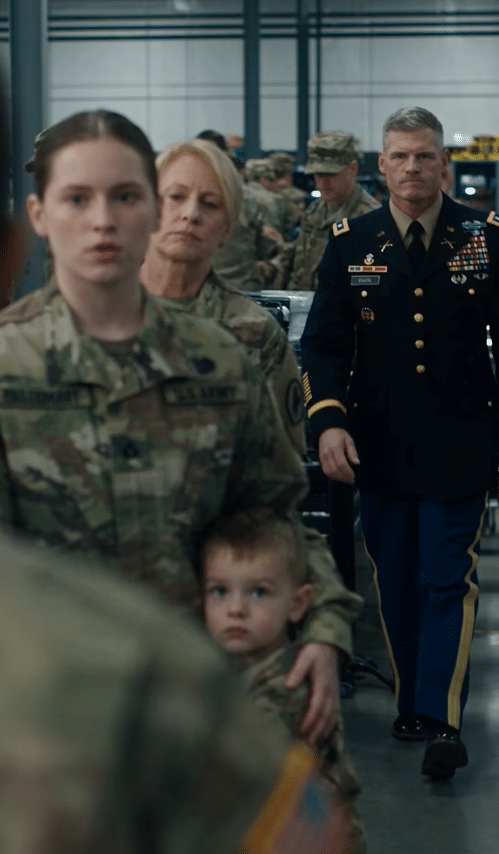
The young Specialist’s voice was quiet, but it was enough to stop the woman pushing a full shopping cart toward the commissary checkout. A military family stood behind her, waiting patiently. A mother held a toddler against her shoulder while another child leaned against the cart.
The woman barely glanced back.
“My wife doesn’t wait behind enlisted families,” a Colonel announced.
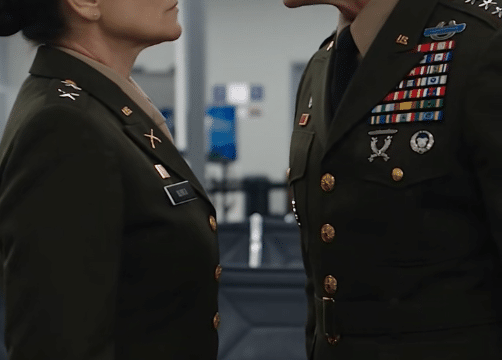
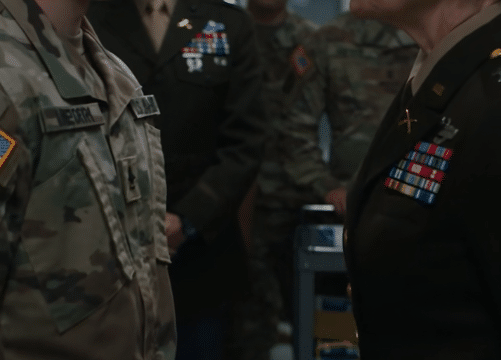
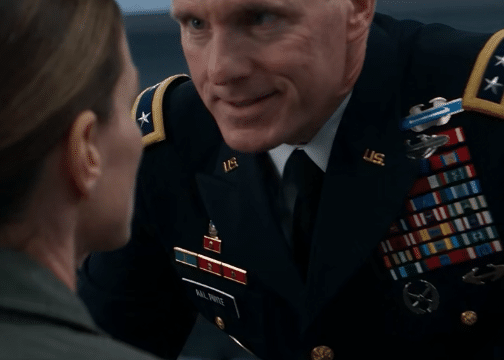
He stood beside her in a crisp Army service uniform, silver eagle insignia shining above a neat row of ribbons. His polished shoes and confident posture made it clear that he expected the line to move whenever he wanted.
A few shoppers looked away.
Nobody wanted trouble over groceries.
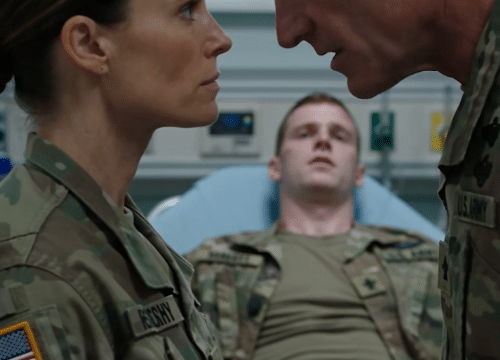
But another soldier stepped forward. She wore an Army OCP uniform and tan boots, her dark hair secured in a low bun. At forty-five, she had the composed expression of someone who had spent years watching people reveal their character when they thought nobody important was paying attention.
“She waits like everyone else.”
The Colonel turned toward her.
His wife folded her arms, visibly annoyed. The Specialist looked uncomfortable, suddenly aware that a simple request to respect the line had become a confrontation with a senior officer.
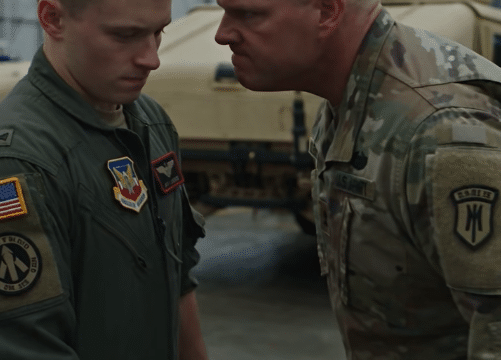
The Colonel studied the woman in uniform.
“Know what three grades above you means.”
She did not retreat.
“Back away.”
The warning was calm, direct, and unmistakable.
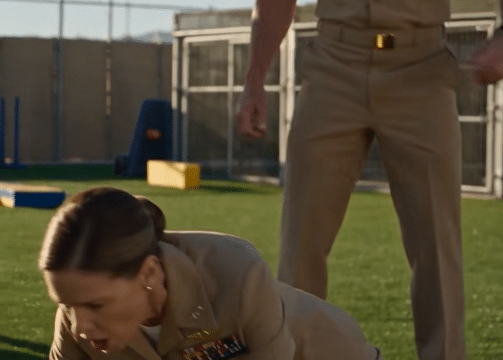
The Colonel responded by slapping her hard across the cheek. Her head snapped sideways, and a red swelling appeared almost immediately. A faint trace of blood formed at the corner of her mouth.
Then he kicked her in the front torso, driving her into the checkout divider. Before she could recover, another hard strike forced her against it again.
The checkout area went silent.
The Specialist stared in horror. The Colonel’s wife stepped back.
But the woman in uniform slowly regained her footing.
And the Colonel was about to discover that the person he had attacked was not someone he could intimidate with his rank.
Act II
The commissary was one of the few places on base where military life briefly became ordinary.
Soldiers came in after long shifts. Spouses picked up groceries. Parents tried to keep children occupied while waiting for their turn at the register. Officers and enlisted families stood in the same lines, choosing the same food and waiting for the same checkout machines.
That ordinary rhythm was exactly what made the Colonel’s behavior so offensive.
His wife had arrived with a cart full of groceries and expected to move directly to the front. When the Specialist politely pointed out that other families were waiting, she acted as though the request itself was disrespectful.
The Colonel had been nearby.
He could have told his wife to join the line. He could have apologized and allowed the checkout to continue. Instead, he announced that she did not have to wait behind enlisted families.
It was not the first time people had seen him behave that way.
He was known for treating his rank as a personal privilege rather than a responsibility. He expected subordinates to move aside, expected staff to accommodate his preferences, and rarely considered whether the people around him had legitimate reasons to say no.
His wife had grown accustomed to the same treatment.
Over time, the distinction between military courtesy and personal entitlement had disappeared inside their small world. She believed being married to a colonel meant ordinary rules were for other people.
The Specialist had not intended to challenge anyone’s authority.
She was twenty-three, still early in her Army career, and had come to the commissary after duty. She was simply standing in line with a young child and a few groceries. When the Colonel’s wife pushed ahead, she spoke up because the families behind her had been waiting.
The Colonel interpreted that small act as disrespect.
The woman who intervened had seen the exchange from nearby.
She was a Lieutenant General, one of the Army’s senior officers, but she had not announced her position. She had no reason to turn a checkout line into a display of rank.
What mattered to her was that the Specialist and the families behind her deserved the same basic consideration as everyone else.
She had watched the Colonel’s wife cut the line. She had heard his explanation. And she had seen how quickly the other shoppers became afraid to object.
That was why she stepped forward.
“She waits like everyone else.”
The Colonel did not recognize her authority. He saw only another uniformed soldier refusing to accept his wife’s privilege.
He leaned toward her and invoked the difference in rank.
“Know what three grades above you means.”
The woman gave him one final warning.
“Back away.”
But the Colonel had already decided that the only acceptable outcome was her silence.
He struck her in front of the checkout line.
The sound brought every conversation to an end.
Act III
The first blow left the woman’s cheek red and swollen.
She staggered from the impact, and the Colonel immediately drove a kick into her torso. She was forced backward into the checkout divider, where the metal edge rattled against the counter.
He struck her upper body again, driving her into the divider a second time.
A few groceries slipped from the checkout belt. A bottle rolled onto the floor.
The Specialist stood frozen, one hand close to the young child beside her. The families in line stared in disbelief. The Colonel’s wife had moved away from the confrontation, but she did not appear to understand how completely her husband’s behavior had crossed the line.
The Lieutenant General struggled to regain her balance.
Her cheek was visibly swollen. A faint trace of blood marked the corner of her mouth, and she guarded her torso as she took a careful breath.
The Colonel stood in front of her.
He looked satisfied.
He had just assaulted someone in a public place because she refused to let his wife cut in line. In his mind, the display had restored his authority.
The woman slowly straightened.
She looked at him without raising her voice.
The Colonel expected her to back down. He expected the people watching to lower their eyes and pretend they had seen nothing.
Instead, she held her ground.
The Specialist watched her with a mixture of fear and disbelief. She had spoken up because she believed the line should be fair. Now someone else had been hurt for defending that same principle.
The Lieutenant General glanced briefly toward the families.
They were not simply witnesses to an argument anymore. They had seen an officer use violence to protect a personal favor.
The Colonel’s wife stood beside the cart, her expression changing as the situation became harder to dismiss. The groceries were still on the belt, but nobody was thinking about checkout anymore.
Then the Colonel moved toward the woman again.
He was convinced that she would finally submit.
Instead, he was about to lose the advantage he thought he had.
Act IV
The Colonel charged.
The Lieutenant General moved cleanly to one side.
His momentum carried him past her, and she delivered one short, controlled counter to his upper torso. He stumbled backward several steps, struggling to recover his balance.
The checkout line erupted in startled gasps.
The Colonel touched the corner of his mouth. A faint trace of blood marked his fingers.
He stared at it as if he could not understand what had happened.
A few seconds earlier, he had been certain that his rank made him untouchable. Now he was the one standing off balance in front of the families he had tried to intimidate.
The Lieutenant General remained steady.
Her cheek was still swollen, and she continued to guard her torso, but her posture was controlled. She had not pursued him or tried to turn the confrontation into a spectacle. She had simply stopped his second attack.
The Specialist looked at her with new understanding.
The woman who had stepped forward was not trying to win an argument over a checkout line. She had been protecting a basic standard that should have applied to everyone on the installation.
The Colonel looked around.
The shoppers had not disappeared. The military families were still there. The Specialist was still standing beside the child. His wife was still beside the cart.
Every one of them had seen him strike the woman.
Every one of them had also seen her refuse to be intimidated.
His confidence began to break.
He adjusted his uniform, but the gesture could not restore the authority he had just thrown away. His silver eagle insignia remained visible, yet the people looking at him no longer seemed impressed by it.
The Lieutenant General watched him carefully.
She had given him a warning. He had ignored it. He had chosen to attack her, then charged again after the assault.
The reversal had not come from a speech or a dramatic announcement.
It had come from the moment he discovered that intimidation would not make her surrender.
And the worst part for him was that the entire commissary had witnessed it.
Act V
The Colonel stared at the woman, one hand still near his mouth.
“You hit me?”
The question came out in disbelief.
The Lieutenant General looked directly at him.
Her expression was stern, but not triumphant. She had no reason to celebrate what had happened. A military commissary was supposed to be a place where families could shop without worrying about whether a senior officer might attack someone over a queue.
The Colonel’s wife stood motionless beside the cart.
The Specialist remained with the young child, still shaken by the confrontation. Around them, the other families watched in silence.
The Colonel seemed to be waiting for someone to intervene on his behalf. He looked toward his wife, then toward the people in line, expecting the usual deference to return.
It did not.
He had demanded that enlisted families accept a lower place in the world simply because his wife wanted to go first. He had invoked rank as though it were a private entitlement. When a woman challenged that belief, he had assaulted her.
Now the same people he expected to intimidate had seen him lose control.
The Lieutenant General adjusted her stance, careful of her injuries.
The checkout divider was still crooked. A few items had fallen to the floor. The Specialist’s child was being held close, and the families behind them remained waiting.
The ordinary life of the base had been interrupted by one man’s belief that his family deserved special treatment.
The General looked toward the Specialist.
The young soldier had done nothing wrong. She had not insulted the Colonel or his wife. She had simply reminded them that other families had been waiting.
That should never have required courage.
The Colonel’s wife finally looked toward the line. Her cart was still full, but the privilege she had expected had become an embarrassment witnessed by everyone around her.
The Lieutenant General turned back to the Colonel.
His rank had not given him permission to assault another soldier. His wife’s status had not placed her above the families behind her. And his anger had not transformed an ordinary request for fairness into an act of disrespect.
The line had been there before they arrived.
It would still be there after they left.
The Colonel had wanted everyone to understand that three grades of rank made him more important.
Instead, the entire commissary had seen what happened when a man confused authority with entitlement.
And the woman he had attacked had just shown him that real leadership did not mean making everyone else step aside.
Tighten this into the exact 30-second scriptRemove details that conflict with the JSON