The ballroom looked less like a tournament hall and more like a cathedral built for money.
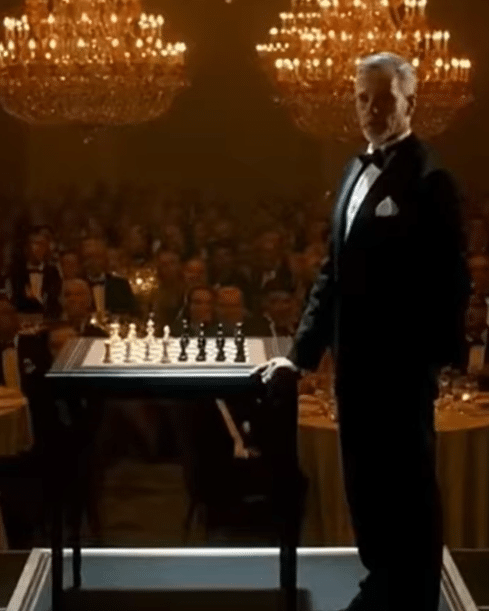
Crystal chandeliers rained light across the marble floor. Gold-trimmed columns reflected the glow of hundreds of candles set in mirrored sconces. Men in black tuxedos and women in silk evening gowns stood in neat clusters, their champagne flutes catching the light like tiny trophies. At the center of it all, on a raised platform draped in velvet, stood a chessboard crafted from ebony and ivory.
Beside it waited Adrien Vale.
Even in a room designed to impress billionaires, Adrien commanded the eye. He was tall, silver-haired, and impeccably tailored, the kind of man whose presence made other people straighten their posture without realizing it. He had spent three decades building a legend that stretched far beyond chess. He was a champion, a strategist, a speaker at elite finance summits, a consultant to investment firms that loved using words like precision and vision. To the public, he was proof that genius could be polished into luxury.
He placed one hand lightly on the edge of the board and let the room settle into silence.
“Ladies and gentlemen,” he said, his voice smooth and authoritative, “this position has only one winning move.”
A murmur rolled through the hall.
On large screens behind him, the board position appeared in perfect clarity. Some guests narrowed their eyes. Others leaned toward one another, whispering calculations. Several young prodigies invited for the event had already begun tracing variations in the air with tense fingers.
Adrien gave them all a measured smile, the kind that looked warm from a distance and cold from nearby.
“Find it,” he said, now looking straight into the cameras broadcasting the event to millions online, “and I will personally award you one hundred thousand dollars.”
That woke the room fully.
The atmosphere shifted. What had begun as a performance now became a hunt. A famous grandmaster offering a six-figure prize for a single move was the kind of spectacle that attracted everyone: elite players, content creators, wealthy patrons, banking sponsors, luxury lifestyle reporters, even executives from private health foundations hoping to attach themselves to genius and prestige.
On the screens, the board remained frozen like a riddle.
Then something unexpected disturbed the order of the room.
At first, only a few people noticed him.
He was small enough to be hidden by the crowd, but once he stepped into the open, the contrast was impossible to ignore. He was a Black boy, maybe twelve or thirteen, wearing a faded gray hoodie under a jacket that had seen better winters. His shoes were worn thin. One sleeve had been stitched by hand. His face carried the dust and strain of someone who had traveled farther than a child should have to travel alone.
The room reacted before Adrien did.
Brows lifted. Conversations stopped. One woman clutched her evening bag as though poverty itself had approached her table. A security guard near the rear straightened, waiting for a signal.
But the boy kept walking.
He did not move like someone lost. He moved like someone arriving.
By the time he reached the front row, Adrien had finally looked down from the board and seen him clearly.
Something sharp flashed in the grandmaster’s eyes, gone almost as soon as it appeared. Then his mouth curled into a thin smile.
“This,” Adrien said into the microphone, “is not a street-corner puzzle, boy.”
A few uneasy laughs echoed from the guests who were always eager to join cruelty when it came dressed in confidence.
Adrien’s gaze swept over the boy’s hoodie, his frayed cuffs, his silence.
“You do not belong at this board.”
The insult hung in the air, polished and public.
Everyone waited for the boy to flinch.
He didn’t.
The camera zoomed in, perhaps expecting tears, or anger, or embarrassment. Instead it found something more unsettling: stillness. The boy’s face did not harden, because it had already learned harder things than mockery. His eyes did not rise to Adrien’s. They remained fixed on the pieces, as though the grandmaster’s voice had become irrelevant noise.
Around him, the ballroom blurred into nothing.
There was only the board.
Only the position.
Only the truth hidden inside it.
Adrien, perhaps irritated by the lack of reaction, lifted a brow. “Well? If you have something to say, say it.”
Still, the boy said nothing.
He stepped closer.
One of the security guards moved, but Adrien raised a hand. The grandmaster was too proud to fear a child in front of an audience. He wanted the moment. He wanted to humiliate the interruption with style.
So the boy stood at the base of the platform, looked up once at the board, and then lifted a finger.
He pointed to a single square.
Nothing dramatic at first. No flourish. No speech.
Just one square.
But for those who truly understood chess, the air changed instantly.
A young international master near the stage went pale. An elderly coach from Prague inhaled so sharply his monocle nearly slipped. One of the commentators whispering from the media booth muttered, “No… no, that can’t be…”
Because the boy had not pointed to an obvious move. He had not chosen the flashy sacrifice most amateurs loved, or the tactical sequence the engines suggested three moves too late. He had pointed to something stranger, deeper—an invisible hinge in the position, the square no one had treated as real until that moment.
Adrien’s expression tightened.
“For the cameras,” he said, voice lower now, “explain yourself.”
The boy finally spoke.
“It wins because of the ghost square.”
The room went dead silent.
Not confused silence. Shocked silence.
The phrase hit the serious players first. Several of them stared at the boy as though a grave had opened beneath the ballroom floor. One woman in the second row, a chess historian from London, set down her glass so fast it cracked against the table.
Ghost square.
It was not standard terminology. It did not belong to textbooks, coaching manuals, or any modern theory database. The phrase existed only in rumor, tucked inside old interviews and unfinished forum posts about a vanished genius named Elijah Boone.
Elijah Boone had once been the only player in the world who could make Adrien Vale look ordinary.
Twenty years earlier, they had been rivals, opposites in every way. Adrien was disciplined, aristocratic, perfectly groomed. Elijah was intuitive, unpredictable, and impossible to package for wealthy sponsors. He came from nothing, spoke bluntly, dressed simply, and played with a creativity that made even masters feel like schoolchildren. Then, just as their rivalry became the most captivating story in chess, Elijah disappeared from professional life.
No final press conference. No farewell tour. No official explanation.
Only rumors.
Burnout. Debt. Illness. Betrayal.
Adrien had continued upward. Elijah had become a mystery.
Now, in the center of Adrien’s carefully staged spectacle, a boy in a worn hoodie had spoken a phrase buried with that mystery.
Adrien’s face lost color so subtly that only those closest to him noticed.
“Where did you hear that term?” he asked.
The question came out too quickly.
The boy reached into his pocket.
When he pulled out the object in his hand, the room leaned forward as one body.
It was a black knight, old and dulled by time. One corner of its base had been chipped away. It did not match the luxurious set on the platform, nor any modern collector’s set. But to those who had studied Elijah Boone, it was unmistakable.
The black knight from Boone’s personal travel set.
The only set he had used in every photographed tournament during the peak of his career.
Adrien stared at it as though staring at a fingerprint left at a crime scene.
The boy closed his fingers around the knight.
“My grandfather told me,” he said quietly, “that if you ever showed this position in public, it meant you were still hiding from the real ending.”
A ripple spread through the hall. Not chatter now, but something closer to fear.
Adrien’s grip tightened on the edge of the table.
“Who are you?” he asked, though by then he already knew the answer would ruin the evening.
The boy met his gaze for the first time.
“My name is Micah Boone.”
No one moved.
“I’m Elijah Boone’s grandson.”
The words landed harder than any shouted accusation.
Several reporters began frantically typing into their phones. One sponsor representative looked ready to faint. The livestream comments projected on a side monitor began exploding faster than the moderators could remove them.
Adrien tried to recover the room, tried to reassemble his famous composure. “Elijah Boone had no documented family,” he said. “No son. No—”
“My mother was his daughter,” Micah said. “He kept us away from your world.”
There was no tremor in the boy’s voice. That, somehow, was what made it devastating. He was not improvising. He was delivering.
Micah stepped closer to the platform.
“When my grandfather got sick, he talked about you. A lot. Not because he hated you. Because he couldn’t understand why a man who already had everything still needed to steal peace.”
A few guests exchanged startled looks.
Adrien’s jaw tightened. “Be careful.”
But Micah continued.
“He said the world thought you beat him because you were better for business. Easier to sell to luxury brands. Easier to put next to insurance firms and private banks and all the people who wanted chess to look expensive instead of true. He said that didn’t bother him as much as what happened after.”
Now Adrien looked genuinely afraid.
Not of the boy.
Of memory.
Micah lifted the chipped black knight slightly.
“He said there was one final analysis. One ending only the two of you understood. And he said you never solved it. You buried it. Then you built your legend on top of that hole.”
The ballroom felt suddenly smaller, its chandeliers harsher, its wealth cheap in the face of something older and rawer.
Adrien opened his mouth, perhaps to deny it, perhaps to order security to intervene, but a voice from the audience cut him off.
“Is the boy right?”
It came from the chess historian in London.
Then another voice: “Was this Boone’s position?”
A third: “Did you stage a puzzle you still couldn’t solve?”
The questions came faster now, from every direction.
Adrien’s empire had always depended on certainty. Sponsors invested in certainty. Audiences adored certainty. His whole brand—across books, interviews, speaking tours, lifestyle magazines, even those glossy campaigns where he explained how strategic thinking could guide wealth management and executive health—rested on the image of a man who always knew the winning move.
And there, under the chandeliers, in front of the cameras, stood a child holding the one piece of evidence that certainty had always been a performance.
Micah looked back at the board.
“The winning move isn’t the point,” he said.
No one breathed.
“The point is that you knew it existed. And instead of honoring the man who found it first, you turned his unfinished truth into your prize game.”
Adrien’s face seemed to age by ten years in a single minute.
At last, he looked at the square Micah had pointed to.
Then, slowly, like a man dragged by invisible chains, he reached toward the board and played the move.
Gasps erupted through the ballroom.
Within seconds, the strongest players present saw it all. The hidden geometry. The quiet zugzwang. The sequence that left Black helpless no matter what came next. It was brilliant, yes—but more than that, it was undeniably Boone. Elegant, paradoxical, human. The kind of move that did not merely win. It revealed character.
Adrien took a step back.
He did not look like a legend anymore. He looked like a man standing in the ruins of his own curation.
Micah did not ask for the money.
That was the final blow.
He could have claimed the hundred thousand dollars. In a room full of people who measured worth in checks and contracts, refusing the prize made him untouchable.
“I didn’t come for your money,” he said.
He slipped the chipped knight back into his pocket.
“I came so my grandfather’s ending would finally be seen.”
Then he turned and walked away.
No security guard stopped him. No guest blocked his path. The crowd parted without being asked, as if everyone understood they were witnessing the only true nobleman in the room.
Behind him, Adrien Vale remained on the platform, silent beneath the chandeliers, trapped at last by the one thing he had spent a lifetime outmaneuvering.
Not defeat.
Truth.
And in the days that followed, the story spread everywhere. Not as the tale of a grandmaster’s prize puzzle, but as the night a forgotten legacy returned wearing threadbare sleeves and exposed the cost of polished greatness. Sponsors quietly withdrew. Interviewers revisited old matches. Historians reopened Boone’s work. Foundations in Elijah’s name received donations from people who had never heard of him until that night.
As for Micah, he disappeared from the headlines almost as quickly as he had entered them.
But among serious players, a new phrase began circulating with reverence.
Not for the move itself.
For the lesson behind it.
Every board, they said, has a ghost square.
The place where truth waits, even when power pretends not to see it.