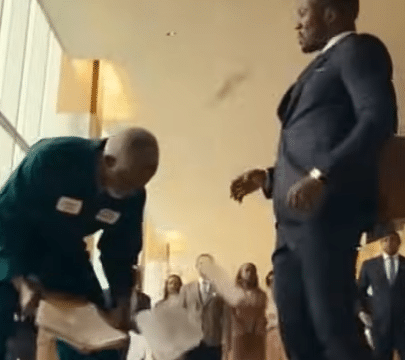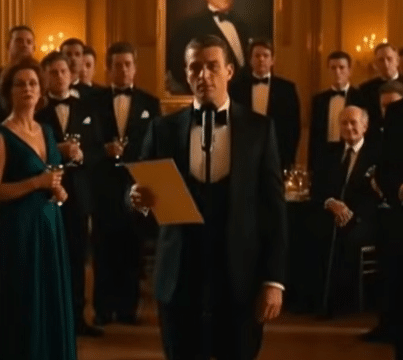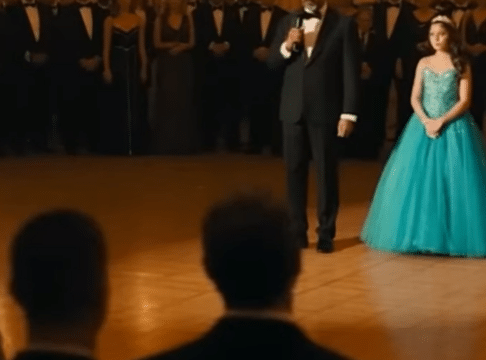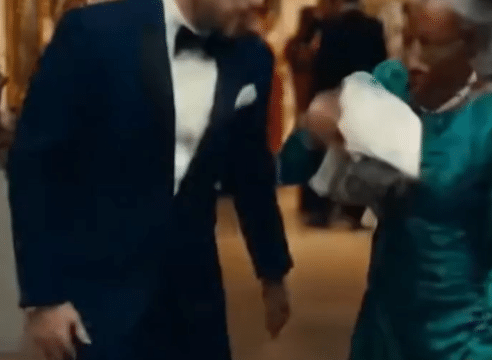
The chandelier lights shimmered like a constellation trapped inside crystal glass, casting golden reflections across the grand ballroom of the Regency Crown Hotel Ballroom. Every inch of the space whispered wealth—polished marble floors, velvet drapes, and tables adorned with fine china and delicate white roses.
Guests filled the room, dressed in tuxedos and evening gowns, their voices blending into a soft hum of polite conversation. It was the kind of event where influence mattered more than introductions, and where even silence felt expensive.
At the center of the room, however, the atmosphere was different.
A circle had formed.
And inside it stood a man who looked like he had everything—except the one thing he wanted most.
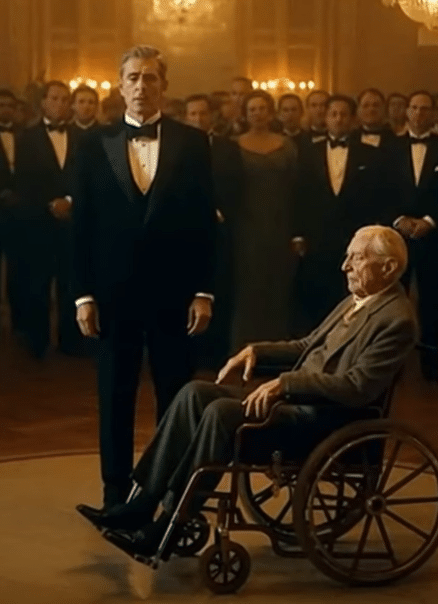
Richard Hale adjusted his tuxedo sleeve as he stood beside a wheelchair.
Seated in that chair was his father, Edward Hale—once a titan in the world of finance and banking, a man whose decisions had shaped industries and whose name had opened doors across continents. But now, his eyes wandered aimlessly, unfocused, disconnected from the world around him.
And from his own son.
Richard took a breath, steadying himself. His voice, when it came, was controlled—but it carried the weight of something deeply personal.
“My father doesn’t remember my name anymore.”
The room fell silent.
Not the polite kind of silence.
The heavy kind.
The kind that made people shift uncomfortably in their seats, unsure whether to look away or lean in closer.
Richard stepped forward slightly, his hand resting gently on the handle of the wheelchair.
There was no performance in his posture.
No ego.
Just desperation.
Close to him, someone raised a phone. Others exchanged glances. A few guests—investors, partners, long-time associates—lowered their eyes, as if witnessing something too intimate for a public stage.
Richard’s gaze lifted, scanning the crowd.
“If anyone can bring his memory back…”
He paused, just long enough for hope to slip into the silence.
“…I’ll give them one million dollars.”
A ripple moved through the room.
It wasn’t excitement.
It was disbelief.
In a world driven by money, even a promise that large carried a certain gravity. Conversations that had once been light now turned sharp, analytical.
Medical specialists whispered to each other. A woman in a silver gown murmured something about neurological trials. A man near the back shook his head, clearly skeptical.
Because everyone there understood something Richard was only now saying out loud:
Some things couldn’t be bought back.
And memory—once gone—was often one of them.
Then, something shifted.
The crowd began to part.
At first, it was subtle—a step back here, a turn of the shoulder there. But within seconds, a narrow path formed through the sea of black and gold attire.
And walking through it was someone no one expected.
A girl.
She couldn’t have been older than fourteen.
She wore a simple brown coat, slightly oversized, with sleeves that covered part of her hands. Her shoes were clean but modest. There were no designer labels, no jewelry, nothing that suggested she belonged in a room filled with elite figures and high-stakes conversations.
And yet—
She walked like she belonged everywhere.
Her posture was straight. Her pace steady. Her eyes clear.
She stopped just a few feet away from Richard and his father.
“I can make him remember.”
The words were soft.
But they landed like thunder.
Several people laughed under their breath. Others frowned. A few exchanged amused glances, already dismissing her as naive, maybe even inappropriate for the moment.
Richard turned to her slowly.
Up close, his expression revealed everything—fatigue, frustration, and a flicker of irritation.
“This is not a fairy tale, little girl.”
There was no cruelty in his tone.
Just exhaustion.
The kind that comes from trying everything—and failing.
The girl didn’t flinch.
She didn’t argue.
She simply reached into her coat pocket.
From it, she pulled out a small white handkerchief.
At first glance, it seemed ordinary.
But as she unfolded it carefully, revealing a delicate embroidered pattern in one corner, something in the room changed.
“He knows this,” she said.
She held it up—not dramatically, not like a performance, but like someone presenting a truth.
The camera of the moment—the attention of every single person—shifted instantly to the elderly man in the wheelchair.
Edward Hale had been still.
Distant.
Lost.
But now—
His eyes moved.
Not randomly.
Not vaguely.
They locked onto the handkerchief.
His fingers twitched.
A small movement.
Almost unnoticeable.
But in a room filled with people searching for miracles, it was enough to stop every heartbeat.
Richard leaned forward slightly, his brows furrowing.
“What…?”
Then it happened.
Edward’s expression changed.
It wasn’t sudden.
It was like watching a light slowly flicker back on after years of darkness.
Confusion.
Recognition.
Emotion.
His lips parted.
“Where did you get that?”
The question came out fragile—but clear.
Not a reflex.
Not a random phrase.
A real question.
Directed.
Intentional.
Alive.
The room erupted—not in noise, but in shock.
A woman gasped.
Someone dropped a glass.
Richard staggered back half a step, his composure cracking for the first time that night.
Because in that one sentence—
His father had come back.
Even if only for a moment.
Richard turned sharply toward the girl, his voice now urgent.
“Where did you get that?”
But she didn’t answer right away.
Instead, she stepped closer to Edward.
Carefully.
Gently.
Like someone approaching something sacred.
She knelt slightly, bringing herself to his level.
The handkerchief trembled slightly in her fingers—not from fear, but from the weight of the moment.
Then she placed it into his hand.
The old man’s fingers closed around it instinctively.
He stared at it as if it were a key to a door he had forgotten existed.
And maybe it was.
The girl finally spoke.
“My mother made it.”
Richard froze.
The room seemed to tilt.
Years of business instincts, negotiations, strategies—all of it failed him in that moment.
Because this—
This wasn’t business.
This was something else.
“Your mother?” he repeated quietly.
The girl nodded.
“She used to work for your family,” she said. “A long time ago.”
Edward’s grip tightened slightly around the handkerchief.
His eyes welled up—not fully, not completely—but enough to show that something deep inside him was moving, shifting, reconnecting.
“She said… you gave this to her,” the girl continued softly. “The day she left.”
Richard’s mind raced.
Fragments.
Memories.
Staff records.
Faces he hadn’t thought about in decades.
Then suddenly—
It clicked.
A young woman.
Kind.
Quiet.
Someone who had cared for his father during a difficult time, long before the wealth, the expansions, the headlines.
He had been too busy back then.
Too focused on building an empire.
He had barely noticed the people who helped hold his family together.
“She… kept it,” the girl said.
“And she told me… if he ever forgot everything…”
The girl looked at Edward, her voice steady.
“…this would help him remember who he used to be.”
Silence returned.
But this time—
It wasn’t heavy.
It was full.
Full of realization.
Full of regret.
Full of something dangerously close to redemption.
Richard’s eyes filled—not dramatically, not for show, but quietly, like a man finally understanding the cost of everything he had gained.
The one million dollars no longer mattered.
The crowd no longer mattered.
Even the event itself faded into irrelevance.
Because standing in front of him was the one person who had done what no money could:
She brought back a piece of his father.
Not through science.
Not through power.
But through something far more enduring.
Memory tied to humanity.
Connection.
Kindness that had outlived status.
The girl stood up slowly.
She didn’t ask for the money.
She didn’t look at the crowd.
She didn’t even look at Richard again.
Because she hadn’t come for any of that.
She had come to return something that was never meant to be lost.
And as she turned to walk away, the room parted once more—not out of curiosity this time, but out of respect.
Because everyone there understood something they hadn’t before:
The most valuable things in life are often the ones that never come with a price tag.