The hallway at Blackwater Naval Academy was known for its silence.
Not the peaceful kind. Not the kind that came from discipline alone.
It was the kind of silence that made people measure every step, every word, every glance. The polished floors reflected the hard white overhead lights in long, cold streaks. Steel doors lined both sides of the corridor, each marked with numbers and insignias that reminded every cadet exactly where they stood in the chain of command. At the far end, a sealed elevator sat beneath a red indicator light, reserved for senior personnel and command staff only.
Most cadets never even looked at that elevator for too long.
At 0705 hours, the corridor was already lined with trainees.
Seven or eight of them stood near the walls in pressed uniforms, pretending to review notes, adjust belts, or wait for assignment. But what they were really doing was watching.
Because in the center of that long hallway stood a scene that had already begun to turn ugly.
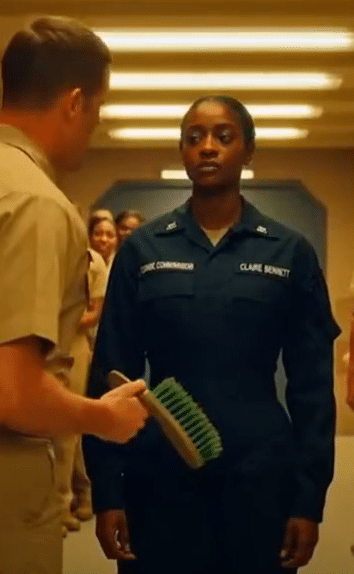
Lieutenant Aaron Cole held a floor brush loosely in one hand.
He was young for his rank, sharp-featured, broad-shouldered, and painfully aware of the authority his uniform gave him. His khaki service attire was immaculate, his boots gleaming, his posture rigid in the way ambitious men often practiced when they wanted to be seen as destined for more. Around the academy, Cole had a reputation that split cleanly down the middle. His superiors called him efficient. His peers called him arrogant. Cadets under him used a different word when he wasn’t around.
Cruel.
In front of him stood a woman in a dark blue protective work uniform, the kind worn by technical support staff during maintenance inspections or emergency drills. A stitched name patch over her chest read: CLAIRE BENNETT.
That was all most people noticed.
Not the steadiness in her eyes.
Not the way she stood.
Not the stillness in her shoulders.
She looked younger than her authority, older than her silence, and completely unimpressed by the theater happening around her.
Cole tilted his head, as though studying her for flaws.
“New girl,” he said, loud enough for the whole corridor to hear, “grab that brush.”
A few of the cadets exchanged glances immediately.
The phrase landed exactly the way he intended it to.
Dismissive.
Public.
Calculated.
He held the brush out for half a second, then let it drop to the floor between them.
The wooden handle clattered across the polished surface and spun once before stopping near her boots.
A couple of cadets snorted.
Another covered a grin with his hand.
Then the laughter spread—not bold, not explosive, but sharp and cowardly. The kind of laughter people gave when they wanted to stay close to power, even if it meant joining in on someone else’s humiliation.
Claire Bennett did not move.
She didn’t bend down.
She didn’t argue.
She didn’t even blink right away.
She simply stood at attention, chin level, hands still at her sides, her face unreadable.
That only encouraged Cole.
“You deaf too?” he asked, taking one step closer. “I said pick it up.”
The cadets along the wall were all watching now.
Some were amused.
Some were uncomfortable.
A few knew, instinctively, that something about the woman in blue did not fit the role Cole had decided she belonged in. But hierarchy has a way of silencing doubt. In places built on rank and obedience, people often trust confidence over truth.
Cole mistook Claire’s composure for weakness.
That was his first mistake.
His second was assuming that because she wore no visible rank, she had none.
He folded his arms. “You want to stand in my corridor, you work in my corridor.”
Still, Claire did not move.
She glanced once at the brush on the floor, then back at him.
Her expression was calm, but there was something behind it now—something that made one cadet near the wall quietly stop smiling. It wasn’t fear. It wasn’t anger either.
It was patience.
The kind that suggested she had seen men like him before.
And knew exactly how they ended.
Before Cole could speak again, the red light over the elevator at the far end of the corridor began to flash.
The change was immediate.
The cadets straightened.
Laughter died so fast it was as if it had never happened.
Even Cole turned toward the sound, though his expression carried more irritation than caution.
The elevator had not been scheduled for use that morning.
A low mechanical hum filled the corridor.
Then the doors slid open.
Three senior officers stepped out.
Everything about them shifted the air.
They wore formal naval dress uniforms—crisp, decorated, immaculate. The two officers in the rear moved with practiced precision, but no one could look anywhere except the man in front.
He was older, white-bearded, commanding without needing to raise his voice. His cap sat perfectly beneath the corridor lights, and rows of medals lined his chest, gleaming with the weight of decades of service. His face was stern, carved by years, but his eyes were sharp enough to cut through pretense in a single glance.
The cadets snapped to attention.
Cole did too, though a fraction too late.
The older officer stepped forward, his shoes striking the floor with quiet certainty. He looked first at the brush on the ground.
Then at Cole.
Then at the woman in blue.
And in that instant, something passed over his face that several cadets would remember for years: not confusion, not surprise, but controlled disapproval.
He walked directly past Cole.
Stopped in front of Claire Bennett.
And spoke in a voice that filled the corridor without needing volume.
“Commander Bennett, stand. This hallway answers to you.”
The words hit like a detonation.
For half a second, no one moved because no one’s body seemed capable of catching up with what had just happened.
Commander.
Not maintenance staff.
Not a new recruit.
Not a support worker.
Commander Bennett.
The woman Cole had ordered to pick up a brush in front of everyone was not beneath him.
She outranked him.
Badly.
Every cadet’s face changed at once.
The amusement vanished.
The certainty vanished.
Even the walls seemed to hold their breath.
Claire finally moved.
Not quickly. Not dramatically.
She straightened just enough for the gesture to register as formal rather than theatrical and inclined her head toward the senior officer with professional ease, as though this revelation was nothing more than an overdue correction.
“Admiral,” she said.
Her voice was low, clear, and composed.
One of the cadets near the left wall actually inhaled sharply at that. It was the first time they had heard her speak, and there was no hesitation in it, no uncertainty, no trace of someone out of place. She sounded exactly like what she was:
someone used to being obeyed.
Cole’s face drained, then flooded with color just as quickly.
He stared at Claire, then at the admiral, then back at the name patch on her chest as if the stitched letters had betrayed him personally.
“What?” he said.
It came out smaller than he meant it to.
Not a challenge.
Not even a question, really.
Just the sound of a man discovering, too late, that arrogance is not the same thing as authority.
The admiral turned his head slowly toward him.
That was all.
He didn’t shout.
He didn’t posture.
He simply looked at Cole with the kind of disappointment that made grown men wish for anger instead.
“Lieutenant,” he said, “do you normally assign janitorial tasks to command officers before confirming who they are?”
No one in the hallway dared move a muscle.
Cole opened his mouth, but nothing useful arrived. “Sir, I—I believed—”
“Yes,” the admiral said, cutting him off. “You believed. That appears to be the problem.”
The words were crisp, devastating, and impossible to escape.
Claire remained still beside them, one hand resting lightly near the seam of her uniform trousers. She wasn’t enjoying his humiliation in an obvious way. That made it worse. She didn’t need to.
His own behavior was humiliating him thoroughly enough.
The admiral glanced toward the cadets lined along the walls. “And the rest of you?”
Several eyes dropped instantly.
One cadet swallowed so hard it was visible.
“You laughed,” the admiral said. “Not because you understood the situation. Not because you had facts. But because someone with temporary authority pointed at a target, and you followed.”
The silence became suffocating.
Military institutions teach order, discipline, and respect. But they also expose character very quickly. The weak often mistake rank for permission. The insecure often mistake mockery for strength. And groups, especially young ones, can become cruel simply by wanting to belong to the winning side.
This morning, the winning side had changed.
The admiral turned back to Claire. “Commander Bennett arrived early for the operational oversight review.” He let that sit for a moment, making sure every person in the corridor understood the full weight of it. “As of 0700, she assumed direct authority over logistics readiness, trainee conduct review, and corridor command procedures in this wing.”
A cadet near the far wall closed his eyes for one brief, painful second.
That meant there could not have been a worse possible person to mock.
Cole looked as if the floor beneath him had become unstable. “Sir, I was not informed—”
“Then you ask,” the admiral replied.
Again, simple. Again, fatal.
Because that was the truth beneath the entire scene.
Cole had not asked who she was.
He had not asked why she was there.
He had not asked whether the uniform she wore served a function beyond his assumptions.
He had seen a Black woman in a dark blue work suit, standing alone in a military corridor, and decided the role for her before she ever spoke.
He had filled in the blanks with bias, ego, and the confidence of a man who had not yet paid for either.
Claire turned her head slightly, finally looking at him directly.
The corridor seemed to narrow around that moment.
Her eyes were steady. Sharp. Unshaken.
There was no rage in her expression. No dramatic triumph. Only a quiet certainty that made his panic look even smaller.
“I was waiting to see how long it would take,” she said.
Cole blinked. “Ma’am?”
“How long,” she repeated, “before someone in this hallway chose professionalism over performance.”
No one wanted to be breathing when she said that, yet everyone was.
Every cadet along the wall understood she wasn’t just talking to Cole.
She meant all of them.
The admiral clasped his hands behind his back. “Commander Bennett has spent the last eight months evaluating command culture across multiple training sites. The academy requested an unannounced integrity assessment.”
Now several cadets looked physically ill.
An integrity assessment.
This hadn’t been an accident.
Claire hadn’t stumbled into the wrong hallway.
She had entered it intentionally, in a stripped-down operational uniform, without visible rank on display, to see what people did when they believed no one important was watching.
And they had failed.
Spectacularly.
Cole’s lips parted, but nothing came.
The cadets who had laughed now looked at the floor as if it had personally betrayed them.
Claire bent down at last.
For one awful second, Cole looked relieved, as though she might actually pick up the brush and erase the scene through some act of grace.
Instead, she lifted it by two fingers, turned, and handed it to him.
“Since you introduced it,” she said calmly, “you can return it to storage.”
A few cadets almost reacted, then caught themselves. Not because the line was cruel, but because it was precise. Controlled. Earned.
The admiral’s beard shifted slightly with what might have been the faintest sign of approval.
Cole took the brush with a hand that no longer looked steady.
Claire stepped past him, and the entire hallway instinctively opened for her.
That was the real reversal.
Not the embarrassment.
Not the revelation.
Not even the rank.
It was the way the corridor itself seemed to reorient around her presence, as though authority had finally entered the room and every false version of it had nowhere left to stand.
As she walked forward, the two officers behind the admiral turned with disciplined timing and fell into place. She was no longer the silent woman in the blue work suit at the center of someone else’s joke.
She was Commander Claire Bennett.
And now everyone could see it.
Halfway down the hall, she paused.
Not for long.
Just enough to angle her face slightly, the overhead light catching the edge of her profile.
Then she smiled.
It was small.
Confident.
Not gloating, not theatrical, not cruel.
Just the smile of someone who had watched the truth arrive exactly on time.
The kind of smile that said she had never needed to prove who she was.
Only patience had been required.
Behind her, Lieutenant Aaron Cole stood frozen in the middle of the corridor, brush in hand, his entire self-image collapsing under the weight of a lesson he would not forget.
Respect, he had just learned, was not something you wore like polished boots and a pressed uniform.
It was something you either practiced when no one important seemed to be watching—
or exposed yourself for lacking when the right person finally was.
And that was why the moment spread across the academy faster than any official memo.
Because by lunchtime, nobody was talking about the brush.
They were talking about the hallway.
The hallway where a man tried to make someone feel small.
And discovered he had been standing in the presence of real command all along.