The marina was the kind of place that seemed designed to remind people where they stood.
Sunlight flashed across the water in sharp silver streaks. Luxury yachts bobbed gently against polished wooden docks, their hulls gleaming like floating mansions. Crew members in crisp uniforms moved with quiet efficiency. Wealthy guests in linen, sunglasses, and designer shoes stepped from vessel to vessel with the effortless entitlement of people who never expected to be questioned.
At Pier Seven, however, the mood had changed.
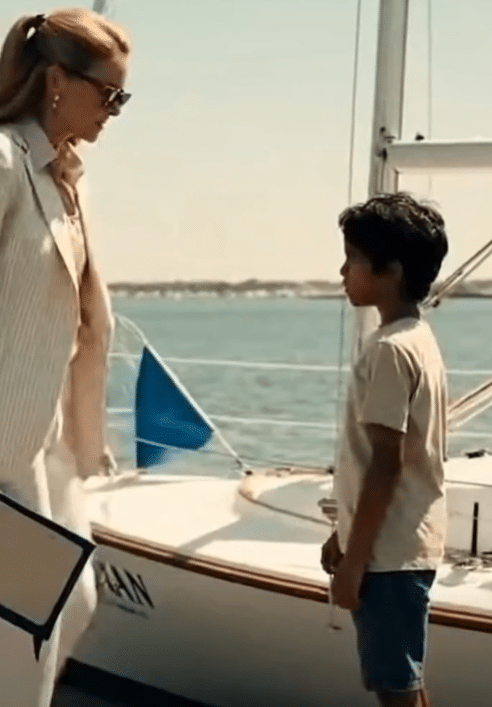
A hush had fallen over the dock around the Black Swan, a handcrafted wooden yacht so famous along the coast that people often slowed their walk just to admire it. Its polished teak railings glowed under the afternoon sun. Brass fixtures shone like gold. The name on the stern carried a reputation all its own. The Black Swan wasn’t just expensive. It was storied. Old money, old craftsmanship, old power.
And on the planks beside its bow, a boy had just hit the ground.
He couldn’t have been older than eleven.
He wore a short-sleeved blue shirt, khaki shorts, and sneakers that had clearly seen better days. One palm pressed against the dock as he tried to push himself up, his face tight with shock more than pain. He had not been running. He had not been rough. He had only reached out, with the kind of quiet wonder children sometimes have around beautiful things, and let his fingers brush the polished wood of the yacht’s side.
That was all it took.
Standing above him was a woman in a white suit so immaculate it looked almost hostile against the salt air. Her black sunglasses hid half her face, but nothing could hide the contempt in her posture. She leaned forward, one manicured finger pointed down at him like an accusation.
“Don’t put your filthy hands on that boat.”
Her voice sliced across the marina hard enough to turn heads from two docks away.
A few people stopped walking.
Others were already watching.
Behind her stood a small cluster of onlookers: a man in a dark blue windbreaker, a young girl in a life vest, two deckhands near a utility cart, and several guests who had clearly been drawn in by the sharpness of the scene. Their expressions varied—uneasy, surprised, embarrassed on the boy’s behalf—but none of them stepped in.
That was the quiet cruelty of public humiliation.
It often survives on witnesses who tell themselves they are only observing.
The boy rose slowly to his feet.
He didn’t answer.
He didn’t cry.
He just stood there, shoulders tense, eyes lowered for a second as if trying to understand what he had done wrong.
The woman in white mistook his silence for permission to go further.
Her lips pressed into a tight, superior line. Even without seeing her eyes, everyone on the dock could feel the disgust radiating off her.
“Boys like you belong on the dock,” she said, each word sharpened by class contempt, “not at the helm.”
That landed even harder than the first insult.
Because it wasn’t just about the boat.
It was about place.
About telling a child that some worlds were built for admiration from a distance, never for belonging. That beauty, wealth, and power were things he could look at, maybe clean around, maybe dream about—but never touch, never claim, never command.
The boy finally looked up.
There was no anger in his face.
Just something worse.
The beginning of shame.
Around him, the adults shifted awkwardly. The man in the windbreaker opened his mouth, then closed it again. A woman farther down the pier adjusted her bag and looked away. The little girl in the life vest frowned openly, confused by the meanness of it all.
The woman in white straightened, satisfied with the damage she had done.
For one beat, the marina went quiet except for gulls overhead and the soft slap of water against the pilings.
The boy turned away from her and faced the harbor.
His small back filled the frame of the moment—straight but lonely, a child standing before a row of boats that suddenly felt much farther away than they had a minute earlier.
That was when another pair of heels clicked across the dock.
Not rushed.
Not loud.
Just precise.
A woman in a navy blazer with gold buttons stepped into view from the gangway of the Black Swan. She moved with the self-possession of someone who didn’t need to announce authority because authority had long ago settled into her posture. Her dark hair was pinned neatly back. A captain’s folder was tucked under one arm. One glance at her and the nearest deckhands straightened instinctively.
She took in the entire scene in seconds: the boy, the woman in white, the watching crowd, the tension hanging over the dock like a storm that had not yet decided whether to break.
Then she did something no one expected.
Instead of addressing the adults first, she walked directly to the boy.
And when she reached him, she bent down to his eye level.
Not as a gesture. Not for drama.
Out of respect.
The difference was immediate and devastating.
Where the woman in white had leaned over him to make him feel smaller, this woman lowered herself so he would not have to look up in fear.
Her voice, when it came, was calm, formal, and clear enough for everyone to hear.
“Young Mister Navarro,” she said, “take the helm.”
Silence.
Complete silence.
The boy blinked.
At first, it looked as though he wasn’t sure he had heard correctly.
Neither was anyone else.
The woman in white turned so sharply that even her sunglasses slipped slightly down the bridge of her nose.
The marina itself seemed to pause.
The woman in the navy blazer rose back to her full height and faced the group with measured certainty. She rested one hand lightly on the rail of the yacht behind her.
“Black Swan is yours,” she said. “Your father named you skipper. You sail her today.”
This time, there was no room for misunderstanding.
A visible shock moved through the people on the dock.
The deckhands looked at each other.
The man in the windbreaker actually took a step back.
The little girl in the life vest stared at the boy with open-mouthed amazement.
And the boy—still trying to absorb it—looked from the woman in navy to the yacht and back again, his expression caught between innocence and disbelief.
“Mine?” he asked quietly.
The woman’s face softened.
“Yes, sir.”
That single word hit harder than a speech ever could.
Not kid.
Not son.
Not sweetheart.
Sir.
The respect in it rearranged the whole scene.
Suddenly, the blue shirt and worn sneakers no longer read as insignificance. They read as what they really were: the clothes of a child. Nothing more, nothing less. All the ugly assumptions that had been projected onto him by the woman in white now stood exposed for what they were—arrogance, prejudice, and the smug confidence of someone certain she could judge another human being on sight.
The woman in navy continued, still addressing the dock.
“Your father left standing instruction with the harbor office, the legal team, and this crew. On his son’s first visit after probate clearance, command of the vessel passes to him for the ceremonial sail.”
Now even the people who had only half been listening were fully locked in.
Probate.
Legal team.
Command of the vessel.
This was no sentimental performance. No symbolic little moment meant to entertain a child. This was formal. Documented. Real.
The Black Swan belonged to the boy.
The same boy who, less than a minute ago, had been lying on the dock while a stranger told him he was too low to touch it.
A strange, painful understanding began to settle over the witnesses. They had not just watched a child get insulted.
They had watched the owner of the yacht get insulted.
And worse, they had watched it happen without stopping it.
The woman in white finally found her voice.
“How…” she said.
It was barely a word. More like the remains of one.
Her mouth had fallen open. The sunglasses no longer helped. Behind them, her eyes were wide with the kind of shock that strips a person of every practiced expression. The sharpness, the confidence, the sneering control—gone. In their place was the naked panic of someone realizing that the story she had invented about another person had collapsed instantly and publicly.
The woman in navy looked at her only briefly.
Long enough to make it clear she had been assessed and found unimportant.
Then she turned back to the boy.
“If you’re ready, Mister Navarro, the crew is ready for you.”
The boy looked again at the yacht, this time not with distant wonder but with something deeper, more fragile, more powerful.
Belonging.
His father had died eight months earlier. Everyone at the marina knew some version of that story. What most people didn’t know was that the elder Navarro, a shipping magnate who had built his fortune from coastal freight, had been fiercely private about his son. The boy had been kept far from cameras, from gossip columns, from the kinds of people who treated inheritance like entertainment. There had been rumors, of course: about trusts, vessels, properties, legacy holdings. But rumors tend to circle wealth without ever understanding it.
The truth was much simpler.
His father had loved him.
And somewhere in the last legal pages of a life too short, he had decided that his son would not first meet his inheritance through a boardroom or a press release.
He would meet it on the water.
At the helm.
The boy stepped toward the gangway.
Then paused.
Not because he was afraid of the yacht.
Because he was still carrying the sting of what had just happened.
He turned slightly, not all the way, just enough to glance toward the woman in white. She stood frozen beside the bow, still unable to rebuild herself from the humiliation of being wrong at the worst possible level.
He could have said something.
A child in his place might have.
An adult probably would have.
But he didn’t.
That was the final reversal.
He didn’t need revenge to prove anything.
The truth had already done it for him.
The woman in navy offered him her hand, not to pull him, but to guide him onto the gangway with ceremony. He accepted, and together they stepped toward the Black Swan as the crew shifted into formal readiness.
One deckhand lowered the boarding line.
Another stood by the polished wheel.
A third removed the protective helm cover as if unveiling a crown.
The watching crowd parted naturally now, not around the woman in white, but around the boy.
For the first time all afternoon, people were careful where they stood.
Respect had arrived too late to be noble, but it had arrived.
As he reached the deck, the boy turned back once more toward the harbor, the sunlight catching the side of his face. He looked younger from that angle. Smaller. But also steadier, as though something essential had just settled into place inside him.
Not power.
Not pride.
Identity.
Below him, on the dock, the woman in white remained rooted where she stood, her silence now heavier than all her insults had been. She had wanted to make him feel that he belonged only on the dock, far from the wheel, far from command.
Instead, in front of everyone, she had learned that the dock had only ever been the threshold.
The helm had always been his.
And as the Black Swan’s crew prepared for departure, the marina understood the lesson all at once:
the easiest way to expose your own smallness is to decide someone else’s worth before you know their name.