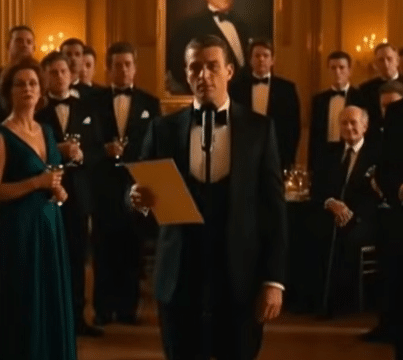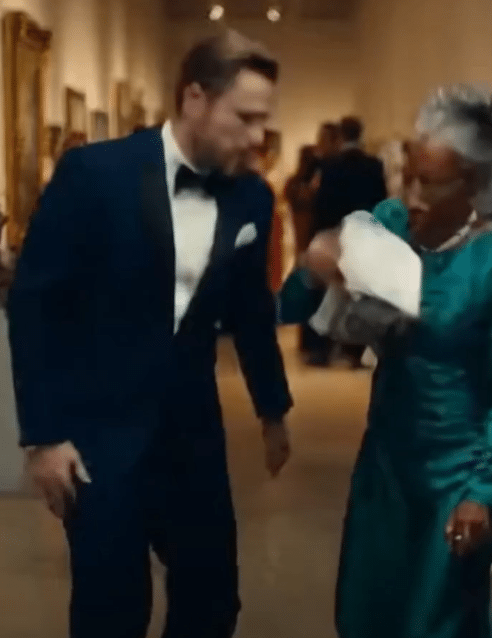
The Grand Palais d’Or was a building designed to intimidate quietly.
Its ceilings rose high enough to make every voice seem smaller. Chandeliers poured honey-colored light across polished marble floors. Along the gallery walls, priceless modern paintings glowed beneath careful spotlights, each piece framed with the kind of reverence usually reserved for royalty. Waiters in white gloves drifted through the room carrying champagne on silver trays. Guests in tuxedos, silk gowns, diamonds, and tailored velvet spoke in the low polished tones of people who believed they belonged everywhere worth being seen.
Tonight’s event was supposed to be a triumph.
Collectors, curators, investors, and social elites had gathered for a private unveiling of a new art collection rumored to be one of the most important cultural acquisitions of the year. Invitations had been impossible to get. Cameras from select magazines waited near the entrance. Critics circled the room with measured smiles. Every conversation floated around the same questions: Who funded the acquisition? Who had made such an enormous donation? And why had the benefactor chosen to remain anonymous until the end of the evening?
No one knew.
That mystery had become the center of the gala.
And in a room obsessed with names, there was nothing more powerful than a hidden one.
Julian Cross loved rooms like this.
At twenty-nine, he had already mastered the art of looking important. His black tuxedo fit perfectly, his cufflinks caught the light at just the right angle, and he moved with the dangerous confidence of someone who had been praised too often for being charming and never corrected enough for being cruel. He wasn’t the host, and he certainly wasn’t the reason anyone important had come, but he carried himself as if the event were an extension of his own status.
He worked in acquisitions for a prestigious European gallery group and had recently begun to attract attention in cultural circles. Ambitious, polished, and hungry, Julian had one particular talent: he could identify power quickly.
Or at least, he believed he could.
That belief lasted until 8:14 p.m.
The quartet near the staircase had just finished a soft arrangement of Debussy when Julian turned too sharply near the center of the hall. His shoulder clipped someone beside him.
There was a light impact.
A rustle of fabric.
And then a single sheet of paper fluttered from an older woman’s hand and landed on the marble floor.
The music did not stop, but something in the nearby air did.
The woman he had bumped was Black, perhaps in her late sixties, wearing a simple gray coat over an elegant but understated dress. There were no diamonds at her neck, no dramatic designer label visible, no entourage hovering behind her. She looked composed, self-contained, and entirely unimpressed by the room’s performance of wealth. Her silver-streaked hair was pinned neatly back. Her posture was straight. In one gloved hand she still held a folded evening program. The page at her feet had slipped from the papers she carried.
Julian looked down at the fallen sheet.
Then at her.
And in that instant, he made the kind of mistake arrogant people make when they confuse simplicity with insignificance.
“Watch your step, old lady,” he snapped.
The words were loud enough to cut through at least three nearby conversations.
The older woman did not move.
Julian’s face hardened. He glanced around, aware now that people were watching, and instead of stepping back, apologizing, or even helping her retrieve the paper, he did what insecure men often do when embarrassment brushes past them in public:
he attacked first.
“You’re blocking the VIP area,” he said, his voice rising. “Security, get this vagrant out of here before she dirties the art.”
The sentence landed like broken glass.
A woman in a fitted black gown near the sculpture display turned abruptly, her lips parting in shock. A man in round glasses near the champagne station stared over the rim of his drink, visibly stunned. Several guests looked away instinctively, the way people do when they know they are witnessing something ugly but are not yet sure whether courage will cost them socially.
The old woman remained still.
No outrage.
No trembling.
No flustered apology.
She simply looked at Julian with a calm, level gaze that seemed almost detached from the humiliation he was trying to inflict. It was not the expression of someone wounded by cruelty. It was the expression of someone measuring it.
That unsettled him more than tears would have.
He had expected panic, defensiveness, maybe shame.
Instead, he was being observed.
Two security attendants near the entrance shifted awkwardly but did not move. They had heard him. Everyone had. But they hesitated, caught between the assumptions his confidence created and the discomfort his words had caused.
Julian took that hesitation as permission to continue.
“You heard me,” he said, gesturing impatiently. “This is a private collection preview, not a shelter.”
A small silence rippled outward.
Across the room, conversations thinned and died. The quartet stopped mid-transition. Even the waiters seemed to slow their steps.
The older woman bent slightly, picked up the paper from the floor herself, smoothed it once with her fingers, and looked back at Julian.
Still no fear.
Still no anger.
Only composure.
That should have warned him.
But cruelty, once performed publicly, often traps the performer inside it. To retreat would have required humility. Julian had none to spare.
Then a voice rose from behind him.
“Madame Dubois.”
It was warm, formal, and heavy with unmistakable respect.
Julian turned.
An older man with a trim gray beard was approaching from the rear of the gallery. He wore a rich burgundy velvet jacket that set him apart immediately from the sea of black tuxedos around him. His age had not softened his authority; it had refined it. He was André Beaumont, chairman of the Beaumont Foundation and the public face of tonight’s gala. People had spent the evening trying to get within ten feet of him. Now he was walking past everyone else as though the crowd no longer existed.
Toward her.
When he reached the woman in gray, he inclined his head with genuine deference.
“Madame Dubois,” he repeated, louder this time, ensuring the room could hear every syllable. “The anonymous donor of tonight’s entire collection.”
No one breathed.
Julian’s face emptied.
There are revelations that unfold slowly, and there are revelations that detonate. This one detonated.
Around them, guests stiffened visibly. The woman in black brought one hand to her chest. The man with glasses lowered his drink so fast he nearly spilled it. Across the gallery, curators and trustees who had only moments earlier dismissed the older woman as background now stared with open disbelief.
Madame Dubois.
The name moved through the room like an electric current.
Not a vagrant.
Not an intruder.
Not someone who had wandered into the wrong place.
She was the benefactor. The hidden patron. The person whose fortune, taste, and generosity had made the entire evening possible.
The art on the walls.
The collection everyone had flown in to admire.
The gala itself.
It all existed because of her.
And Julian had just ordered security to throw her out.
Beaumont extended one hand toward the paintings in the hall as if reintroducing the entire room to itself.
“We are honored,” he said.
His tone was not theatrical. That made it more powerful. He was not rescuing Madame Dubois with drama. He was simply stating the truth, and the truth was devastating enough.
Julian’s mouth opened.
No sound came out at first.
Then, from somewhere deep inside the collapse of his confidence, a broken stammer emerged.
“T… t… t…”
He looked younger suddenly. Smaller. Not physically, but socially, emotionally, structurally. The expensive tuxedo, the polished hair, the practiced smirk—none of it could hold shape against what had just happened. Arrogance depends on the illusion of superior knowledge. The moment that illusion breaks, the person beneath it is often much less impressive than anyone imagined.
Madame Dubois turned her head toward him.
The whole room seemed to lean into that movement.
She did not smile.
She did not humiliate him back.
She simply regarded him with the same measured calm she had shown from the start, and in that restraint there was a force greater than anger.
“Young man,” she said, her voice smooth and low, marked by the soft elegance of old French schooling, “the surest sign of poverty is not a lack of money.”
Julian froze.
A few guests lowered their eyes instantly, as though even hearing the sentence felt too intimate, too exposing.
Madame Dubois continued.
“It is a lack of character.”
The words were quiet.
But they landed harder than a shout ever could.
Beaumont said nothing. He did not need to. The room itself had become the judgment.
Julian looked around as if searching for somewhere to place his embarrassment, but there was nowhere. Every face that had once rewarded his confidence now reflected some variation of the same thing: discomfort, pity, condemnation, relief that they were not him.
The woman in black who had turned earlier was now openly staring with disgust. The man in glasses adjusted his posture and took one deliberate step away from Julian, a small movement that somehow felt like a public severing. Two younger gallery associates near the west wall suddenly became fascinated by a painting they had ignored all night, unwilling to be seen too close to him.
That was the speed of social gravity in elite rooms.
It could elevate you for the performance of power.
And destroy you for misunderstanding where the real power sat.
Beaumont gently took the paper from Madame Dubois’s hand. It was not just any paper. As several people closer to them now noticed, it was a marked provenance sheet—notations, dates, annotations in the margin, corrections written in elegant pen. She had not been wandering aimlessly through the hall. She had been reviewing the display with the practiced eye of someone who knew every piece intimately.
Of course she had.
She had chosen them.
Financed them.
Gifted them.
She knew these paintings better than the curators pretending expertise beside them.
“Would you like me to escort you to the podium, Madame?” Beaumont asked.
“In a moment,” she said.
Her eyes moved once more to Julian, and he seemed to shrink under nothing more than her attention.
“You told security to remove me before I dirtied the art,” she said. “And yet, it was your voice that stained the room.”
No one moved.
No one dared interrupt.
Julian swallowed hard. “Madame, I—I didn’t know—”
“No,” she said gently. “You did not ask.”
Again, the sentence was soft.
Again, it was fatal.
Because that was the truth underneath the whole scene. He had not asked who she was. He had not apologized for the collision. He had not offered help when her paper fell. He had looked at age, skin, clothing, and quietness, then built an accusation out of prejudice and entitlement.
He had mistaken his own assumptions for discernment.
And now the room could see it clearly.
Madame Dubois turned away from him, which somehow felt harsher than any public dressing-down. Dismissal, when delivered by someone truly important, is often the most complete form of judgment.
Beaumont offered her his arm. She accepted, and together they began walking toward the front of the gallery.
This time the crowd parted not because a spectacle was unfolding, but because respect finally had a direction.
People who had ignored her now stepped back carefully.
Those who had watched in silence lowered their eyes.
A few even looked ashamed.
Julian remained where he was, rooted to the marble as though movement itself had become impossible. He could hear whispers beginning behind him. Not loud enough to quote, but sharp enough to understand.
“Was that really her?”
“He called her a vagrant…”
“My God.”
“He’s finished.”
And perhaps he was.
Not because anyone shouted at him.
Not because security dragged him out.
But because in worlds built on reputation, some mistakes echo farther than punishment ever can. By midnight, every trustee, collector, curator, and journalist in that room would know exactly what he had done. By breakfast, his name would travel quietly through circles that never needed scandal to ruin a career. Invitations would slow. Opportunities would evaporate. People who once praised his instincts would begin describing him with a different set of words: volatile, immature, a liability.
All without anyone needing to say it formally.
At the podium, Beaumont introduced Madame Dubois properly. The applause began hesitantly, then grew into a standing ovation that rolled through the gallery like a wave. Yet even as the room honored her, she did not bask in it. She stood with calm grace, thanked the museum, spoke briefly about beauty, stewardship, and responsibility, and then said something many people would remember far longer than the revelation itself.
“Art,” she said, “is meant to enlarge the human spirit. If it makes us feel superior instead of more humane, then we have misunderstood not only the art, but ourselves.”
The line settled over the room with the weight of truth.
Julian did not stay for the rest of the speech.
He slipped out quietly through the side of the hall, not because anyone ordered him to leave, but because he could no longer survive the room he had tried to dominate. The irony was complete. He had called for someone else to be removed, and in the end, he was the one who no longer belonged.
As for Madame Dubois, people would later call her response elegant, merciful, devastating, unforgettable. They would repeat her words at dinners, in boardrooms, in interviews about philanthropy and power. Some would admire her restraint. Others would say Julian deserved worse.
But those who understood the moment best knew this:
she had given him exactly what karma required.
Not humiliation.
Recognition.
Recognition of who she was.
Recognition of who he had shown himself to be.
And in a room full of art, that was the cruelest portrait of all.