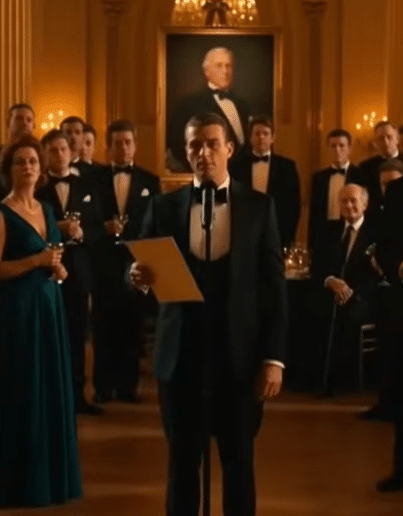
The ballroom of Ashbourne Manor had been built to make power look eternal.
Crystal chandeliers poured light over polished marble floors. Oil portraits of dead patriarchs watched from the walls with stern, painted eyes. Gold-trimmed columns rose toward a ceiling painted in clouds and cherubs, as if the family had once believed even heaven should resemble their dining room. Along the edges of the vast hall, guests in tuxedos, silk gowns, and heirloom diamonds stood with champagne flutes suspended in their hands, waiting for the moment that would decide the future of one of the wealthiest family empires in Europe.
At the far end of the room hung the newest portrait.
Edmund Ashbourne.
Silver-haired. Sharp-eyed. One hand resting on the head of a carved cane, the other on a mahogany desk. Even in paint, he looked like a man who had spent a lifetime making difficult people feel very small.
And tonight, only three days after his burial, his son Jonathan intended to inherit everything.
He stood beneath the portrait in a black tuxedo cut to perfection, one hand holding a folded legal document, the other resting lightly beside the microphone stand. He wore grief well—at least on the surface. His jaw was solemn, his expression measured, his voice prepared. But beneath the polished sorrow was something else, something a little too sharp to be mourning.
Triumph.
The guests could feel it.
Lawyers stood near the stage with neutral faces. Board members lined the front row. Distant cousins, social climbers, old investors, and family friends clustered in careful silence, all pretending this was a dignified transition rather than a public test of who had truly won Edmund Ashbourne’s final game.
Jonathan unfolded the paper and lifted his chin.
“My father left me everything,” he declared.
His voice carried cleanly through the room, steady and confident, meant to leave no room for hesitation. A few guests exchanged quick glances, but no one interrupted.
Jonathan let the silence breathe for one second, then drove the point deeper.
“If anyone disagrees,” he said, his eyes scanning the crowd with the cool challenge of a man already certain of victory, “say it now.”
There it was.
Not grief.
Not ceremony.
A dare.
The kind only a man protected by money, name, and presumption would issue in public.
No one spoke.
At first.
A woman in emerald satin looked down into her drink. One elderly board member adjusted his cuffs, avoiding eye contact. Two cousins near the rear of the hall seemed to lean toward one another, then think better of it. The family attorney, stationed beside a table of legal folders, remained expressionless, though his stillness looked strained.
Jonathan noticed all of it and mistook caution for surrender.
Of course he did.
He had spent his life being the son who stood nearest the throne. The one photographed beside his father at ribbon cuttings, charity auctions, annual reports, and yacht christenings. He had learned early that proximity can resemble worth, especially in families that treat affection like a business asset. While others worked for approval, Jonathan performed inheritance. He mastered the smile, the handshake, the public loyalty. He had been so visibly present in Edmund’s later years that most outsiders assumed the old man’s empire had already passed to him in all but paperwork.
That assumption was exactly what Jonathan was counting on tonight.
Then a voice rose from the back of the room.
“That wasn’t the last thing he wrote.”
The words were not shouted.
They did not need to be.
Something in the clarity of them cut through the ballroom more sharply than any raised voice could have. Heads turned. Conversations died before they could begin.
From the far end of the crowd, a young Black woman in a maid’s uniform stepped forward.
Her dress was dark blue, plain and immaculate, with a white collar and white cuffs crisp against the fabric. In another room, at another hour, most of the people present would have looked straight through her without ever registering her face. Tonight, as she walked through parted silk and black wool, every eye in Ashbourne Manor followed her.
She did not hurry.
She did not bow her head.
She walked with the calm certainty of someone carrying something heavier than fear.
Jonathan turned toward her, and the change in his face was almost imperceptible—first annoyance, then disbelief, then the thin edge of contempt he had not bothered to hide from people he considered beneath him.
It was Clara Bennett.
Most guests knew her only vaguely. She had worked in the manor for four years, first in housekeeping, later as Edmund’s late-night attendant when his health began to decline. She was the one who brought tea no one thanked her for, collected glasses after arguments, and moved silently through rooms built for people who assumed silence meant invisibility.
Jonathan’s lips tightened.
He recognized her immediately, and whatever faint amusement he might have felt at a servant speaking out lasted less than a second. Because Clara’s gaze did not waver.
“You don’t belong in this room,” Jonathan said coldly, before she had even reached the front.
There was a murmur around them. The line had come too quickly, too automatically. It sounded practiced, as if Jonathan had spent years sorting human beings into categories with the ease of separating cutlery.
Clara stopped several feet from the stage.
“No,” she said, her voice level. “That’s what you hoped everyone would believe.”
The ballroom seemed to tighten around the words.
Jonathan’s fingers curled around the paper in his hand. “This is a legal family proceeding.”
“And your father knew exactly what kind of proceeding it would become,” Clara replied.
She slipped one hand into the hidden pocket of her apron.
For the first time, genuine tension flashed across Jonathan’s face.
It vanished quickly, but not before the nearest guests saw it.
Clara drew out a small rolled piece of paper tied with a fading navy ribbon.
Nothing ornate.
Nothing dramatic.
And yet the room reacted to it as though she had lifted a lit match over spilled gasoline.
Jonathan descended one step from the dais.
“What is that?” he demanded.
Clara looked not at him, but at the portrait of Edmund Ashbourne hanging over the ballroom.
“He wrote one more line after everyone left,” she said.
No one moved.
The older board member near the front straightened slowly, as though some half-buried suspicion had just risen to the surface.
Clara held the rolled paper carefully in both hands.
“He signed it with a shaking hand.”
A silence fell so complete that even the clink of glass from the distant bar stopped.
Jonathan laughed then—but badly.
It came out thin, forced, too quick.
“This is absurd. A maid appears in the middle of a formal reading with some scrap of paper and suddenly we’re all meant to abandon legal process?”
His voice grew stronger as he spoke, as though volume might repair the crack already forming beneath him.
The family attorney finally stepped forward. “Jonathan…”
But Jonathan cut him off.
“No. Enough.” He pointed at Clara. “She was staff. She brought trays and changed linens. She was not a witness to estate law.”
Clara met his anger without flinching.
“I was there the night he stopped trusting you.”
The sentence struck harder than any accusation could have.
A woman near the front gasped softly. One of Jonathan’s cousins closed his eyes for a brief second, like a man who had feared this exact moment and hated seeing it confirmed.
Jonathan’s face hardened. “Careful.”
“No,” Clara said. “He was.”
She turned now toward the guests, the board, the attorneys, and all the people who had spent years orbiting Edmund Ashbourne’s wealth without ever understanding the lonely machinery of the man himself.
“Three nights before he died,” she said, “Mr. Ashbourne asked everyone to leave his study. His lawyers had gone. His son had gone. The nurse had gone. He asked only for water, his pen, and the blue leather ledger he kept locked in the left drawer of his desk.”
The family attorney went pale.
He knew the ledger.
Several others clearly did too.
Jonathan stepped down another stair. “This is fiction.”
Clara ignored him.
“He was struggling to write. His hands were weak. I asked if he wanted me to call someone. He said no. He said, ‘They’ve all heard what they wanted. Now I need to leave what I mean.’”
That line moved through the room like a chill.
Because it sounded like Edmund.
Cruel, precise, and impossible to forget.
Clara untied the ribbon.
Inside was not a full will. Not a new document replacing everything. It was a handwritten codicil—a final amendment, brief but devastating if valid. The paper trembled slightly in her hands, not because she was afraid, but because everyone else suddenly was.
The attorney approached carefully. “May I see it?”
Clara hesitated only long enough to make clear that she was not surrendering it to Jonathan.
Then she handed it to the attorney.
He opened it.
Read the first line.
And all the blood drained from his face.
The guests felt the answer before he spoke.
Jonathan saw it too.
“What does it say?” he snapped.
The attorney looked up, swallowing hard. “It states that the principal inheritance and controlling interest in Ashbourne Holdings are not to pass to Jonathan Ashbourne.”
A collective inhale swept the room.
Jonathan’s expression did not collapse all at once. First came disbelief, then fury, then the first unmistakable flicker of fear.
“That’s impossible.”
The attorney continued, because at that point there was no graceful way to stop.
“It further states that his son has mistaken visibility for worth, obedience for loyalty, and ambition for character.”
Now the room was no longer silent because it was shocked.
It was silent because it was witnessing the dead speak.
And Edmund Ashbourne, even from beyond the grave, had chosen his words like knives.
Jonathan took another step down. “That paper is fraudulent.”
But the confidence was gone. His voice was louder now, yet weaker underneath.
The attorney read on.
“In the event of my death, controlling interest shall pass to the only person in this house who served me without asking what she might gain in return.”
There was a pause.
A terrible, electric pause.
Then the attorney looked at Clara.
“Clara Bennett.”
It was as if the entire ballroom forgot how to breathe.
Jonathan stared at her.
Not at the paper.
Not at the lawyer.
At her.
The maid in the blue dress and white collar who had poured tea while board members ignored her. The woman who had stood by the wall during holidays, who had opened doors and closed them, who had heard more truth from the shadows than any shareholder ever had from the head of the table.
Clara.
Owner of Ashbourne Holdings.
Or rather, rightful heir to it.
A younger guest near the back actually laughed once in disbelief, then immediately covered his mouth. Someone dropped a champagne flute. A trustee sitting near the front lowered herself into a chair as though her knees could no longer be trusted.
Jonathan shook his head slowly. “No.”
It was not a rebuttal.
It was the sound of a man watching the architecture of his future catch fire.
Clara stood perfectly still.
No smile.
No gloating.
That made it unbearable for him.
Because if she had looked triumphant, he could have hated her cleanly. But she did not look victorious. She looked tired. Sad, even. As if winning had never been the point.
The attorney cleared his throat. “There are signature marks, witnesses to his condition, and a notarized seal from the on-call registrar. This appears… valid.”
“Appears?” Jonathan exploded. “Appears?”
He spun toward the guests, desperate now for the crowd he had challenged only moments earlier.
“This is insanity. My father would never leave his company to a servant.”
The last word curdled in the air.
And this time, it did not degrade Clara.
It exposed him.
Because the room now heard what Edmund must have heard all along: Jonathan did not believe service had dignity. He did not believe loyalty counted unless it wore a title. He did not believe humanity could outrank blood.
Clara finally looked directly at him.
“He didn’t leave it to a servant,” she said quietly. “He left it to the only person who stayed when he had nothing left to impress.”
That sentence finished him more thoroughly than the inheritance ever could.
The board member in the front row lowered his eyes.
One of the cousins, who had spent the evening hovering near Jonathan in strategic support, took a careful step away. Then another.
It started subtly, the way social gravity always does in elite rooms. People did not defend Jonathan. They repositioned. Distanced. Recalculated. The same guests who had once laughed too loudly at his jokes and praised his “natural leadership” now looked at him as though he had become contagious.
Karma rarely announces itself.
Sometimes it just changes who is willing to stand beside you.
Jonathan noticed.
Of course he noticed.
His face reddened, then lost color altogether. “She manipulated him.”
Clara’s expression barely changed. “You abandoned him in his own house unless cameras were present.”
That one landed like a hammer.
A woman in black near the staircase closed her eyes. She knew it was true. Several people did. Jonathan had been visible, yes—but selectively. Public lunches, charity dinners, staged family appearances. Yet during Edmund’s final illness, it had been staff, nurses, and one quiet maid who remained when the show ended.
Jonathan pointed at Clara with a trembling hand. “She’s lying.”
“No,” said a new voice from the side.
Everyone turned.
Edmund’s longtime physician stepped out from among the guests, silver-haired and grave.
“I was called back that night,” he said. “Your father asked me to confirm his lucidity after the amendment was written. He was perfectly clear about what he wanted.”
Jonathan looked like a man being buried standing up.
The doctor continued, not cruelly, which somehow made it worse. “He said, and I quote, ‘My son has learned how to inherit attention. He has not learned how to inherit responsibility.’”
A few people in the room actually winced.
Jonathan’s mouth opened, but the room had moved beyond him now. The attorney was already speaking in low tones to the board. Trustees were whispering urgently. One of the legal clerks hurried from the hall with a secure case. All at once, the machinery of power—so long assumed to belong to Jonathan—had reoriented around Clara.
She had not raised her voice.
She had not begged anyone to believe her.
She had simply brought the truth into the room.
And the truth had done the rest.
For a long moment, Clara said nothing. Then she stepped forward just enough for the chandelier light to catch the edge of her face.
“I did not come here to humiliate you,” she told Jonathan.
That made him laugh once, bitterly. “Could’ve fooled me.”
She held his gaze.
“I came because your father was afraid you’d turn his last days into your first victory.”
The cruelty of that line was not in its volume, but in its accuracy.
Jonathan’s knees seemed to soften for the briefest second. Not enough to fall. Just enough for everyone to see the effort it took him to remain upright.
And that was the true reversal.
Not the money.
Not the company.
Not even the shock.
It was the fact that the maid he had likely never once seen as a threat now stood at the center of the room with something he could never manufacture for himself:
moral authority.
The portrait of Edmund Ashbourne loomed over them all, and for the first time that night, it no longer seemed to bless Jonathan’s claim. It seemed to judge it.
At last, the attorney turned toward Clara fully.
“Miss Bennett,” he said, with a respect no one in that house had publicly offered her before, “there are immediate matters requiring your signature.”
A ripple went through the room at the word your.
Your signature.
Your company.
Your authority.
Clara glanced around the ballroom, at the people who had never learned her name, at the chandeliers, at the portrait, at the son who thought inheritance belonged to the loudest claimant.
Then she answered with calm that made the entire room listen.
“Not tonight.”
Even the attorney blinked.
She looked at Jonathan one final time.
“Tonight is still his funeral.”
Then she turned and handed the ribbon from the codicil back to the attorney as though returning a burden rather than seizing a crown.
That was the moment the room understood what Edmund had understood before any of them:
Jonathan wanted the estate because it reflected power.
Clara was trusted with it because she understood weight.
And that difference was exactly why one of them belonged in that room…
and the other never truly had.