The lobby of Hayes Global Headquarters was designed to impress people before anyone even spoke.
The floors gleamed like mirrors under long rows of recessed lights. Walls of glass looked out over the city skyline, turning the entire building into a monument of steel, ambition, and money. Employees moved through the space in pressed shirts, tailored skirts, and expensive shoes, carrying coffee, tablets, and the kind of urgency that always filled places where power lived several floors above ordinary conversation.
Everything in that building suggested hierarchy.
Who entered through the main doors.
Who got nodded at.
Who was expected to step aside.
And that was exactly why the moment happened the way it did.
At 8:42 on a Monday morning, the lobby was busy enough that people noticed the collision but not busy enough to pretend they hadn’t.
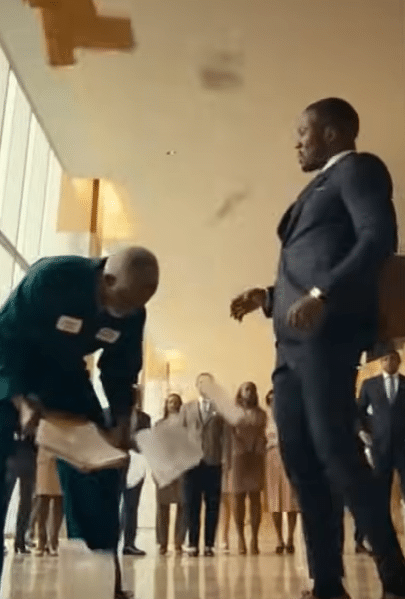
Ethan Cole came striding across the marble in a dark pinstripe suit, one hand gripping a leather portfolio, the other tapping an impatient message into his phone. He was thirty, sharp-featured, and recently promoted into a high-visibility strategy role that he had mistaken for invincibility. Ethan had the polished look of a man who practiced confidence in reflective surfaces. His shoes were flawless. His tie was perfectly knotted. His expression carried the permanent irritation of someone who believed every delay in life was a personal insult.
Near the central corridor, an older janitor in a green work uniform was collecting a stack of printed reports that had slipped from a rolling cart after someone brushed past too quickly.
The papers were everywhere.
Some had slid beneath a seating bench.
Others lay fanned across the floor near the elevator bank.
The older man bent slowly to gather them, careful, methodical, not flustered. His hair was silver at the temples. His shoulders were slightly stooped, but there was something unusually composed about him. Even in the plain maintenance uniform, he carried himself with quiet gravity, as though stillness came naturally to him.
Ethan never saw any of that.
What he saw was an obstacle.
His pace did not slow until the very last second, and by then it was too late. His shin struck the edge of the cart, one shoe slid against a loose sheet, and his balance pitched forward just enough to send his portfolio jerking out of line.
The older man looked up.
“Careful,” he began.
But Ethan, already embarrassed by the stumble and aware that several nearby employees had turned to look, reacted the way arrogant people often do when humiliation brushes against their pride in public:
he looked for someone weaker to blame.
“Move out of the way, old man,” he snapped.
The words cracked through the lobby.
The janitor was still half-crouched, reaching for another sheet, when Ethan shoved his foot forward and knocked him off balance.
It wasn’t a cinematic blow.
It was uglier than that.
Petty. Mean. Deliberate.
The older man fell sideways to one knee, one hand catching himself against the floor as the papers scattered even farther across the marble.
A receptionist near the security desk gasped.
Two analysts near the coffee kiosk stopped dead.
A man waiting by the turnstiles lowered his phone slowly, unsure whether he had just seen what he thought he had seen.
Ethan’s face hardened instead of softening. Public cruelty, once started, often escalates because retreat would require shame.
“Take out the trash,” he barked, his voice loud enough for half the lobby to hear. “You’re paid to clean the floors, not stand on them.”
The sentence landed with a sick thud in the silence.
Some employees looked horrified.
Some looked down.
A few did what people too often do in places ruled by rank: they stayed still and told themselves it was none of their business.
The older man remained on one knee for one quiet beat, then another.
He did not lash out.
He did not plead.
He simply gathered one of the fallen reports, placed it on the stack in his hand, and rose slowly to his feet.
That calm should have warned Ethan.
But men like him rarely recognize dignity unless it is packaged in visible status.
The janitor’s face, now in close view, was serious and unreadable. Not wounded. Not frightened. Just still.
He looked at Ethan the way a teacher might look at a student who had just failed a test without realizing it.
Then the elevator behind them chimed.
The sound was small.
Yet in the frozen lobby, it seemed to split the air.
Heads turned instinctively as the brushed steel doors slid open.
A middle-aged man in an elegant charcoal suit stepped out. He moved with the brisk certainty of someone used to being obeyed without repeating himself. In one hand he carried a slim folder embossed with the Hayes Global seal. The moment he saw the older man in the green uniform, his expression changed—not to confusion, but to immediate concern.
He crossed the lobby at once.
Not toward Ethan.
Toward the janitor.
And when he reached him, he inclined his head in unmistakable respect.
“Chairman Hayes,” he said, his voice controlled but urgent, “the board of directors has been waiting for your final decision.”
The room stopped breathing.
No one moved.
No one even seemed capable of processing the sentence fast enough.
Chairman Hayes.
Not maintenance staff.
Not a janitor.
Not an old man in the way Ethan had meant it.
Chairman Hayes.
Founder of the company. Majority shareholder. The man whose name was on the building, on the annual report, on the stock exchange listings, on every polished award in the lobby display.
For a fraction of a second, the entire hierarchy of the room flipped upside down so violently it was almost physical.
Ethan stared.
Then stared harder, as though reality might rearrange itself if he refused to understand it.
The older man in the green uniform said nothing at first.
He merely straightened the slightly wrinkled sleeve where he had hit the floor, then glanced once at the papers still scattered near the cart.
Around the lobby, recognition spread in waves.
A senior accountant near the elevators put a hand over her mouth.
One of the receptionists went pale.
A vice president crossing from the security gates froze mid-step, instantly understanding what had happened and wishing he had arrived ten seconds earlier.
Because many of the longer-tenured employees had heard rumors.
That once every quarter, Arthur Hayes walked the building without announcement.
No entourage.
No title in front of him.
Sometimes as a visitor.
Sometimes in plain clothes.
Sometimes as maintenance.
He did it to see the company the way ordinary people saw it. To learn who held doors, who ignored support staff, who performed respect upward but never downward. Most people treated the stories like corporate legend.
Until now.
Ethan’s mouth opened.
Nothing came out.
The man in the charcoal suit—Daniel Mercer, chief of staff to the chairman—turned at last and took in the papers on the floor, the older man’s scuffed knee, and Ethan’s white-faced panic.
His expression darkened immediately.
Arthur Hayes finally looked at Ethan.
The gaze was not dramatic.
That made it worse.
It was calm, direct, and devastatingly clear.
“Interesting,” Arthur said.
Just one word.
But under it sat the whole weight of the moment.
Ethan swallowed hard. “Ch… Chairman…”
The title broke apart in his mouth.
Gone was the swagger. Gone was the sneer. Gone was the sharp impatience he had worn like a badge five seconds earlier. In its place was the raw terror of a man realizing that the person he had just publicly humiliated was the one individual in the building with the greatest power to end his future.
Arthur bent down—not because he had to, but because no one else had yet found the courage to move—and picked up one of the fallen reports himself.
That action shamed the lobby more deeply than any speech could have.
Only then did several employees rush forward to help gather the rest.
Too late, of course.
Respect offered after revelation always arrives with a stain on it.
Arthur handed the stack back to the maintenance cart and turned toward Daniel.
“How long have they been waiting?” he asked.
“Twelve minutes, sir,” Daniel answered.
Arthur nodded once.
Then, without looking away from Ethan, he said, “Long enough to learn something useful.”
A pulse of tension moved through the room.
Ethan tried again. “Sir, I didn’t know—”
“No,” Arthur replied. “You didn’t ask.”
The sentence fell cleanly, decisively.
And like so many moments of real karma, it was devastating because it was simple.
Ethan had not asked who the older man was.
He had not apologized for the collision.
He had not offered help with the papers.
He had looked at a green uniform, gray hair, and a crouched posture on the floor—and from those details had built an entire human worth in his mind.
He had decided that because the man appeared to clean the building, he could be treated as less than everyone walking through it.
Arthur took one slow step closer.
Employees all around them lowered their eyes.
“In this company,” he said, “the floor matters as much as the boardroom. Anyone who believes otherwise does not understand either.”
No one in the lobby dared make a sound.
Ethan’s face had gone from flushed to colorless. “Chairman, please. I was rushing. I lost my temper. I—”
“You revealed your character,” Arthur said.
Again, not loudly.
Again, worse because he did not need volume.
Daniel stood slightly behind him, silent, visibly furious on the chairman’s behalf but disciplined enough not to interrupt.
Arthur looked briefly toward the watching employees.
“And the rest of you,” he said, his gaze sweeping the reception desk, the analysts, the managers, the bystanders, “saw an older man humiliated in this lobby and waited for status to tell you whether it was wrong.”
That landed almost as hard as Ethan’s exposure.
Because it was true.
Several people flinched.
The receptionist who had gasped was close to tears now.
One manager near the turnstiles stared at the floor as though he had personally cracked it.
Arthur continued, “A company’s culture is not what it prints in brochures. It is what happens in the first ten seconds when someone powerless is treated badly.”
The lobby seemed to shrink around the words.
And there it was—the real reason he had worn the uniform.
Not theater.
Not humiliation.
Measurement.
A test.
And the building had just failed it in full public view.
Ethan, desperate now, took a small step forward. “Sir, I can explain.”
Arthur met his eyes.
“No,” he said. “You can explain to Human Resources. And then to yourself.”
Daniel already understood. He gave one sharp signal toward security and the head of HR, both of whom were now hurrying from opposite ends of the lobby after hearing enough to know a career had just ended.
But Arthur wasn’t finished.
He glanced at the older cleaning cart, at the reports, then back at Ethan.
“You told me to take out the trash,” he said.
The line hung there, unbearable.
A few employees closed their eyes.
Arthur’s expression did not change.
“It seems,” he added, “the lobby has identified it.”
No one would ever forget that sentence.
Not because it was cruel.
But because it was exact.
Ethan looked as if he might collapse under the weight of what he had done. For a second, he seemed young—not in the flattering sense, but in the exposed sense, stripped of polish and left with nothing except entitlement and fear.
Arthur turned away from him at last, and the dismissal felt more final than rage would have.
“Daniel,” he said, “after the board meeting, schedule mandatory conduct review for every division head, every new manager, and every executive trainee. Anyone who thinks dignity is tied to job title should not be making decisions in this company.”
“Yes, Chairman.”
“And double custodial pay for this quarter,” Arthur added, glancing once at the maintenance team gathering nervously near the corridor. “They see more of our culture than any consultant ever will.”
This time, the reaction in the lobby was different.
Not shock.
Shame.
Because every person present understood that the man they had mistaken for “just a janitor” had been carrying more wisdom than most of the executives who passed him every day.
Arthur adjusted the cuff of the green uniform, as if it were no different from a tailored jacket.
Then he looked once more across the lobby.
At the glass walls.
At the marble floors.
At the employees standing in silence.
At the place that bore his name.
“When people think no one important is watching,” he said, “that is when they show the company what they are building.”
Then he walked toward the elevator with Daniel at his side.
And just like that, the lobby reorganized itself around his absence.
Security approached Ethan.
HR followed.
No one came to stand beside him.
That was the final punishment, at least in that moment—not the coming termination, not the official report, not the ruined promotion track. It was the social vacuum that opened the instant everyone understood his arrogance had no shelter left.
He had spent his career performing power in front of people he wanted to impress.
But real power had been standing in a green uniform with papers on the floor.
And he had kicked it.
By afternoon, the story had spread through every floor of Hayes Global. By evening, it had reached the board minutes, the executive chat groups, the private assistant networks, the break rooms, and the cleaning staff who had known for years that kindness usually travels downward only when it is real.
People repeated the line about the trash.
They repeated the line about not asking.
But what stayed longest was the image.
An older man in a janitor’s uniform, calm on one knee, while a younger man in a pinstripe suit mistook cruelty for superiority.
Then the elevator doors opening.
Then the entire building learning which of the two men truly belonged at the top.
Because that was the real twist.
Arthur Hayes had not dressed as a janitor to prove he could be humble.
He had done it to see who among his employees had never learned that every human being deserves dignity before any title is revealed.
And Ethan Cole, in one ugly burst of entitlement, gave the clearest answer in the entire company.