Act I: The Bag on the Counter
The boy could barely lift it.
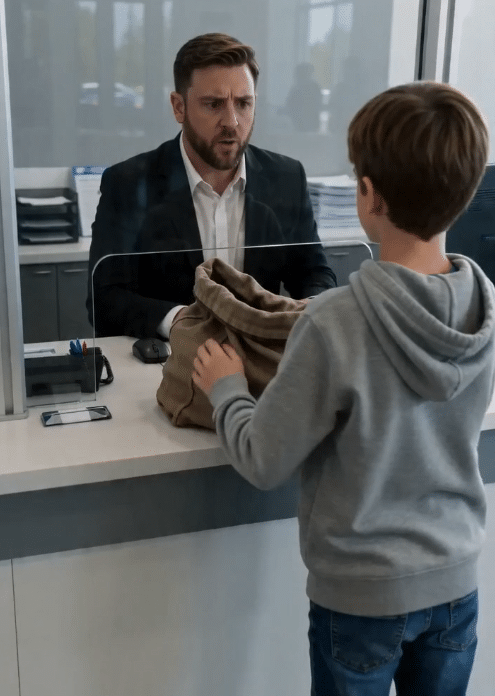
He came through the glass doors of Halcyon Private Bank at 11:17 on a gray Thursday morning, dragging a weathered canvas bag that looked too heavy for his arms and too old for anything a child should own. He wore a gray hoodie over a dark T-shirt, jeans with one knee gone white from wear, and the kind of expression I’ve only ever seen on children who have already learned not to expect adults to help.
At first, I assumed he was lost.
Banks get strange walk-ins all the time—people looking for bus money, older clients who forget where they are, desperate customers convinced a teller can reverse a divorce, a death, or a decade of bad decisions. I was already stepping out from behind my desk to redirect him when he reached Counter Three and heaved the bag onto the service ledge with both hands.
It landed with a heavy, metallic thud.
My relationship manager, Neil Foster, looked up from behind the glass partition with visible irritation. Neil had a white shirt too crisp for honesty, a thin black tie, and the sort of silver watch men buy when they want their wrists to imply competence. He didn’t smile at the boy.
“What do you need?” he asked.
The boy said nothing.
He untied the drawstring and folded the canvas open.
For one full second, Neil just stared.
Then he leaned forward so abruptly his chair wheels rolled backward against the cabinet behind him. Even from ten feet away, I saw the color change in his face.
Inside the bag were gold coins.
Not a handful. Not a little pouch of heirlooms someone might bring in after cleaning out a grandparent’s attic. Hundreds of them. Stacked in cloth rolls and loose clusters, dull with age but unmistakably real. Wedged among them was an antique silver pocket watch and several folded documents on thick yellowed paper.
“Where did you get these?” Neil asked.
The boy kept one hand on the bag, almost protectively.
“They’re my dad’s,” he said. “He said you would know what to do.”
That sentence hit me harder than the gold.
Because six weeks earlier, a man named Gabriel Voss had stood in my office after closing with that same silver watch in his palm and asked me, very quietly, whether dormant family reserves could be stolen by the bank if the wrong people knew where to look.
I remembered every detail of him at once.
Work boots.
Cheap coat.
Hands scrubbed too hard at the knuckles.
The visible embarrassment of a man carrying something valuable into a room designed to make men like him feel temporary.
Neil wasn’t there that night. Neither was anyone else. Just me, Gabriel, the watch, and a photocopied certificate with a broken wax seal bearing a name I’d never seen before in any active client file.
Hovesinte.
Now that same name stared up at me from the top document in the child’s bag.
And the boy standing at my counter, with his jaw set too tightly for his age, had Gabriel Voss’s eyes.
Neil looked up at me through the glass.
I didn’t need him to speak. I could see the panic already moving behind his face. Not because of the gold. Gold in a private bank is unusual, but not impossible.
What terrified him was recognition.
Because if Gabriel’s son had walked into Halcyon carrying proof that the Hovesinte papers were real, then the man the city said died in a warehouse fire had either known he was about to be killed—or had been killed for knowing too much.
The boy shifted his weight and said the next line in a voice so steady it made my skin go cold.
“My dad said not to let Mr. Crane see the bag.”
And just like that, the entire bank changed.
Act II: The Man Everyone Called Delusional
Gabriel Voss first came to see me on a rainy Tuesday in late April.
The branch had already closed. Cleaners were moving through the lobby. The automatic shades were half-drawn against the street. He stood just outside my office door holding a grocery-store umbrella and looking like he expected to be thrown out the moment he spoke.
“I need someone who reads before he laughs,” he said.
That was how he introduced himself.
Halcyon catered to a certain class of client—inheritance families, trust beneficiaries, discreet wealth, expensive anxiety. Gabriel Voss looked like the sort of man security might mistake for a delivery driver if he paused too long in the marble lobby. But there was nothing uncertain in his eyes.
He sat down only after I asked twice.
Then he placed the silver pocket watch on my desk, followed by a folded document and a single old gold coin wrapped in tissue paper. The coin carried a crest I didn’t recognize. The document was harder to parse: formal English in archaic phrasing, signatures in ink long turned brown, and a heading referencing a custodial reserve maintained through predecessor institutions that no longer existed.
One line mattered more than the rest.
Transfer rights retained by blood claimant in perpetuity.
Gabriel told me a story that should have sounded absurd.
His great-grandmother had once worked for a private shipping family who fled Europe before the war. They deposited a reserve—gold, certificates, and negotiable claims—through a predecessor institution that later merged, then merged again, until it eventually vanished into modern Halcyon. The family line supposedly ended in scandal, the record closed, the reserve absorbed.
Except it hadn’t ended.
Not completely.
One daughter had survived under another name. Gabriel was descended from her.
“How do you know?” I asked.
He slid over birth records, an affidavit from an old family solicitor, and the pocket watch, which contained a hidden key and a paper slip with one line written inside the back cover.
For the claimant when the bank stops pretending not to know.
That was the moment I stopped seeing Gabriel as confused and started seeing him as inconveniently correct.
I spent the next three days in archive systems I was not supposed to touch without senior approval. Most private banks carry their history like a polished myth. Halcyon carried it like sediment—layers of mergers, acquisitions, dead trusts, sealed litigation, and dormant instruments nobody alive had reason to revisit unless they were forced to.
I found the name.
Not in active vault records, but in a restricted heritage ledger accessible only to executive review.
Hovesinte Reserve.
Status: extinguished.
Disposition: internalized under administrative closure order.
The closure order was signed eighteen years earlier by Walter Crane, then junior counsel, now regional managing director over my branch.
That made no sense.
Walter shouldn’t have had authority to extinguish anything of that scale at his rank. Yet the file was marked complete, archived, and locked.
When I called Gabriel back, he didn’t sound surprised.
“They know,” he said. “That’s why I’m here now.”
He told me he had worked nights for a restoration contractor hired during Halcyon’s lower-level renovations. While cleaning a disused records room, he found references to sealed vault inventories and the Hovesinte name. He followed the paper trail, recognized his great-grandmother’s alias, and began asking quiet questions.
Three days later, someone broke into his truck.
Nothing was taken except the folder.
After that, he made copies.
He came to me because I was the only person in the building who had once treated him like a human being when he’d been waiting to sign payroll forms for the contractors. That tiny courtesy, it turned out, had become the basis for an extraordinary amount of trust.
I told him to say nothing to anyone else until I could verify more.
He nodded, thanked me, and stood to leave. At the door, he turned back.
“If anything happens to me,” he said, “my boy will come.”
I remember feeling impatient with that.
Not dismissive. Impatient. As though I could still keep the situation in the realm of paperwork and prevent it from becoming the kind of story that ruins lives. I told him not to catastrophize.
The next week, Gabriel Voss died in a warehouse fire at the East River restoration yard.
That was the official version.
Unattended electrical fault. Late shift. No survivors. Rapid burn.
Walter Crane himself called me into his office the morning after and told me, with polished regret, that I was to close any internal inquiry tied to “the Voss matter.” When I asked how he knew about it, he smiled and said good governance requires escalation of fraudulent claims before they infect client confidence.
Fraudulent claims.
He used the phrase before I had even put anything in writing.
I understood then that Gabriel had not been paranoid enough.
Now his son stood in my branch with the gold, the watch, and the documents his father had tried to protect.
And the man he had specifically warned the child against was one floor above us in the executive conference room.
Act III: The Boy Who Knew Too Much
I came around the side gate and told Neil to let the boy through to my office.
Neil hesitated.
Not because he cared about procedure. Because he was calculating risk. He knew Walter Crane’s name had just entered the room, and men like Neil survive by deciding quickly which fear deserves their loyalty.
“Daniel,” he said under his breath, “we should call Security.”
The boy heard that.
His fingers tightened around the canvas bag.
“My dad said you’d say that if the wrong people were there.”
I looked at him carefully then.
Not just his face. His posture. The way he stood slightly sideways to keep the bag out of easy reach. The way he scanned the branch every few seconds without making it obvious. He wasn’t simply frightened.
He had been instructed.
“What’s your name?” I asked.
“Noah.”
“How old are you, Noah?”
“Nine.”
He said it like a fact that no longer had much to do with childhood.
I nodded once and keyed my office door open. “Bring the bag.”
Noah dragged it in with both hands and set it carefully on the low meeting table. Only when the door shut did he seem to breathe fully. He looked around my office—the framed certificates, the matte-black monitor, the glass wall facing the branch—and then at me.
“He said if Mr. Crane saw the papers first, we’d both disappear into process.”
That was exactly the kind of sentence Gabriel Voss would teach a son who knew adults used polite words to hide violence.
I opened the bag myself.
The coins were genuine. Not all from the same mint, not all from the same period, but enough old sovereign weight to make the bag’s contents significant even before the papers entered the equation. The pocket watch opened with the pressure sequence Gabriel had shown me weeks earlier. Inside the back casing, the hidden key was still there.
Beneath the certificates lay a sealed envelope addressed in Gabriel’s handwriting.
For Daniel Reese only. If Noah reaches you, don’t trust the branch. Go below.
My stomach tightened.
I opened the letter.
Gabriel wrote in a clear, hurried hand that he had found more than reserve documentation in the lower records room during renovation. There were internal closure memos, off-ledger transfers, and a supplemental vault schedule indicating that the Hovesinte assets had not been extinguished at all. They had been divided, monetized, and redistributed across executive discretion accounts over eighteen years.
He named Walter Crane directly.
He also named someone else.
Sergeant Paul Briggs.
I looked up instinctively toward the lobby.
Briggs was the uniformed police officer assigned to midday branch presence three days a week. He stood near the entrance right then, chatting with one of the tellers, visible through the blurred glass line of my office wall. I had always assumed he was there as a standard deterrent for a high-value branch.
Gabriel’s letter said otherwise.
Briggs had been working private security favors for Walter since before Gabriel’s death. He had been seen at the restoration yard the night of the fire. If the bank tried to “help” once Noah appeared, Briggs would be part of the help.
The letter ended with a sentence that made my mouth go dry.
The real ledger is still below the archive room. Watch opens Box 4C. My death won’t look like murder unless the ledger survives me.
Noah was watching my face by then.
“Did he tell you anything else?” I asked.
He nodded once.
“He said if you looked scared, that meant he was right.”
That nearly undid me.
Because Gabriel had anticipated not only his own death, but my reaction to proof of it. He had built his son a path through the bank using my conscience as one of the lock combinations.
Outside, I saw Neil rise from his station.
He was holding the office phone.
Seconds later, my extension lit up.
Walter Crane was calling.
And somewhere near the lobby doors, Officer Briggs turned his head and began looking around as if he’d just been given a description.
Act IV: What the Watch Opened
I silenced the call.
Then I took Noah by the shoulder, not roughly, and walked him through the private records corridor behind my office before Walter could decide to come down in person. Halcyon’s public spaces were all glass, stone, and expensive restraint. Its lower service levels were different—unfinished ceiling grids, coded doors, archival shelving, machine rooms, and the residual smell of paper nobody powerful expects to see daylight again.
Noah didn’t ask questions.
He simply kept up.
That unnerved me more than panic would have.
The old heritage archive sat below the sub-basement storage vault, accessible through a service door most staff assumed led only to deed boxes and legacy bond records. Gabriel had been right about one thing: the bank had forgotten parts of its own body. Institutions do that when the same small circle controls access for too long.
Box 4C was hidden behind a false rear panel in a shelf marked DECOMMISSIONED BOND INSTRUMENTS.
The key from the watch fit perfectly.
Inside lay one black ledger, a flash drive, and three manila envelopes bound with rubber bands gone brittle from age. The ledger was handwritten for the first nine years, then supplemented with printed transfer sheets and initials that became increasingly careful the closer they got to Walter Crane’s promotion timeline.
Hovesinte wasn’t just a dormant reserve.
It had become an internal feeding source.
Gold converted quietly through intermediary dealers. Certificates fractionalized and sold through family offices. Liquidations disguised as executive bonus instruments and settlement reserve smoothing. A fortune erased from public claim and slowly cannibalized by men in ties who believed the dead and poor stayed disorganized enough to make excellent collateral.
Noah leaned over the table beside me without touching anything.
“What does it say?”
I looked at him.
“It says your father was telling the truth.”
He absorbed that without visible surprise.
That broke my heart a little.
Children should not hear a sentence like that and look only confirmed.
The first envelope held the original closure challenge Gabriel had drafted but never filed. The second contained photographs from the warehouse restoration site—Walter Crane in a hard hat, Officer Briggs beside him after hours, and Gabriel’s truck parked near the service ramp on the night of the fire.
The third envelope was the worst.
It contained a typed memo prepared for internal counsel the morning after Gabriel died.
Issue resolved. Claimant deceased. Minor unlocated.
Minor unlocated.
Not son grieving.
Not family.
Not human.
A risk variable.
I heard footsteps in the corridor above us.
More than one person.
Noah heard them too.
His eyes went immediately to the service stairs.
“We’re not alone,” he said.
I grabbed the flash drive, the ledger, the envelopes, and shoved them into my briefcase while dialing my compliance contact in Manhattan from a direct regulator line I’d never used outside formal escalations. No answer. I left one sentence only.
Heritage theft. Suspected homicide. Minor claimant present. Lock the branch.
Then I called 911 from my personal phone and requested state-level financial crimes response, explicitly excluding local coordination until federal preservation arrived. I named Briggs on the call. I named Walter. I named the dead man.
The footsteps stopped outside the sub-basement door.
A keycard buzzed once.
Denied.
Then again.
Walter had override privileges. I knew that.
What I didn’t know was how far he would be willing to go with a child inside the evidence room and daylight still above us.
Noah looked at me, steady and pale.
“My dad said if they came downstairs,” he said, “it means they’ll stop pretending.”
The lock clicked.
Walter Crane stepped through first.
Officer Briggs came behind him.
And on Walter’s face was the smooth, exhausted sadness of a man who had already decided how much of tonight’s story he meant to survive.
Act V: The Claim That Stayed Alive
Walter didn’t shout.
That was his style. Men like him prefer to wrap threat in concern and let tone do the bruising.
“Daniel,” he said, looking first at the ledger in my hand and then at Noah, “you’ve made this much worse than it needed to be.”
Briggs stayed near the door, one hand hovering too close to his belt for a routine welfare check.
I set the briefcase on the table between Noah and me.
“Your problem,” I said, “is that he made copies before he died.”
Walter smiled faintly.
“That’s what desperate men always say in notes.”
So he knew about Gabriel’s letter.
That told me he’d already searched for one version of it and failed to find the right one. Good.
Briggs spoke next, voice low and falsely patient. “Kid doesn’t need to be here for this.”
Noah stared at him without blinking. “My dad said you’d say that too.”
I wish I could tell you Walter lost control at that point.
He didn’t.
He only became more honest.
He took one slow step into the room and looked at Noah the way executives look at lawsuits—unfortunate, expensive, and easier to manage if separated early from human context.
“Your father found something he didn’t understand,” Walter said. “He turned a family myth into obsession.”
“He found your theft,” I said.
Walter’s eyes moved back to me.
“No,” he said. “He found history. History is rarely fair, Daniel. Banks survive because someone has to decide which claims remain alive and which ones are too old, too damaged, too undocumented to destabilize the present.”
That sentence told me everything about him.
He thought the crime was administrative discretion. He thought the murder, if he even allowed himself that word, was just another unpleasant function of institutional continuity.
The sirens started above us before I could answer.
Faint at first.
Then multiplying.
Walter heard them and finally changed.
Not much. Just a small tightening around the mouth, the first crack in a mask that had likely served him since prep school. Briggs heard them too and looked toward the stairwell, calculating.
I lifted the ledger.
“This is the present,” I said.
Walter moved then.
Fast.
Not toward me—toward the briefcase.
Briggs did the same.
But Noah was quicker than both of them in the one way that mattered. He grabbed the silver watch from the table and threw it hard at the emergency fire box on the wall. Glass shattered. The building alarm detonated above us in a shriek of red light and noise.
For one beautiful second, every adult in the room lost structure.
I drove the briefcase backward across the shelving gap and shoved Noah toward the secondary exit door while Briggs cursed and Walter lunged after the sliding evidence instead of the child. That choice will haunt him in court more than anything else. In the moment of crisis, he reached for the assets before the witness.
The secondary door opened onto the loading bay stairwell where two state troopers were already descending.
I’ve never been so relieved to see uniforms in my life.
What followed became procedure.
Briggs detained.
Walter on the floor yelling about privileged material and contaminated chain of custody.
Neil upstairs trying to claim he knew nothing until his phone records suggested otherwise.
Regulators in the branch by 3 p.m.
Federal financial crimes by 5.
Press by sunset.
The gold was authenticated. The reserve claim was reinstated. The Hovesinte trust, or what remained of it after two decades of elegant cannibalism, became the basis for one of the largest recovery actions Halcyon had faced in a century.
Gabriel Voss’s death was reclassified within nine days.
Not accident.
Homicide under active investigation.
The warehouse fire had been the cover, not the cause.
Three months later, Noah sat in a navy blazer far too stiff for him in a conference room overlooking the river while court-appointed trustees explained what restitution, guardianship review, and protected inheritance would mean. He listened the way he had listened in my office that first day—calm, serious, slightly older than any child should ever need to be.
When the meeting ended, he took the pocket watch back from the evidence clerk and turned it over in his hands.
“Did my dad know this would work?” he asked me.
I thought of Gabriel in the rain outside my office. The gold coin wrapped in tissue. The exhaustion in his shoulders. The care with which he prepared his son for a bank instead of a bedtime.
“He knew it might,” I said.
Noah nodded.
Then he opened the watch and read the hidden line inside one more time.
For the claimant when the bank stops pretending not to know.
That, in the end, was the whole story.
Not just of Halcyon. Of every institution that survives by deciding some people can be documented out of their own inheritance if enough years pass and enough polished men agree. They tell themselves the record is gone, the claimant is dead, the child will never arrive, the bag will never hit the counter hard enough to make anyone look.
They were wrong about all of it.
The boy arrived.
The gold was real.
The documents survived.
And the father they tried to bury under smoke had prepared his son not merely to grieve him, but to outlast the bank that thought it could erase his family without anyone young enough to matter learning how to say no.