Act I
The chandelier was still trembling when the spaghetti hit her.
For one breath, nobody moved.
A ribbon of red sauce slid down Amelia Vale’s temple, catching on the diamond clip in her dark hair before dripping onto the cream silk of her dress. Strands of pasta clung to her bare shoulder, hot and humiliating, the smell of basil and crushed tomatoes rising into the stunned silence of the Morrison dining room.
It should have been a scream.
It should have been tears.
That was what Helene Morrison had intended.
The older woman stood behind Amelia’s chair with the empty porcelain serving bowl still tilted in her hands. Her navy blazer was immaculate, her pearls glowing beneath the chandelier, her blond bob sharp enough to look carved. She had not spilled a single drop on herself.
Around the long dark table, six guests in tuxedos and black gowns stared as if they had just witnessed a murder of manners. Forks hovered midair. Wine glasses froze halfway to painted lips. Someone’s watch flashed beneath a cuff, but nobody dared look away.
Amelia sat at the head of the table.
That alone had been enough to offend them.
She had arrived that evening in a beige sleeveless dress, composed and quiet, with the kind of stillness people mistook for weakness. She had taken the chair Helene said belonged to “real blood,” smiled politely at the staff, and listened while the family discussed her as though she were an unfortunate stain on the carpet.
Then came the pasta.
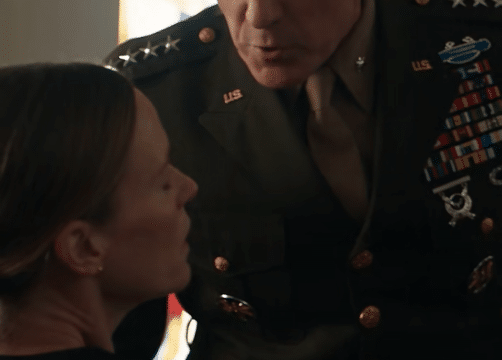
Helene leaned down until her lips nearly touched Amelia’s sauce-streaked ear.
“Now maybe you understand. You are not part of this family!”
The words landed harder than the bowl.
At the far end of the room, beyond the floor-to-ceiling windows, the manicured garden disappeared into blackness. Inside, every candle flame seemed to shrink.
Amelia lowered her eyes.
A younger woman might have tried to wipe the sauce away. A humiliated guest might have apologized for existing. A desperate impostor might have begged.
Amelia did none of those things.
She breathed once.
Then she reached into the small clutch beside her plate and took out her smartphone.
Helene’s smile faltered by half an inch.
Amelia lifted the phone with two fingers, as calm as if she were ordering a car.
Her thumb touched the screen.
For the first time all evening, the guests saw her face clearly beneath the mess they had allowed. Not broken. Not ashamed.
Smiling.
Coldly.
She placed the phone to her ear.
“It’s time,” Amelia said. “Initiate the Morrison Protocol. Effective now.”
Across the table, every watch, every phone, every hidden device lit up at once.
And that was when the screams finally began.
Act II
The first sound came from Charles Morrison, Helene’s eldest nephew, who had been laughing ten minutes earlier when Helene called Amelia “the charity girl with a pedigree problem.”
Now his phone shook in his hand.
His face went white.
“What the hell is this?” he whispered.
Next to him, his wife pressed a hand to her diamond necklace as if it could protect her from whatever she had just read. Across the table, a retired senator with Morrison money in three foundations stood too quickly and knocked over his wine. A woman in a velvet gown opened her banking app, blinked twice, then made a strangled little sound.
Helene did not move.
Amelia remained seated, sauce sliding down the bridge of her nose.
She looked almost peaceful.
To understand the silence before the collapse, one had to understand what the Morrisons were.
They were not merely rich. Rich people bought things. The Morrisons owned the rooms where things were decided.
Their name sat on museum wings, children’s hospitals, scholarship endowments, private clubs where nobody raised their voice because nobody had to. Their ancestors had shipped steel, insured railroads, financed wars, and laundered their sins through philanthropy so thoroughly that society had long ago mistaken their money for virtue.
Helene Morrison had guarded that illusion for thirty-seven years.
She had married into the family young, beautiful, and hungry. By the time her husband died, she had already mastered the true language of old money: exclusion. She knew which cousin to starve of invitations, which scandal to bury, which board member to flatter, which servant to intimidate.
And she knew how to erase people.
Amelia Vale had been one of them.
Until six months ago, Amelia had lived in a small apartment outside Portland with a mother who never spoke ill of the Morrisons, even when medical bills stacked beside the toaster. Amelia grew up knowing only three things about her father: his name was Thomas, he loved classical piano, and he had died before she was born.
Her mother, Elise, kept a silver baby bracelet in a drawer wrapped in tissue.
A.M.
That was all Amelia had.
Then Elise died.
Three weeks after the funeral, a lawyer appeared with a sealed envelope, a DNA test Amelia had never requested, and a letter written by Edward Morrison, the patriarch whose portrait hung above the fireplace in the room where spaghetti now dripped onto his granddaughter’s dress.
“My dear Amelia,” the letter began.
Not Miss Vale.
Not claimant.
Granddaughter.
Edward had known.
That was the first crack in the Morrison myth. The second came when Amelia learned Thomas Morrison had not died before she was born. He had died after trying to leave Helene’s version of the family.
The official story said Thomas had disgraced himself, vanished overseas, and been cut from the estate. Helene had told everyone he had fathered no legitimate child. The family repeated it for twenty-eight years because repeating a lie in a mansion makes it sound like history.
But Edward had discovered the truth too late.
Thomas had married Elise quietly. Helene had buried the certificate. She had intercepted letters. She had paid a clerk to misfile records. When Thomas tried to bring his wife and newborn daughter home, he was stopped by threats, legal traps, and a family so obsessed with reputation that they called cruelty “protection.”
By the time Edward found the evidence, Thomas was gone, Elise had disappeared into ordinary life, and Amelia had grown up thinking the rich people in newspapers had nothing to do with her.
Edward could not undo the past.
So he built a trap for the future.
And Helene had just stepped into it with both feet.
Act III
The second notification struck the room harder than the first.
It was not a bank alert.
It was a legal notice.
Charles staggered backward, reading aloud without meaning to.
“Temporary suspension of trustee privileges pending fraud review…”
His voice cracked.
The retired senator cursed under his breath. Another cousin began calling someone named Martin, then stopped when he saw he had no service on the secure family network. A woman named Beatrice, who had spent dinner explaining that “bloodline matters,” dropped into her chair as if her bones had been removed.
Helene finally set the empty bowl down.
The porcelain touched the table with a delicate click.
“What did you do?” she asked.
Amelia wiped one strand of pasta from her cheek and laid it beside her plate.
“No,” she said softly. “What did you do?”
The question traveled around the table like smoke.
For months, Helene had believed Amelia was merely inconvenient. A girl with a lawyer. A signature to intimidate. A face to shame until she walked away from a fortune too large for her to comprehend.
That was why dinner had been arranged.
Officially, it was a reconciliation.
Unofficially, it was a performance.
Helene had invited the most useful witnesses in the family circle: Charles, who managed the private equity arm; Beatrice, who chaired the Morrison Foundation; Senator Valech, who owed them favors; two cousins who had signed old inheritance affidavits; and Helene’s personal attorney, who had spent the evening pretending not to know Amelia existed.
They had expected Amelia to be overwhelmed by crystal, silver, portraits, and judgment.
They did not know she had spent the last six months reading every file Edward had left behind.
They did not know about the red leather box hidden in a climate-controlled archive beneath the estate chapel.
They did not know Edward had recorded his final confession on a cassette tape because he did not trust the family servers.
Amelia had listened to his voice alone at two in the morning.
“I failed your father,” Edward had said, each word scraped raw by age. “And because I failed him, I failed you. Helene believes the family name belongs to those ruthless enough to guard it. She is wrong. It belongs to the one person they tried hardest to erase.”
Inside the box were copies of the marriage certificate, letters from Thomas to Elise, canceled checks paid to officials, sworn statements from a former chauffeur, and a photograph of Edward holding infant Amelia in secret.
But there was more.
There was the Morrison Protocol.
It was not revenge, not exactly.
It was a dead man’s safeguard.
Edward had restructured the controlling trust before his death. If the legal heir he named was threatened, coerced, publicly defamed, or pressured into surrendering rights by any trust beneficiary, an emergency clause could be activated. Assets tied to those beneficiaries would freeze. Voting rights would transfer. Internal records would be released to independent counsel, federal regulators, and the family’s banking institutions.
It required only three things.
A triggering act.
A witness.
And the heir’s voice authorization.
Helene had provided all three.
The old woman stared at Amelia, and for one flicker of a second, the mask slipped.
Not anger.
Fear.
Amelia saw it.
So did everyone else.
Then the dining room doors opened.
Two men in dark suits entered, followed by a silver-haired woman carrying a leather portfolio. Behind them came the head of household security, who did not look at Helene for orders.
He looked at Amelia.
“Ms. Morrison,” he said. “Counsel is here.”
The name landed like a gavel.
Act IV
Helene laughed once.
It was a brittle, ugly sound.
“Ms. Morrison?” she repeated. “Don’t be absurd. Look at her.”
Every eye turned back to Amelia.
Covered in pasta. Dress stained. Hair ruined. Sitting beneath the chandelier like a woman dragged through disgrace and somehow made more dangerous by it.
“That,” Helene snapped, pointing at her, “is exactly what she is. A mess someone left at our door.”
The silver-haired lawyer opened the portfolio.
“Mrs. Morrison,” she said, “I strongly advise you to stop speaking.”
Helene ignored her.
“You think a phone call makes you family? You think documents change blood?”
Amelia stood.
The room fell still again, but this time it was different.
Before, silence had belonged to Helene.
Now it belonged to the woman she had tried to break.
Amelia lifted her napkin and slowly wiped sauce from her eyes. She did not rush. She did not tremble. The staff stood frozen along the walls, watching a private dynasty split open under candlelight.
“My father was Thomas Morrison,” Amelia said. “My mother was Elise Vale. They were married on June seventeenth, twenty-eight years ago, in a courthouse you paid to forget.”
Helene’s jaw tightened.
Amelia turned to Charles.
“You signed an affidavit saying my father died unmarried.”
Charles swallowed.
“To Beatrice,” Amelia continued, “you approved foundation payments to the same clerk who altered the county record.”
Beatrice shook her head. “I didn’t know what those payments were.”
“You asked him to label them archival restoration.”
The senator reached for his coat.
One of the men in suits stepped toward the door.
“Please remain until counsel has finished,” he said.
Helene’s attorney rose, sweating. “This is highly irregular.”
The silver-haired lawyer slid a document across the table.
“So was concealing a lawful heir from a controlling trust.”
Nobody touched the paper.
Amelia looked at Helene last.
For years, she had imagined this woman as a monster from her mother’s silence. Then, after Elise died, as a gatekeeper. Then, after the letters, as a thief. Tonight, covered in red sauce under a chandelier worth more than her childhood apartment, Amelia finally saw the truth.
Helene was smaller than the damage she had caused.
That almost made it worse.
“You wanted me to cry,” Amelia said.
Helene’s lips thinned.
“You wanted everyone here to see me humiliated so they could go home and say I didn’t belong at this table. That I was unstable. Emotional. Cheap. A mistake.”
She took a breath.
“So I made sure they were here.”
A third notification swept through the room.
This time it came with attachments.
Video files.
Scanned documents.
Audio transcripts.
A message from the independent trustee.
Charles opened one and nearly dropped the phone. Beatrice whispered, “Oh God.” The senator sat down as if he had aged ten years in ten seconds.
Helene did not check hers.
She was looking at the chandelier.
At the tiny black lens hidden above one crystal arm.
Amelia followed her gaze.
“Edward installed it after he realized papers could disappear,” Amelia said. “He trusted memory even less than he trusted you.”
The room changed then.
Not visibly at first. The candles still burned. The silver still gleamed. The garden outside remained perfectly dark.
But power left Helene the way warmth leaves a body in winter.
Her guests began distancing themselves without moving their chairs. Eyes shifted away from her. Shoulders angled toward Amelia. People who had laughed at her minutes earlier now watched her with the desperate politeness of those hoping judgment might pass them by.
Helene saw it happen.
That was her real punishment.
Not the frozen accounts. Not the lawyers. Not the documents. Those were consequences.
This was humiliation.
The kind she understood.
“You ungrateful little girl,” she said, but the words had lost their blade.
Amelia looked down at her ruined dress.
Then she smiled again.
“Now maybe you understand,” she said quietly. “I was never asking to be part of your family.”
Act V
By midnight, the dining room had emptied of laughter, certainty, and most of the people who had arrived believing the Morrisons were untouchable.
They left through the front hall in silence.
No dramatic arrests in front of the staff. No screaming in the driveway. Amelia had not wanted spectacle after the truth had already done its work.
But the consequences moved with them.
Charles was removed from every trust committee before his car reached the gate. Beatrice resigned from the foundation by morning. The senator’s office received questions from reporters before breakfast. Helene’s attorney requested a private meeting, then discovered his access to family records had been revoked.
Helene remained the longest.
She stood beneath Edward Morrison’s portrait, still wearing her pearls, though they looked less like jewelry now and more like a collar.
Amelia had changed into a dark coat someone from the staff had brought her. Her hair was damp from washing, though faint traces of sauce still marked the edge of her jaw. She looked tired for the first time all night.
Helene stared at her.
“You’ll destroy everything,” she said.
Amelia glanced around the room.
The chandelier. The portraits. The polished table. The windows reflecting generations of people who mistook wealth for worth.
“No,” Amelia said. “I’m going to clean it.”
Helene gave a humorless smile. “You think they’ll love you for it? The staff? The public? The board? People love a scandal until they need someone to blame.”
Amelia did not answer immediately.
Because Helene was not entirely wrong.
Truth did not make loneliness disappear. Justice did not return dead parents. A bank freeze could not give Amelia the childhood stolen from her mother or the father she never met. Even victory had a strange, hollow echo when it arrived too late for the people who deserved to see it.
But Amelia had learned something from Elise.
Survival did not have to look loud.
Sometimes it looked like keeping a baby bracelet wrapped in tissue for twenty-eight years. Sometimes it looked like refusing to poison a child against a family that had already done enough damage. Sometimes it looked like letting your daughter grow up kind, even when the world had given you every excuse not to be.
Amelia reached into her coat pocket and took out that bracelet.
A.M.
Helene’s face shifted when she saw it.
She recognized it.
Of course she did.
“You were there,” Amelia said.
Helene’s silence answered before her mouth could.
“The night my mother came here.”
It was the final piece Edward had not been able to prove. Elise had once brought infant Amelia to the Morrison estate. She had stood in the rain at the servant entrance with Thomas’s letters and a sleeping child in her arms.
Helene had turned her away.
Amelia had suspected it.
Now she knew.
For the first time all night, Helene looked old.
“She would have ruined him,” Helene whispered.
“My father?”
“The family.”
Amelia closed her hand around the bracelet.
“There it is,” she said.
Not an apology. Not remorse. Not even regret.
Just the family.
Always the family.
Amelia stepped closer, close enough to see the tiny cracks in Helene’s powder, the tremor near her mouth, the fear she had dressed in pearls for decades.
“You spent your life protecting a name,” Amelia said. “And somehow you never learned what a name is for.”
Helene’s eyes glistened, but no tear fell.
The security chief appeared at the doorway.
“The car is ready, Mrs. Morrison.”
For one wild second, Helene looked as if she might refuse. As if she might declare the house hers by force of habit alone.
Then she looked at the head of the table.
Amelia’s chair.
Edward’s chair.
The chair she had tried to turn into a stage for shame.
And she understood it was no longer hers to command.
She walked out without another word.
The next morning, the Morrison estate woke under a different kind of light.
Reporters gathered beyond the gates, but Amelia did not stand before cameras. Not yet. There would be time for statements, investigations, resignations, and the slow public dismantling of Helene’s empire of silence.
Instead, Amelia went to the kitchen.
The staff froze when she entered.
For years, they had known more than they were allowed to say. They had watched Helene reduce people with a look, watched guests smile through cruelty, watched old money polish itself while ordinary people cleaned the mess.
Amelia stood in the doorway, awkward now in a sweater and jeans.
“I’m sorry about last night,” she said.
The chef blinked.
Then, from the back, one of the younger maids laughed.
Not cruelly.
Softly.
Humanly.
The room exhaled.
Someone poured coffee. Someone set down a plate of toast. The chef, after a long pause, asked whether Ms. Morrison would prefer eggs or fruit.
Amelia almost corrected the name.
Almost.
Then she thought of Edward’s letter. Her father’s lost voice. Her mother’s bracelet.
“Eggs,” she said. “And please call me Amelia.”
A week later, the portrait above the dining room fireplace was moved.
Not removed. Moved.
Edward Morrison was placed in the library, where Amelia thought he belonged, surrounded by records, letters, and the consequences of finally telling the truth.
In his place above the dining room mantel, she hung a simple black-and-white photograph.
Thomas Morrison holding Elise Vale’s hand outside a courthouse.
Young. Defiant. Happy.
On the back, in faded ink, Thomas had written one sentence.
Someday, we’ll bring her home.
The next formal dinner at the Morrison estate was smaller.
No senator. No false cousins. No women in velvet sharpening smiles behind crystal glasses.
Just the remaining trustees, the staff invited as guests, and Amelia at the head of the table, wearing a plain navy dress and her mother’s bracelet around her wrist.
When the first course arrived, the room went quiet for half a second.
Pasta.
Red sauce.
The chef looked horrified when he realized.
Amelia stared at the plate.
Then she laughed.
Not because it was funny. Not exactly.
Because sometimes the only way to reclaim a moment is to survive it so completely that it becomes yours.
One by one, the others smiled.
Outside, the garden was dark again. The chandelier glowed above them. The old table shone like polished history.
But the room no longer belonged to the people who had used silence as a weapon.
It belonged to the woman they covered in shame.
And to every truth that refused to stay buried.