Act I
The little girl appeared between the headstones like she had walked out of the fog.
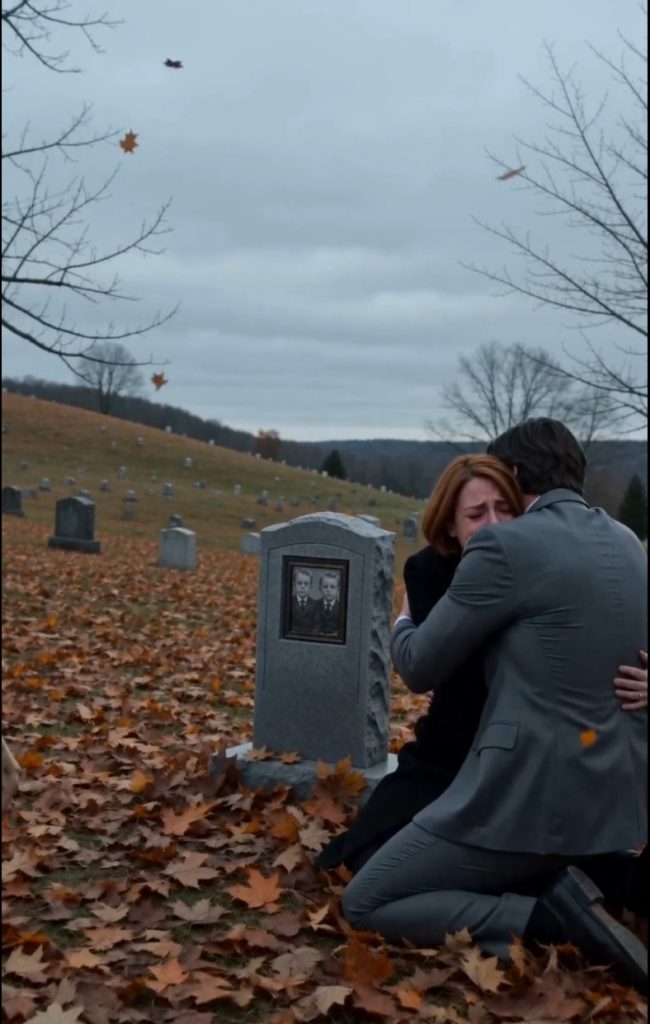
Emma Caldwell was kneeling in the leaves, both hands pressed against the cold granite grave in front of her. Her husband, Daniel, held her close from behind, his gray suit damp at the knees, his jaw clenched so tightly it trembled.
On the headstone was a framed black-and-white photograph of two identical boys in tiny suits.
Oliver and Noah Caldwell.
Born together. Loved together. Lost together.
Emma touched the picture with shaking fingers.
“I can’t do this,” she whispered into Daniel’s chest. “I can’t keep coming here and leaving without them.”
Daniel closed his eyes.
He wanted to tell her it would get easier, but grief had made liars of everyone around them. The neighbors said time would help. The pastor said heaven was close. His mother said they needed to accept what could not be changed.
But there was no acceptance for two empty bedrooms.
No peace in a house where twin beds still faced each other beneath glow-in-the-dark stars.
Then a voice came from the left.
“They’re not gone.”
Emma’s body went rigid.
Daniel opened his eyes.
A little girl stood a few feet away, barefoot in the fallen leaves. Her blonde hair was matted, her tan smock torn at one sleeve and stained with dirt. Her face was smudged, but her eyes were calm.
Too calm.
She lifted one dirty finger and pointed at the photograph on the grave.
Emma stared at her.
“What did you say?”
The girl did not look afraid of the cemetery. She did not look afraid of the crying woman or the man rising slowly beside her.
She tapped the photograph once.
“They stay with me.”
Emma’s breath caught so sharply it sounded painful.
“Who?”
The girl tapped the picture again.
“Both of them.”
Daniel stepped forward, his bloodshot eyes suddenly wide with something more dangerous than grief.
Hope.
Emma clutched the edge of the headstone, her fingers whitening against the stone.
“Where?” she whispered.
The girl looked directly into her eyes.
“At the orphanage.”
Leaves moved across the ground in a dry, restless wave.
Daniel stood fully now, tears finally spilling down his face.
He had spent four months trying to be strong for his wife. He had stood through the funeral. He had chosen the photograph. He had carried Emma out of the boys’ room when she collapsed over their pajamas.
But now his strength broke.
“Please,” he said, voice shaking. “Take us there.”
The girl stared up at him without blinking.
Then she looked past them, toward the cemetery road.
And for the first time, fear crossed her face.
“Not if the lady in black sees us.”
Act II
The girl’s name was Lily.
At least, that was what she told them after Daniel wrapped his coat around her shoulders and led her to their car. She sat in the back seat with both feet tucked beneath her, shivering but silent, watching the cemetery gates as if something might follow them out.
Emma turned around from the passenger seat.
“What lady in black?” she asked.
Lily lowered her eyes.
“The one who brings the papers.”
Daniel and Emma exchanged a look.
Four months earlier, their sons had vanished during what everyone called a tragic accident.
Oliver and Noah had been six years old. They had been spending the weekend with Daniel’s mother, Vivian Caldwell, at her lake house two counties north. Vivian was elegant, wealthy, and cold in the way old money often mistakes for discipline. She believed children should be quiet, clean, and grateful.
Emma had never liked leaving the twins there.
But Daniel had insisted his mother deserved a relationship with her grandsons. He told Emma Vivian was difficult, not dangerous.
He had regretted that sentence every day since.
On Sunday morning, Vivian called screaming.
There had been a fire at the lake house guest cottage. The boys had been sleeping inside. By the time firefighters arrived, they were told it was too late.
Daniel and Emma were not allowed to see the bodies.
Vivian said it was better that way.
The funeral was closed-casket.
The documents were signed before Emma could think. The funeral director was a family friend. The sheriff who handled the case had gone to college with Daniel’s older brother, Peter.
Everything had moved fast.
Too fast.
Grief made the world blurry, and people with power knew how to move through blur without being stopped.
Now a barefoot child in a cemetery had shattered the one fact everyone told Emma she had to accept.
“They have different names there,” Lily said from the back seat.
Emma turned completely around.
“What names?”
“Ben and Sam.”
Daniel’s hands tightened on the steering wheel.
Emma covered her mouth.
Oliver had a tiny crescent scar above his left eyebrow from falling off a scooter the summer before. Noah had one front tooth slightly turned inward because he refused to stop chewing pencils. Emma asked Lily about both.
The girl nodded.
“The one they call Ben has the eyebrow mark. The one they call Sam talks less, but he draws houses all the time.”
Emma made a sound like someone had touched an open wound.
Noah drew houses constantly.
Always the same house.
Their house.
Blue shutters. Red door. Two boys in the upstairs window.
Daniel pulled the car onto the shoulder because his hands were shaking too badly to drive.
“Where is this orphanage?” he asked.
Lily looked out at the gray road.
“Hawthorne House.”
Emma knew the name.
Everyone in the county knew Hawthorne House. It sat behind a black iron fence on the edge of Briar Glen, a private children’s home run by a charitable board and praised every Christmas by local newspapers. Vivian Caldwell had donated to it for years.
Daniel went pale.
“My mother sits on that board.”
Lily nodded slowly, as if this was not news to her.
“The boys cry at night,” she said. “They say their mom sings the moon song.”
Emma’s entire body went still.
The moon song was not a real song. It was something she made up when the twins were babies, half lullaby, half nonsense, about the moon keeping watch through the window.
No one else knew it.
No one.
Emma’s voice came out barely alive.
“They remember me?”
Lily looked at her.
“They whisper your name into their pillows.”
Daniel pressed his fist against his mouth.
Emma opened the door and staggered out into the cold air. She bent forward beside the road, trying to breathe, trying not to let hope kill her before the truth could save her.
Daniel got out and held her.
Behind them, Lily watched from the back seat, small and silent under his coat.
Then she reached into the torn pocket of her smock and pulled out a folded drawing.
“I took this,” she said.
Emma turned.
Lily held up a page covered in crayon.
A blue house. A red door. Two boys in an upstairs window.
And beneath it, in uneven child handwriting, were three words.
Mommy, find us.
Act III
Hawthorne House did not look like a prison.
That was the cruelest part.
It sat at the end of a gravel drive behind iron gates, with white columns, trimmed hedges, and a bronze plaque near the entrance thanking the Caldwell Family Foundation for decades of generosity. Warm yellow light glowed in the windows. A wreath hung on the door even though Thanksgiving had not yet passed.
Emma wanted to run inside.
Daniel stopped her.
“We can’t go in blind.”
She looked at him like he had struck her. “Our sons are in there.”
“I know.”
“You don’t know. You are standing here talking like there are rules.”
His face broke.
“I know they used rules to bury them.”
That stopped her.
Lily stood between them, still wrapped in Daniel’s coat.
“They won’t let you see them if you ask,” she said. “They’ll move them.”
Daniel crouched in front of her.
“How do you know that?”
Lily hesitated.
Then she said, “Because they moved me before.”
Her story came out in pieces.
She had lived at Hawthorne House for almost a year. She did not know where her mother was. A woman at the home told her she had been abandoned, but Lily did not believe it. Her mother had sewn a yellow button inside her smock and told her once that if they ever got separated, she should remember she was loved.
The button had been cut out the first week.
The boys arrived after midnight four months ago.
They were feverish, confused, and crying for their parents. One kept saying there had been smoke, but not fire. The other said Grandma told them it was a game and they had to be quiet in the car.
After that, the staff separated them from the other children for several days.
When they came back, they had new names.
Ben and Sam.
But children do not forget themselves just because adults print new labels.
“They told everyone their mommy would come,” Lily said. “The lady in black said if they kept saying that, they would be split up.”
Emma’s eyes hardened through tears.
“Vivian.”
Daniel looked toward the glowing windows.
He had spent his whole life making excuses for his mother.
Her coldness was grief from losing his father. Her control was concern. Her cruelty was old-fashioned discipline. Her money made people uncomfortable, that was all.
But this was different.
This was not a difficult woman.
This was a monster with manners.
A car came down the gravel drive from the house.
Daniel pulled Emma and Lily behind a line of bare hedges.
The car passed close enough for them to see the driver.
Peter Caldwell.
Daniel’s older brother.
Emma grabbed Daniel’s arm.
Peter had been the one who urged them not to ask for an independent investigation. Peter had said it would only prolong their suffering. Peter had managed the insurance paperwork, the memorial fund, the estate protections, the press inquiries.
Peter had stood at the graveside and cried.
Daniel felt something inside him go cold.
“Why would he be here?”
Lily looked confused. “He comes every week.”
The answer made the night tilt.
Peter’s car rolled through the gate and disappeared down the road toward town.
Daniel took out his phone and called the only person outside his family he still trusted: Mara Jenkins, a lawyer who had once worked child welfare cases before turning private investigator.
She answered on the third ring.
Daniel gave her the name Hawthorne House, the twins, the fake deaths, the closed caskets, Peter’s car.
Mara did not interrupt.
When he finished, she said, “Do not enter that building without a warrant or a camera.”
“My sons are inside.”
“I believe you,” Mara said. “That’s why you need to be smarter than the people who stole them.”
Emma’s face crumpled at the word stole.
Mara continued. “Listen to me. Hawthorne House has been flagged twice in sealed complaints. Records vanish. Kids get renamed. Private adoptions move through donors. Nobody could prove the chain because the children were always relocated before interviews.”
Daniel stared at the house.
“And my family?”
“Your family funds the chain.”
Emma looked at Daniel.
The truth was no longer a crack in the wall.
It was the whole house collapsing.
Mara’s voice sharpened. “I can get a judge tonight if you can give me a witness.”
Daniel looked at Lily.
The little girl stood barefoot in the leaves, holding Noah’s drawing in both hands.
Lily lifted her chin.
“I’ll tell,” she said.
But before anyone could answer, a light snapped on behind them.
A woman’s voice cut through the dark.
“Well,” Vivian Caldwell said, “isn’t this touching.”
Act IV
Vivian stood near the gate in a long black coat, one gloved hand resting on the iron bars.
Even in the cold, not a single hair on her head moved out of place.
Behind her stood two men from Hawthorne House, both broad-shouldered, both silent.
Emma stepped forward before Daniel could stop her.
“Where are my sons?”
Vivian’s eyes moved over her with mild distaste.
“You were always too emotional to be a mother.”
Emma flinched, but this time she did not break.
Daniel moved beside his wife.
“Answer her.”
Vivian looked at him then.
“My poor boy,” she said. “Still letting grief make you foolish.”
“No,” Daniel said. “Grief made me obedient. That ends tonight.”
For the first time, Vivian’s expression shifted.
Only slightly.
But enough.
Peter’s headlights appeared at the far end of the road. He had turned back.
Lily stepped behind Emma.
Vivian saw the girl and sighed.
“You should have stayed inside.”
Lily’s hand tightened around the drawing.
“You said nobody would believe me.”
Vivian smiled thinly.
“And I was almost right.”
Emma lunged toward the gate.
Daniel caught her around the waist.
“Tell me they’re alive,” she screamed. “Tell me my babies are alive.”
Vivian did not answer.
She did not have to.
Her silence was a confession with perfect posture.
Peter’s car stopped behind them. He got out fast, face flushed with panic.
“Daniel, listen to me.”
Daniel turned on him. “How long?”
Peter swallowed.
“It wasn’t supposed to happen like this.”
Emma let out a broken laugh. “You mean we weren’t supposed to find out?”
Peter looked at her with a kind of pleading irritation, as if she were making a business problem emotional.
“Mother was trying to protect the family.”
“From what?” Daniel demanded.
Peter’s eyes flicked toward Emma.
And suddenly she understood.
Not all of it.
But enough to feel the blade.
Vivian had never believed Emma belonged in the Caldwell family. Emma came from a public school teaching job, student loans, and parents who lived in a two-bedroom ranch. She was warm in a way Vivian called unsophisticated. She let the twins paint on the kitchen floor. She let them wear mismatched socks. She let them be loud.
To Vivian, love without control looked like chaos.
But stealing children required more than snobbery.
Daniel looked at Peter.
“What did you get?”
Peter’s silence stretched too long.
Daniel stepped closer. “What did you get for helping her?”
Peter’s face hardened.
“The company was drowning.”
Emma stared at him.
Peter kept going now because shame had turned into defense.
“Father’s trust only released the next block of shares if Daniel had living heirs under Caldwell guardianship. Mother found a way to secure the inheritance without leaving the children with someone who would turn them against us.”
Emma went still.
Daniel looked physically ill.
“My sons,” he said slowly, “were worth shares to you?”
Peter’s voice cracked. “You don’t understand what I was trying to save.”
Emma’s eyes were blazing now.
“You buried my children so you could save a company?”
Vivian’s voice cut in.
“They were never buried.”
Everyone turned.
She stood behind the gate, calm as a judge.
“The caskets contained sealed medical remains from a hospital donation arranged legally.”
Emma covered her mouth.
Daniel staggered back.
Even Peter looked shaken by how easily she said it.
Vivian continued, “The boys were alive. They were frightened, yes, but children adjust. They would have been placed with a suitable family under private guardianship until Daniel recovered from his attachment to this disaster of a marriage.”
Emma whispered, “You let me mourn them.”
Vivian looked at her.
“I hoped it would teach you the cost of weakness.”
That was when the sirens came.
Not loud at first.
Just a distant rising thread through the trees.
Vivian turned toward the road.
Daniel looked down at his phone.
The call with Mara had never ended.
Every word had been heard.
Within minutes, sheriff’s vehicles and two state police cars filled the road. Mara arrived behind them with a judge on speaker and an emergency order already being read aloud.
Vivian tried to speak over it.
For once, no one listened.
The gates opened.
Emma ran.
Daniel ran beside her.
They pushed through the front doors of Hawthorne House as staff shouted and children cried from somewhere upstairs. A woman in a gray cardigan tried to block the hallway, but a state officer moved her aside.
Lily pointed.
“Second floor. Blue room.”
Emma took the stairs two at a time, sobbing before she even reached the top.
At the end of the hall, behind a locked door painted pale blue, two little boys began shouting.
Not Ben.
Not Sam.
“Mommy?”
Emma stopped breathing.
Daniel reached the door as an officer forced it open.
And then the world that had ended four months earlier began again.
Act V
Oliver reached her first.
He had always been faster.
He flew into Emma’s arms with such force that she fell to her knees on the bedroom floor. Noah came half a second later, quieter but shaking harder, burying his face against Daniel’s chest as if he were afraid someone might pull him away before he could hold on.
Emma could not speak.
She touched their hair, their cheeks, their hands, counting them with frantic tenderness. Oliver had the scar above his eyebrow. Noah had the turned tooth. They smelled like unfamiliar soap and old blankets, but beneath that, impossibly, they were still hers.
“My babies,” she kept saying. “My babies, my babies.”
Daniel held Noah with one arm and reached for Oliver with the other, folding all three of them against him and Emma.
For a few minutes, there were no police, no files, no crimes, no dead leaves, no empty grave.
Only four people on the floor of a locked room, breathing each other back into existence.
Lily stood in the doorway.
She watched them with a strange expression.
Not jealousy.
Not exactly sadness.
Something quieter.
The ache of someone who had done the right thing and still did not know where she belonged after.
Noah saw her first.
“Lily,” he said, pulling back from Daniel. “You found them.”
Lily nodded.
Oliver wiped his face with both fists. “We told you our mommy was real.”
“I know,” Lily said.
Emma looked at her.
Really looked.
The little girl who had walked barefoot through a cemetery had saved her sons because she believed children when adults would not.
Emma opened one arm.
Lily stared.
Then she ran into it.
The investigation became larger than anyone expected.
Hawthorne House was shut down before winter. Records were seized. Children were identified by names they had not heard in months, sometimes years. Families were called. Some reunions came quickly. Others came with harder truths. Not every story ended cleanly, but the silence ended.
Vivian Caldwell was arrested in the black coat she had worn to the cemetery.
Peter tried to cooperate too late.
The sheriff resigned before charges reached his office. The funeral director lost his license and then his freedom. The Caldwell Foundation board claimed ignorance, but documents have a way of making cowards look literate.
Emma did not attend every hearing.
Some days, she could not.
Some days, victory sounded too much like testimony, and testimony meant saying out loud that her sons had screamed for her in a room less than an hour away while she knelt at an empty grave.
Daniel went when she could not.
He sat through every word.
He listened to what his mother had done and did not look away. That became his penance. Not enough. Nothing would ever be enough. But it was the beginning of becoming a man who no longer mistook obedience for loyalty.
The headstone was removed in December.
Emma insisted on being there.
The cemetery workers lifted the granite carefully while orange-brown leaves gathered along the path. The boys stood between their parents, each holding one of Emma’s hands. They did not fully understand why their names had been carved in stone, but they understood enough to stand quietly while the photograph was taken down.
Noah touched the empty patch of earth.
“Were we really here?” he asked.
Emma knelt beside him.
“No,” she said. “You were never here.”
Oliver frowned. “Then why did everybody think that?”
Daniel crouched too.
“Because some adults lied.”
Oliver looked at him.
“Grandma?”
Daniel’s throat tightened.
“Yes.”
Noah’s small hand slid into his.
“Are we going back?”
“No,” Daniel said. “Never.”
The boys accepted that answer because children often know when never is a promise adults have finally earned the right to make.
Lily stayed with them at first as an emergency placement.
That was the official language.
Placement.
Emma hated the word.
Children were not furniture. They were not files. They were not temporary arrangements in manila folders.
Lily slept in the guest room for three nights without getting under the blankets. On the fourth night, Emma found her curled on the floor beside the bed, one hand gripping the hem of the curtains.
“You can sleep in the bed,” Emma whispered.
Lily opened her eyes.
“I don’t want to get used to it.”
Emma sat on the floor beside her.
“I understand.”
Lily stared at the wall. “People send you away when you get used to things.”
Emma wanted to say not here.
But Lily had heard too many promises from adults who used soft voices to hide hard intentions.
So Emma did not promise.
She stayed.
That night, she slept on the floor beside Lily until morning.
Spring came slowly.
Oliver began laughing again first. Noah followed in pieces, with drawings taped to the refrigerator like proof he had returned to a world with walls that held. Daniel took time away from the company, then resigned from the board entirely when he learned how much of the family money had moved through places like Hawthorne House.
He sold the lake house.
Emma never asked where the money went.
Then one afternoon, she found a letter on the kitchen table.
Daniel had created a trust for children taken through illegal private placements, funded with every dollar from the sale.
At the bottom, he had written one line.
For the children who were told their names did not matter.
Emma cried when she read it.
Not because money fixed anything.
Because he finally understood that repair was not the same as apology.
Lily’s mother was found in April.
Not dead. Not vanished forever. Just trapped in the machinery of poverty and false records, working under the table in another state after being told her daughter had been legally adopted. Their reunion happened in a quiet room with a social worker, Emma, Daniel, and a box of tissues no one used politely.
Lily did not run to her at first.
She stood still.
Her mother fell to her knees and said, “I never stopped looking.”
Only then did Lily move.
Emma turned away to give them privacy, but Daniel saw her crying and took her hand.
A month later, Lily and her mother came to dinner.
Oliver and Noah showed her their room. Lily pretended not to care about the glow-in-the-dark stars, then asked if she could have one for her ceiling. Noah gave her three.
The cemetery became a different place after that.
Not good.
Never good.
But different.
In late autumn, one year after the day everything changed, Emma and Daniel returned with the twins. Lily came too, wearing boots this time and a yellow coat Emma had bought her for her birthday.
The grave was gone.
Grass had grown over the place where the stone once stood. Leaves scattered across it like the earth was trying to hide the scar.
Emma stood there for a long time.
Oliver tugged her sleeve.
“Mommy?”
She looked down.
“Are you sad?”
Emma thought about lying.
Then she looked at Lily, who had once walked out of the cemetery with the truth in her dirty hands.
“Yes,” Emma said. “But I’m also grateful.”
Noah looked around. “For what?”
Emma knelt and pulled both boys close.
“For the girl who knew you weren’t gone.”
Lily looked down, embarrassed.
Daniel smiled at her.
“You saved our family.”
Lily shook her head.
“They saved me too.”
The wind moved through the bare trees.
For once, it did not sound like mourning.
It sounded like leaves turning, seasons changing, locked doors opening somewhere far behind them.
Emma looked at the place where her sons’ names had once been carved and finally let herself breathe.
Her children were not beneath the ground.
They were running ahead through the leaves, laughing with the girl who had brought them home.