Act I
The first thing Nora Vale heard was barking.
Not voices.
Not sirens.
Not the sound of someone calling her name.
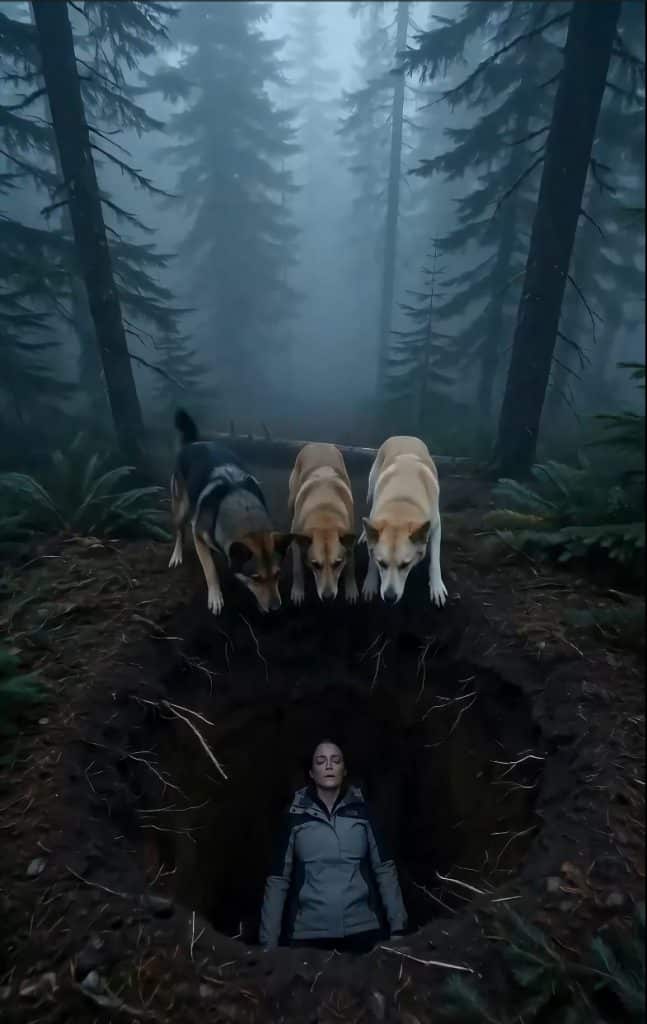
Just three dogs standing somewhere above her in the fog, barking down into the dark like they were trying to pull her soul back into her body.
Her eyes snapped open.
For one terrifying second, she did not understand where the sky had gone.
Damp earth rose around her in a rough circle. Roots curved out of the walls like black fingers. Loose soil clung to her cheek, her jacket, her hair. Above her, a pale slice of forest canopy swayed in the wind, blurred by cold mist.
Nora gasped and tried to sit up.
Pain shot through her shoulder.
She fell back against the muddy floor, breathing hard.
The dogs barked louder.
There were three of them at the rim of the pit. One black-and-tan, two light brown, all soaked by fog and forest damp. Their paws scraped at the edge, sending little clumps of dirt tumbling down onto Nora’s jacket.
“Stop,” she rasped, though she had no idea why.
The black-and-tan dog leaned farther over the edge and barked directly at her.
Nora blinked against the falling dirt.
Memory returned in broken flashes.
Pine trees.
A trail that had disappeared under leaves.
The old survey map in her hand.
A warning sign half-buried in moss.
Then the ground giving way beneath her.
She turned her head and saw her backpack lying a few feet away, one strap twisted under a rock. Her phone was gone. Her water bottle had cracked open and spilled into the mud.
She was alone at the bottom of a pit deep enough to swallow daylight.
“Help,” she called upward.
Her voice came out thin and useless.
The dogs stopped barking for one heartbeat.
Then all three looked away from her at the same time.
Their heads turned toward the trees.
Nora froze.
Something moved beyond the fog.
A branch snapped.
The dogs barked again, but not down at her now. They barked toward the forest, sharp and urgent, as if the pit had only been the beginning.
“No,” Nora whispered. “Don’t leave me.”
But they did.
One by one, the dogs turned from the rim and ran into the mist, paws tearing through wet leaves and broken twigs. Nora dragged herself upright, ignoring the pain in her arm, and stared after them from the bottom of the hole.
She saw them race toward a long fallen log lying across the forest floor.
Then the fog swallowed them.
And from somewhere near that log, a man’s voice said her father’s name.
Act II
Nora had come back to Blackpine Forest to prove a dead man was not a coward.
That was what the town had called her father for twelve years.
A coward.
A drunk.
A man who abandoned his family after losing the fight over the land.
Elias Vale had been the last forest warden before the county sold Blackpine’s outer acres to a private development company. He knew every ridge, every creek bed, every hollow where the fog gathered before rain. He could name trees by their bark in the dark. He could follow broken ferns and tell whether a deer, dog, or human had passed through.
To Nora, he had been magic.
To the town, he had been difficult.
Elias fought the sale because he said something was wrong with the survey. The boundary lines had been moved. Old sinkholes had been covered. Unsafe ground had been marked as buildable. He wrote letters. He filed complaints. He stood in county meetings holding photographs no one wanted to see.
Then one autumn morning, he vanished.
His truck was found near the northern trailhead.
His jacket was found beside the creek.
His flask was found empty in the passenger seat.
The story wrote itself after that.
The grieving wife. The embarrassed daughter. The stubborn man who had gone into the woods angry and never come out.
Nora was sixteen when they stopped searching.
Her mother lasted four more years before illness and heartbreak emptied her completely.
After that, Nora left Blackpine and built a life where no one knew the name Vale. She worked as a wildlife photographer, took assignments in places where silence felt clean, and told people her father had died in an accident because it was easier than explaining a disappearance everyone had already judged.
But grief does not die just because people stop asking about it.
It waits.
It waited until a letter arrived at Nora’s apartment in Portland with no return address.
Inside was a copy of an old survey map and a photograph of a fallen log marked with a carved symbol: a small V inside a circle.
Her father’s trail mark.
On the back of the photo, someone had written one sentence.
He found what they buried.
Nora should have taken it to the police.
Instead, she came alone.
At dawn, she parked near the abandoned ranger access road and followed the old map into Blackpine. The forest looked smaller than it had in her childhood and darker than it had in her dreams. Fog drifted between the pines, turning every tree into a ghost of another tree.
The dogs appeared before noon.
They were waiting near the creek.
Nora had seen strays before, but these were not wild. They watched her with strange purpose, especially the black-and-tan one with the scar across its snout. When she moved deeper into the forest, they followed.
At first, she tried to shoo them away.
They refused.
When she lost the trail, they found it.
When she stopped near a collapsed signpost, the tan dog pawed at the leaves until Nora uncovered an old strip of orange survey tape.
By the time the ground broke under her, she had almost started to trust them.
Then she woke in the pit.
And they ran toward the very log from the photograph.
Something about that was not coincidence.
It was a message.
Act III
Nora forced herself to stand.
The pit walls were slick and nearly vertical. Every time she dug her fingers into the dirt, it crumbled under her nails. Roots snapped in her hands. Pebbles skittered down past her boots.
She tried three times to climb.
On the fourth, her foot slipped and she slammed back against the wall hard enough to knock the breath out of her.
For a few seconds, she lay still, staring up through the fog.
The dogs were gone.
The forest had swallowed their barking.
But the man’s voice came again.
Closer now.
“Elias Vale never should have come back here.”
Nora stopped breathing.
Another voice answered, lower and rougher. “You said no one used this trail anymore.”
“No one did.”
Nora pressed herself against the wall of the pit, heart hammering.
Men.
Two of them.
She did not call out.
Something in their voices told her not to.
Leaves crunched above her. The long log creaked nearby, as if someone had stepped onto it or kicked it aside. The dogs growled, not frantic now, but warning.
Then one of the men cursed.
“Get those mutts away.”
A dog barked sharply.
There was a scramble of paws, a heavy stumble, and the sound of something wooden shifting across the ground.
Nora looked up.
The fog moved.
For a moment, she saw a shape pass near the rim: a man in a dark jacket, holding something long in his hand.
Then he disappeared.
Nora’s stomach turned cold.
She had not fallen into an old animal hole.
This pit had been cut.
The sides were too clean under the loose soil. The rim had been hidden with branches and moss. Someone had covered it deliberately.
A trap.
Her father had known about it.
Maybe he had died in one just like it.
Nora clamped a hand over her mouth to keep from making a sound.
The dogs barked again near the log, louder now, as if trying to draw the men away from the pit. Nora heard a scraping noise, then a hollow thud.
One of the men said, “Leave it. We need to check the lower trench.”
“No. If she found the mark, she found the map.”
Nora’s eyes filled with tears she refused to let fall.
She had spent twelve years wondering whether her father had walked away.
Now, at the bottom of a hidden pit in the same forest, she knew the truth had been buried under everyone’s certainty.
He had not abandoned them.
He had been silenced.
A small shape suddenly appeared at the rim.
The black-and-tan dog.
It looked down at Nora, panting hard, then dropped something into the pit.
It landed near her boot with a soft thump.
Nora crouched and picked it up.
A leather pouch.
Old. Water-stained. Tied shut with faded cord.
Her hands trembled as she opened it.
Inside was a compass, scratched across the back with initials she knew instantly.
E.V.
Her father’s.
Under it was a folded note wrapped in plastic.
Nora unfolded it carefully.
The handwriting was faded, but the words were still there.
Nora, if you find this, do not trust the official map.
She pressed the note to her mouth and nearly broke apart.
Above her, the dog barked once.
Then the men started running back.
Act IV
Nora shoved the note into her jacket.
The black-and-tan dog vanished from the rim just as the first man reached the pit.
He looked down.
For a second, neither of them moved.
He was older than she expected, maybe in his sixties, with a gray beard and a hard, narrow face Nora recognized from county records.
Caleb Rusk.
Former survey chief.
The man who had testified that Elias Vale’s complaints were baseless.
His eyes widened when he saw her.
“You,” he said.
Nora stood very still.
Caleb looked over his shoulder. “She’s in here.”
The second man appeared beside him, younger and broader, breathing hard. His muddy boots crumbled dirt into the pit.
Nora backed away until her shoulder hit the wall.
Caleb stared down at her with something worse than anger.
Fear.
“You should have stayed away,” he said.
“My father didn’t run, did he?” Nora’s voice shook, but she forced the words out. “You lied about him.”
Caleb’s jaw tightened.
The younger man leaned closer. “We can’t leave her.”
Before Caleb could answer, the dogs attacked the silence.
They came from behind the men in a blur of wet fur and snapping barks. Not biting. Not mauling. Just charging hard enough to startle, confuse, and drive them back from the rim.
The younger man stumbled.
Caleb cursed and swung his arm.
The tan dogs darted away.
The black-and-tan one grabbed the end of something on the ground and pulled.
A rope.
Nora saw it slide over the edge.
Not a rescue rope from the men.
An old climbing line hidden beneath the long fallen log.
Her father had left it there.
Or someone had.
The rope dropped into the pit, swinging against the wall inches from Nora’s hands.
“Nora!” a new voice shouted from somewhere beyond the trees.
This voice she knew.
“Lena?” Nora cried.
Her cousin Lena burst through the fog with a phone in one hand and a hiking pole in the other, face pale with fear. Behind her came two county deputies and an older woman in a search-and-rescue jacket.
The dogs had not run away to abandon Nora.
They had run to the log because that was where the rope was hidden.
And then they had found help.
Caleb tried to run.
He made it three steps before the black-and-tan dog blocked his path, barking so fiercely he backed straight into the deputies.
The younger man raised his hands immediately.
Nora grabbed the rope.
Her injured shoulder screamed as she pulled, but the search-and-rescue woman anchored the line from above and called down steady instructions.
“Slow. Feet against the wall. Don’t look down.”
Nora almost laughed from the bottom of the pit.
There was nowhere lower to look.
Inch by inch, she climbed.
Her boots slipped. Dirt fell. Her hands burned around the rope. Twice she thought she would lose her grip, but every time she faltered, the dogs barked from above like a chorus of stubborn little alarms.
When Nora’s hand finally reached the rim, Lena grabbed her wrist.
“I’ve got you,” she sobbed.
Nora collapsed onto the forest floor.
The fog rolled over her face.
For the first time in twelve years, she was lying on Blackpine soil and not wondering whether her father had left her.
She knew.
And because she knew, the whole lie began to collapse.
Act V
The truth came out in pieces.
It always does.
Not as one clean confession. Not as a perfect answer handed to the wounded. Truth usually arrives muddy, damaged, and late.
Caleb Rusk did not confess in the forest.
He sat handcuffed beside the fallen log, staring at the dogs like he could not understand how three unwanted animals had undone a secret kept by powerful men for over a decade.
But the pouch from under the log gave investigators enough to start.
Elias Vale had documented everything.
The moved boundary stakes. The covered sinkholes. The illegal dumping near the old ridge. The false reports signed by Caleb and approved by men who stood to make millions once the land was declared safe for development.
Elias had hidden copies beneath trail markers because he knew his office was being searched.
The long fallen log was not random.
It was his final marker.
The dogs had known because they had been trained there.
Years earlier, Elias had rescued a stray black-and-tan puppy from a drainage ditch and taught it to track along the warden trails. After he vanished, the dog disappeared too. People assumed it had died in the woods.
It had not.
It had survived.
And over the years, it had gathered two more strays, guarding the old trails like a forgotten patrol waiting for someone with Elias’s blood to return.
Nora named the black-and-tan dog Ranger.
The other two became Birch and Penny.
No one argued.
By sunset, search teams had roped off the pit. Deputies marked the hidden traps. The development company’s old files were seized within days. Retired officials who had once spoken confidently about Elias Vale’s instability suddenly forgot details, misplaced records, and hired attorneys.
Nora watched it unfold from a hospital bed with a bandaged shoulder and her father’s compass on the table beside her.
Lena sat in the chair by the window, still angry enough to shake.
“You could have died,” she said.
Nora looked at the compass.
“I think he knew someone might.”
Lena’s face softened.
Nora opened the folded note again.
She had read it twelve times already, but each reading felt different.
Nora, if you find this, do not trust the official map. The land is hollow beneath the ridge. They know. Rusk knows. If I don’t come home, remember this: I did not leave you. I would never leave you.
The last line was smudged, as if written in rain.
Or with shaking hands.
Nora cried then, not loudly, not the way people cry in movies, but silently, with one hand over her eyes because the child inside her had waited twelve years to hear that sentence.
He did not leave.
Two weeks later, she returned to Blackpine with the search team.
They found her father near the old ridge, beneath a cedar marked with another small V inside a circle. The discovery was handled with dignity. Quietly. Carefully. Nora stood beside Lena while Ranger sat at her feet, head bowed as if he understood the sacredness of bringing someone home.
There was no victory in that moment.
Only ending.
But sometimes an ending is mercy.
The town held a memorial for Elias Vale on a cold morning washed clean by rain. People came who had once believed the worst of him. Some cried. Some apologized. Some stood in the back because shame kept them from coming closer.
Nora spoke last.
She wore her father’s old warden pin on her jacket.
“For twelve years,” she said, “my father’s name was used as a warning. People said he was stubborn. Unstable. Impossible. They were right about one thing.”
She looked toward the forest.
“He was impossible to buy.”
No one moved.
“He told the truth when it cost him everything. And when no one listened, he left enough behind for the forest to remember.”
At the edge of the crowd, Ranger barked once.
Softly.
People turned, and for the first time, no one called him a stray.
Months later, Blackpine’s disputed acres were protected permanently. The unsafe development was canceled. The old ranger trails were reopened, but the hidden pits were filled, marked, and fenced off. A small wooden sign was placed near the long fallen log before it was allowed to remain where it had always been.
Elias Vale Trail.
Nora visited often.
Not because the forest no longer scared her.
It did.
Some places keep the echo of what happened there. Fog still moved strangely between the pines. Leaves still covered old wounds in the earth. Wind still made the branches whisper like people trying to finish sentences.
But now, when Nora walked there, she did not walk alone.
Ranger trotted ahead. Birch and Penny moved through the ferns on either side. Lena came when she could. Children from town joined guided walks in spring, learning how to read trail markers and respect land that looked solid but might not be.
One afternoon, Nora stopped by the fallen log.
She crouched and touched the carved V her father had left behind.
For years, she had imagined finding him alive. She had imagined a door opening, a phone call, a miracle clean enough to erase the pain.
That was not what she got.
She got a pit.
A rope.
A compass.
Three barking dogs.
And the truth.
It was not enough to give back the years.
But it was enough to give back his name.
Ranger pressed his wet nose against her hand.
Nora smiled through tears.
Above them, the fog thinned, and sunlight slipped between the pines for the first time all morning.
The forest had kept its secret for twelve years.
Then three dogs looked into a pit and refused to let the truth stay buried.