Act I
The cafeteria had been deafening just seconds earlier.
Hundreds of conversations overlapped as students rushed through lunch, trays clattering against tables while laughter echoed beneath the fluorescent lights. No one noticed the quiet girl in the faded cardigan carefully guiding her wheelchair through the narrow space between crowded tables.
She was used to making herself as small as possible.
Then it happened.
The edge of her wheelchair lightly brushed a food tray, sending only a splash of water onto a cheerleader’s expensive jacket.
The room seemed to pause.
“I’m sorry,” the thirteen-year-old whispered immediately. “I didn’t mean to.”
Her apology should have ended everything.
Instead, it became the beginning of the worst moment of her school life.
The popular cheerleader stared at the tiny wet spot on her uniform as though it were an unforgivable insult. Surrounded by laughing friends, she refused to let herself look embarrassed.
“If everyone was already watching,” she thought, “she couldn’t afford to lose.”
So she picked the easiest target.
“Trash,” she sneered loud enough for half the cafeteria to hear. “You just ruined my lunch.”
The laughter around her grew louder.
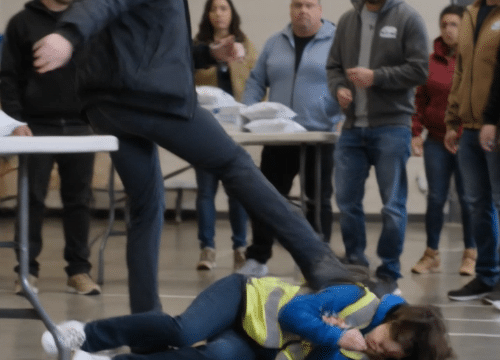
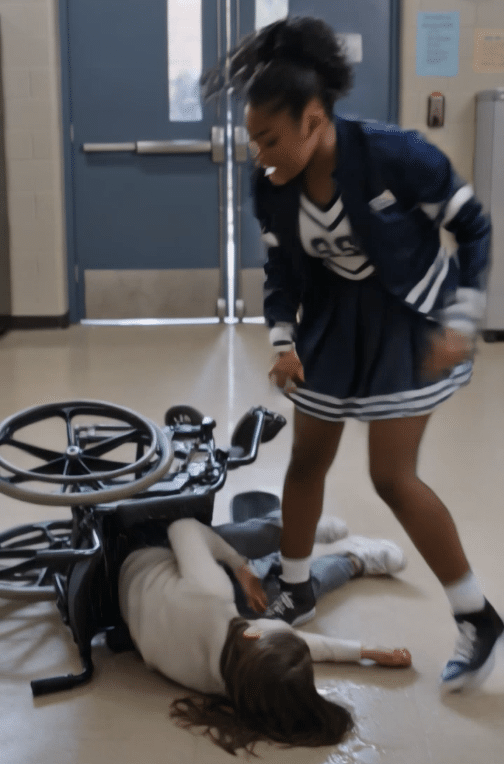
Then she shoved the girl’s wheelchair hard enough for it to tip sideways.
The lunch tray crashed to the floor.
Students gasped.
The girl landed awkwardly, scraping her elbow against the cafeteria tiles. She struggled to sit up, cheeks burning with humiliation more than pain.
No one moved.
And the cheerleader wasn’t finished.
No one realized the cafeteria doors were about to open.
Act II
Emily Carter had attended Jefferson High for barely three months.
Most students knew almost nothing about her except that she used a wheelchair and rarely spoke unless someone spoke first.
What they didn’t know was that she had transferred after years of intensive rehabilitation following a serious car accident that had taken her father’s life.
Her mother had quietly rebuilt their lives from nothing.
Emily never wanted sympathy.
She only wanted the chance to eat lunch, attend class, and disappear into the background.
Meanwhile, Madison Brooks had spent years at the top of Jefferson’s social ladder.
Captain of the cheer squad.
Honor student.
Popular enough that teachers often overlooked her attitude.
She had learned something dangerous over the years.
Popularity could become power if nobody challenged it.
Standing over Emily, Madison pointed toward the spilled lunch.
“Maybe next time,” she laughed, “eat from the floor instead.”
Some students looked away.
Others nervously laughed because everyone else was laughing.
Only one freshman quietly reached for her phone.
She wasn’t recording for social media.
She was recording because she knew someone had to tell the truth.
The truth, however, was about to walk through the cafeteria itself.
Act III
The double cafeteria doors burst open.
Conversation stopped instantly.
The principal entered first.
Behind him walked two campus security officers.
And beside them was a woman in a navy business suit whose face every teacher immediately recognized.
Margaret Carter.
Chair of the district school board.
She had arrived unexpectedly to inspect campus accessibility improvements that morning.
Instead, she found something no parent should ever see.
Her daughter sitting on the cafeteria floor.
Emily looked up.
Neither of them spoke at first.
Margaret hurried across the cafeteria, ignoring every adult trying to explain what had happened.
She knelt beside Emily, gently brushing hair away from her daughter’s face.
“Are you hurt?”
Emily swallowed hard.
“I’ll be okay.”
Only after making sure her daughter was safe did Margaret slowly stand.
The cafeteria had become completely silent.
She turned toward the crowd.
Then her eyes stopped on Madison.
“Who pushed my daughter?”
No one breathed.
The freshman holding the phone quietly raised her hand.
“I recorded everything.”
That single sentence changed everything.
Act IV
Within minutes, the video was playing on the principal’s phone.
There were no missing details.
No confusing angles.
No arguments.
Emily apologized.
Madison mocked her.
Madison deliberately shoved the wheelchair.
Madison laughed while everyone watched.
Every second was undeniable.
The principal’s expression hardened.
Several teachers lowered their heads, ashamed they had frozen instead of stepping in.
Margaret didn’t shout.
She didn’t threaten.
Her calm voice carried far more weight.
“No student should ever fear coming to school because others believe kindness is optional.”
She looked directly at the principal.
“I expect accountability—not because she’s my daughter, but because every child deserves to be safe here.”
Madison’s friends slowly stepped away from her.
For the first time all afternoon…
She stood completely alone.
And the hardest lesson was still waiting.
Act V
The investigation moved quickly.
Witness statements matched the recording.
Madison was suspended pending disciplinary review, removed from extracurricular leadership, and required to participate in restorative and behavioral accountability measures before returning to campus.
But the moment students remembered wasn’t the punishment.
It was Emily.
The following Monday, she returned to the cafeteria.
The same tables.
The same hallway.
The same wheelchair.
Only this time, something had changed.
Before she even reached the lunch line, students began moving their chairs without being asked.
Someone held the door.
Another student carried her tray.
Not because she was the school board chair’s daughter.
Because they finally understood how easily silence can become part of cruelty.
Emily smiled politely and thanked each of them.
She never mentioned what had happened the week before.
She didn’t have to.
Across the cafeteria, Madison caught her eye.
The confidence that once ruled the room had disappeared, replaced by quiet regret.
Sometimes the greatest reversal doesn’t come from power.
It comes from the moment the truth leaves everyone with no excuse to look away.